

Contents
Market Overview
Macro Update
Hopes that a ceasefire deal between the U.S. and Iran could pave the way to an end to the Middle East conflict got a boost at the end of the week when President Trump signaled that a preliminary deal has been reached and that he was in the final stages of reviewing it and deciding on next steps.
Signs that diplomacy might be on the verge of a breakthrough supported risk sentiment, with oil prices giving back earlier gains, stocks reaching fresh all-time highs, and DM bond yields declining. Brent crude, the global oil benchmark, tumbled to the low-$90 per barrel for the first time since mid-April, around $15 lower compared to last week’s close. The U.S. treasury curve bull-flattened, with the 10Y benchmark yield declining around 13bps back to below 4.50%. The USD attempted to break above 99.5 on the DXY mid-week but closed well below 99 as the Iran deal narrative gained momentum.
Despite expected Middle East de-escalation, global inflation concerns remain elevated, with markets pricing moderate rate hikes by all systemic central banks by the end of this year. As the USD lost steam, gold and silver spot prices regained some ground, to around $4,600 and $76 per oz, respectively.
In the world of fundamental macro data, the U.S. PCE index, the Fed’s preferred inflation gauge, came in line with expectations for April (3.3% YoY core and 3.8% headline), but marked the highest level since 2023 and remains almost two percentage points above the Fed’s target, highlighting the challenging outlook for new Fed Chairman Kevin Warsh. Meanwhile, inflation-adjusted consumer spending increased just 0.1% last month as real incomes eroded under war-driven inflation pressures and 1Q GDP was revised lower to 1.6% QoQ, from 2.0% in the previous reading.
Elsewhere, preliminary May inflation data from Europe also signaled building inflationary pressures and the central banks of South Africa (+25bps) and Sri Lanka (+100bps) increased their policy rates. China’s industrial profits jumped to 24.7% YoY in April, from 15.8% in March, reflecting a net positive effect from the global energy shock and contained hit on global demand for Chinese exports.
EM Credit Update
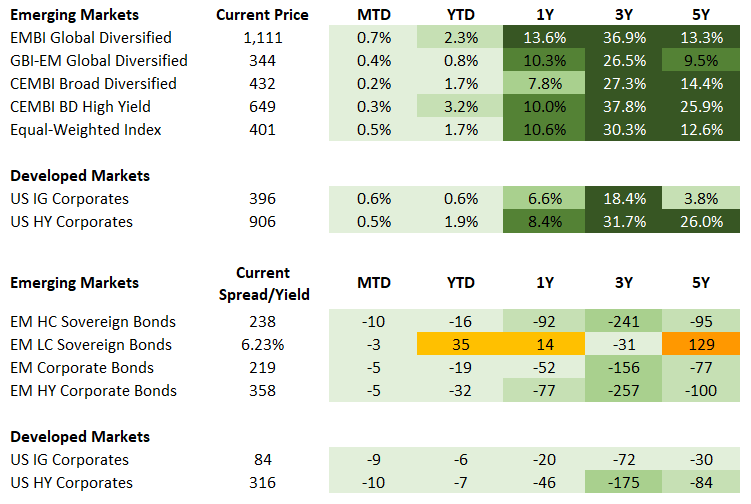
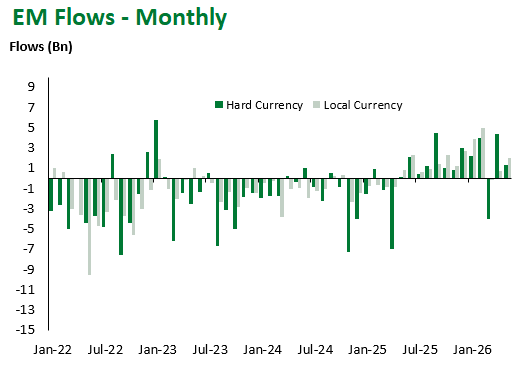
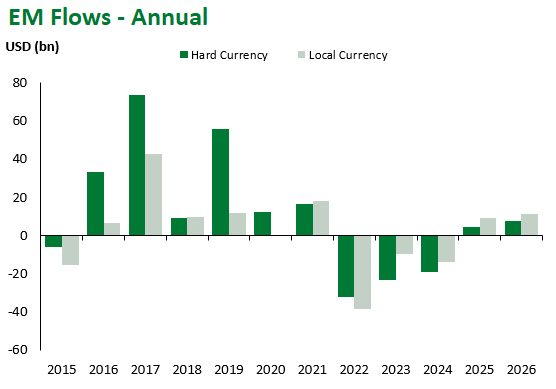
Emerging Markets (EM) fixed income delivered positive returns across all three sub-asset classes this week, as continued ceasefire optimism and a softer U.S. dollar extended the risk-on tone that began the prior week. Hard currency sovereign bonds were the top performer among the three sub-asset classes, with local currency close behind, though differentiation at the country level remained pronounced, reflecting the market’s ongoing sensitivity to both geopolitical headline risk and idiosyncratic fundamentals.
Hard currency sovereign bonds rose +0.90% at the index level, with high yield (+0.94%) modestly outperforming investment grade (+0.85%). Regionally, Africa (+1.21%) and the Middle East (+0.94%) led, while Europe (+0.69%) and Asia (+0.73%) lagged – the latter continuing to reflect the net negative economic spillovers from elevated energy prices on the region’s oil importers. At the country level, Gabon (+2.46%), Kenya (+2.05%), and Egypt (+1.64%) led gains in Africa, while Sri Lanka (+1.87%) was a notable outperformer in Asia, buoyed by the IMF Executive Board’s approval of a $695 million disbursement that provided a timely reserve boost, with additional inflows from the World Bank and ADB underpinning the country’s new $8.5 billion reserve target. On the downside, Senegal (-3.16%) was a pronounced underperformer following President Faye’s dismissal of Prime Minister Sonko, a development that reduces the prospects for political continuity and a muddling-through scenario for the country’s fiscal consolidation path this year. Venezuela (-1.11%) gave back some of its recent gains.
Local currency sovereign debt advanced +0.75% on the week as the U.S. dollar continued to lose ground and the external backdrop remained broadly supportive. South Africa (+4.18%) and Colombia (+4.21%) were the standout performers. South Africa benefited from improving risk sentiment and rand appreciation tied to ceasefire optimism, while Colombia rallied on one of the candidates perceived as market-friendly gained ground in the polls ahead of the May 31 first-round presidential election. Hungary (+2.81%) extended its post-election rally, with the forint continuing to appreciate as markets priced in a more constructive policy trajectory under the new pro-EU government. On the other end of the spectrum, Brazil (-0.29%), Indonesia (-0.41%), and Malaysia (-0.21%) lagged, with FX headwinds and domestic factors offsetting the supportive broader backdrop.
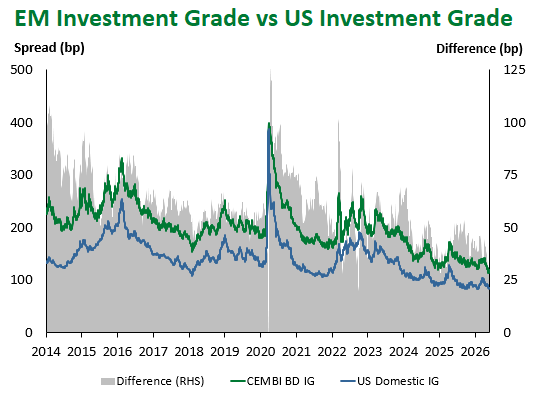
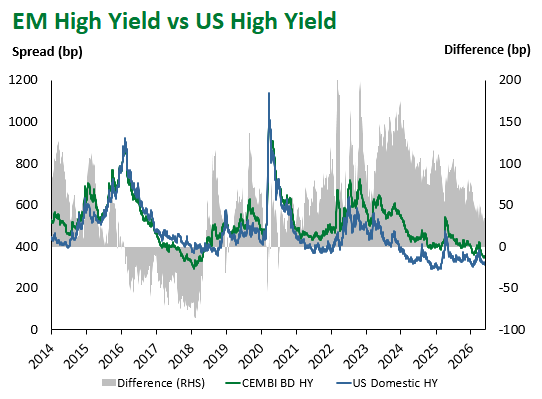
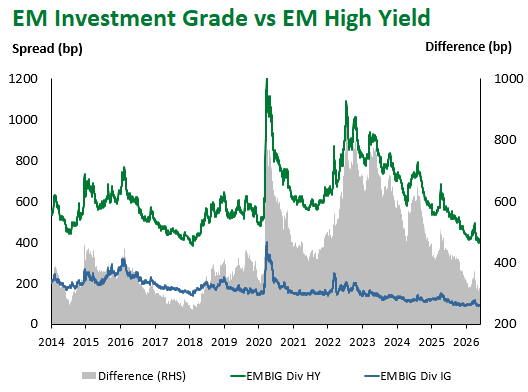
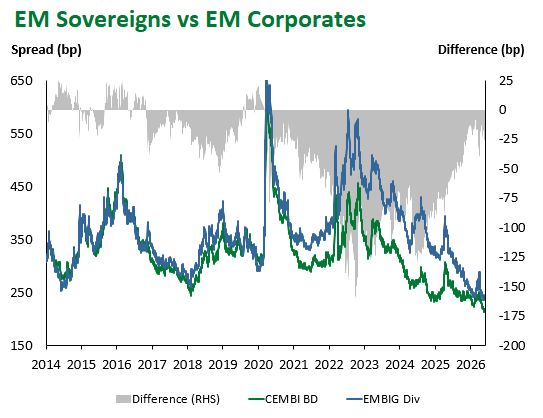
EM corporates also delivered positive returns, with the index up +0.39%. Investment grade (+0.42%) modestly outperformed high yield (+0.33%), an inversion from the pattern seen in sovereigns. Regionally, Latin America (+0.43%) and Africa (+0.42%) led, while Asia (+0.36%) and the Middle East (+0.36%) lagged, mirroring the regional dynamic observed in the sovereign space. Longer-duration bonds outperformed across the curve, consistent with the week’s broader rates rally.
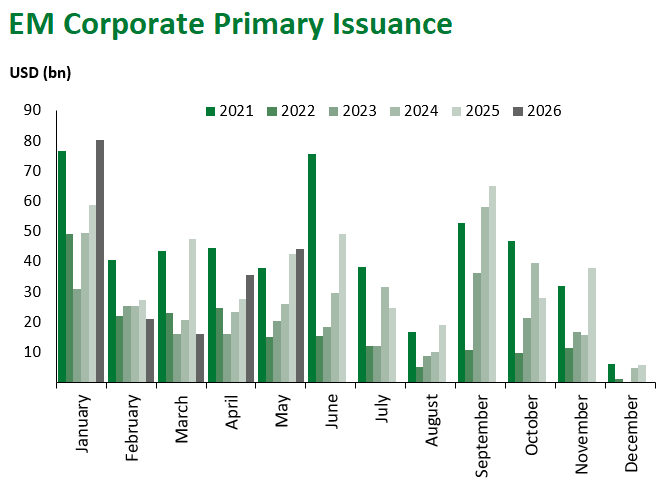
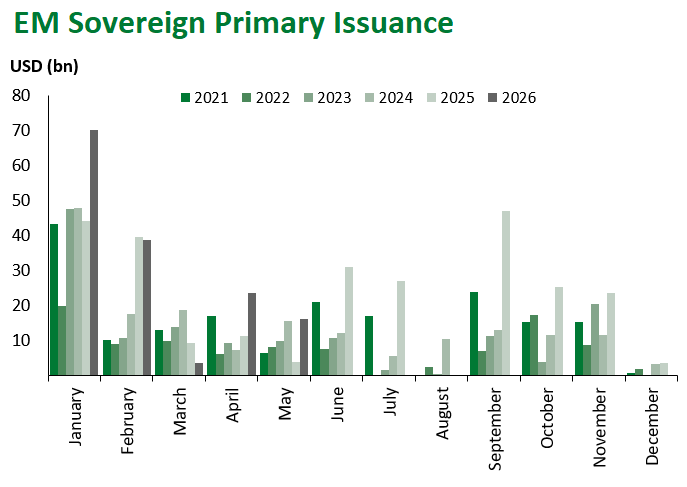
Primary market activity was restrained this week, with nine issuers pricing approximately $6.3 billion, as the Memorial Day holiday shortened the U.S. execution window. Investment grade dominated, with BBVA Mexico ($1.0 billion), Bank Pekao of Poland (EUR 750 million), OTP Mortgage Bank of Hungary (EUR 500 million, covered), and Bank of Communications Financial Leasing of China ($750 million, floating rate) among the notable transactions. The Federation of Bosnia Herzegovina was the highlight on the high yield side, pricing an EUR 800 million sovereign bond to EUR 2.4 billion in final books.
The Week Ahead
A busy global data week featuring U.S. May jobs report, ISM manufacturing/services, JOLTS job openings, initial jobless claims, unemployment, 1Q GDP from the Eurozone, India, and Türkiye, May inflation and PMI readings across key developed and emerging markets, and central bank rate decisions in Poland and India. The OECD will release its latest economic outlook during the ministerial council meeting, and the St. Petersburg International Economic Forum is held in Russia with Saudi Energy Minister Prince Abdulaziz bin Salman Al Saud expected to attend. On Sunday, Colombia holds the first round of its presidential election, with a runoff to be held in June if no candidate wins an outright majority.
Fixed Income
Equities

Commodities

Source for data tables: Bloomberg, JPMorgan, Gramercy. EM Fixed Income is represented by the following JPMorgan Indicies: EMBI Global, GBI-EM Global Diversified, CEMBI Broad Diversified and CEMBI Broad High Yield. DM Fixed Income is represented by the JPMorgan JULI Total Return Index and Domestic High Yield Index. Fixed Income, Equity and Commodity data is as of May 29, 2026 (mid-day).
Highlights
South Africa received another positive ratings outlook; SARB raised rates by 25bps
Event: Moody’s revised the outlook on South Africa’s Ba2 sovereign rating to positive, citing “gradually strengthening fiscal performance and sustained commitment to structural reforms, with prospects of increasingly tangible results.” A future upgrade will depend on continued fiscal improvement and a credible, sustained decline in the public debt burden. The move follows S&P’s positive outlook revision on South Africa’s BB/BB+ ratings in November 2025. Later in the week, the South African Reserve Bank (SARB) raised its policy rate by 25bps to 7.0% in a split 4-2 decision, while also revising its 2026 inflation forecast higher to 4.4%.
Gramercy Commentary: South Africa’s positive credit trajectory remains intact despite elevated external risks stemming from the Middle East conflict and renewed domestic political pressure on President Ramaphosa. Sustaining this momentum will require continued commitment to fiscal consolidation throughout the political cycle, alongside prudent management of renewed inflationary pressures. The SARB’s risk scenarios leave the door open for a more aggressive tightening cycle if necessary while the split decision reflects patience in a fluid external backdrop. On the political front, we expect the Government of National Unity (GNU) to remain intact in the near-term. That said, we cannot rule out an increased risk of political fragmentation as local elections approach later this year or if impeachment proceedings against President Ramaphosa gain traction.
Argentina clears second IMF review for $1 billion disbursement
Event: On May 21, the IMF Executive Board approved the second review of Argentina’s Extended Fund Facility, unlocking a $1 billion disbursement. The review reflects continued progress under the government’s stabilization program, particularly on fiscal consolidation, while highlighting ongoing challenges in reserve accumulation. The IMF emphasized the need for sustained implementation of the central bank’s FX purchase program, exchange rate flexibility, and a “multi-pronged financing strategy” to restore durable access to international capital markets. The Fund’s 2026 projections estimate GDP growth at 3.5%, average inflation at 30.4%, and the current account balance at -0.8% of GDP.
Gramercy Commentary: We view completion of the review as a constructive milestone and largely a “check-the-box” event, with market attention remaining firmly focused on the external position and the pace of durable reserve accumulation ahead of a sizable amortization schedule. Recent trade data has been encouraging and supports the potential to exceed reserve purchase and accumulation targets, helping build a stronger external buffer ahead of the 2027 electoral cycle. Achieving this, however, will depend on the strength of the economic recovery, exchange rate dynamics, and terms-of-trade developments in the second half of the year. Further clarity around the government’s broader financing strategy will also remain a key area of focus for investors.
Colombia court decision delivers important institutional win for the central bank
Event: Colombia’s State Council suspended a rule requiring the finance minister to be present for the central bank board to meet and make monetary policy decisions, according to a ruling published on the court’s website.
Gramercy Commentary: This decision reinforces central bank independence and institutional quality in Colombia. The court found that allowing the minister’s absence to prevent decision-making would undermine the central bank’s autonomy. We note that last month’s central bank decision to interrupt its rate hiking cycle despite increasing inflationary pressures surprised markets, raising concerns about institutional erosion as Finance Minister Germán Ávila signaled he would boycott the meeting, which would have made a vote impossible and effectively paralyzed monetary policy. Incumbent President Gustavo Petro has repeatedly criticized monetary policy management and has even threatened to counter tighter monetary policy with additional fiscal expenditures. The next BanRep monetary policy meeting will take place on June 30, by which time Colombia will have a new president-elect. The first round of a tight presidential race takes place this Sunday, May 31; the outcome of the election will be the key determinant of the economic policy outlook and market sentiment on Colombian assets for the rest of the year. While investors have grown more optimistic in recent days as Abelardo de la Espriella, one of two main right-wing candidates, has gained ground in the latest polls against Petro-aligned left-wing candidate Ivan Cepeda, we believe that the ultimate outcome after a likely second round run-off on June 21 remains highly uncertain and carries relatively symmetric downside and upside risks for markets.
Emerging Markets Technicals
Emerging Markets Flows
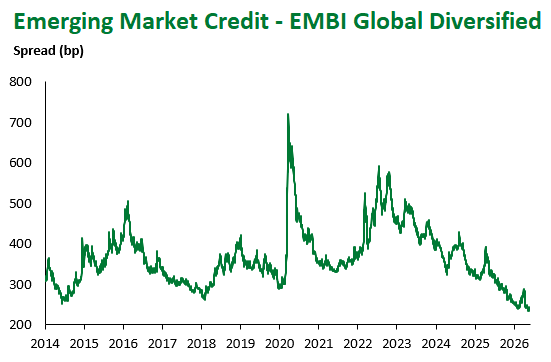
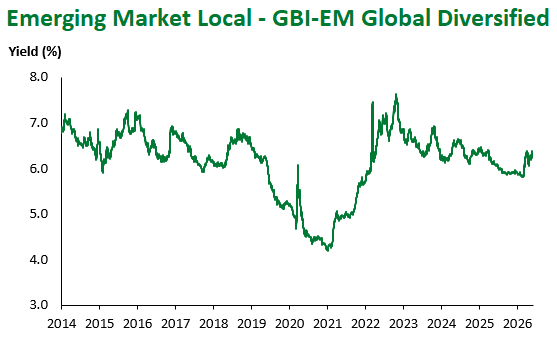
Source for graphs: Bloomberg, JPMorgan, Gramercy. As of May 29, 2026.
For questions, please contact:
Kathryn Exum, CFA ESG, Director, Co-Head of Sovereign Research, [email protected]
Petar Atanasov, Director, Co-Head of Sovereign Research, [email protected]
This document is for informational purposes only. The information presented is not intended to be relied upon as a forecast, research or investment advice, and is not a recommendation, offer or solicitation to buy or sell any securities or to adopt any investment strategy. Gramercy may have current investment positions in the securities or sovereigns mentioned above. The information and opinions contained in this paper are as of the date of initial publication, derived from proprietary and nonproprietary sources deemed by Gramercy to be reliable, are not necessarily all-inclusive and are not guaranteed as to accuracy. This paper may contain “forward-looking” information that is not purely historical in nature. Such information may include, among other things, projections and forecasts. There is no guarantee that any forecasts made will come to pass. Reliance upon information in this paper is at the sole discretion of the reader. You should not rely on this presentation as the basis upon which to make an investment decision. Investment involves risk. There can be no assurance that investment objectives will be achieved. Investors must be prepared to bear the risk of a total loss of their investment. These risks are often heightened for investments in emerging/developing markets or smaller capital markets. International investing involves risks, including risks related to foreign currency, limited liquidity, less government regulation, and the possibility of substantial volatility due to adverse political, economic or other developments. References to any indices are for informational and general comparative purposes only. The performance data of various indices mentioned in this update are updated and released on a periodic basis before finalization. The performance data of various indices presented herein was current as of the date of the presentation. Please refer to data returns of the separate indices if you desire additional or updated information. Indices are unmanaged, and their performance results do not reflect the impact of fees, expenses, or taxes that may be incurred through an investment with Gramercy. Returns for indices assume dividend reinvestment. An investment cannot be made directly in an index. Accordingly, comparing results shown to those of such indices may be of limited use. The information provided herein is neither tax nor legal advice. Investors should speak to their tax professional for specific information regarding their tax situation.