


Contents
Market Overview
Macro Update
Hopes that U.S.–Iran negotiations would pave the way to an end to the Middle East conflict remained alive as a conditional ceasefire between Israel and Lebanon (rejected by Hezbollah) offered to ease the way toward a peace deal. Optimism that diplomacy will prevail overshadowed tensions escalating midweek amid fresh strikes being exchanged across the region.
Against a highly fluid backdrop, oil prices were volatile, with Brent crude, the global benchmark, initially climbing back close to $100 per barrel before easing to below $95 on conflicting reports about the state of diplomacy, still slightly above last week’s close.
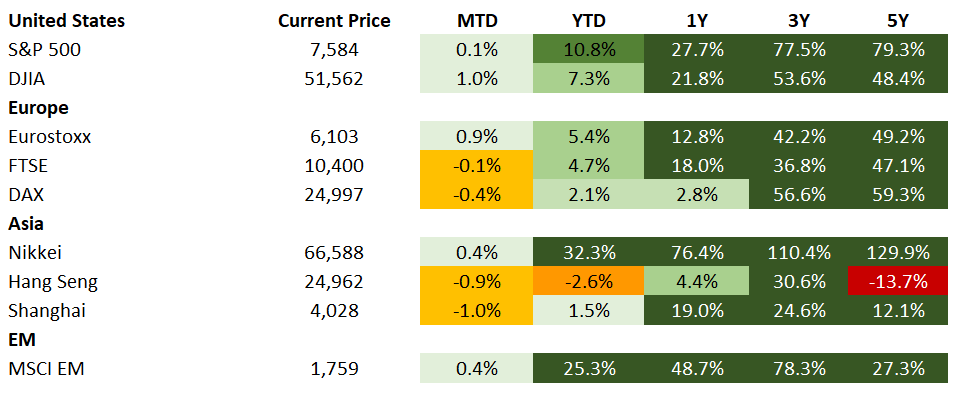
In equity markets, the record breaking weekly run took a breather as a solid U.S. jobs report added to speculation that the Federal Reserve’s next interest rate move will be a hike and investors were also disappointed by some tech companies’ guidance earlier in the week.
The U.S. Treasury curve bear-flattened with the short end underperforming (2-3Y ~+15bps) and the benchmark 10Y yield around 10bps higher to 4.54%. The USD got a major boost from repriced Fed rate path expectations, touching 100 on the DXY index for the first time since early April when de-escalation expectation in the Middle East war gained momentum.
Global inflation concerns appeared to intensify this week: markets now price one full 25bps Fed rate hike by year-end, a stark reversal from the easing cycle priced earlier in the year, as war-driven inflation continues to reprice expectations across systemic central banks. The ECB and the BoE are also expected to raise rates, by around 60 and 40bps respectively, by year-end. As the USD gained, gold and silver spot prices tumbled by close to 5% to around $4,300 and $69 per ounce, respectively. Crypto came under heavy pressure with Bitcoin falling close to $60,000, its lowest level since September 2024.
In the world of fundamental macro data, U.S. labor market readings surprised firmer this week. Recent data pointed to an acceleration in employment growth, consistent with earlier ADP and JOLTS reports. The May nonfarm payrolls report, released Friday, blew past expectations: the economy added 172,000 jobs versus consensus near 90,000, the unemployment rate held at 4.3% for a third straight month, and the prior two months were revised up by a combined 93,000—the strongest three-month run of hiring in over two years. The clearly firmer-than-expected print hardened the higher-for-longer narrative and the prospect of a Fed hike.
Elsewhere, the hawkish repricing extended to other developed markets, with the ECB expected to raise borrowing costs next week and traders pricing in a further 25bp hike in September as energy-driven inflation pressures build across the Euro Area. On the political front, EU member states unanimously agreed to open accession talks with Ukraine and Moldova—a milestone made possible after Hungary dropped its objections following the defeat of the pro-Russian Orban government in April, the same political shift that has underpinned the forint’s recent rally and Hungary’s post-election outperformance. The constructive tone was tempered by an intensification of the war itself, as Russia launched one of its largest assaults in months, firing more than 600 drones and missiles at Ukrainian cities and killing at least 17 people. Against that backdrop, President Zelenskyy late in the week issued a rare open letter to President Putin proposing a full ceasefire for the duration of negotiations; with strikes still intensifying, however, markets largely faded the gesture, skeptical that a U.S.-pushed early-summer deadline would deliver a near-term settlement.
In Latin America, Colombia’s first-round presidential vote delivered a sharply polarized result, with right-wing lawyer Abelardo de la Espriella advancing to a June runoff against the hard-left Iván Cepeda; Mr. De la Espriella will enter the second round on June 21 with momentum on his side, but Mr. Cepeda retains a path to the presidency, albeit a narrower one relative to pre-first round market expectations.
Adding to the supply-side risk backdrop, the World Meteorological Organization warned that an El Niño event—potentially the strongest in decades—is set to begin imminently, raising the prospect of droughts and flooding that could feed through to food prices over the next three to four quarters.
EM Credit Update
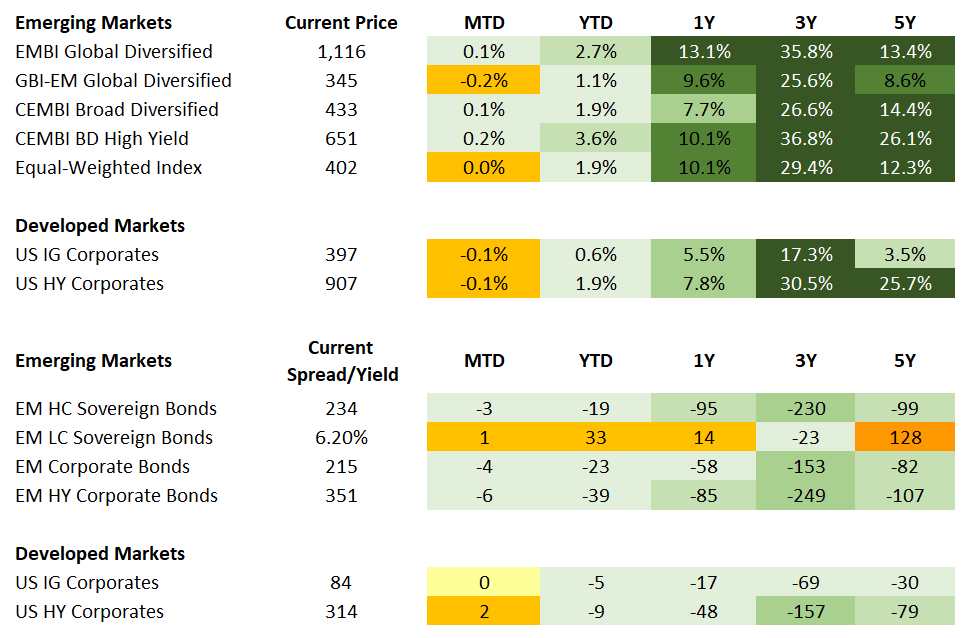
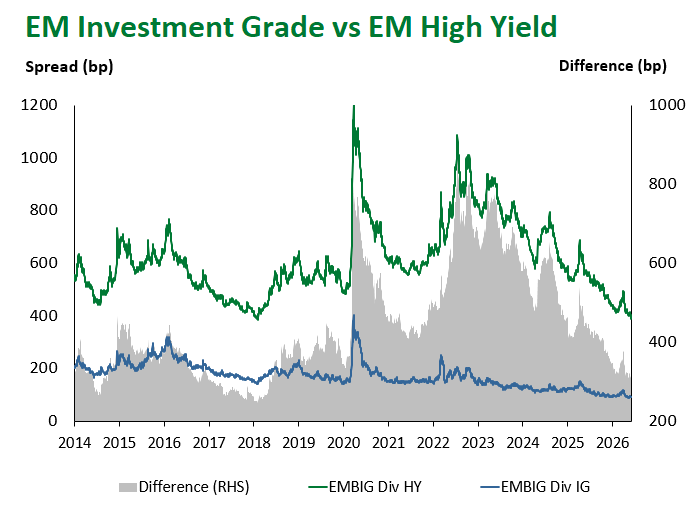
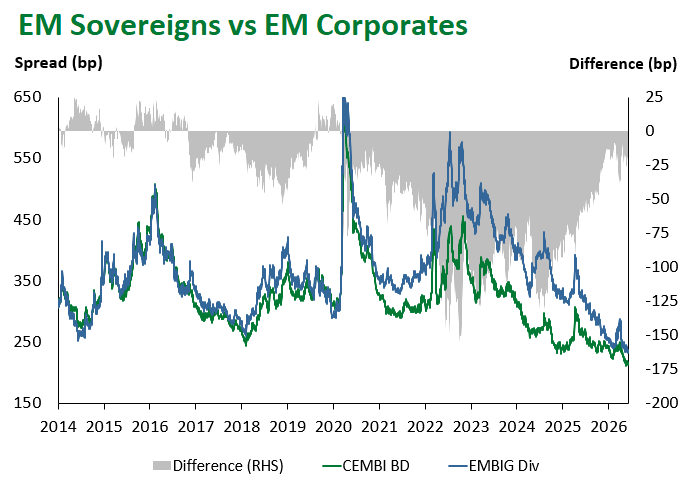
Emerging Markets (EM) fixed income delivered mixed results across the three sub-asset classes this week, against a still-complex macro backdrop. The ongoing Iran war kept energy prices elevated, a continued headwind for oil importers, while Ukraine-related peace diplomacy and Colombia’s first-round presidential election drove much of the week’s idiosyncratic dispersion. Hard currency sovereigns and corporates eked out modest gains, while local currency debt slipped into negative territory as currency weakness across several heavily weighted Asian and Latin American markets outweighed strength elsewhere. Within the dollar-denominated space, high yield outperformed investment grade in both sovereigns and corporates, pointing to a constructive risk tone at the credit level even as country- and currency-level differentiation remained pronounced. Hard currency sovereigns were the top performer of the three sub-asset classes, narrowly ahead of corporates, with local currency being the laggard.
Hard currency sovereign bonds rose +0.11% at the index level, with high yield (+0.23%) outpacing investment grade (-0.03%), the latter posting a small loss. Regionally, Latin America (+0.43%) and Africa (+0.15%) led, while Asia (-0.21%), Europe (-0.13%), and the Middle East (-0.13%) all finished modestly lower—Asia continuing to reflect the negative spillover of elevated energy prices on the region’s oil importers, and the Gulf carrying an elevated geopolitical risk premium given the active conflict on its doorstep. Performance skewed toward the lower-rated and unrated segments of the index, with NR (+1.33%), BB (+0.33%), and B (+0.21%) leading, while AA (-0.23%), A (-0.13%), and CCC (-0.09%) lagged. At the country level, distressed and frontier credits dominated the leaderboard, as Lebanon (+2.32%), Zambia (+2.10%), Senegal (+1.79%), Angola (+1.23%), Gabon (+1.22%), and Ecuador (+1.11%) posted the largest gains. On the downside, Ukraine (-2.15%) was the most pronounced underperformer; the move came even as President Zelenskyy issued a rare open letter to President Putin late in the week proposing a full ceasefire for the duration of negotiations, with markets fading the diplomatic headlines amid intensified Russian strikes on energy infrastructure and growing doubt that the U.S.-pushed early-summer deadline would deliver a near-term settlement. Bolivia (-0.95%), South Africa (-0.49%), Kenya (-0.43%), and Egypt (-0.36%) also lagged. Along the curve, the long end held up best (10+ years +0.26%, 5-7 years +0.20%), while 7-10 year paper (-0.13%) lagged.
Local currency sovereign debt declined -0.20% on the week, as currency weakness in several core markets weighed on the index despite sizable gains in a handful of higher-beta names. Colombia (+7.18%) was the standout by a wide margin, with the move split between a +4.84% price gain and +2.29% of currency appreciation; the rally followed the May 31 first-round presidential vote, in which market-friendly, right-wing candidate Abelardo de la Espriella led the field over the ruling-coalition contender, prompting the peso to post one of its strongest sessions in months ahead of the June 21 runoff. Turkey (+1.87%, almost entirely a price return), Peru (+1.32%), the Dominican Republic (+1.21%, largely FX-driven), and Mexico (+0.77%) also advanced. At the other end of the spectrum, Indonesia (-1.85%) was the weakest market, dragged by a -0.97% currency drag, followed by Brazil (-1.34%, with both FX and price contributing negatively), Egypt (-1.21%, where a -2.66% price decline more than offset currency strength), and Malaysia (-0.84%, also FX-led). Hungary and Poland finished essentially flat. The negative index print reflected the concentration of losses in the larger-weight Asian and Brazilian markets, which outweighed the strong but smaller-weight rallies in Colombia and Turkey.
EM corporates also delivered a modest positive return, with the index up +0.08%. High yield (+0.23%) outperformed investment grade (-0.03%), mirroring the pattern seen in sovereigns this week rather than inverting it. Regionally, Latin America (+0.37%) led, followed by Europe (+0.13%) and Africa (+0.04%), while the Middle East (-0.09%), Asia (-0.04%), and CEEMEA (-0.01%) lagged. At the country level, Paraguay (+2.16%) and Colombia (+1.71%, echoing the post-election rally in Colombian assets) were the top performers, with Bahrain (+0.45%), Ukraine (+0.40%), and Argentina (+0.38%) also firm; Israel (-0.37%), Jamaica (-0.32%), and Barbados (-0.30%) were among the weakest. Longer-duration bonds outperformed across the curve (10+ years +0.16%), consistent with the constructive tone at the long end of the sovereign space.
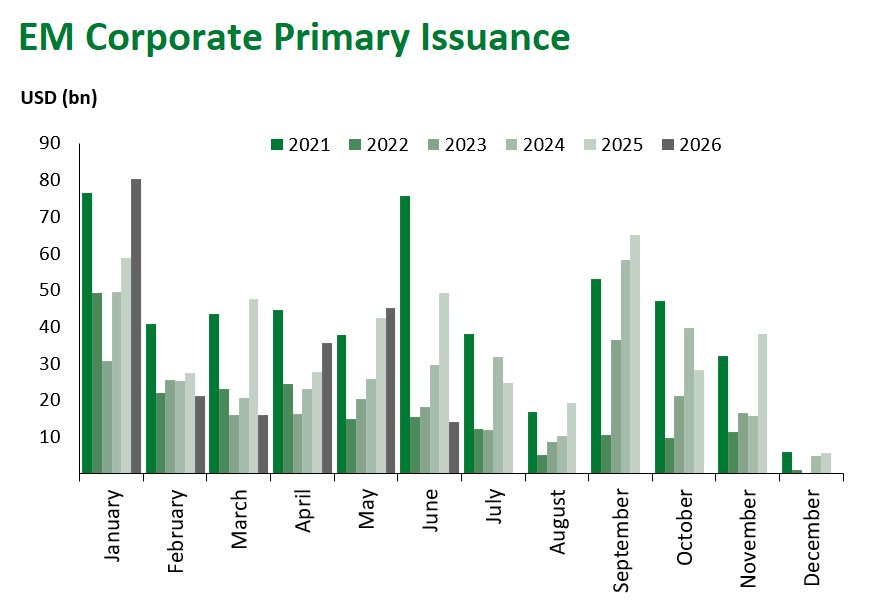
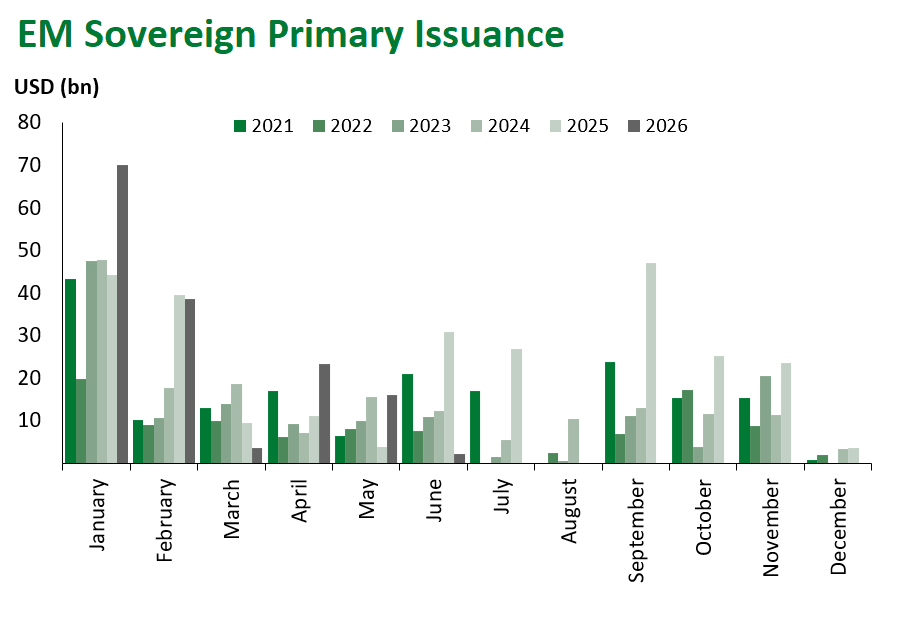
Primary market activity picked up this week, with twelve issuers pricing approximately $16.2 billion across sixteen tranches. Investment grade dominated, accounting for roughly $13.6 billion of supply versus about $2.6 billion of high yield, and euro-denominated deals (~$7.3 billion equivalent) ran nearly level with dollar supply. Saudi Arabia’s Green Palm was the week’s largest transaction, pricing $3.5 billion across two long-dated tranches ($1.5 billion and $2.0 billion). Other notable investment grade prints included CEMEX of Mexico ($1.5 billion), while on the sovereign side the highlight was Bahrain’s $1.0 billion 10-year sovereign—the first public GCC sovereign deal since the Iran war began in late February, priced hours after Bahraini forces intercepted Iranian missiles and drones, yet still drawing more than $3.2 billion in orders and allowing pricing to tighten to a 7.125% yield from initial guidance in the 7.5% area.
The Week Ahead
A heavy central-bank calendar headlines the week ahead, led by the European Central Bank’s rate decision and President Christine Lagarde’s press conference, alongside a Bank of Canada decision and a cluster of emerging-market rate-setting meetings in Türkiye, Peru, Serbia, and Kenya. U.S. May CPI is the key data release, offering an important test of inflation trends amid the Iran conflict, with a hotter-than-expected reading reinforcing the case for keeping monetary policy restrictive for longer; it is accompanied by U.S. PPI and jobless claims, China CPI, PPI, and trade, GDP prints across Japan, Saudi Arabia, South Africa, and South Korea, and a broad slate of May inflation readings spanning Germany, France, Spain, Mexico, Brazil, and India. With energy markets in focus, OPEC+ convenes to set July crude production at a pivotal moment for oil, OPEC releases its monthly oil market report, and the Fed enters its communications blackout ahead of the June 16-17 FOMC meeting. SpaceX is expected to debut on the Nasdaq in what may be the largest IPO ever—seeking to raise as much as $75 billion at a valuation of at least $1.8 trillion—against a busy slate of technology and private-capital gatherings including Apple’s Worldwide Developers Conference, London Tech Week, and SuperReturn International in Berlin. On the political calendar, Peru holds a presidential runoff while Kosovo and Armenia hold elections, G7 leaders prepare to convene, and the FIFA World Cup opens in Mexico.
Fixed Income
Equities
Commodities

Source for data tables: Bloomberg, JPMorgan, Gramercy. EM Fixed Income is represented by the following JPMorgan Indicies: EMBI Global, GBI-EM Global Diversified, CEMBI Broad Diversified and CEMBI Broad High Yield. DM Fixed Income is represented by the JPMorgan JULI Total Return Index and Domestic High Yield Index. Fixed Income, Equity and Commodity data is as of June 5, 2026 (mid-day).
Highlights
De la Espriella’s first-round win improves the outlook for Colombian assets
Event: Right-wing political newcomer Abelardo de la Espriella won the first round of Colombia’s presidential election with 43.7% of the vote, significantly outperforming expectations. He will face Petro-supported leftist candidate Ivan Cepeda, who placed second with 40.9%, in the June 21 runoff. Center-right candidate Paloma Valencia took 6.9% and promptly pledged her support to de la Espriella.
Gramercy Commentary: De la Espriella materially outperformed pre-election polls and market expectations, while Cepeda performed broadly in line with what the polls had suggested. Given that the first round gap between the two candidates is only around 600K votes (out of around 40 million eligible voters), Cepeda retains a path to the presidency, but it has narrowed substantially given De la Espriella’s momentum, a constructive development from a market perspective. Although de la Espriella remains a relatively unknown figure to markets and not much clarity exists on his economic agenda yet, we expect investors to give a potential De la Espriella administration the benefit of the doubt that Colombia’s fiscal trajectory will be shifting in a market-friendly direction. In addition, despite lacking an established political base, we think that De la Espriella would be well positioned to build alliances in the center-right leaning Congress elected back in March, at least initially, in line with similar recent cases in Latin America such as President Milei of Argentina and President Noboa of Ecuador, for example. We expect that improved odds of a conservative administration and likely lower institutional pressure relative to the status quo under Petro will underpin an overall improvement in sovereign assets performance, all else being equal.
Indonesia codifies dual mandate, compounding policy credibility concerns
Event: On June 4, Indonesia’s parliament passed legislation expanding Bank Indonesia’s mandate to include real sector growth alongside rupiah and price stability while granting lawmakers new authority to evaluate the central bank’s performance. The bill received unanimous support across political parties. The change comes against a backdrop of significant market pressure. Indonesian equity indices are down over 30% YTD while the rupiah hit its weakest level, above IDR 1800, depreciating approximately 7.5% year-to-date. Bank Indonesia raised its benchmark 7-day reverse repo rate by 50bps to 5.25% on May 21, its first rate hike in two years.
Gramercy Commentary: The formalization of the central bank’s expanded remit risks further erosion of Indonesia’s policy framework that began with Sri Mulyani’s departure in September 2025 and the January appointment of President Prabowo’s nephew, Thomas Djiwandono, as Deputy Governor of Bank Indonesia. The dilution of the central bank’s inflation mandate comes at a challenging time, with inflation acceleration, weaker external balances amid spillovers from the Middle East conflict and opaque export restrictions, and fiscal expansion. These developments are weighing on market sentiment and sovereign credit fundamentals. While Indonesia’s headline metrics remain relatively strong—public debt near 40% of GDP, adequate FX reserve coverage despite recent intervention-related declines, and a sound banking sector—we expect continued policy slippage to increase the likelihood of rating downgrades toward BBB-. We nevertheless expect Indonesia to retain its investment-grade status. Given ongoing FX instability, we expect Bank Indonesia to deliver another rate hike at its mid-June meeting; a more dovish stance would risk intensifying pressure on the rupiah and broader financial markets.
Emerging Markets Technicals
Emerging Markets Flows
Source for graphs: Bloomberg, JPMorgan, Gramercy. As of June 5, 2026.
For questions, please contact:
Kathryn Exum, CFA ESG, Director, Co-Head of Sovereign Research, [email protected]
Petar Atanasov, Director, Co-Head of Sovereign Research, [email protected]
This document is for informational purposes only. The information presented is not intended to be relied upon as a forecast, research or investment advice, and is not a recommendation, offer or solicitation to buy or sell any securities or to adopt any investment strategy. Gramercy may have current investment positions in the securities or sovereigns mentioned above. The information and opinions contained in this paper are as of the date of initial publication, derived from proprietary and nonproprietary sources deemed by Gramercy to be reliable, are not necessarily all-inclusive and are not guaranteed as to accuracy. This paper may contain “forward-looking” information that is not purely historical in nature. Such information may include, among other things, projections and forecasts. There is no guarantee that any forecasts made will come to pass. Reliance upon information in this paper is at the sole discretion of the reader. You should not rely on this presentation as the basis upon which to make an investment decision. Investment involves risk. There can be no assurance that investment objectives will be achieved. Investors must be prepared to bear the risk of a total loss of their investment. These risks are often heightened for investments in emerging/developing markets or smaller capital markets. International investing involves risks, including risks related to foreign currency, limited liquidity, less government regulation, and the possibility of substantial volatility due to adverse political, economic or other developments. References to any indices are for informational and general comparative purposes only. The performance data of various indices mentioned in this update are updated and released on a periodic basis before finalization. The performance data of various indices presented herein was current as of the date of the presentation. Please refer to data returns of the separate indices if you desire additional or updated information. Indices are unmanaged, and their performance results do not reflect the impact of fees, expenses, or taxes that may be incurred through an investment with Gramercy. Returns for indices assume dividend reinvestment. An investment cannot be made directly in an index. Accordingly, comparing results shown to those of such indices may be of limited use. The information provided herein is neither tax nor legal advice. Investors should speak to their tax professional for specific information regarding their tax situation.