


Contents
Market Overview
Macro Update
This week markets remained in the whirlpool of conflicting geopolitical headlines. Reports emerged that Iran’s leadership sees the latest proposal by the Trump administration as “partly bridging the gap” between the two sides, but also that Tehran plans to keep its uranium, which is seen as a key obstacle to any potential peace deal.
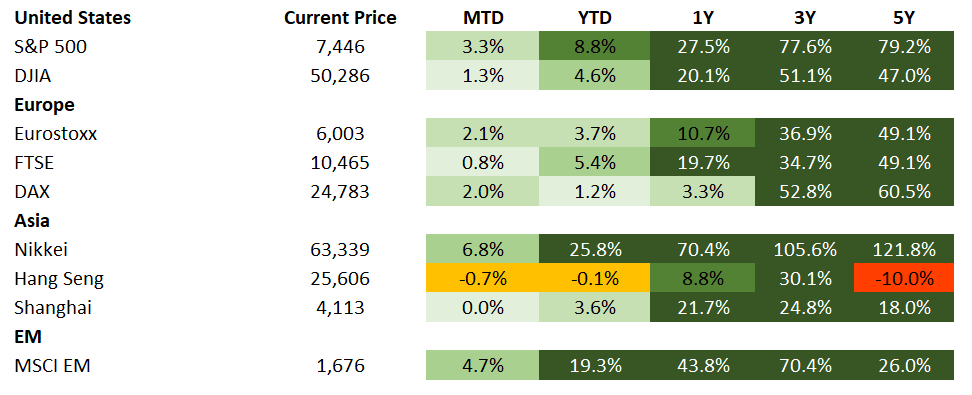
Hopes for a deal between the U.S. and Iran were reinforced by the United Arab Emirates, Saudi Arabia, and Qatar jointly urging President Trump to give negotiations a chance to end the war, citing fears of retaliation from Iran that could harm Gulf economies. Renewed optimism about conflict resolution helped stocks reverse losses form earlier in the week and drove the S&P 500 toward eight consecutive weekly gains. However, in corporate world developments, Walmart cautioned that fuel costs are likely to lead to higher prices for U.S. consumers while a solid outlook from Nvidia failed to impress investors who worry the company will not be able to maintain its rapid growth rate.
Brent crude, the global oil benchmark, closed below $105 per barrel, around $5 lower than last week. Bond markets were relatively calm as the recent sell-off that drove global yields to multi-year highs paused this week, despite concerns about medium-term inflation under “higher for longer” energy prices and warnings from Jamie Dimon and other high-profile market figures that global interest rates may climb much further.
Concerns remain that in the absence of a quick resolution, a prolonged closure of the Strait of Hormuz could worsen energy disruptions and inflationary pressures, ultimately forcing the Federal Reserve to raise interest rates. Kevin Warsh was sworn in as the 17th Fed chair, taking over at a tense moment for the U.S. economy and the Fed amid likely aggressive political pressure to lower interest rates despite a deteriorating inflation outlook.
Against this backdrop, the U.S. treasury curve flattened, with the front-end underperforming on hawkish remarks by Fed Governor Waller: the 2-year yield was around 4bps higher to 4.12% while the 10-year benchmark yield declined 2bps to around 4.57%. The USD was stable in mid-99s on the DXY, its highest level since Middle East de-escalation rhetoric began in early April, as markets have now fully priced in a 25bps Fed hike by the end of 2026. Amid USD strength, gold and silver spot prices were modestly lower, around $4,500 and $75 per oz, respectively.
In terms of macro data and releases, minutes from the April 28-29 FOMC meeting revealed that the majority of Fed policymakers were already shifting in a hawkish direction in the face of stubborn above-target inflation. The U.S. May flash manufacturing PMI showed activity expanding by the most in four years as customers strived to get ahead of mounting price pressures arising from the Iran war; however, the composite PMI was little changed. Meanwhile, the University of Michigan’s final May sentiment index came below already depressed expectations, showing that U.S. consumer sentiment fell in May to a record low and long-term inflation expectations worsened notably due to the Iran war.
In the UK, data released this week pointed to a weakening labor market amid a surprise rise in unemployment. April inflation was lower than expected in both year-on-year and month-on-month terms while the flash May composite PMI came below expectations and back in contractionary territory (48.5).
In the Eurozone, final April inflation was confirmed in line with expectations (3.0% year-over-year) and flash May PMIs underperformed consensus expectations. In China, signs of slowing economic activity across the board re-ignited stimulus talk, with investment resuming declines and domestic consumption deteriorating. Commercial banks kept Loan Prime Rates unchanged at 3.5% (5-year) and 3.0% (1-year) as the PBOC remains on hold, but the pressure for lower rates looks likely to increase in the second half of the year.
In Japan, preliminary estimates showed that the economy grew by 2.1% year-over-year in 1Q26, well above consensus expectations (1.7%), driven by rising consumption and exports. However, as elsewhere around the world, growth is expected to slow in the coming quarters as the fallout from the Iran war percolates throughout the global economy.
Beyond Middle East developments, other geopolitical highlights included a meeting in Beijing between Chinese and Russian leaders Xi Jinping and Vladimir Putin who, signing a series of trade and technology agreements, declared the Sino-Russian relationship has reached the “highest level of comprehensive strategic partnership”.
Meanwhile, the U.S. Justice Department indicted Raúl Castro, Cuba’s de facto leader, on several charges in a sign of increasing pressure against Havana by the Trump administration.
EM Credit Update
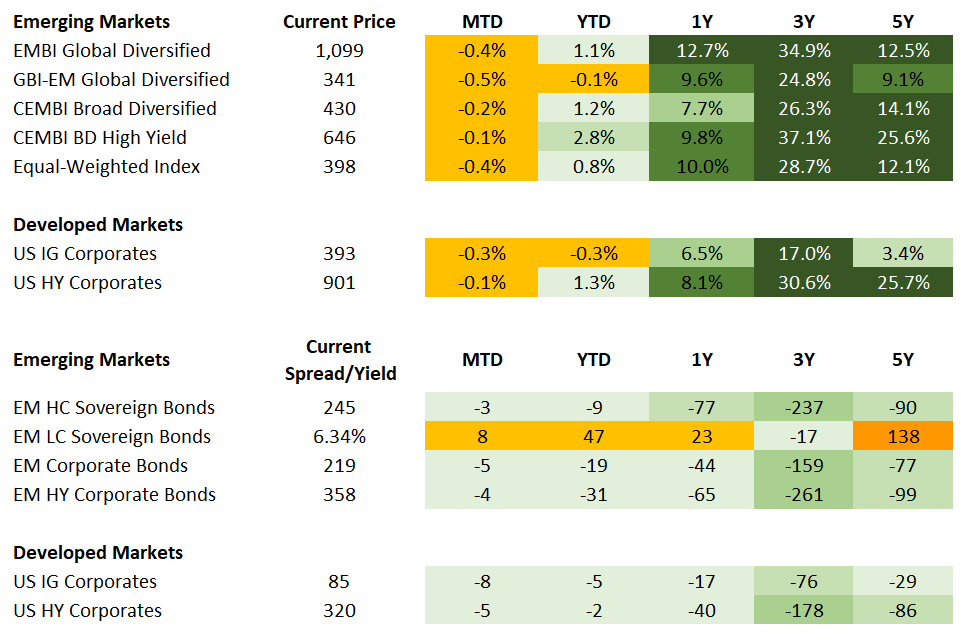
Emerging Markets (EM) fixed income delivered mixed returns this week, with hard currency sovereigns and corporates under modest pressure while local currency debt eked out a marginal gain. Performance was notably dispersed across all three sub-asset classes, with renewed ceasefire uncertainty and shifting risk sentiment driving sharp divergence at the country level, particularly within local markets where FX moves dominated the return picture.
Hard currency sovereign bonds declined -0.14% at the index level, with high yield (-0.12%) outperforming investment grade (-0.15%). Regionally, Asia (+0.04%) was the only region to post positive returns, supported by sovereign strength in Malaysia (+0.35%) and continued inflows into higher-quality credits, while Latin America (-0.23%) and Europe (-0.21%) lagged. Africa (-0.03%) and the Middle East (-0.12%) were also in negative territory, though losses were modest. At the country level, the standout performers were Ethiopia (+2.20%), Ukraine (+2.00%), and Zambia (+1.38%), all benefiting from idiosyncratic catalysts including continued restructuring progress and improving terms-of-trade dynamics. Argentina (+1.26%) also delivered solid gains. On the downside, Bolivia (-2.17%) and Venezuela (-2.11%) were the week’s weakest performers. Türkiye (-1.00%) lagged amid a domestic political shock after the Ankara appeals court voided the election of Özgür Özel as CHP chairman, rattling markets temporarily, while Ecuador (-0.75%) also underperformed.
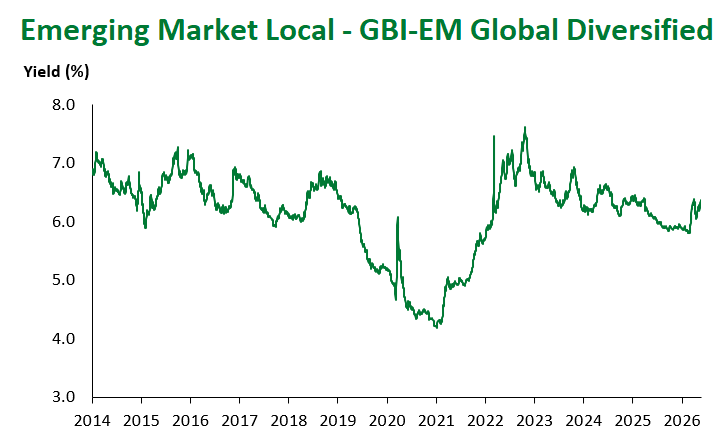
Local currency sovereign debt posted a marginal gain of +0.05% at the index level in USD terms, masking significant cross-country divergence driven by FX dynamics. Colombia (+1.67%) was the standout performer, boosted by a combination of constructive political developments and partial peso recovery. Egypt (+0.28%) and Peru (+0.18%) also posted modest positive returns. In contrast, Türkiye (-2.85%) was the weakest local currency performer by a wide margin, with the CHP court ruling amplifying pressure on both the lira and local rates. Thailand (-1.91%), Romania (-1.89%), and Hungary (-1.66%) also underperformed, with the latter two weighed by broader European currency weakness and rates volatility.
EM corporates declined -0.07% at the index level, with investment grade (-0.02%) outperforming high yield (-0.13%). Regionally, Asia (+0.07%) and the Middle East (-0.02%) were the relative outperformers, while Europe (-0.37%) lagged, pressured by corporate credits in Türkiye (-0.64%) and Kazakhstan (-0.43%). Along the credit quality spectrum, investment-grade rated segments held up better with AAA (+0.18%), AA (+0.14%), and A (+0.06%) all in positive territory, while BBB (-0.11%), BB (-0.14%), and B (-0.18%) lagged. The C-rated segment (+0.18%) outperformed on a carry basis. Across the curve, the 1-3-year segment (+0.03%) outperformed the 10+ year bucket (-0.14%), as investors favored shorter duration due to rates uncertainty. Ukrainian corporates (+0.51%), Egyptian corporate credits (+0.19%), and Ghanaian issuers (+0.13%) were among the week’s brighter spots.
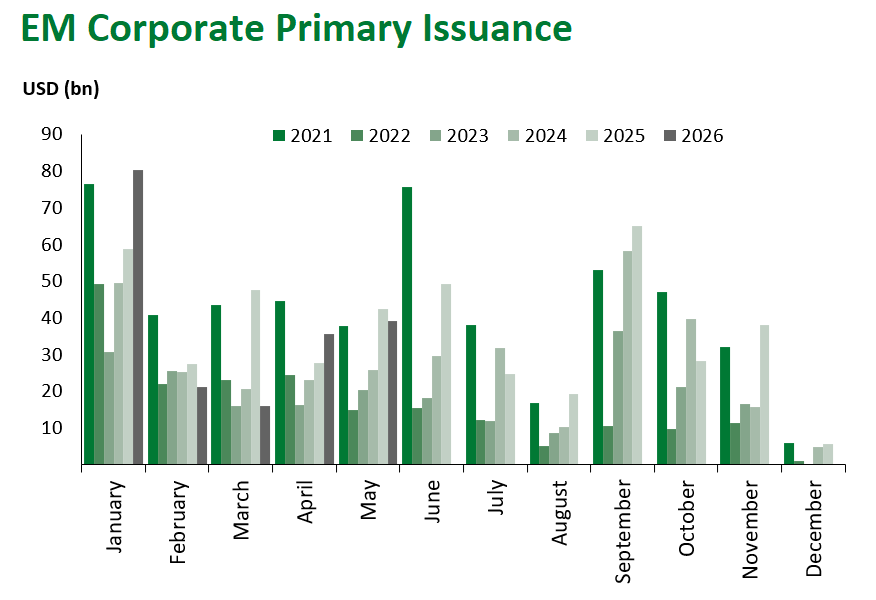
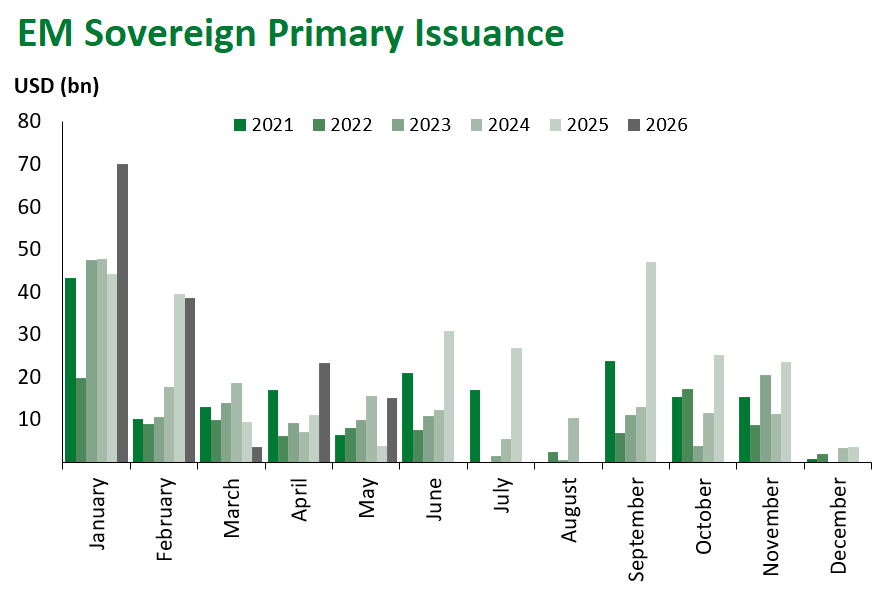
Primary market activity was robust, with approximately 27 tranches pricing nearly $19 billion equivalent in hard currency supply across a diverse set of issuers and regions. Sovereign issuance was anchored by Indonesia, which raised approximately $3.4 billion equivalent across four tranches in USD and EUR format – a strong signal of continued market access for investment-grade EM sovereigns. Morocco priced a dual-tranche EUR2.6 billion equivalent transaction across 5- and 10-year maturities, while Angola placed approximately $1.5 billion across two USD tranches at yields between 8.25% and 9.50%. The Republic of Congo also accessed the market for $850 million in an amortizing structure with an 8-year weighted average life. On the corporate and financial side, VEON priced a $1.4 billion dual-tranche transaction and CEZ Group of the Czech Republic priced EUR750 million in green bonds. Yapi ve Kredi Bankasi of Turkey and Alinma Bank of Saudi Arabia both accessed the AT1 market, each raising $500 million. Fibra Soma of Mexico priced an $800 million crossover-rated real estate transaction. The week’s breadth of issuance – spanning sovereigns, financials, and corporates across CEEMEA, Asia, and Latin America – underscored continued market function despite the uncertain macro backdrop.
The Week Ahead
Next week will be a short one in key global markets such as the U.S. and UK due to the Monday holiday. It includes the April U.S. personal income and spending report including the PCE index, the Fed’s preferred inflation gauge, which will offer an important read for policymakers. A slate of preliminary May inflation data from Europe and globally will also be reported, as well as final 1Q GDP numbers across various economies, including the U.S. In emerging markets, the central banks in Hungary, Sri Lanka, South Africa, and Colombia will deliver their interest rate decisions. The Eurasian Economic Forum will take place in Kazakhstan with Russian President Vladimir Putin expected to attend and the Shangri-La Dialogue, Asia’s premier defense summit, begins in Singapore, with U.S. Defense Secretary Pete Hegseth among the expected participants. Elsewhere, Cyprus holds parliamentary elections, and the annual Hajj pilgrimage begins in Mecca, Saudi Arabia.
Fixed Income
Equities
Commodities
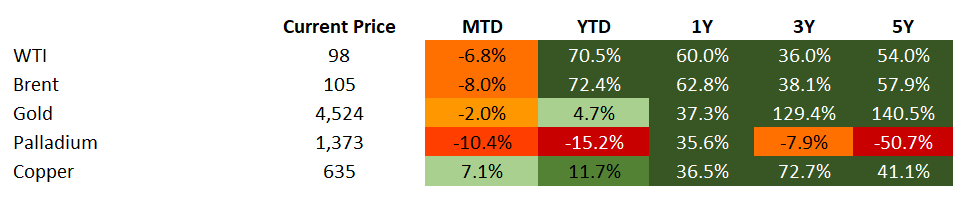
Source for data tables: Bloomberg, JPMorgan, Gramercy. EM Fixed Income is represented by the following JPMorgan Indicies: EMBI Global, GBI-EM Global Diversified, CEMBI Broad Diversified and CEMBI Broad High Yield. DM Fixed Income is represented by the JPMorgan JULI Total Return Index and Domestic High Yield Index. Fixed Income, Equity and Commodity data is as of May 22, 2026 (mid-day).
Highlights
Leadership of Türkiye’s main opposition party removed by the courts
Event: A Turkish court annulled the results of the 2023 congress of CHP, the main opposition party, voiding the election of its current leader and reinstated the party’s previous administration, including former long-time chairman Kemal Kilicdaroglu.
Gramercy Commentary: We see two-fold principal market implications from this latest political risk manifestation in Türkiye. On one hand, CHP’s decapitation by the courts and reinstatement of Mr. Kilicdaroglu, who has a consistent multi-year track-record of losing elections against President Erdogan, further cements Mr. Erdogan’s domestic political prospects, decreasing his incentives to revisit previous episodes of heterodox economic policy management ahead of the next presidential elections expected in late 2027 or 2028. On the other hand, this development is yet another signal to global markets about elevated political risk that is likely to pressure investor sentiment on Turkish assets, which are already being tested by regional geopolitical uncertainty and elevated energy prices. In the coming days, we will be watching for any meaningful domestic protests against this decision, which we believe is unlikely given that even the March 2025 arrest of Istanbul mayor and the most popular opposition figure, Ekrem Imamoglu, failed to trigger sustained social upheaval. In terms of market reaction, it has been predictably negative but mostly centered on equities with the main Turkish stock index down around 8.0%. TRY was little changed amid reports that state-owned banks have sold around $6 billion to defend the currency after the news broke. For comparison, the Imamoglu episode in March 2025 is estimated to have drained more than $50 billion from CBT’s reserves to maintain FX stability.
Mexico credit ratings downgraded
Event: Moody’s downgraded Mexico’s sovereign rating to Baa3 with a stable outlook, removing the negative outlook that had been in place since late 2024. The downgrade reflects slower-than-anticipated fiscal consolidation, continued fiscal support for Pemex, and weaker medium-term growth prospects that are likely to delay debt stabilization. Earlier in the week, S&P revised the outlook on Mexico’s BBB rating to negative, citing similar concerns.
Gramercy Commentary: The rating actions are broadly consistent with market expectations and reflect long-standing structural challenges rather than a material deterioration in the near-term macroeconomic outlook. Importantly, we believe Mexico is likely to retain its investment-grade status in the near-term, supported by a still-moderate debt-to-GDP ratio in the 55-60% range and a historically prudent macroeconomic policy framework. Market concern over ‘fallen-angel’ status could emerge if Fitch revises the outlook on its BBB- rating to negative.
More broadly, we expect Mexico to maintain competitive access to the U.S. market and continue to benefit from resilient remittance inflows, despite uncertainty surrounding USMCA negotiations, evolving U.S. immigration policy, and bilateral political dynamics that may generate periodic volatility. In addition, we believe President Sheinbaum remains well positioned to balance increasing U.S. pressure for security coordination with domestic political sensitivities.
Peru first-round election results finalized
Event: Peru’s electoral authorities finalized the results of the first round of the 2026 presidential election, confirming a June 7 runoff between Keiko Fujimori and leftist candidate Roberto Sánchez. Fujimori secured approximately 17% of the vote, while Sánchez advanced with roughly 12%, narrowly edging out Rafael López Aliaga in a highly fragmented field.
Gramercy Commentary: The outlook for the runoff remains fluid given the elevated share of undecided and blank voters, while both candidates face distinct challenges. Fujimori benefits from high name recognition, though she continues to contend with historically elevated but improving rejection rates. Sánchez, by contrast, is less well known but has gained traction as a candidate representing political change.
Markets continue to view macroeconomic policy continuity as a key anchor for Peruvian assets. The composition of Congress suggests Sánchez could face meaningful institutional resistance to the more controversial elements of his agenda, while Fujimori may benefit from broader legislative support than recent administrations. In our view, a Fujimori victory would likely support stronger growth expectations and lower market volatility, whereas a Sánchez win could introduce greater policy uncertainty and heightened volatility. Investors will also remain closely focused on the July central bank leadership transition, which will serve as an important indicator of policy continuity.
Emerging Markets Technicals
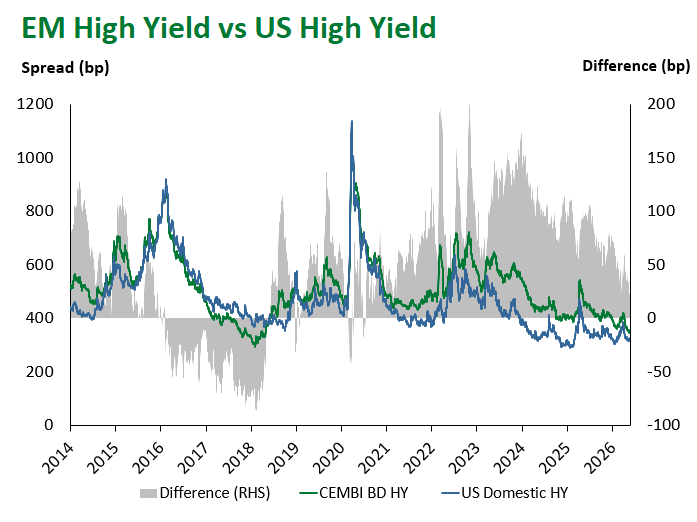
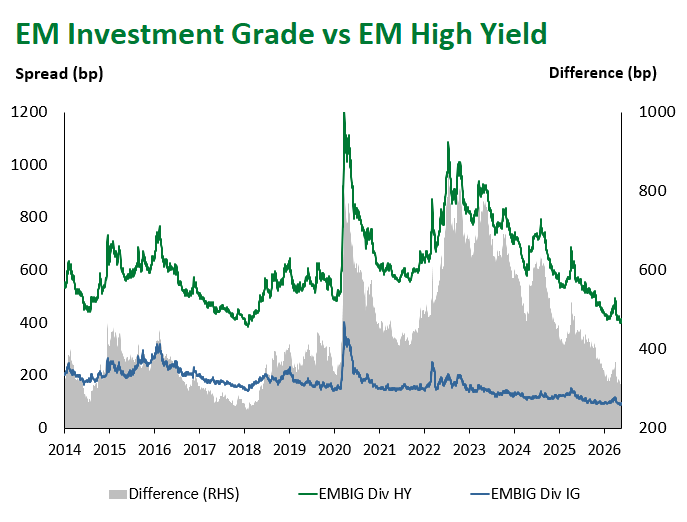
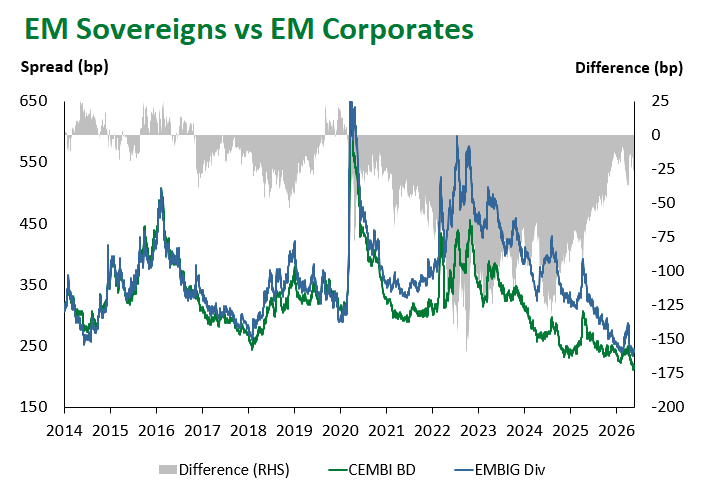
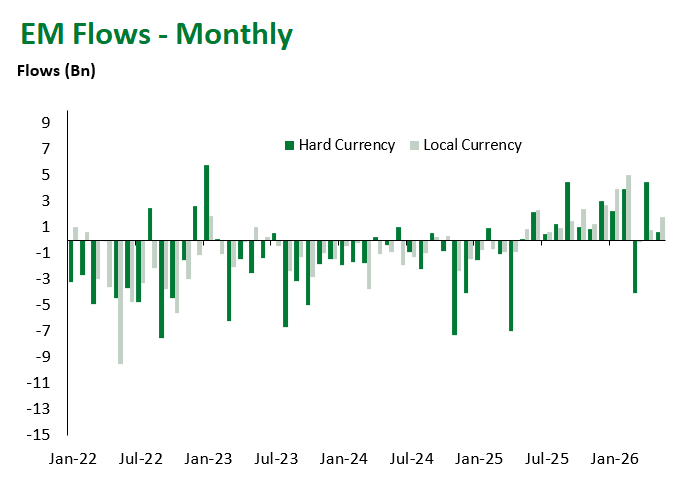
Emerging Markets Flows
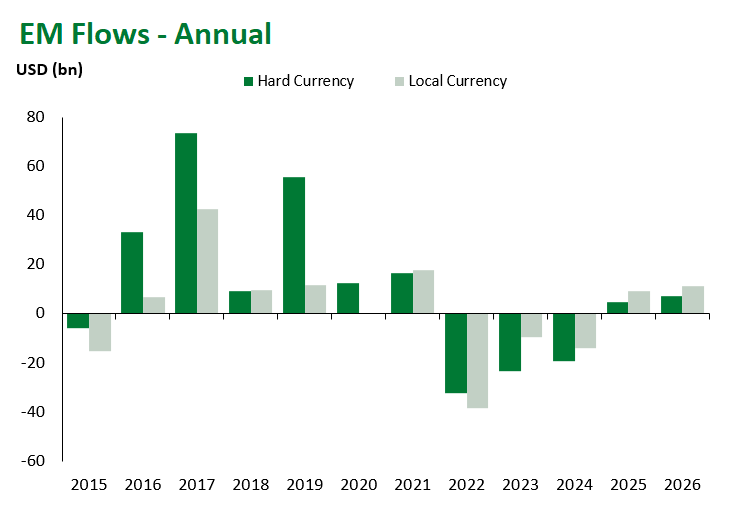
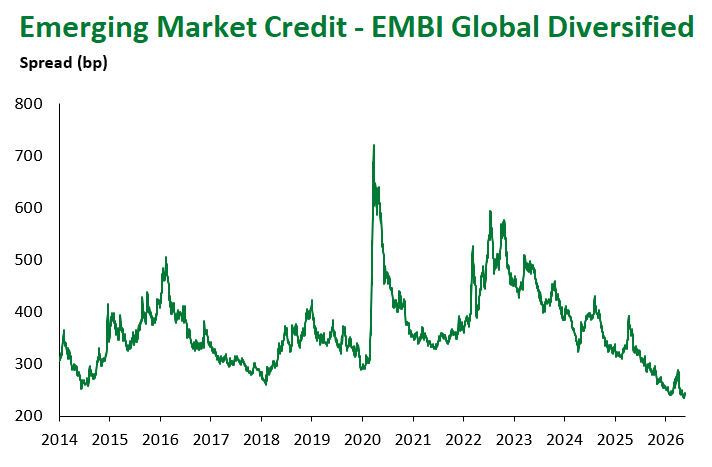
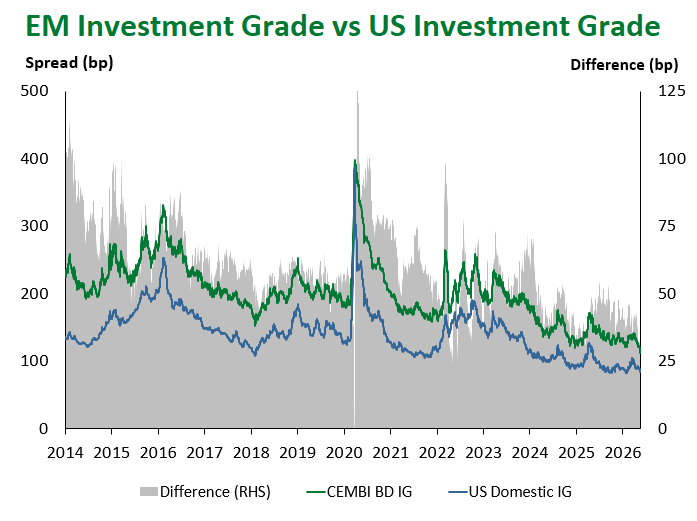
Source for graphs: Bloomberg, JPMorgan, Gramercy. As of May 22, 2026.
For questions, please contact:
Kathryn Exum, CFA ESG, Director, Co-Head of Sovereign Research, [email protected]
Petar Atanasov, Director, Co-Head of Sovereign Research, [email protected]
This document is for informational purposes only. The information presented is not intended to be relied upon as a forecast, research or investment advice, and is not a recommendation, offer or solicitation to buy or sell any securities or to adopt any investment strategy. Gramercy may have current investment positions in the securities or sovereigns mentioned above. The information and opinions contained in this paper are as of the date of initial publication, derived from proprietary and nonproprietary sources deemed by Gramercy to be reliable, are not necessarily all-inclusive and are not guaranteed as to accuracy. This paper may contain “forward-looking” information that is not purely historical in nature. Such information may include, among other things, projections and forecasts. There is no guarantee that any forecasts made will come to pass. Reliance upon information in this paper is at the sole discretion of the reader. You should not rely on this presentation as the basis upon which to make an investment decision. Investment involves risk. There can be no assurance that investment objectives will be achieved. Investors must be prepared to bear the risk of a total loss of their investment. These risks are often heightened for investments in emerging/developing markets or smaller capital markets. International investing involves risks, including risks related to foreign currency, limited liquidity, less government regulation, and the possibility of substantial volatility due to adverse political, economic or other developments. References to any indices are for informational and general comparative purposes only. The performance data of various indices mentioned in this update are updated and released on a periodic basis before finalization. The performance data of various indices presented herein was current as of the date of the presentation. Please refer to data returns of the separate indices if you desire additional or updated information. Indices are unmanaged, and their performance results do not reflect the impact of fees, expenses, or taxes that may be incurred through an investment with Gramercy. Returns for indices assume dividend reinvestment. An investment cannot be made directly in an index. Accordingly, comparing results shown to those of such indices may be of limited use. The information provided herein is neither tax nor legal advice. Investors should speak to their tax professional for specific information regarding their tax situation.