


Contents
Market Overview
Macro Update
President Donald Trump’s visit to China and rhetoric regarding Iran kept geopolitics front and center. U.S. and Chinese readouts from the high-level Trump-Xi meeting diverged, with Washington characterizing it as “great”, while Beijing striking a more cautious tone. Chinese President Xi warned his U.S. counterpart that any “mishandling of Taiwan” could lead to “clashes” between the two superpowers, moderating optimism about the relationship trajectory.
Earlier in the week Trump warned that the ceasefire with Iran was “on massive life support” and dismissed Teheran’s response to the latest White House proposal to end the war as “totally unacceptable”. As in previous counterproposals, Iran’s version included the end of the U.S. blockade on its ports as the main pre-condition as well as the recognition of Iran’s sovereignty over the Strait of Hormuz that remains practically closed.
In the U.S., Kevin Warsh was confirmed as Fed chair in the closest vote (54-45) since Senate approval became a requirement in 1970s. Mr. Warsh, who is expected to have a dovish bias, will be stepping in amid a deteriorating inflation backdrop with the April U.S. wholesale inflation (PPI) rising 6.0% year-over-year, the highest since late 2022, on a war-driven increase in energy prices.
Parallel to Trump’s China visit, Treasury Secretary Scott Bessent arrived in Tokyo for talks with Japanese officials amid focus on FX moves and coordination as Japan is suspected to have recently spent more than $60 billion to prop up the Yen. A much hotter than expected Japanese PPI reading for April (4.9% year-over-year vs. 3.0%) added to concerns about rapidly increasing producer prices in the U.S., turbocharging the move higher in fixed income yields.
In the UK, mounting political pressures on Prime Minister Starmer and a likely internal party challenge to his leadership added to fiscal jitters and global fixed income pressures, pushing 30-year gilt yields to their highest since 1998.
Against this fluid backdrop involving many moving parts, this week saw oil prices moving higher again, global bonds under pressure and the USD stronger. Brent crude, the global oil benchmark, edged back up to around $109 per barrel (~8% higher compared to last week) amid no breakthrough in the standoff over the Strait of Hormuz.
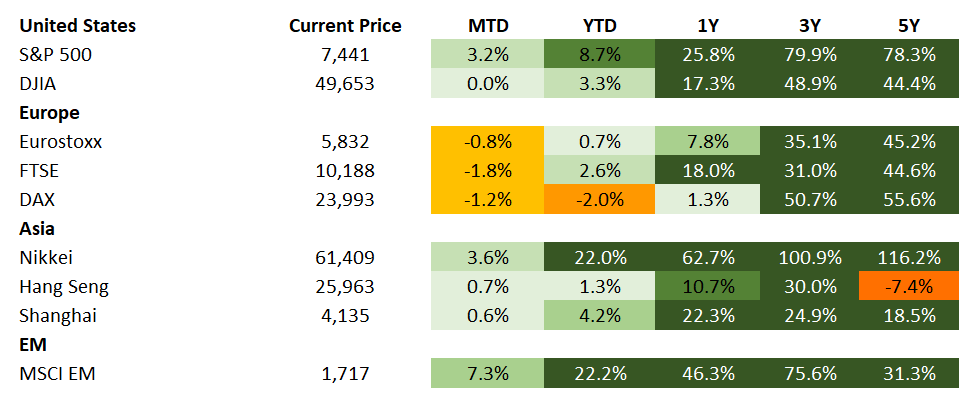
Despite continuing optimism about the AI trade, the selloff in global bonds halted the equity rally with concerns intensifying that central banks will be forced to tighten policy to keep inflation in check amid persistently elevated oil prices.
U.S. treasury yields moved sharply higher across the cure, led by the belly (+25bps) and the 10-Year benchmark yield widened by more than 20bps to end the week close to 4.60%. The USD gained, breaking into 99 territory on the DXY index for the first time since early April as markets started to price modest rate hikes by the Fed (+40bps) over a 1-year horizon. As the dollar surged, gold and silver spot prices fell to around $4,550 and $77 per oz, respectively.
In the world of macro data, U.S. April headline and core CPI came in hotter than expected on a year-over-year basis; the same dynamic was observed in China, but from a much lower base. In Europe, German and French inflation came in line with expectations as did Eurozone 1Q GDP in its second reading (+0.8% year-over-year and +0.1% quarter-over-quarter). Meanwhile, preliminary 1Q GDP in the UK was significantly stronger than expected (1.1% year-over-year vs 0.8%), driven by robust consumer and government spending at the start of the year, but the momentum is not expected to last due to higher energy costs and tighter funding conditions.
EM Credit Update
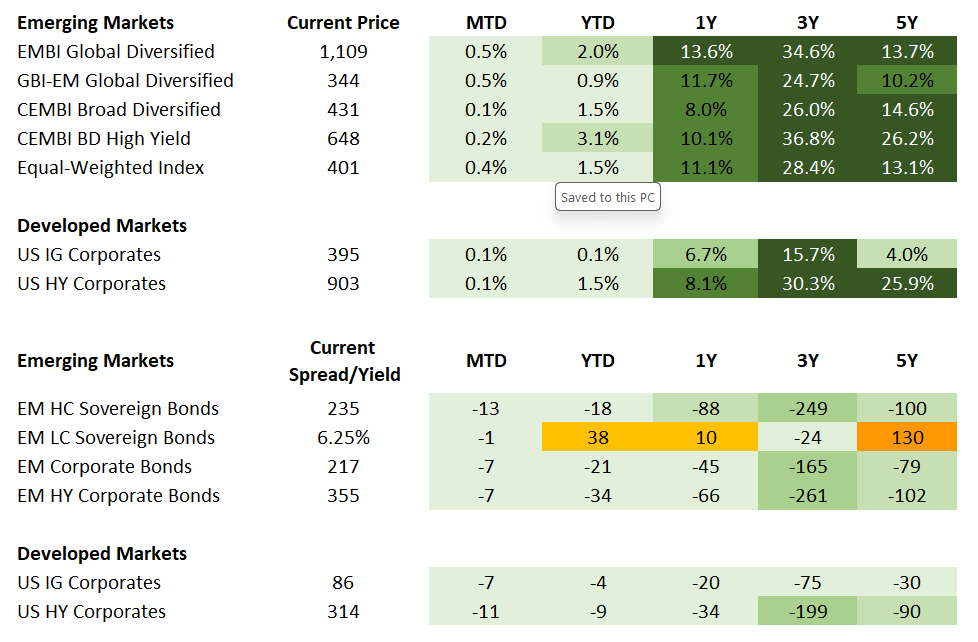
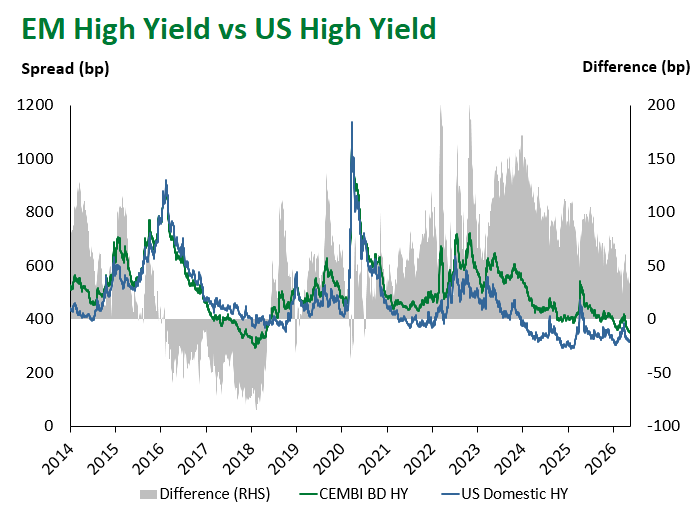
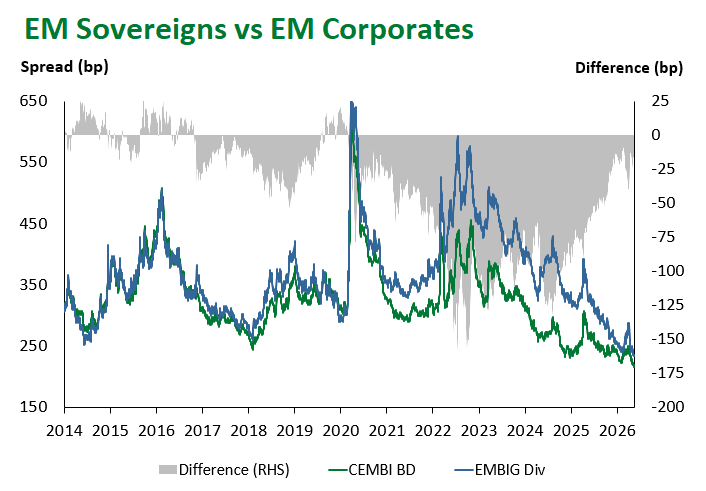
Emerging Markets (EM) fixed income retreated across all three sub-asset classes this week, with the risk-off tone driven by renewed ceasefire fragility, persistent uncertainty surrounding the trajectory of Iran-U.S. negotiations and energy supply, and growing inflation concerns that drove U.S. dollar strength and pushed back expectations for rate cuts across developed and emerging market central banks. Local currency sovereign debt was the weakest performer, declining -0.78% at the index level. Hard currency sovereigns (-0.38%) and EM corporates (-0.18%) held up comparatively better, though neither escaped the week’s negative backdrop.
Local currency debt saw broad-based weakness across most countries, with energy-importing economies and those with idiosyncratic vulnerabilities underperforming most sharply. Egypt (-2.47%), Colombia (-2.14%), Brazil (-1.94%), the Philippines (-1.93%), Poland (-1.78%), and Turkey (-1.69%) were among the notable laggards. Brazil sold off as concerns mounted that a leading presidential candidate has become embroiled in the Banco Master scandal, adding meaningful political uncertainty to an already challenging rates and FX environment. Egypt, Colombia, Poland, and Turkey reflected a more familiar mix of FX depreciation and rates pressure, while the Philippines lagged on broader risk-off sentiment. On the positive side, Peru (+1.18%), the Dominican Republic (+0.62%), Romania (+0.60%), and China (+0.32%) were the standout outperformers, with Peru benefiting from its commodity export position and China supported by modest currency appreciation and contained domestic inflation.
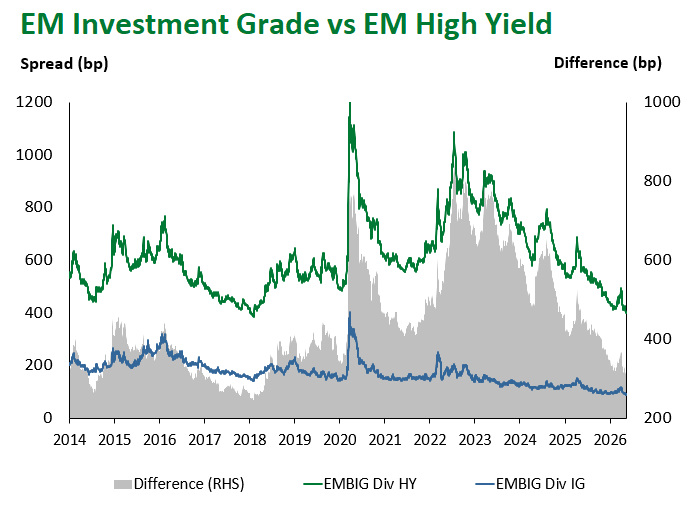
Hard currency sovereign bonds were down -0.38% at the index level, with high yield (-0.30%) outperforming investment grade (-0.47%). Europe (+0.25%) was the only region to post positive returns, while Africa (-0.54%), Asia (-0.58%), Latin America (-0.51%), and the Middle East (-0.49%) all declined. At the country level, Ukraine (+5.58%) was the unambiguous standout, continuing to rally on diplomatic momentum and speculation around a potential Russia-Ukraine resolution. Venezuela (+1.99%) also outperformed for a second consecutive week, supported by ongoing energy sector normalization and easing of U.S. sanctions. Romania (+0.32%) rounded out the top performers on the European side. On the negative end, Senegal (-3.71%) and Lebanon (-2.87%) were the weakest performers, the former reflecting idiosyncratic fiscal concerns and the latter retreating after earlier ceasefire-driven gains. Argentina (-1.00%), Colombia (-1.09%), and Brazil (-0.74%) also lagged as risk appetite for higher-beta Latin American credits softened.
EM corporates were the relative outperformer, declining only -0.18% at the index level, with high yield (-0.11%) outperforming investment grade (-0.23%). The Middle East (-0.11%) and Africa (-0.12%) were the most resilient regions, while Latin America (-0.26%) and Asia (-0.18%) lagged. By rating, the CCC segment was the only cohort to post positive returns (+0.39%), while AAA-rated bonds underperformed (-0.30%), reflecting duration sensitivity in a week when long-end rates remained under pressure. At the country level, Ukraine (+1.05%), Iraq (+0.31%), and Ghana (+0.16%) were among the notable corporate outperformers. Across the curve, shorter-duration bonds continued to outperform longer-duration ones, consistent with the broader rates environment.
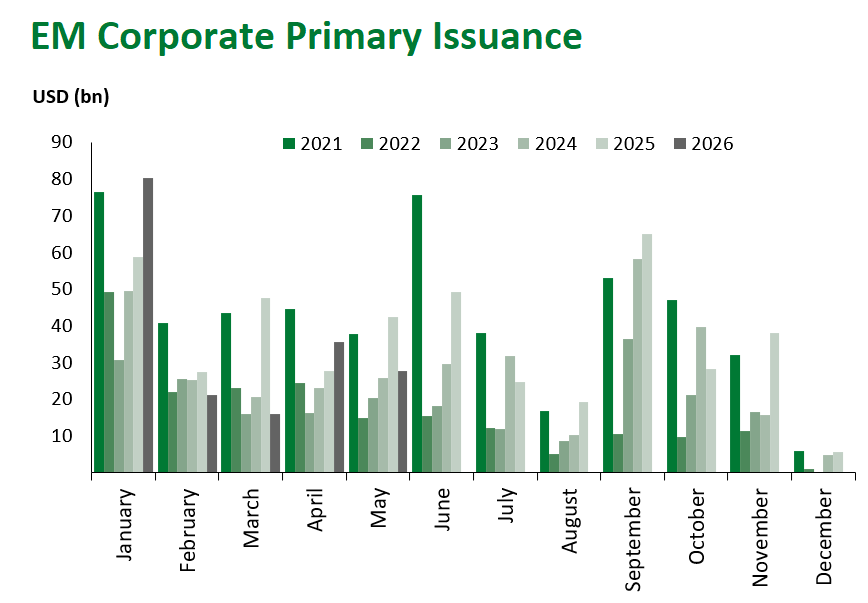
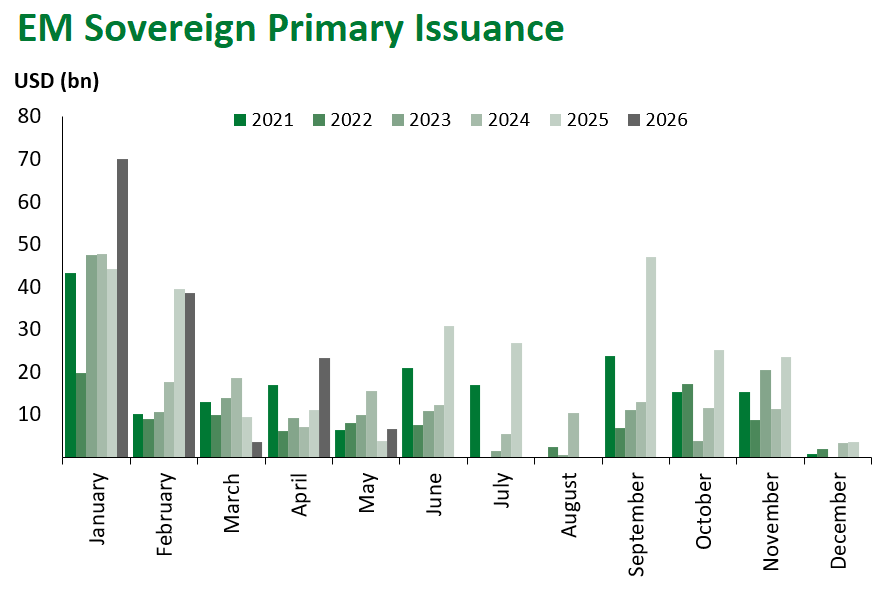
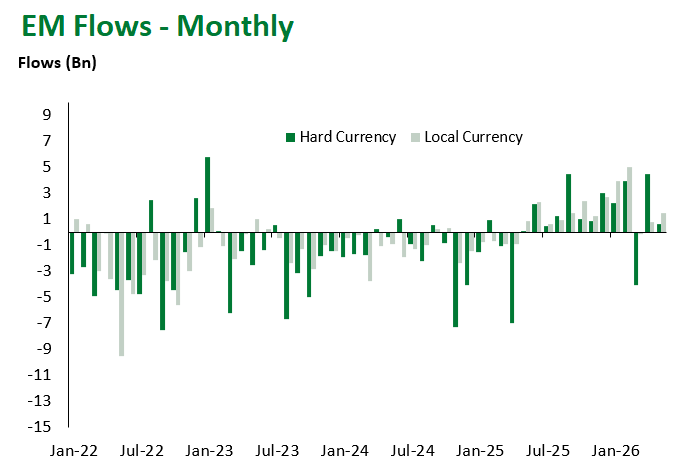
Primary market activity was relatively active given the volatile backdrop, with 22 issuers raising approximately $11.3 billion in hard currency supply, split roughly between high yield ($6.5 billion) and investment grade ($4.9 billion). The sovereign segment was anchored by Egypt’s $1.0 billion 7.625% bond and Lithuania’s €1.0 billion ($1.17 billion equivalent) transaction. On the corporate side, Telekom Serbia accessed markets with a three-tranche deal totaling approximately $2.3 billion equivalent in USD and EUR, one of the larger single-issuer corporate transactions in CEEMEA this year. ABSA Bank of South Africa priced a $300 million AT1 perpetual, and Ecobank Transnational raised $450 million in Tier 2 capital. In Latin America, Pampa Energia of Argentina priced $500 million and Movida of Brazil raised $350 million, both in the high yield space. In Asia, ICBC Financial Leasing ($600 million) and Bank of China ($500 million) were among the larger investment grade transactions.
The Week Ahead
Next week will provide markets with a trove of macro data across EM and DM economies. In the first week of new Fed chair Warsh on the job, the April meeting FOMC minutes will be published; other notable U.S. data includes the final May University of Michigan consumer sentiment, initial jobless claims, and the S&P Global manufacturing PMI. Preliminary May PMI readings will be released also in the Eurozone and its member states, India, Japan and the UK, among others. We’ll have April inflation reported in Eurozone, UK, Japan, Malaysia and South Africa, while 1Q GDP numbers will be released in Germany, Japan, Mexico, and Thailand. Central bank rate decisions are due in Indonesia, Nigeria and Egypt. China reports property prices, retail sales, industrial production, loan prime rates. The European Commission (EC) publishes its spring economic forecasts. Beyond economic data releases, the G-7 finance ministers and central bank governors meet in Paris, with the focus on global imbalances, trade tensions and FX policy, and Indian Prime Minister Narendra Modi visits Europe, with stops to include the Netherlands, Sweden, Norway and Italy. In terms of corporate earnings reports focus will be on Walmart for the health of U.S. consumers and Nvidia on whether it can sustain its dominance in AI chips.
Fixed Income
Equities
Commodities
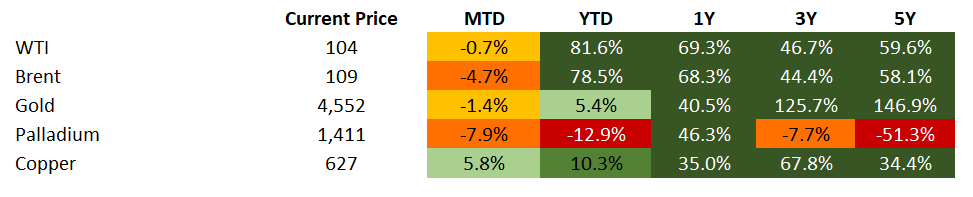
Source for data tables: Bloomberg, JPMorgan, Gramercy. EM Fixed Income is represented by the following JPMorgan Indicies: EMBI Global, GBI-EM Global Diversified, CEMBI Broad Diversified and CEMBI Broad High Yield. DM Fixed Income is represented by the JPMorgan JULI Total Return Index and Domestic High Yield Index. Fixed Income, Equity and Commodity data is as of May 15, 2026 (mid-day).
Highlights
Implication with the Master Bank scandal could harm Flavio Bolsonaro’s bid in extremely tight race against Lula
Event: Brazilian media outlets published leaked audio allegedly revealing presidential candidate Senator Flavio Bolsonaro requesting funds for a movie about Flavio’s father, former President Jair Bolsonaro, from Daniel Vorcaro, the former owner of Master Bank and the main figure in Brazil’s most recent fraud scandal.
Gramercy Commentary: The race between right-wing Flavio Bolsonaro and leftist President Lula ahead of the October presidential elections appears to be extremely tight, with most polls pointing to a “coin toss”. In this context, developments such as this one have the potential to tilt the race in one direction or the other and carry significant market implications. If allegations linking the younger Bolsonaro to the disgraced former owner of Master Bank deepen, they could detract votes for Flavio Bolsonaro from Brazil’s small share of centrist swing voters, who are most likely to react to such revelations and who are also ultimately likely to decide the outcome of the very tight race. Despite steady progress in polls in recent months, Flavio Bolsonaro still suffers from weak name recognition (beyond being associated with his father) and has an uphill battle against his famous opponent Lula’s significant incumbency advantages, including the ability and willingness to spend the bulk of Brazil’s sizable fiscal windfall from higher oil prices on pre-election stimulus. From investors’ perspective, a potential Flavio Bolsonaro administration in 2027 is seen as a chance to begin addressing Brazil’s long-standing fiscal issues in a market-friendly expenditure-led way, while a Lula 4.0 cabinet would likely be a continuation of tepid attempts at revenue-led fiscal adjustment.
Venezuela Initiates Public Debt Restructuring Process
Event: Venezuela formally launched a “comprehensive and orderly” public debt restructuring process and appointed Centerview Partners as financial advisor. The restructuring is expected to encompass both the Republic and PDVSA, including outstanding commercial liabilities and Eurobonds. Official bilateral and multilateral obligations are intended to be addressed through a broader process of “institutional normalization.” Authorities have committed to publishing a macroeconomic framework and Debt Sustainability Analysis (DSA) by June, guided by principles of sustainability, comprehensiveness, good faith engagement, transparency, and expediency.
Gramercy Commentary: The rapid launch of the restructuring process following the recent OFAC authorization permitting the engagement of legal and financial advisors underscores the degree of U.S. policy influence over the sequencing and pace of normalization efforts and signals a clear intention to move swiftly toward an eventual debt resolution framework. The commitment to deliver a DSA within the coming month suggests that the restructuring track may advance in parallel with — rather than subsequent to — the broader institutional normalization process involving the IMF and other multilaterals.
Key near-term signposts will include clarification around the debt reconciliation process, the definition of the ultimate “debt perimeter” incorporated into the DSA, and the potential issuance of licenses authorizing direct negotiations with creditors. Questions also remain regarding inter-creditor treatment, legal enforceability, governance credibility, and the extent to which authorities may seek coercive restructuring mechanisms to secure broad participation. Nevertheless, despite the considerable uncertainty that still surrounds the process, we expect policymakers to remain focused on restoring market access and designing a restructuring framework capable of catalyzing the scale of external capital necessary to support Venezuela’s medium-term economic recovery and rehabilitation of the energy sector.
Emerging Markets Technicals
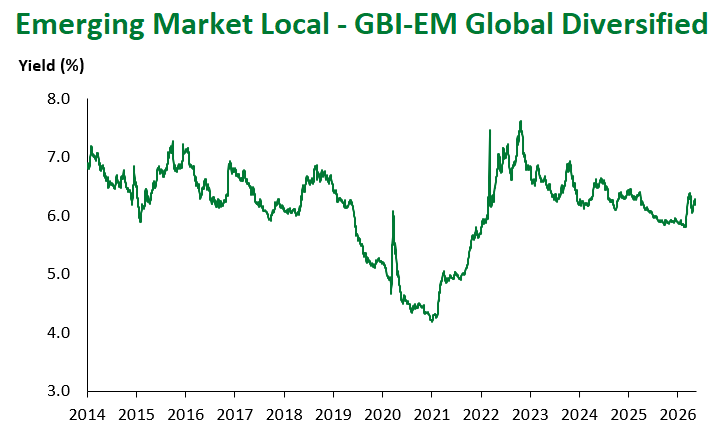
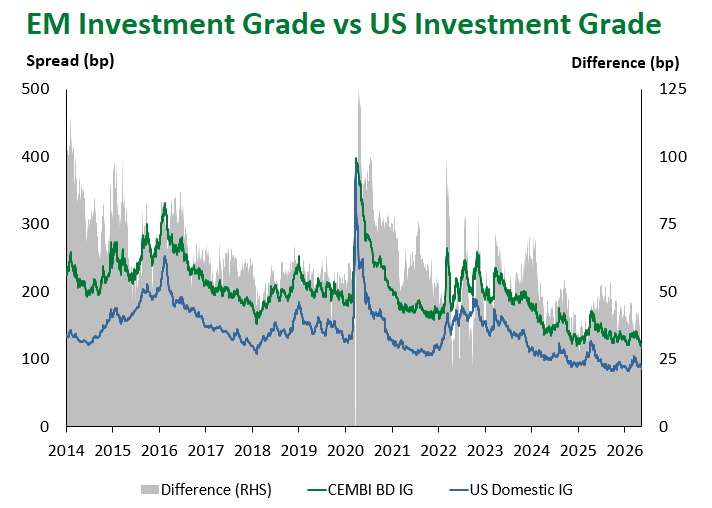
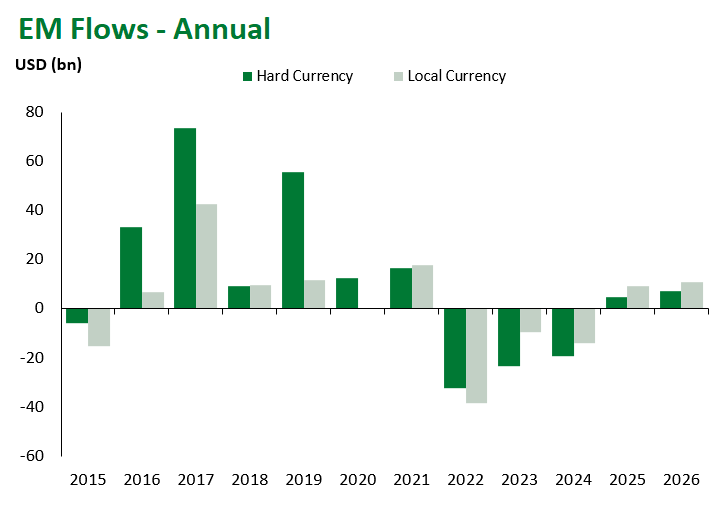
Emerging Markets Flows
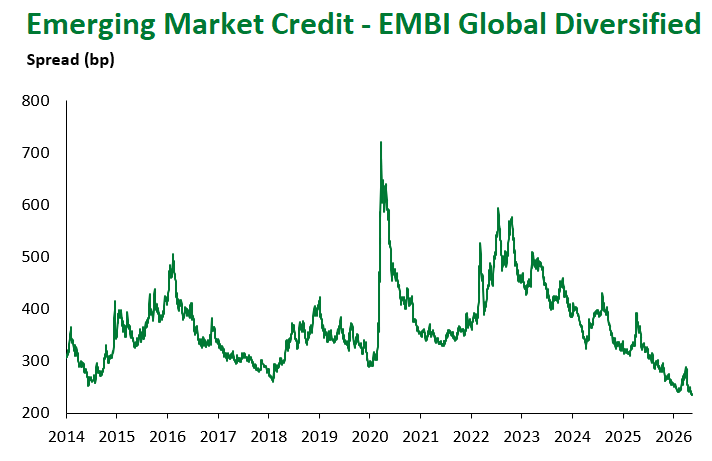
Source for graphs: Bloomberg, JPMorgan, Gramercy. As of May 15, 2026.
For questions, please contact:
Kathryn Exum, CFA ESG, Director, Co-Head of Sovereign Research, [email protected]
Petar Atanasov, Director, Co-Head of Sovereign Research, [email protected]
This document is for informational purposes only. The information presented is not intended to be relied upon as a forecast, research or investment advice, and is not a recommendation, offer or solicitation to buy or sell any securities or to adopt any investment strategy. Gramercy may have current investment positions in the securities or sovereigns mentioned above. The information and opinions contained in this paper are as of the date of initial publication, derived from proprietary and nonproprietary sources deemed by Gramercy to be reliable, are not necessarily all-inclusive and are not guaranteed as to accuracy. This paper may contain “forward-looking” information that is not purely historical in nature. Such information may include, among other things, projections and forecasts. There is no guarantee that any forecasts made will come to pass. Reliance upon information in this paper is at the sole discretion of the reader. You should not rely on this presentation as the basis upon which to make an investment decision. Investment involves risk. There can be no assurance that investment objectives will be achieved. Investors must be prepared to bear the risk of a total loss of their investment. These risks are often heightened for investments in emerging/developing markets or smaller capital markets. International investing involves risks, including risks related to foreign currency, limited liquidity, less government regulation, and the possibility of substantial volatility due to adverse political, economic or other developments. References to any indices are for informational and general comparative purposes only. The performance data of various indices mentioned in this update are updated and released on a periodic basis before finalization. The performance data of various indices presented herein was current as of the date of the presentation. Please refer to data returns of the separate indices if you desire additional or updated information. Indices are unmanaged, and their performance results do not reflect the impact of fees, expenses, or taxes that may be incurred through an investment with Gramercy. Returns for indices assume dividend reinvestment. An investment cannot be made directly in an index. Accordingly, comparing results shown to those of such indices may be of limited use. The information provided herein is neither tax nor legal advice. Investors should speak to their tax professional for specific information regarding their tax situation.