


Contents
Executive Summary
01Weak U.S. jobs print supported duration over credit selection this week, but high uncertainty over differentiated top-down outcomes underscores the increasing importance of the latter.
02Investor positioning continues to reflect a pronounced “wait-and-see” stance. Several key macro uncertainties remain unresolved, with outcomes that could materially diverge, suggesting greater market volatility and cross-asset dispersion in the months ahead.
03Positioning should remain agile and data-dependent. A balanced approach that combines selective exposure to structural winners with defensive allocations to shorter-duration, asset-backed credits provides the flexibility to adapt as the macro outlook becomes clearer.
Market Overview
Macro Update
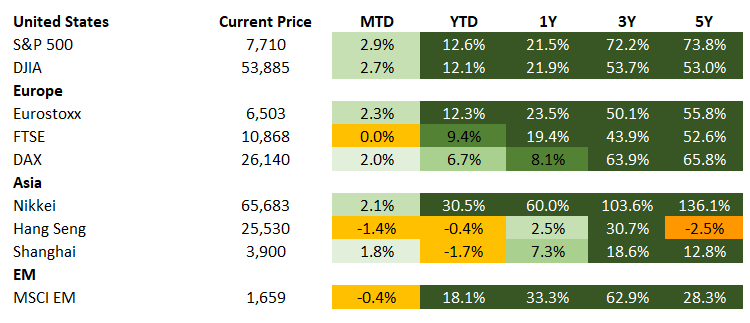
Markets drifted through a typically low-volume summer week, with selective risk-on positioning in emerging markets and commodities against an otherwise genuinely undecided backdrop. Easing geopolitical concerns in the Middle East, including progress in negotiations over shipping through the Strait of Hormuz, contributed to softer oil earlier in the week, which partially reversed course. The S&P 500 gained around 3.5%, the U.S. 10-year yield declined to 4.6%, and the DXY hovered around 99. Yen appreciation stalled following last week’s estimated $34 billion coordinated U.S.-Japan FX intervention. Outside energy, AI-related industrial metals outperformed, with silver and copper rising 10.5% and 2.1%, respectively, while gold advanced 7.7%.
The week’s key macro event was the July U.S. employment report. Markets entered the week assigning over 60% probability to a September Fed rate hike, but an unexpected decline in nonfarm payrolls (-23k versus +80k consensus), following softer JOLTS, ADP employment and ISM services data, reduced implied odds to 40-45% by week-end.
Corporate fundamentals contrast with the softer labor market. More than 80% of S&P 500 companies have exceeded earnings expectations this reporting season, although notable guidance reductions across industrials, building materials and consumer-facing sectors suggest macroeconomic and commodity-related headwinds remain unevenly distributed.
European data presented a mixed picture. Eurozone July PMI edged higher to 52.0, while June retail sales disappointed expectations as heightened Middle East geopolitical uncertainty weighed on consumer spending. Within Emerging Europe, Czech industrial production exceeded expectations and the trade surplus widened. By contrast, Hungarian industrial production disappointed after drought conditions on the Danube disrupted operations at the Paks nuclear facility and curtailed automotive production. Romania’s retail sales fell 7.3% year-on-year, while acting Finance Minister Nazare warned that second-quarter GDP is likely to contract, adding to ongoing fiscal and sovereign rating concerns.
China’s activity data softened modestly, with the official NBS manufacturing PMI slipping back into contractionary territory, while the more export-oriented Rating Dog PMI remained in expansion. Export and import growth moderated but remained robust at 23.9% and 27.5% year-on-year, respectively, supported by AI- and technology-related industries. We continue to expect stronger implementation of existing policy measures rather than a significant shift in policy direction following last week’s Politburo meeting.
Emerging market central banks broadly maintained a cautious, data-dependent stance, albeit with increasing policy divergence. The Reserve Bank of India left rates unchanged at 5.25% for a fourth consecutive meeting. Brazil’s central bank cut the Selic rate by 25bps to 14% but refrained from providing forward guidance, emphasizing policy optionality. Banxico unanimously kept rates unchanged while signaling little inclination to either ease or tighten in the near term. Colombia unexpectedly paused its tightening cycle at 12% and announced a $4 billion reserve accumulation program aimed at moderating peso appreciation, prompting an initial decline of more than 2% in the currency before a partial recovery. The Czech National Bank held its policy rate at 3.75% while retaining a modest tightening bias, concluding a week in which most emerging market central banks opted to await greater clarity on the global inflation and growth outlook before adjusting policy.
EM Credit Update
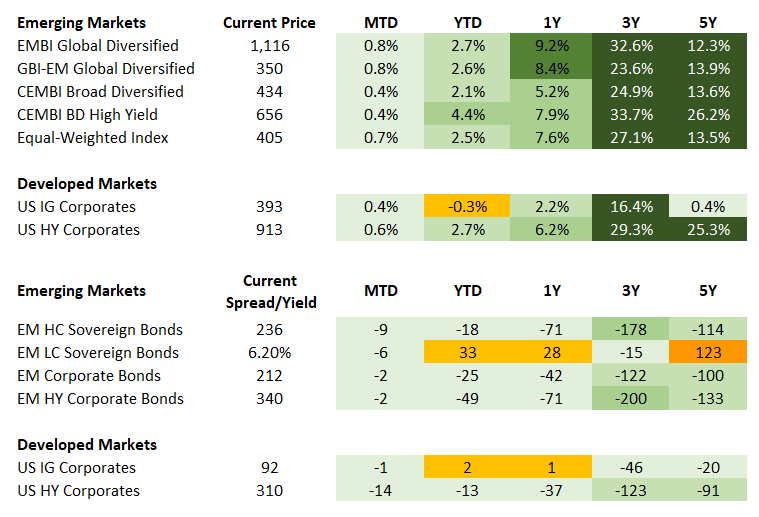
Emerging Markets (EM) fixed income advanced across all three sub-asset classes this week, with hard currency sovereigns leading at +0.84%, local currency sovereigns close behind at +0.79%, and corporates lagging at +0.38%. Rates stabilized following last week’s move wider, allowing the long end to recover and skewing returns toward duration. The 10+ year EMBIGD bucket returned +1.31% against +0.47% for 1-3 years, with the corresponding CEMBI buckets at +0.64% and +0.19%. With rates rangebound, that gap points to spread compression concentrated at the long end. Credit differentiation was otherwise thin, particularly in corporates, where high yield (+0.39%) and investment grade (+0.37%) were effectively indistinguishable. Where high yield did outperform in sovereigns, the gap was concentrated in distressed and unrated names rather than reflecting a broad repricing of risk premia.
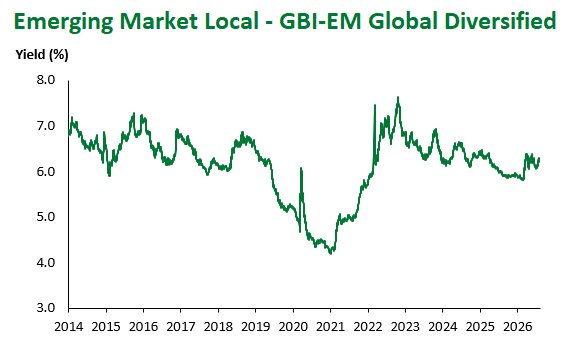
Local currency sovereign debt returned +0.79%, with the currency contribution doing most of the work in EMEA and Asia while detracting in Latin America. Egypt (+4.10%) was the standout, supported by continued improvement in the country’s external position, including a further rise in net foreign assets and record-high foreign exchange reserves, which reinforced confidence in Egypt’s macroeconomic stability and financing outlook and drove a +1.71% currency contribution. South Africa (+2.80%) followed, with FX (+1.23%) and price (+1.39%) contributing roughly equally, ahead of Thailand (+1.88%), Chile (+1.51%), and Türkiye (+1.48%). Türkiye’s return was entirely a local rates and carry story, with a price contribution of +2.01% and carry of +0.58% against an FX drag of -0.36%. The pattern reversed in Latin America: Brazil (-0.04%) and Colombia (+0.43%) both saw solid local bond price gains (+0.38% and +0.80%, respectively) more than offset or heavily eroded by currency weakness (-0.50% and -0.52%). Peru (-0.45%) was the weakest market, driven by a -0.79% price contribution, followed by the Dominican Republic (-0.24%) and Romania (-0.07%).
Hard currency sovereign bonds gained +0.84% at the index level, with high yield (+0.96%) outperforming investment grade (+0.72%). Regionally, Africa (+1.09%) and the Middle East (+1.01%) led, followed by Latin America (+0.86%), while Asia (+0.70%) and Europe (+0.64%) lagged. Country-level performance was dominated by frontier and distressed credits: Kenya (+2.42%), Venezuela (+2.34%), Egypt (+1.78%) on the external account improvement noted above, Sri Lanka (+1.68%), Bahrain (+1.56%), Côte d’Ivoire (+1.42%), and Lebanon (+1.34%). The rating breakdown reinforces the point, with the unrated bucket returning +2.19% against +0.99% for B and +0.69% for A. Gabon (-0.48%) was the only negative performer at the country level, with Papua New Guinea (-0.09%), Ukraine (+0.10%), Argentina (+0.12%), and Iraq (+0.16%) rounding out the laggards.
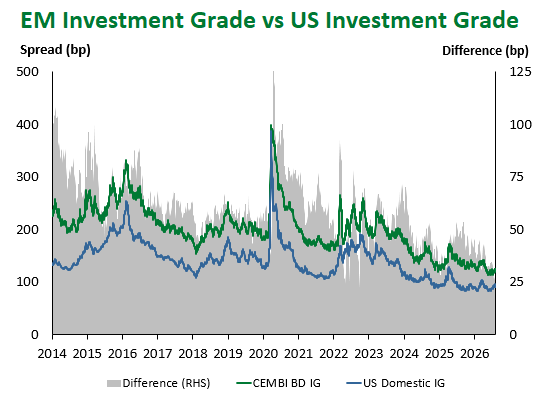
EM corporates delivered +0.38%, with essentially no separation between investment grade (+0.37%) and high yield (+0.39%). Regional dispersion was similarly narrow, with Africa and Latin America both at +0.45% and Asia (+0.32%) the only meaningful laggard. Notably, the corporate rating profile diverged from sovereigns: returns rose steadily from AAA (+0.19%) through B (+0.43%), but the C bucket was the only segment in negative territory (-0.03%), in contrast to the distressed-led rally at the sovereign level. Morocco (+1.17%) led at the country level, followed by Colombia (+0.91%), Paraguay (+0.90%), Mexico (+0.68%), and Saudi Arabia (+0.68%). Ghana (-0.44%) was the weakest market, with Iraq (-0.29%) and Jordan (-0.13%) also in negative territory.
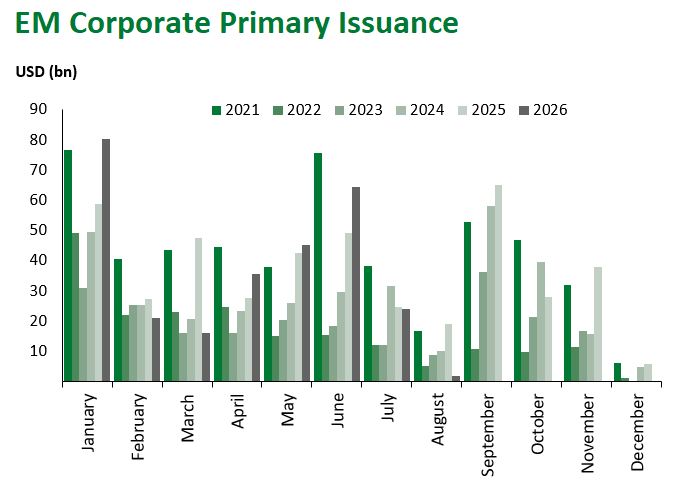
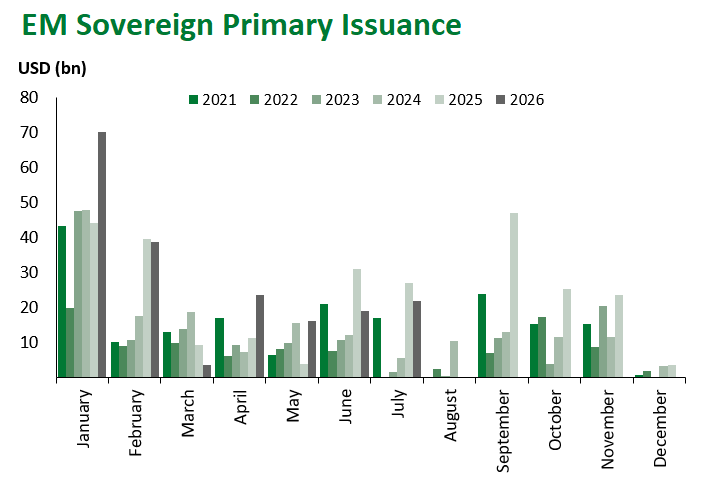
Primary market activity was minimal, with five hard currency issuers pricing approximately $1.7 billion and no sovereign supply. Investment grade issuance came from Korean Air Lines ($300 million three-year at T+57, with books reaching $2.1 billion) and Sichuan Development Holding ($450 million three-year at 4.55%). The high yield calendar comprised Banco Multiva of Mexico ($300 million AT1 perpetual at 11.00%), EDL Generation of Laos ($300 million 5NC3 at 11.125%), and Alloha Fibra of Brazil ($350 million at 12.25%), all for refinancing or general corporate purposes.
The Week Ahead
Developments surrounding the Strait of Hormuz remain the near-term driver of emerging market sentiment. Reports suggest Iran and Oman have made progress on discussions over shipping arrangements, although key issues—including transit fees, final approval in Tehran and reported restrictions on U.S. and Israeli vessels under current proposals—remain unresolved. As a result, Brent crude and broader EM risk assets are likely to remain highly sensitive to geopolitical headlines.
In the U.S., CPI, PPI, retail sales and the University of Michigan consumer sentiment survey will be closely watched for evidence that higher energy prices are broadening inflationary pressures or weighing on consumer demand ahead of upcoming PCE inflation releases.
In Europe, UK second-quarter GDP, together with Eurozone industrial production, GDP, trade and employment data, will provide an updated assessment of regional growth momentum.
In Japan, trade data and weekly portfolio flow statistics will offer further insight into external demand and whether domestic investors continue to repatriate overseas bond holdings, particularly U.S. Treasuries. Markets will also monitor whether use of the Federal Reserve’s FIMA repo facility continues to reduce the need for outright Treasury sales associated with foreign exchange intervention.
In Asia, China’s CPI and PPI are expected to show further moderation, while India’s July CPI release will test whether the Reserve Bank of India’s recent downward revision to its inflation forecast remains consistent with incoming data.
In Latin America, inflation releases in Brazil and Colombia will be important for the near-term policy outlook. In Brazil, markets will assess whether inflation supports a pause in the easing cycle, while in Colombia attention will focus on whether price pressures reinforce last week’s unexpected policy pause. Peru’s central bank is widely expected to keep rates unchanged, with investors focused on any indication of a more hawkish bias following recent upside inflation surprises.
Fixed Income
Equities
Commodities
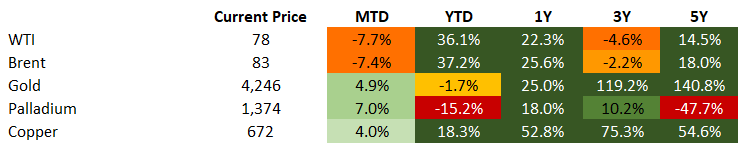
Source for data tables: Bloomberg, JPMorgan, Gramercy. EM Fixed Income is represented by the following JPMorgan Indicies: EMBI Global, GBI-EM Global Diversified, CEMBI Broad Diversified and CEMBI Broad High Yield. DM Fixed Income is represented by the JPMorgan JULI Total Return Index and Domestic High Yield Index. Fixed Income, Equity and Commodity data is as of August 7, 2026 (mid-day).
Highlights
Is the global economy becoming structurally more resilient?
Event: In a discussion led by Gramercy’s Chair, Mohamed El-Erian, and Portfolio Manager, Belinda Hill, Gramercy’s investment team debated both sides of this argument. The outlook hinges on whether recent resilience reflects a structural shift or a cyclical extension. The bullish case rests on five pillars: limited sensitivity to higher rates due to low-cost refinancing during 2020–21, stronger emerging market (EM) fundamentals, increasingly service-oriented developed market economies, AI-driven productivity gains, and resilient labor markets without a wage-price spiral. The bearish view argues that resilience has been supported by fiscal stimulus, delayed refinancing pressures, unproven AI productivity benefits, and favorable but potentially temporary external conditions. The key test will be whether AI translates into measurable productivity gains and whether economic activity remains resilient as refinancing needs rise through 2026–28. The answer will have materially different implications for spreads and duration.
Investment Implications: This uncertainty argues for bottom-up credit selection rather than broad macro positioning. With the macro outlook genuinely two-sided, issuer-specific fundamentals offer greater conviction than directional bets on credit or rates. Both scenarios point to EM as the most compelling structural opportunity, supported by stronger policy frameworks, healthier balance sheets, and improved refinancing profiles, while favoring caution toward fiscally weaker sovereigns and highly leveraged issuers facing near-term refinancing risk. Positioning should remain agile and data-dependent. As evidence of AI-driven productivity and refinancing pressures emerges, portfolios should be re-underwritten accordingly. A balanced approach—combining selective exposure to structural winners with defensive allocations to shorter-duration, asset-backed credits—provides the flexibility to adapt as the macro outlook becomes more clear.
Emerging Markets Technicals
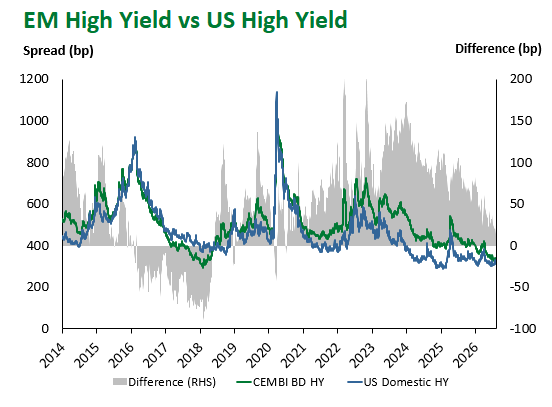
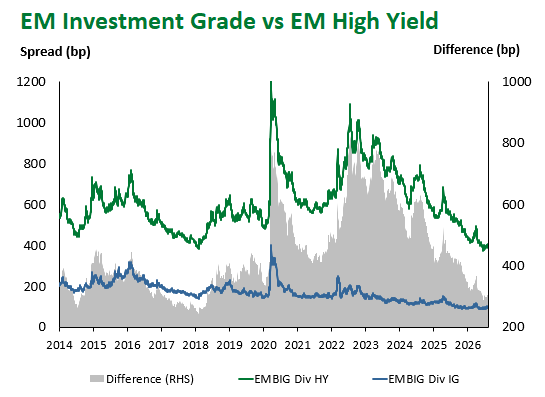
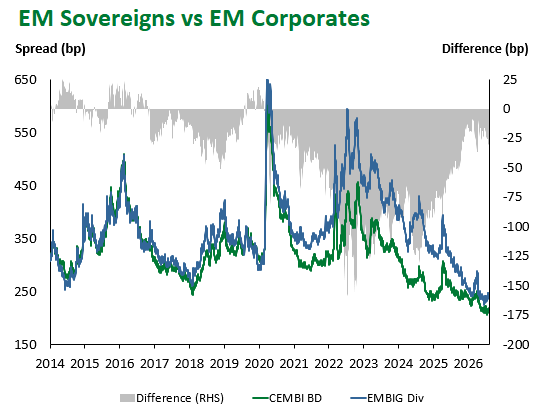
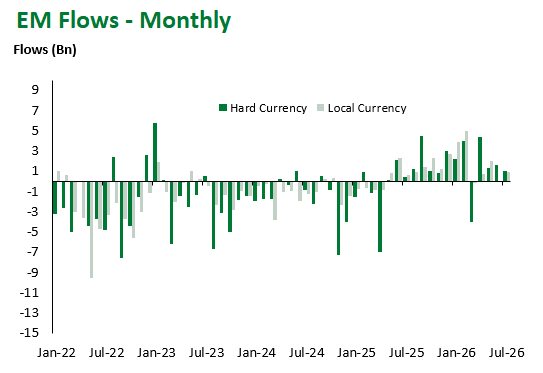
Emerging Markets Flows
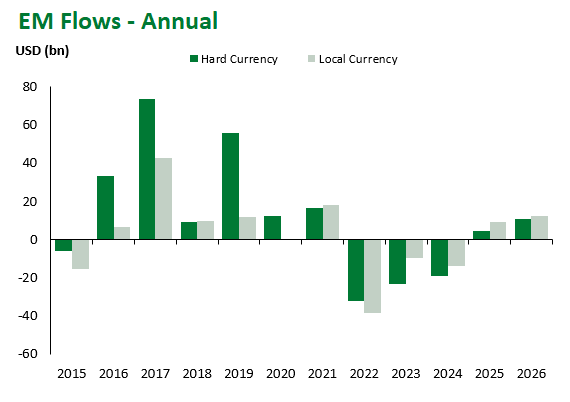
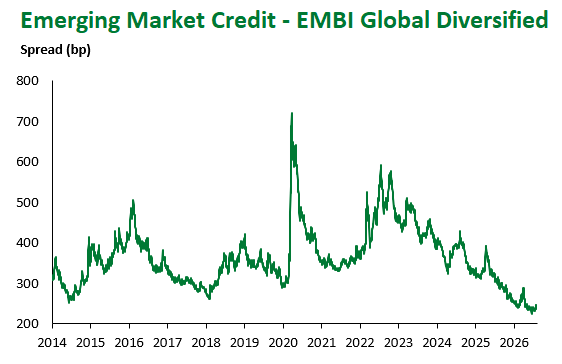
Source for graphs: Bloomberg, JPMorgan, Gramercy. As of August 7, 2026.
For questions, please contact:
Kathryn Exum, CFA ESG, Director, Co-Head of Sovereign Research, [email protected]
Petar Atanasov, Director, Co-Head of Sovereign Research, [email protected]
This document is for informational purposes only. The information presented is not intended to be relied upon as a forecast, research or investment advice, and is not a recommendation, offer or solicitation to buy or sell any securities or to adopt any investment strategy. Gramercy may have current investment positions in the securities or sovereigns mentioned above. The information and opinions contained in this paper are as of the date of initial publication, derived from proprietary and nonproprietary sources deemed by Gramercy to be reliable, are not necessarily all-inclusive and are not guaranteed as to accuracy. This paper may contain “forward-looking” information that is not purely historical in nature. Such information may include, among other things, projections and forecasts. There is no guarantee that any forecasts made will come to pass. Reliance upon information in this paper is at the sole discretion of the reader. You should not rely on this presentation as the basis upon which to make an investment decision. Investment involves risk. There can be no assurance that investment objectives will be achieved. Investors must be prepared to bear the risk of a total loss of their investment. These risks are often heightened for investments in emerging/developing markets or smaller capital markets. International investing involves risks, including risks related to foreign currency, limited liquidity, less government regulation, and the possibility of substantial volatility due to adverse political, economic or other developments. References to any indices are for informational and general comparative purposes only. The performance data of various indices mentioned in this update are updated and released on a periodic basis before finalization. The performance data of various indices presented herein was current as of the date of the presentation. Please refer to data returns of the separate indices if you desire additional or updated information. Indices are unmanaged, and their performance results do not reflect the impact of fees, expenses, or taxes that may be incurred through an investment with Gramercy. Returns for indices assume dividend reinvestment. An investment cannot be made directly in an index. Accordingly, comparing results shown to those of such indices may be of limited use. The information provided herein is neither tax nor legal advice. Investors should speak to their tax professional for specific information regarding their tax situation.