


Executive Summary
Benign U.S. inflation cut September hike odds below 30%, supportive for duration but capped by supply. July CPI landed in line at 3.4% with softer PPI, retail sales, and sentiment, but a record-weak 30-year auction is the offset. The front end can rally while the long end stays pressured by issuance. Our bias is toward the belly, but with selective duration extension on a bottom-up basis.
The week rewarded quality and differentiation over beta. IG led HY in hard-currency sovereigns, the lowest-rated names were the laggards, and local currency split by driver: firmer Latin American FX against an EMEA rates selloff and a Brazilian real drop. Favor country and quality selection across EM local rates and FX.
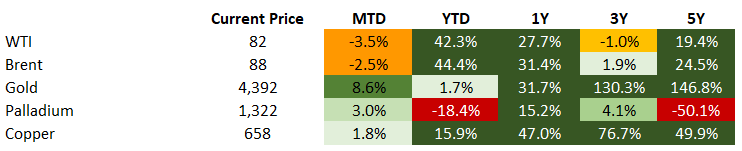
Energy stays the dominant tail risk. The unresolved Hormuz standoff keeps a geopolitical premium in oil (Brent mid-to-high $80s) and inflation risk live, supporting exporters, pressuring importers, and arguing for positioning resilient to renewed oil and inflation volatility.
Market Overview
Macro Update
A benign U.S. inflation print strengthened expectations for a less restrictive Fed path. July CPI rose 3.4% YoY, in line with expectations, while cooler-than-expected PPI, soft retail sales, and weaker-than-expected University of Michigan sentiment pushed the implied probability of a September rate hike below 30% from 50% at the start of the week. The combination of contained inflation and a less hawkish Fed backdrop is supportive for duration and risk assets, but this is currently being offset by elevated issuance expectations, underscored by this week’s $25 billion 30-year Treasury auction, which cleared at its highest yield since 2001.
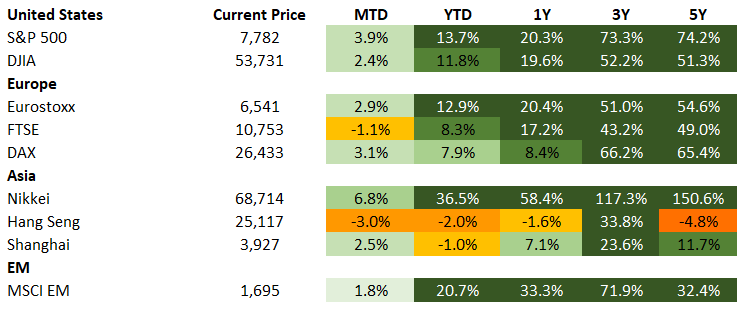
The U.S.-Iran standoff over the Strait of Hormuz remained unresolved. Talks are deadlocked, Iran’s military has shifted to an “offensive doctrine,” and its new Security Chief has conditioned any reopening on a region-wide ceasefire. Pakistani sources report that both sides have agreed to extend the 60-day ceasefire beyond its August 17 expiry, but markets remain skeptical of a near-term breakthrough. Brent traded in the mid-to-high $80s, while the U.S. 10-year yield held around 4.6% and the 2s10s curve steepened 8 bps. U.S. equities posted modest gains, and the dollar was range-bound, while gold and silver extended last week’s gains. For investors, the unresolved standoff keeps an elevated geopolitical premium embedded in energy prices and argues for maintaining hedges against renewed oil and inflation volatility.
European data remained mixed. UK 2Q GDP grew 1.2% YoY, slightly above expectations, driven by a strong investment contribution, while June industrial production was weak. Eurozone June industrial production also beat expectations but remained subdued at 0.1% YoY, while 2Q GDP came in at 1% year-on-year. The data point to gradual growth rather than a broad European reacceleration.
EM inflation outcomes were mixed, with central banks largely preserving optionality. Brazil’s July IPCA rose 4.44% YoY, modestly above consensus, marginally strengthening the case for a hold at the next meeting, although BCB minutes retained the option of another cut. Colombia’s July inflation surprised lower at 6.03%, reinforcing the case for patience following last month’s unexpected hold. India’s CPI rose to 4.45% but remained comfortably within the RBI’s 2-6% target band.
China remains at the opposite end of the inflation spectrum. July CPI slowed to 0.5% YoY, below expectations and a six-month low, while PPI declined at a slower pace for the first time since the Iran conflict began. The persistent disinflation backdrop supports policy easing but remains a constraint on nominal growth and Chinese asset reflation.
Elsewhere, Peru’s central bank held rates at 4.25% despite firmer inflation. Türkiye raised its end-2026 CPI forecast to 28% while maintaining its 24% target. Governor Karahan remained hawkish but signaled scope to resume one-week repo funding and normalize the reference rate toward 37%, implying roughly 300 bps of effective easing. For EM investors, the divergence argues for greater differentiation across local rates and FX rather than a broad directional allocation.
In Venezuela, the Delcy Rodríguez government and the 2015 National Assembly agreed to pursue judicial reform, including changes to the Supreme Court. The scope and timing will be important signals of the government’s willingness to facilitate a broader political transition. Progress on institutional reform would improve the medium-term outlook for political and economic normalization and would be constructive for investor sentiment.
The Week Ahead
The U.S. data calendar is light, so the question is whether the week firms or fades the market’s roughly 30% odds of a September hike. Empire manufacturing, housing starts, flash PMIs, and weekly ADP and claims are incremental inputs to that call, but the July FOMC minutes matter more. How much weight the committee puts on oil-driven inflation versus the soft July payrolls will steer the front end and the 2s10s slope. Walmart earnings are worth watching for whether energy and tariff costs are reaching the consumer, a signal for U.S. corporate credit and the growth trajectory. In Europe, eurozone and UK CPI and PMIs feed directly into whether the ECB and BoE easing cycles stay interrupted, with implications for bund and gilt direction and for the euro and sterling.
Japan’s 2Q GDP feeds the BoJ hike debate, and with the yen still the pressure point after last month’s intervention, a firm print pulls forward September-October tightening risk for JGBs and the currency. In China, the loan prime rate should be a non-event with policy on hold. Alibaba earnings are the more useful read on private demand and the tech complex, consistent with our view that Beijing implements existing measures rather than pivots.
Indonesia’s August 18-19 BI meeting is the week’s key EM catalyst. A hold from acting Governor Damayanti would signal continuity and support the rupiah and Indonesian local duration, while a dovish surprise or renewed independence concern could pressure the currency and the local curve. The rest of the calendar refines the EM easing-cycle differentiation theme: Banxico minutes on Mexico’s neutral stance, Brazil activity data on the COPOM easing path, 2Q GDP from Colombia and Chile, Uruguay’s rate decision, plus Thailand GDP, Malaysia CPI and trade, South Africa CPI, and Mexico retail sales.
For investors, most releases should refine rather than shift policy expectations, keeping the emphasis on differentiation across EM local rates and FX.
Highlights
Colombia earthquake adds complexity to De la Espriella’s policy debut
Event: President Abelardo de la Espriella was inaugurated on August 7 with a focus on fiscal discipline, anti-corruption, and a decisive break from the Petro administration, including an explicit rejection of a constituent assembly. Three days later, a 7.4-magnitude earthquake, the strongest in Colombia this century, struck with its epicenter in Chocó, causing significant damage to hospitals, schools, roads, and airports, as well as more than 5,000 homes. The U.S. has pledged $15.5 million for earthquake response and $1 billion in security support, alongside plans for joint military operations against narcoterrorism. Colombian assets have remained broadly resilient, with markets awaiting greater clarity on a refreshed 2027 budget, the reconstruction financing mix, and BanRep’s assessment of the shock.
Investment Implications: Colombian assets have delivered strong YTD returns, reflecting improved expectations for fiscal adjustment and policy execution. The earthquake introduces an additional near-term fiscal and policy challenge, but the market impact should depend largely on how the government finances reconstruction and manages its broader consolidation agenda. Multilateral and U.S. support could help limit the fiscal burden, while reconstruction spending should provide some support to growth into 2027. For BanRep, the shock adds complexity by weighing on activity while potentially increasing inflation pressure, particularly alongside El Niño risks. The peso could face some volatility if fiscal spending rises or inflation reaccelerates, although the softer July CPI print provides near-term policy flexibility. Overall, the earthquake modestly complicates the outlook rather than fundamentally altering the investment case. Fiscal execution and the policy response remain the key variables to watch.
Damayanti nomination supports Bank Indonesia continuity, but policy risks remain
Event: President Prabowo nominated Senior Deputy Governor Destry Damayanti as the sole candidate to succeed Perry Warjiyo as Bank Indonesia Governor, alongside nominations for the vacant Senior Deputy Governor and Deputy Governor positions. Damayanti has served as acting Governor since Warjiyo’s July 27 resignation and as Senior Deputy Governor since 2019. The rupiah initially strengthened but reversed course mid-week. Parliament is expected to move quickly on the appointments following its return on August 14.
Investment Implications: The nominations should provide greater near-term stability for Indonesian assets, although policy and governance uncertainty remains a source of volatility. The selection of Damayanti and BI insiders for the deputy positions reduces the immediate risk of greater monetary policy politicization and provides markets with a credible technocratic counterpart. The August 18-19 policy meeting will be an important test, particularly for currency support measures and the degree of easing signaled against a softer July CPI print. Investors will also focus on the evolving relationship between BI and the Ministry of Finance, particularly any pressure on the central bank to support government policy objectives. Prabowo’s budget address on Friday signaled a 2027 fiscal deficit target of 2.4% of GDP, which should ease near-term credit concerns, but execution will remain key to sustaining investor confidence.
Market Data
EM Credit Update
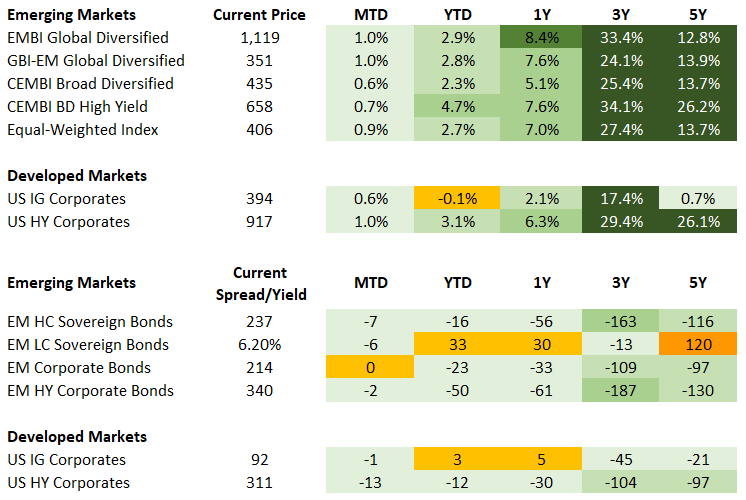
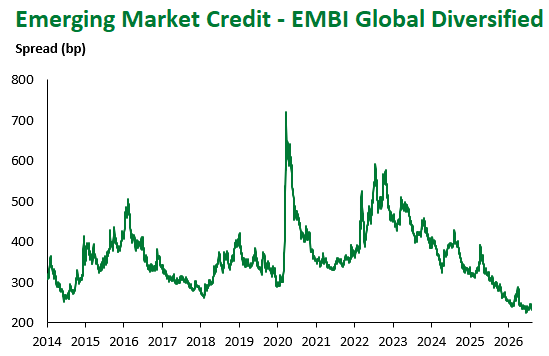
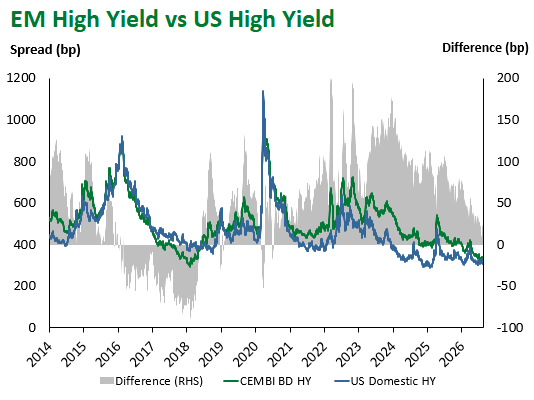
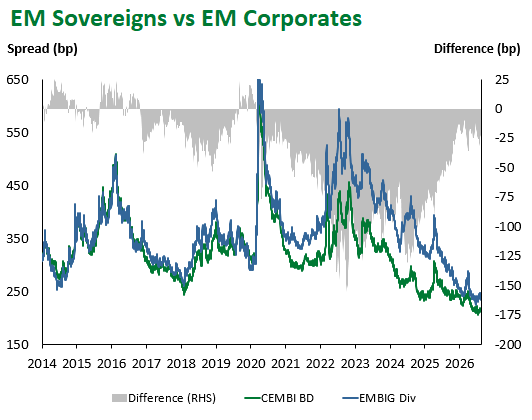
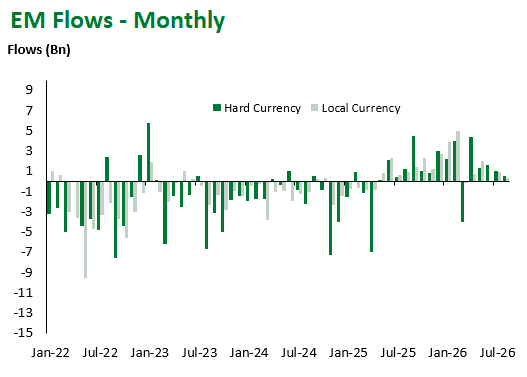
Emerging markets fixed income delivered a more muted but dispersed week than the prior one, as last week’s beta rally gave way to differentiation across countries and down the quality spectrum. Corporates led the three sub-asset classes at +0.15%, with hard currency sovereigns close behind at +0.10%, while local currency sovereigns were essentially flat at -0.07%, a headline that masked wide dispersion between firmer Latin American currencies and a selloff in EMEA local rates. The character of the market inverted relative to last week: in sovereigns the long end lagged rather than led (the 10+ year EMBIGD bucket returned +0.07% against +0.19% for 3-5 years and +0.09% for 1-3 years), and investment grade (+0.15%) outperformed high yield (+0.06%). Credit dispersion widened at the sovereign level, where the lowest-rated cohorts were the only segments in the red (CCC -0.18%, unrated -0.28%), dragged by idiosyncratic distress rather than a broad risk-off move, even as several other frontier names posted the week’s largest gains.
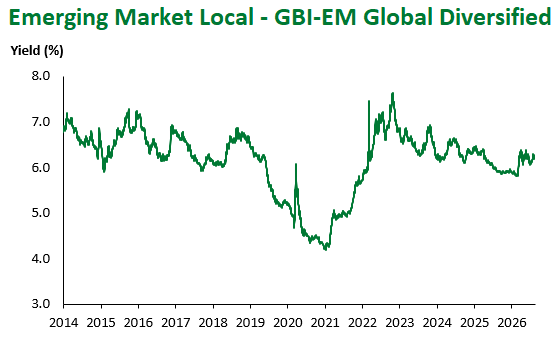
Local currency sovereign debt returned -0.07% at the index level (GBI-EM Global Diversified), a flat headline that masked wide dispersion, with the drivers differing by region. In Latin America, firmer currencies lifted Mexico (+0.63%, FX +0.52%), Colombia (+1.03%, broad-based across FX +0.49%, price +0.36% and carry +0.19%) and Peru (+0.85%), but Brazil (-2.28%) was the weakest market in the index by a wide margin on a sharp currency selloff (FX -1.87%). EMEA moved the other way, and through rates rather than FX: local bonds sold off in South Africa (-0.60%, price -0.80% against a flat rand), Poland (-0.88%, price -0.66%) and the Czech Republic (-0.40%, price -0.52%), while Hungary was roughly flat (-0.10%). Asia was modestly positive, led by Indonesia (+0.77%) on a local bond rally (price +0.51%).
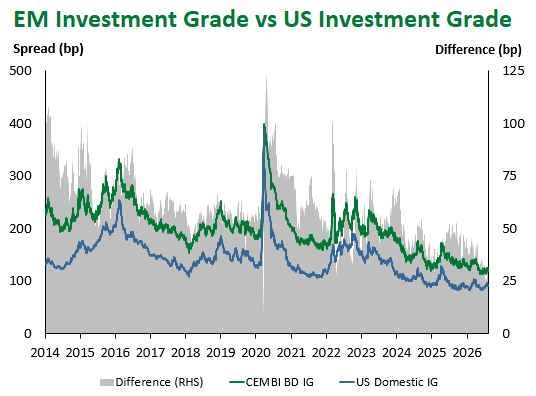
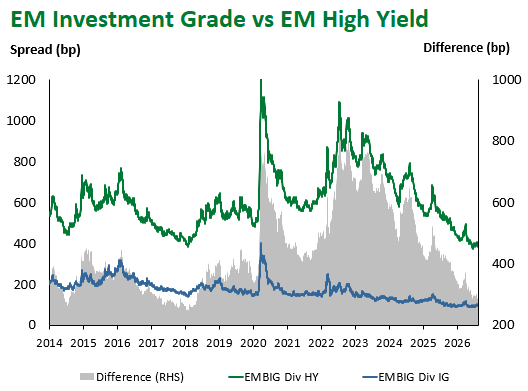
Hard currency sovereign bonds gained +0.10%, with investment grade (+0.15%) outperforming high yield (+0.06%), a reversal of the recent pattern. Regionally, Africa (+0.32%) and Asia (+0.20%) led, followed by Europe (+0.11%) and the Middle East (+0.10%), while Latin America (-0.04%) was the only region in the red. Country-level performance was highly idiosyncratic, and the tail cut both ways. The strongest markets were distressed and frontier credits: Lebanon (+1.09%), Angola (+0.93%), Pakistan (+0.65%), Côte d’Ivoire (+0.60%) and Ghana (+0.56%). Yet Senegal (-3.07%) was a large negative outlier, with Argentina (-0.69%), Venezuela (-0.68%), El Salvador (-0.43%) and Ukraine (-0.41%) also lagging. That split is visible in the rating breakdown, where BBB (+0.16%), A (+0.12%) and B (+0.11%) all advanced while CCC (-0.18%) and unrated (-0.28%) were the only negative buckets, the opposite of the distressed-led leadership of the prior week. Down the curve, the belly outperformed (3-5 years +0.19%) while the long end lagged (10+ years +0.07%), confirming that duration was not the tailwind it had been.
EM corporates delivered +0.15%, the strongest of the three sub-asset classes, with high yield (+0.18%) edging investment grade (+0.13%). Unlike sovereigns, corporate performance was broadly positive and regionally narrow: Europe (+0.19%), CEEMEA (+0.18%) and the Middle East (+0.18%) led, with Africa (+0.16%), Asia (+0.15%) and Latin America (+0.10%) close behind. The rating profile also diverged from sovereigns. The CCC bucket was the clear leader (+0.59%) rather than a laggard, and every rating segment posted gains, from AAA (+0.08%) through BB (+0.19%). Costa Rica (+0.68%), Ghana (+0.39%) and the UAE (+0.37%) led at the country level, while Ukraine (-0.32%), Jordan (-0.27%) and Bahrain (-0.11%) were the weakest.
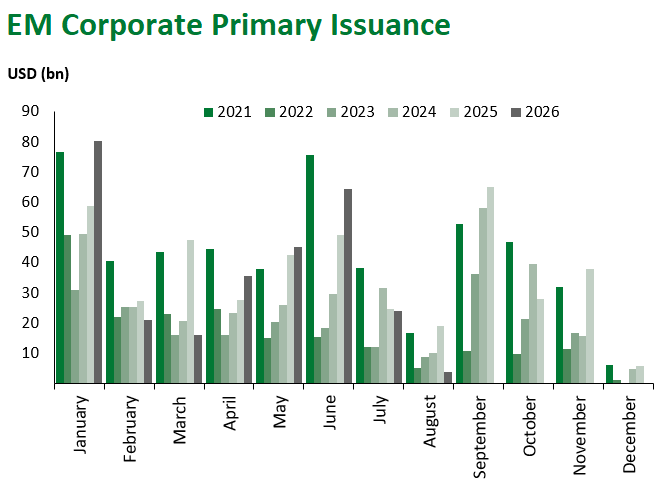
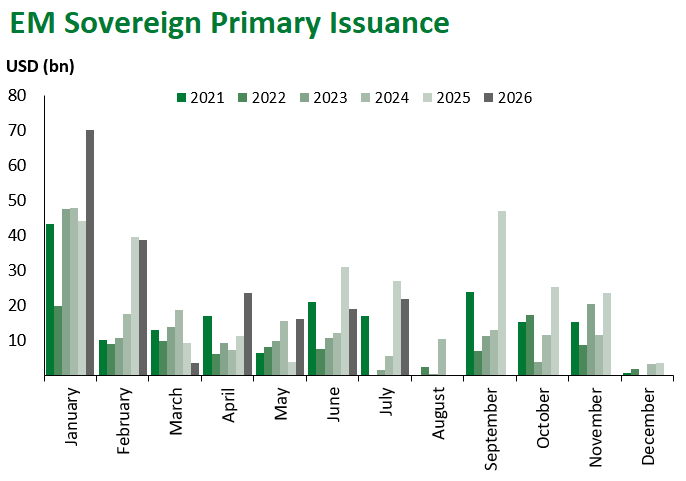
Primary market activity was even thinner than the prior week, with just two hard currency issuers pricing approximately $1.2 billion, all investment grade and, for a second consecutive week, no sovereign supply. Both borrowers were Indian banks: State Bank of India ($500 million five-year at T+88, 5.27%) and Bank of Baroda (a dual-tranche $700 million, split between a $400 million three-year at T+90, 5.11%, and a $300 million five-year at T+100, 5.32%). There was no high yield supply. The quiet dollar calendar stood in contrast to an active local-currency market, including sizeable renminbi issuance from State Grid Corporation of China, which does not enter the hard currency indices.
Fixed Income
Equities
Commodities
Source for data tables: Bloomberg, JPMorgan, Gramercy. EM Fixed Income is represented by the following JPMorgan Indicies: EMBI Global, GBI-EM Global Diversified, CEMBI Broad Diversified and CEMBI Broad High Yield. DM Fixed Income is represented by the JPMorgan JULI Total Return Index and Domestic High Yield Index. Fixed Income, Equity and Commodity data is as of August 14, 2026 (mid-day).
Emerging Markets Flows
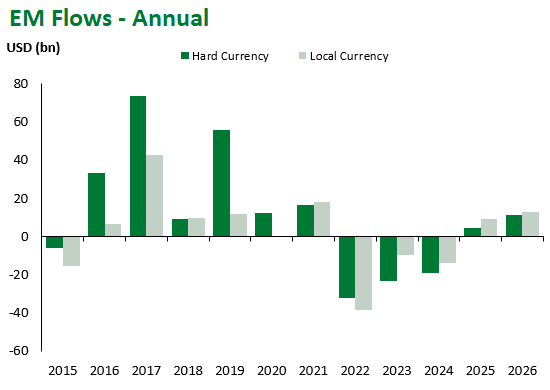
Source for graphs: Bloomberg, JPMorgan, Gramercy. As of August 14, 2026.
For questions, please contact:
Kathryn Exum, CFA ESG, Director, Co-Head of Sovereign Research, [email protected]
Petar Atanasov, Director, Co-Head of Sovereign Research, [email protected]
This document is for informational purposes only. The information presented is not intended to be relied upon as a forecast, research or investment advice, and is not a recommendation, offer or solicitation to buy or sell any securities or to adopt any investment strategy. Gramercy may have current investment positions in the securities or sovereigns mentioned above. The information and opinions contained in this paper are as of the date of initial publication, derived from proprietary and nonproprietary sources deemed by Gramercy to be reliable, are not necessarily all-inclusive and are not guaranteed as to accuracy. This paper may contain “forward-looking” information that is not purely historical in nature. Such information may include, among other things, projections and forecasts. There is no guarantee that any forecasts made will come to pass. Reliance upon information in this paper is at the sole discretion of the reader. You should not rely on this presentation as the basis upon which to make an investment decision. Investment involves risk. There can be no assurance that investment objectives will be achieved. Investors must be prepared to bear the risk of a total loss of their investment. These risks are often heightened for investments in emerging/developing markets or smaller capital markets. International investing involves risks, including risks related to foreign currency, limited liquidity, less government regulation, and the possibility of substantial volatility due to adverse political, economic or other developments. References to any indices are for informational and general comparative purposes only. The performance data of various indices mentioned in this update are updated and released on a periodic basis before finalization. The performance data of various indices presented herein was current as of the date of the presentation. Please refer to data returns of the separate indices if you desire additional or updated information. Indices are unmanaged, and their performance results do not reflect the impact of fees, expenses, or taxes that may be incurred through an investment with Gramercy. Returns for indices assume dividend reinvestment. An investment cannot be made directly in an index. Accordingly, comparing results shown to those of such indices may be of limited use. The information provided herein is neither tax nor legal advice. Investors should speak to their tax professional for specific information regarding their tax situation.