

Contents
Market Overview
Macro Update
A deal at last, or at least, a memorandum of understanding (MoU)! After weeks in which the fragile U.S.-Iran ceasefire lurched between collapse and breakthrough, the standoff appeared to cross a decisive threshold this week. Washington and Tehran signed an interim MoU that extends the ceasefire for 60 days, reopens the Strait of Hormuz and unwinds the dueling naval blockades, with President Trump declaring the waterway toll-free and inviting global shipping to resume transit. A ceremonial signing is expected to take place in Geneva on Friday.
The breakthrough is a framework, not a settlement. Both sides emphasized that the document becomes a binding deal only at the close of the 60-day negotiating window. The most contentious issues, especially the future of Iran’s nuclear program, remain unresolved and Trump cautioned that military action is still possible should Tehran fail to comply. Implementation risk is considerable. Demining of the strait could take up to 30 days, a durable maritime-security regime has yet to be defined, and the parallel Israel-Hezbollah conflict in Lebanon remains a live flashpoint.
Markets seized on the de-escalation. Brent crude, the global benchmark, slid below $80 per barrel – its lowest since early March and down almost 40% from April’s peak – as the first vessels resumed transit through Hormuz and traders looked to the return of halted Gulf output from Saudi Arabia, the UAE and Iraq. The relief was compounded by the IEA, which in its first 2027 outlook warned of a looming surplus, projecting global supply to outpace demand growth by a wide margin.
The dominant macro event, however, was the heavy central bank calendar headlined by the Federal Reserve’s June 17 meeting, the first chaired by Kevin Warsh. The FOMC left its target range unchanged at 3.50-3.75% in a unanimous vote, but struck a hawkish posture. It stripped the residual easing bias from a markedly shortened statement, and the updated dot plot moved up, with nine of eighteen participants now penciling in at least one hike before year-end and the median year-end rate rising to roughly 3.8%, a reversal of the cut implied in March. Officials lifted their 2026 inflation projection to 3.6% headline (3.3% core) while trimming growth to 2.2%.
Warsh used his debut press conference to recast the Fed’s communication, declining to submit his own dot, dispensing with forward guidance, and launching task forces to review the central bank’s operations while underscoring an unambiguous commitment to restoring price stability. Markets read the package as decisively hawkish. The dollar surged about 1% to a more-than-one-year high near 100 on the DXY and the short end of the U.S. treasury curve sold off. The 2Y yield was some 9bps wider relative to last week to around 4.15%, its highest in over a year, and the 10Y held near 4.45%.
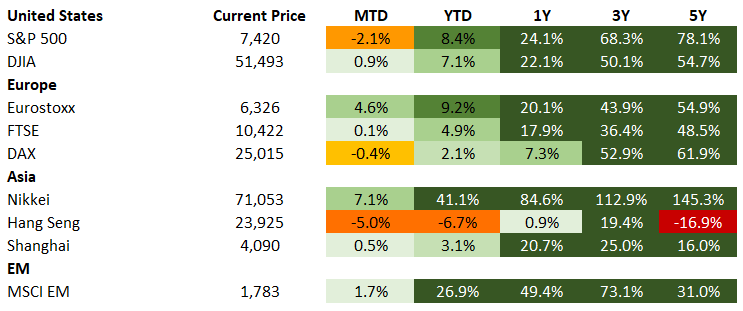
After initially falling on the Fed’s hawkish tone, equities staged a come-back as oil dropped after the U.S.-Iran interim agreement spurred optimism that a reopening of Hormuz will ease inflation risks. Gold tumbled over 2% and silver slid further as higher real-rate expectations and a firmer dollar overwhelmed the metals’ traditional haven bid.
The hawkish tilt was a global theme. The Bank of Japan raised its policy rate 25bps to 1.00%, it’s highest since 1995, in a 7-1 vote, explicitly framing the move as a guard against the energy shock seeping into underlying inflation and signaling further hikes ahead. The Bank of England, by contrast, held at 3.75% for a fourth consecutive meeting, though a 7-2 vote, with two members pressing for a hike, underscored the same dilemma as UK inflation at 2.8% is expected to climb again later this year once earlier energy increases feed through. Coming a week after the ECB’s first hike in a year, the sequence cements a higher-for-longer posture across the major developed market central banks.
For emerging markets, the week pulled in two directions. The unwind of the energy premium is an unambiguous tailwind for Asia’s large oil importers and should ease imported-inflation pressure across the complex, but the offsetting hawkish repricing in developed markets, and a dollar pushing to one-year highs, tightens external financial conditions and revives FX pressure on the most rate-sensitive and externally exposed credits.
EM Credit Update
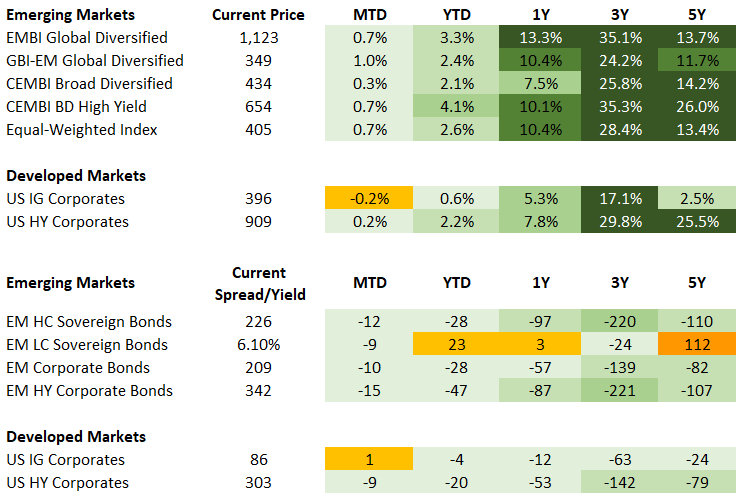
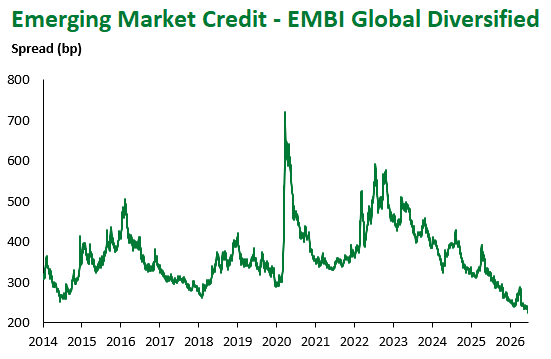
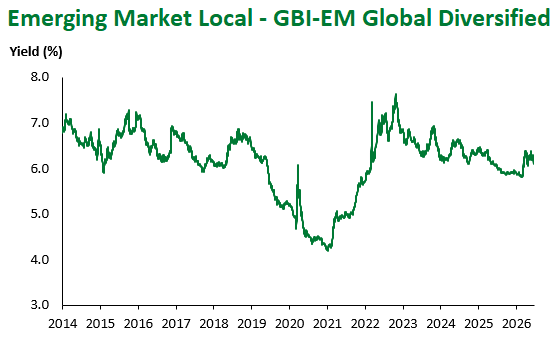
Emerging Markets fixed income gained across all three sub-asset classes in a holiday-shortened week, with returns measured through Wednesday ahead of Friday’s U.S. market closure. Local currency debt led decisively, supported by a softer dollar through midweek, while hard currency credit posted steadier, more modest gains. Notably, the dollar’s weakness reversed Thursday as optimism around an Iran deal took hold, a move that falls outside this week’s return window.
Local currency sovereign debt was the standout, advancing +0.79%; Egypt (+7.32%), Colombia (+5.91%), and South Africa (+4.84%) led, with Chile (+4.36%) and Türkiye (+3.92%) also outperforming. The composition differed by market. Most of the gains came through the FX channel, though Türkiye was the exception, where the move was almost entirely rates-driven (price +3.72%, with a marginally negative currency contribution). South Africa similarly saw price (+2.54%) outpace its currency contribution. At the other end, the Dominican Republic (+0.03%), Malaysia (+0.22%), and Serbia (+0.37%) lagged, the former two held back by softer local currencies.
Hard currency sovereign bonds rose +0.32% at the index level, with high yield (+0.40%) outperforming investment grade (+0.24%). Regionally, Europe (+0.65%) led, while Asia (+0.12%) lagged, consistent with the region’s continued sensitivity to the energy cost shock. At the country level, Ukraine (+2.67%) and Bolivia (+2.20%) posted the largest gains, followed by Sri Lanka (+1.27%), Egypt (+1.27%), and Pakistan (+1.20%). Lebanon (-2.50%) was the weakest performer, with the oil exporters Angola (-1.32%) and Gabon (-0.91%) also in the red. By rating, CCC (+0.59%) outperformed, while non-rated paper (-0.13%) lagged.
EM corporates posted more muted gains, with the index up +0.17%. High yield (+0.23%) outperformed investment grade (+0.12%). Regionally, the Middle East (+0.32%), Europe (+0.28%), and CEEMEA (+0.28%) led, while Asia (+0.04%) lagged, mirroring the pattern in sovereigns. Ghana (-1.36%) was the most notable country-level drag.
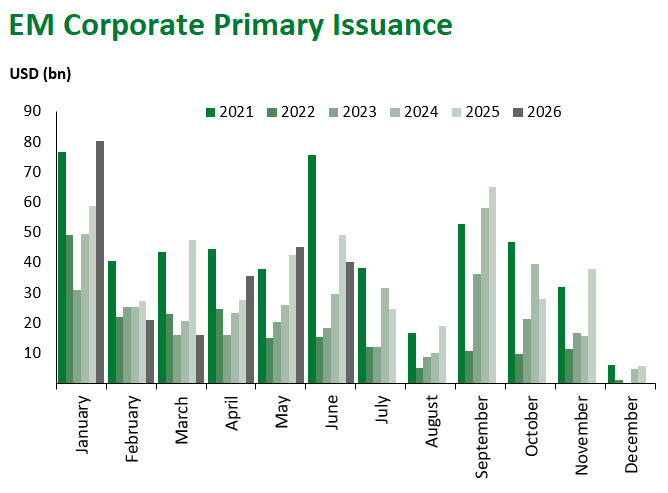
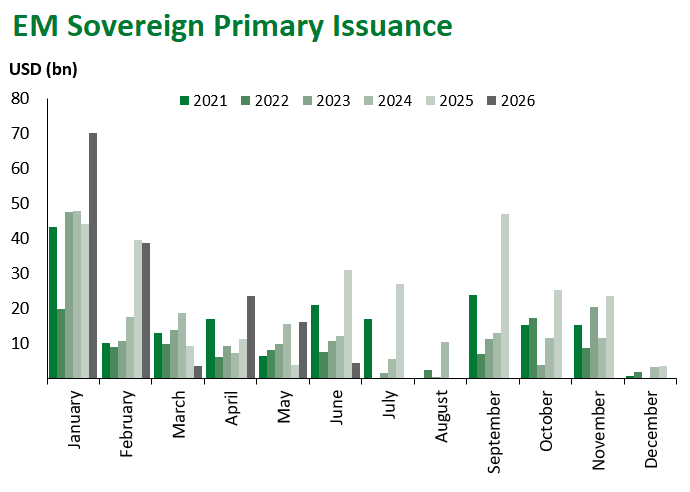
Primary market activity was solid for a short week, with 15 issuers pricing approximately $18.9 billion in hard currency supply across 24 tranches. Issuance skewed heavily investment grade and was concentrated in Asia and CEEMEA, with USD tranches accounting for roughly 78% of volume. QatarEnergy brought the single largest deal at $3.5 billion, while Hyundai Capital was the most active issuer across a multi-tranche USD and EUR financing totaling roughly $4.4 billion. The Philippines was the sole sovereign, pricing approximately $2.5 billion across three tranches including a long-dated 2051 tap. Subordinated and hybrid supply featured prominently: Banorte (Banco Mercantil del Norte) priced $1.35 billion across two AT1 perpetuals, OTP Bank and PKO Bank brought Tier 2 paper, Bank AlJazira issued a $500 million AT1 sukuk, and CPI Property Group placed a EUR perpetual hybrid.
The Week Ahead
The May U.S. personal income and spending report, including the PCE price index, the Fed’s preferred inflation gauge, headlines the calendar, alongside U.S. durable goods, the final 1Q GDP estimate, and initial jobless claims. Flash manufacturing PMIs are due across the major developed and emerging economies, including the Eurozone, Germany, France, the UK, the U.S., Japan, and India, together with CPI prints in Canada, Australia, Hong Kong, Singapore, and Tokyo, and Germany’s IFO business climate survey. EM central bank rate decisions are scheduled in Hungary, Thailand, and Mexico, while a heavy slate of monetary policy speakers spans the Fed, ECB, BOE, and BOJ. On Sunday, Colombia holds its presidential runoff between conservative lawyer Abelardo de la Espriella (ADLE) and leftist Senator Iván Cepeda, the week’s most closely watched political event in EM, following the post-first-round rally in Colombian assets.
Fixed Income
Equities
Commodities
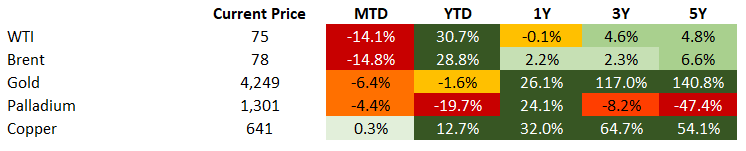
Source for data tables: Bloomberg, JPMorgan, Gramercy. EM Fixed Income is represented by the following JPMorgan Indicies: EMBI Global, GBI-EM Global Diversified, CEMBI Broad Diversified and CEMBI Broad High Yield. DM Fixed Income is represented by the JPMorgan JULI Total Return Index and Domestic High Yield Index. Fixed Income, Equity and Commodity data is as of June 18, 2026 (mid-day).
Highlights
Indonesia hikes policy rate another 25bps after last week’s off-cycle increase
Event: Bank Indonesia (BI) raised its policy rate by 25bps to 5.75% following last week’s off-cycle hike, aiming to support the IDR and stem capital outflows. Authorities have lifted the policy rate by 100bps since April. Alongside the rate hike, the central bank lowered the foreign currency purchase allowance for residents, indicating outflow pressures persist. Last week, hedging costs for foreign investors were lowered while officials signaled fewer bond purchases designed to support higher domestic yields and enhance the attractiveness of local assets to investors. The IDR recovered part of its recent losses following last week’s measures, though gains moderated this week against the backdrop of a more hawkish Federal Reserve meeting absent explicit forward guidance.
Gramercy Commentary: The authorities’ willingness to act decisively in defense of macroeconomic and FX stability is a constructive signal, particularly as markets assess the implications of the government’s broader policy priorities and BI’s evolving dual mandate. While uncertainty is likely to remain elevated in the near-term, recent policy actions should help reinforce confidence in Indonesia’s commitment to maintaining financial stability. Looking ahead, a more sustained recovery in Indonesian assets would require fiscal and monetary policy discipline, clarity on MSCI classification and ratings adjustments, and further easing of policy uncertainty through clarification or softening of its newly unveiled centralized export management framework.
Emerging Markets Technicals
Emerging Markets Flows
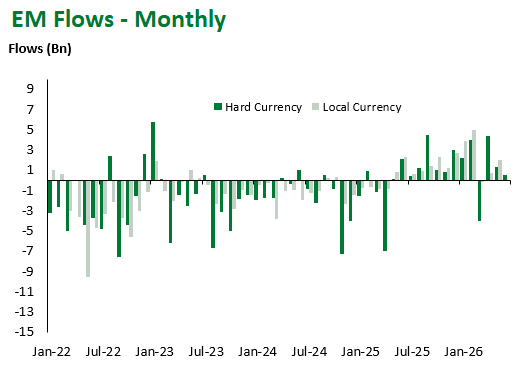
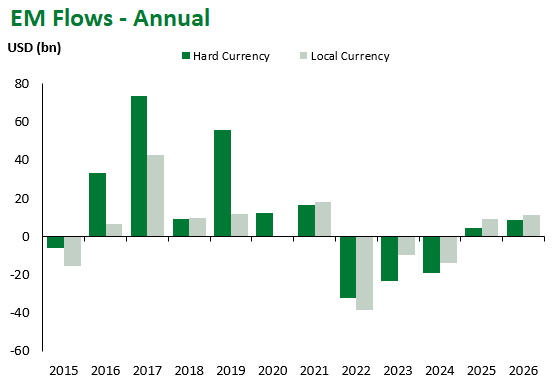
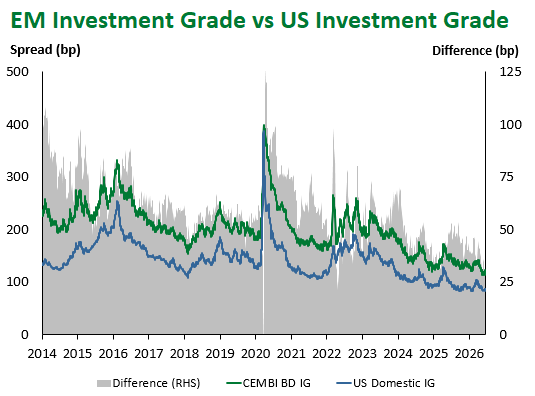
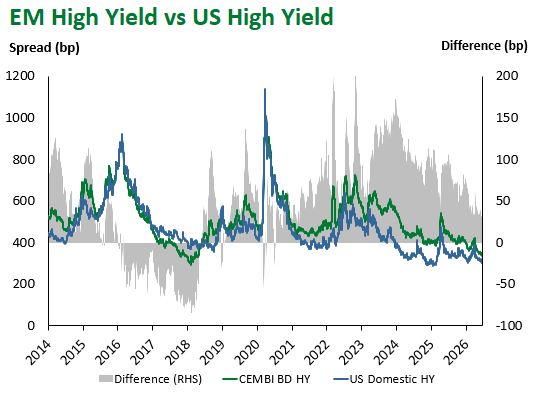
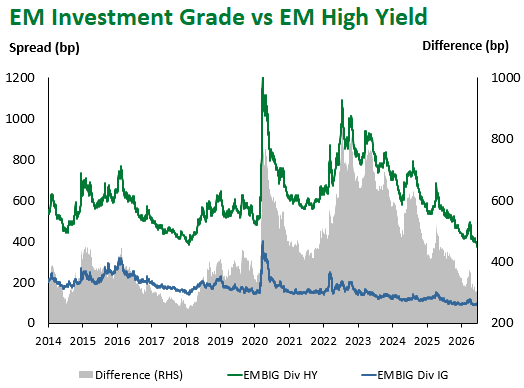
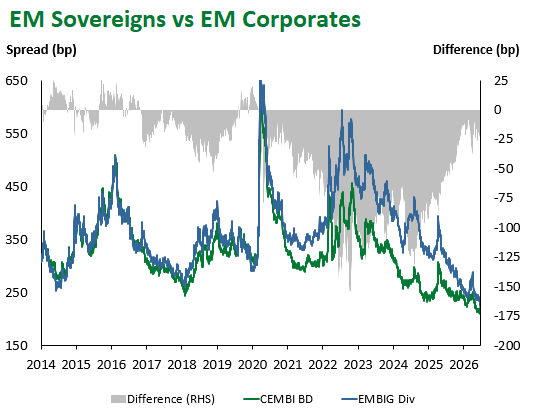
Source for graphs: Bloomberg, JPMorgan, Gramercy. As of June 18, 2026.
For questions, please contact:
Kathryn Exum, CFA ESG, Director, Co-Head of Sovereign Research, [email protected]
Petar Atanasov, Director, Co-Head of Sovereign Research, [email protected]
This document is for informational purposes only. The information presented is not intended to be relied upon as a forecast, research or investment advice, and is not a recommendation, offer or solicitation to buy or sell any securities or to adopt any investment strategy. Gramercy may have current investment positions in the securities or sovereigns mentioned above. The information and opinions contained in this paper are as of the date of initial publication, derived from proprietary and nonproprietary sources deemed by Gramercy to be reliable, are not necessarily all-inclusive and are not guaranteed as to accuracy. This paper may contain “forward-looking” information that is not purely historical in nature. Such information may include, among other things, projections and forecasts. There is no guarantee that any forecasts made will come to pass. Reliance upon information in this paper is at the sole discretion of the reader. You should not rely on this presentation as the basis upon which to make an investment decision. Investment involves risk. There can be no assurance that investment objectives will be achieved. Investors must be prepared to bear the risk of a total loss of their investment. These risks are often heightened for investments in emerging/developing markets or smaller capital markets. International investing involves risks, including risks related to foreign currency, limited liquidity, less government regulation, and the possibility of substantial volatility due to adverse political, economic or other developments. References to any indices are for informational and general comparative purposes only. The performance data of various indices mentioned in this update are updated and released on a periodic basis before finalization. The performance data of various indices presented herein was current as of the date of the presentation. Please refer to data returns of the separate indices if you desire additional or updated information. Indices are unmanaged, and their performance results do not reflect the impact of fees, expenses, or taxes that may be incurred through an investment with Gramercy. Returns for indices assume dividend reinvestment. An investment cannot be made directly in an index. Accordingly, comparing results shown to those of such indices may be of limited use. The information provided herein is neither tax nor legal advice. Investors should speak to their tax professional for specific information regarding their tax situation.