


Contents
Market Overview
Macro Update
This week markets oscillated again between escalation risk in the Gulf and expectations of containment, as President Trump signaled that he would keep pressure on Tehran while investors looked for off-ramps that could reduce the odds of an extended energy shock. Trump vowed to not lift a naval blockade of Iran’s ports until he secures a deal with Tehran to address the country’s nuclear program and rejected an Iranian proposal to reopen the Strait of Hormuz because it would have delayed nuclear talks. It was also reported that the U.S. military has briefed the president on plans for a short, powerful wave of renewed strikes on Iran to raise pressure on the regime, keeping uncertainty on the trajectory of the conflict elevated.
Global energy headlines were compounded by UAE’s decision to leave OPEC effective May 1, after six decades of membership. The departure should be seen in a geopolitical context signaling increased UAE alignment with U.S./Israel interests and a broadening rift with Saudi Arabia. UAE’s departure could weaken the bloc that supplies around a third of the world’s oil and could have implications for future production levels.
Against this fluid backdrop, markets appeared hopeful that a diplomatic solution would ultimately prevail in the Middle East conflict. Sentiment was also boosted by the AI-driven growth and investment theme. Brent crude, the global oil benchmark, climbed to above $126 per barrel mid-week, its highest intraday level in four years, but made a full roundtrip to finish the week where it started (below $110 per barrel) on renewed de-escalation hopes amid reports that Iran has delivered a new peace proposal to the U.S.
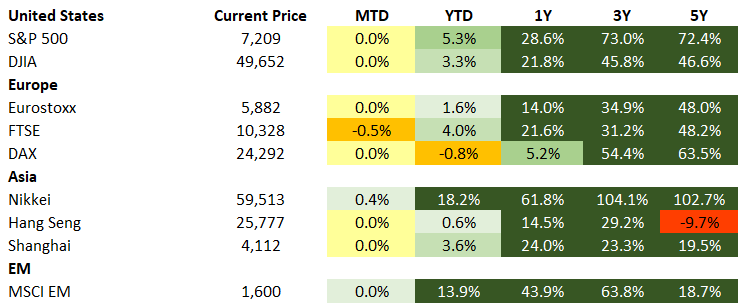
Signs of resilience in the U.S. economy and the AI-related investment bonanza fueled optimism about the outlook for corporate America, driving stocks to record highs, with the S&P 500 rising by 10% in April, its biggest monthly jump since 2020. As far as U.S. equities are concerned, investors appear to be betting that gains from the AI boom will outweigh the effects of the war in Iran.
U.S. treasuries were 10-11bps wider in the belly of the curve compared to last week and the 10Y benchmark was 7bps wider to around 4.37%. The USD fluctuated to end the week slightly weaker at around 98 on the DXY as the Japanese Yen was boosted by the authorities’ intervention. Gold and silver spot prices were little changed, at around $4,600 and $77 per oz, respectively.
The preliminary 1Q26 real GDP reading showed that U.S. economic growth accelerated to 2.0% YoY at the start of the year, from 0.5% in the last quarter of 2025, boosted by a massive AI-driven upswing in business investment and strong consumer spending. However, the GDP number fell short of consensus expectations of 2.3%. Meanwhile, the Federal Reserve’s preferred measure of inflation – the personal consumption expenditures price index – rose 0.7% MoM in March, the most since 2022, but the less volatile core measure remained muted at 0.3% MoM, down from 0.4% in February.
In terms of global interest rate decisions, the “Big 4” systemic central banks – the Fed, ECB, BOE and BOJ – kept rates on hold this week, in line with market consensus, but signaled increased vigilance against inflationary pressures amid current geopolitical and economic uncertainty and the energy price shock.
In the case of the Fed, there was an unusually high number of dissents, highlighting an increasing divergence of views: three regional bank presidents objected to language suggesting the Fed would eventually resume easing policy, while a governor dissented in favor of cutting rates now. Jerome Powell, in his last meeting as chair, warned of higher inflation because of the energy shock but said it was too soon to know the full extent of price pressures.
The Japanese Yen strengthened sharply against the USD as the government and the Bank of Japan conducted yen-buying operations after the currency weakened past 160 Yen vs the USD, its cheapest levels in four decades. Officials in Tokyo delivered a “final” warning to investors against selling the currency.
EM Credit Update
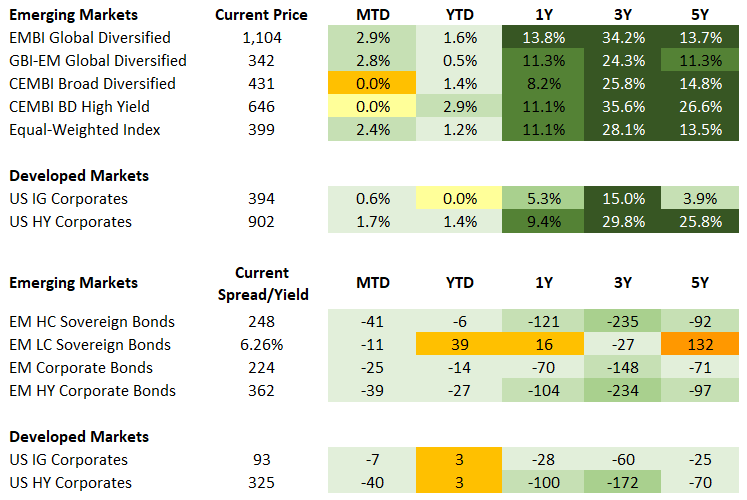
Emerging Markets (EM) fixed income came under broad-based pressure this week, with all three sub-asset classes finishing in negative territory as geopolitical uncertainty and continued volatility in global energy prices weighed on risk sentiment. Despite occasional relief rallies on ceasefire-related headlines, the underlying tone remained cautious, with investors reluctant to add risk in the absence of a clearer path toward a durable resolution to the Middle East conflict.
Local currency sovereign debt was the weakest performer, declining -0.80% at the index level, as a combination of U.S. dollar resilience and domestic macro headwinds across key EM economies weighed on returns. At the country level, Colombia (-3.10%) and Turkey (-1.69%) were among the notable underperformers, reflecting a challenging cocktail of currency weakness, elevated inflation, and idiosyncratic political risk. Egypt (-2.12%) also lagged, with persistent FX pressures and elevated local yields continuing to constrain investor appetite. On the positive side, Hungary (+0.48%) and the Dominican Republic (+1.09%) were the standout outperformers. Hungary continued to benefit from post-election political momentum following the opposition victory, while the Dominican Republic was supported by easing inflation and a resilient growth outlook that reinforced expectations for policy easing.
Hard currency sovereign bonds declined -0.27% at the index level, with high yield (-0.27%) and investment grade (-0.26%) finishing broadly in line with each other. Regionally, Europe (-0.54%) and Asia (-0.40%) underperformed, reflecting sensitivity to global rates and the compounding economic headwinds facing net oil-importing economies. Latin America (-0.06%) proved the most resilient regional performer, supported by its relative distance from the conflict and favorable commodity dynamics for several major issuers. At the country level, Angola (+2.06%), Venezuela (+1.41%), and Bolivia (+1.39%) led gains, boosted by the constructive energy price backdrop for net oil exporters. On the other end of the spectrum, Sri Lanka (-1.95%), Ukraine (-1.65%), and Lebanon (-1.54%) were the notable laggards, with the latter two reflecting acute geopolitical and balance-sheet vulnerabilities.
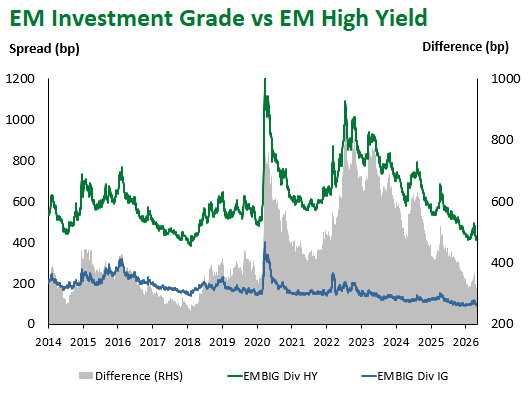
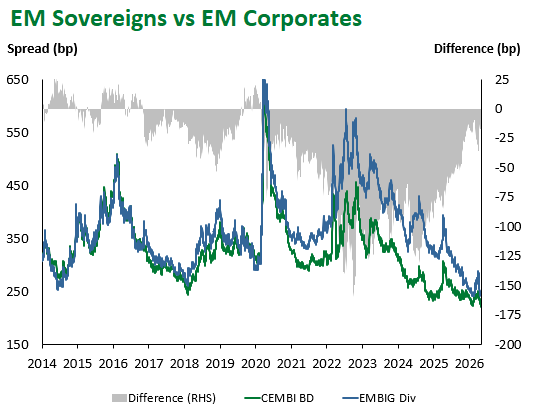
EM corporates outperformed sovereigns on a relative basis, declining -0.10% at the index level. High yield (-0.09%) marginally outperformed investment grade (-0.16%). Regionally, Africa (-0.06%) and Latin America (-0.07%) were the relative outperformers, with Ghana (+2.19%), the standout corporate performer, continuing its run of strong returns amid improved visibility on long-term asset licensing. Europe (-0.25%) and Asia (-0.10%) lagged. Across the rating spectrum, the CCC bucket bucked the broad negative trend with a gain of +0.46%, while investment grade-rated names underperformed. Along the curve, the 1-3-year segment was the relative outperformer (+0.01%), with longer-duration bonds bearing the brunt of rate sensitivity.
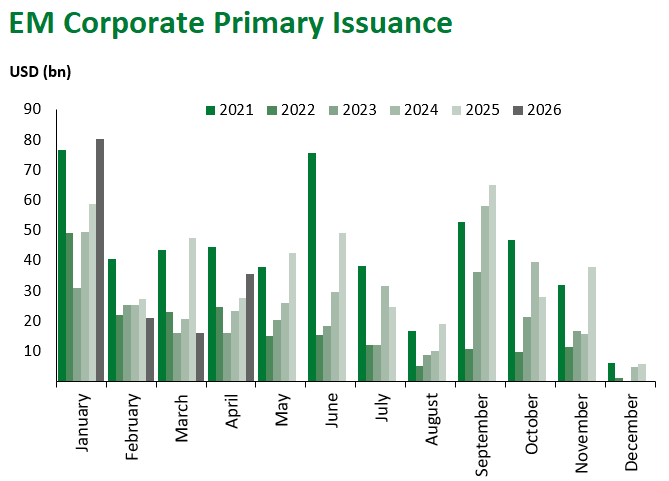
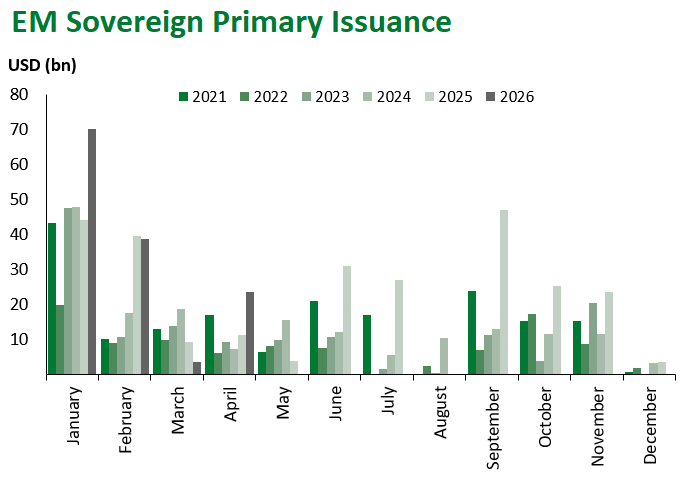
Primary market activity was solid for a risk-off week, with 11 issuers pricing approximately $11 billion in hard currency supply across 14 tranches. CEEMEA dominated supply, led by Serbia’s triple-tranche transaction totaling approximately $3.4 billion equivalent across EUR and USD, the largest EM sovereign deal of the week. Korea contributed roughly $1.8 billion via Kookmin Bank’s dual-tranche offering and Korea Expressway’s 5-year benchmark. The Middle East was represented by Emirates NBD’s $750 million AT1 perpetual, while Kazakhstan saw two issuers – Baiterek and Qazaqgas – collectively raise approximately $1.2 billion. In Latin America, Banamex priced a $1.3 billion AT1 and Generadora de Gatun launched a $1.05 billion infrastructure deal out of Panama. The week’s issuance skewed heavily toward investment grade, with crossover and high yield names accounting for a modest share of overall volume.
The Week Ahead
Markets head into next week with event risk from the Middle East conflict in focus and a busy slate of central-bank communication from officials across developed and emerging economies. Attention will also be on the OPEC+ monthly meeting as the war in Iran enters its third month and UAE withdraws from the organization. Global macro data releases include Eurozone manufacturing and services PMIs, Eurozone retail sales, China and India PMIs, and 1Q GDP/ April inflation prints across Asia and Latin America (Hong Kong and Indonesia GDP; CPI in the Philippines, Indonesia, South Korea, Thailand, Taiwan, Mexico, Chile, and Colombia). Several policy decisions are due, including Poland, Malaysia, and Mexico. In the U.S., ISM services and initial jobless claims lead into Friday’s April nonfarm payrolls and the May preliminary University of Michigan consumer sentiment; consensus estimates suggest payroll growth slows significantly to 60k from March’s 178k with the jobless rate steady. The ASEAN leaders’ Summit begins in Cebu, Philippines.
Fixed Income
Equities
Commodities

Source for data tables: Bloomberg, JPMorgan, Gramercy. EM Fixed Income is represented by the following JPMorgan Indicies: EMBI Global, GBI-EM Global Diversified, CEMBI Broad Diversified and CEMBI Broad High Yield. DM Fixed Income is represented by the JPMorgan JULI Total Return Index and Domestic High Yield Index. Fixed Income, Equity and Commodity data is as of May 1, 2026 (mid-day).
Highlights
Policy crosswinds for markets dominate in Colombia’s pre-election environment
Event: This week, BanRep, Colombia’s central bank, unexpectedly held its main policy rate unchanged at 11.25% in a unanimous decision. Meanwhile, President Petro’s controversial executive decree, which looks to urgently transfer about $7 billion from private pension savings into the public retirement system, was partially suspended by Colombia’s top administrative court.
Gramercy Commentary: The central bank’s decision to keep the policy rate on hold came against market consensus that expected a 50-75bps hike given concerns about the inflation outlook and earlier communications by policymakers. As such, the decision likely reflects a compromise between BanRep and the Petro administration designed to tone down tensions between the bank’s board and the president, who has threatened to raise the minimum wage again (after December 2025) if the central bank were to increase interest rates further. Separately, Petro’s now partially blocked decree on pension system asset transfers carried risks for local financial markets from potential urgent liquidation of portfolio assets by private sector managers. These developments highlight the various economic policy crosscurrents that investors need to navigate in Colombia’s pre-election context. Polls ahead of the first round of presidential elections on May 31 are also sending mixed signals about the relative strength and chances of the main candidates, Petro-supported left-wing senator Ivan Cepeda and center-right Senator Paloma Valencia, investors’ preferred candidate, adding to a binary environment for markets. We see significant risks on both the upside and downside for Colombian assets, depending on the election’s outcome, and see potential for market volatility in the case Mr. Cepeda outperforms polls/expectations ahead of and/or in the first round of voting.
Emerging Markets Technicals
Emerging Markets Flows
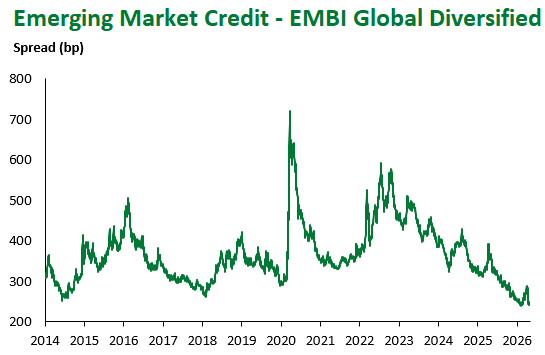
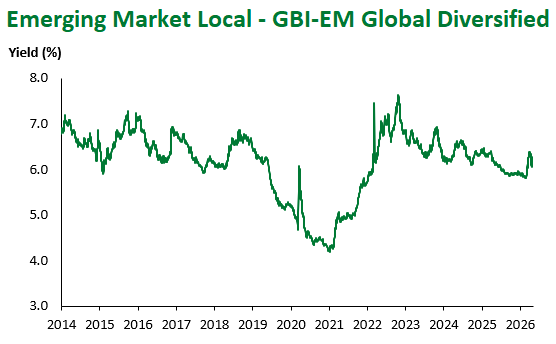
Source for graphs: Bloomberg, JPMorgan, Gramercy. As of May 1, 2026.
For questions, please contact:
Kathryn Exum, CFA ESG, Director, Co-Head of Sovereign Research, [email protected]
Petar Atanasov, Director, Co-Head of Sovereign Research, [email protected]
This document is for informational purposes only. The information presented is not intended to be relied upon as a forecast, research or investment advice, and is not a recommendation, offer or solicitation to buy or sell any securities or to adopt any investment strategy. Gramercy may have current investment positions in the securities or sovereigns mentioned above. The information and opinions contained in this paper are as of the date of initial publication, derived from proprietary and nonproprietary sources deemed by Gramercy to be reliable, are not necessarily all-inclusive and are not guaranteed as to accuracy. This paper may contain “forward-looking” information that is not purely historical in nature. Such information may include, among other things, projections and forecasts. There is no guarantee that any forecasts made will come to pass. Reliance upon information in this paper is at the sole discretion of the reader. You should not rely on this presentation as the basis upon which to make an investment decision. Investment involves risk. There can be no assurance that investment objectives will be achieved. Investors must be prepared to bear the risk of a total loss of their investment. These risks are often heightened for investments in emerging/developing markets or smaller capital markets. International investing involves risks, including risks related to foreign currency, limited liquidity, less government regulation, and the possibility of substantial volatility due to adverse political, economic or other developments. References to any indices are for informational and general comparative purposes only. The performance data of various indices mentioned in this update are updated and released on a periodic basis before finalization. The performance data of various indices presented herein was current as of the date of the presentation. Please refer to data returns of the separate indices if you desire additional or updated information. Indices are unmanaged, and their performance results do not reflect the impact of fees, expenses, or taxes that may be incurred through an investment with Gramercy. Returns for indices assume dividend reinvestment. An investment cannot be made directly in an index. Accordingly, comparing results shown to those of such indices may be of limited use. The information provided herein is neither tax nor legal advice. Investors should speak to their tax professional for specific information regarding their tax situation.