


Contents
Market Overview
Macro Update
This week markets navigated conflicting signals about the status of the Strait of Hormuz and prospects of easing energy disruptions amid U.S. naval posturing and Iran’s pushback. The week concluded on an optimistic note as Pakistani officials indicated that Iran’s foreign minister is traveling to Islamabad and a second round of peace negotiations between the U.S. and Iran is expected, despite Iran’s parliament speaker resigning from the negotiating team earlier in the week, which drove oil prices higher.
Meanwhile, President Donald Trump announced he would extend the ceasefire with Iran “until peace talks conclude”, but Iranian officials reiterated that reopening the Strait was “not possible” until the U.S. naval blockade is lifted. Reports suggested that at least three Iranian-flagged tankers were intercepted by U.S. forces and Trump ordered the U.S. navy to shoot any boats suspected to be deploying mines in the Strait.
Amid lingering uncertainty, traffic through the strategic waterway remains largely frozen, despite ongoing diplomatic efforts to find a way out of the crisis. Meanwhile, Trump announced that the fragile ceasefire in Lebanon will be extended by three weeks and he will invite Israeli Prime Minister Netanyahu and Lebanese President Aoun to meet with him soon; however, Hezbollah remained defiant and called the truce “meaningless”.
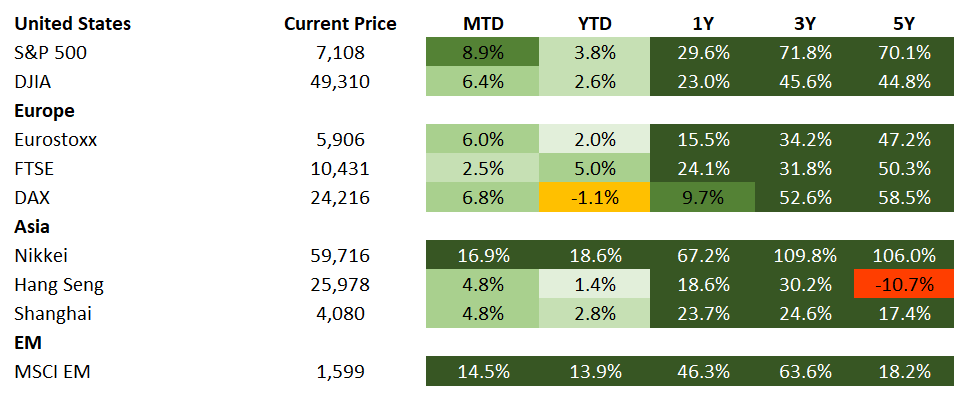
Against this fluid geopolitical backdrop, markets remained in a risk-on mode as investors remain hopeful that a de-escalation scenario will prevail. Nevertheless, this week’s conflicting signals drove the price of Brent crude, the global oil benchmark, back above $100 per barrel, from the mid-80s seen last Friday when President Trump claimed that the Strait was “open”. U.S. equity indexes, boosted by renewed AI optimism and strong quarterly earnings reports, remained around new all-time highs, with the tech-heavy NASDAQ on pace for its longest weekly winning streak since 2024.
As geopolitical sentiment turned more cautious during the week, the U.S. dollar strengthened marginally, but gave up some gains as diplomatic optimism resurfaced, with the DXY index finishing the week with a mid-98 handle. The U.S. Treasuries curve bear-flattened, with the 2-3 year area of the curve widening by 7-8bps to around 3.80% and the 10-year benchmark yield finishing the week around 4.30%, 5bps wider compared to last week. Gold and silver spot prices trended lower, but held near recent ranges, around $4,750 and 75 per oz, respectively.
Beyond geopolitical developments, focus this week was also on Kevin Warsh’s confirmation hearing to lead the Federal Reserve where Mr. Warsh sought to dispel concerns that he would favor politically motivated interest rate cuts. Markets are currently pricing that the Fed will remain on hold for the rest of 2026.
In terms of notable macro data, March U.S. retail sales came in above expectations printing the strongest monthly pace in a year, suggesting that consumers continued to spend on a wide variety of items, despite the jump in gasoline prices. Initial jobless claims were marginally higher last week, but the 4-week moving average remains stable at around 210K. U.S. April Flash PMIs were stronger than expected across the board, also pointing to economic optimism, despite the energy crisis. In contrast, the final April University of Michigan consumer sentiment index fell from a month earlier to another record low, reflecting worries around the economic fallout from the Middle East war and higher inflation expectations by U.S. consumers.
UK’s April Flash PMIs came in stronger-than-expected across the board as well, while those in the Euro area pointed to divergence between manufacturing (stronger-than-expected) and services (weaker-than-expected). Meanwhile, UK’s headline inflation in March jumped to 3.3% year-over-year, from 3.0% in February, with the main driver unsurprisingly coming from significantly higher fuel costs; amid the uptake in price pressures, markets believe that the Bank of England is likely to hike rates by as much as 50bps this year, despite soft labor market and overall economic demand.
Elsewhere, EU ambassadors gave a preliminary approval for disbursements under EU’s €90 billion loan to Ukraine after Hungary lifted its veto, bringing an end to years of former Hungarian Prime Minister Viktor Orban’s obstruction to European assistance for Ukraine. In Bulgaria, former President Rumen Radev’s newly formed political party (Progressive Bulgaria) won a resounding victory in snap parliamentary elections on a reform and anti-corruption platform. While Radev’s strong mandate makes constructive structural reforms more likely, markets will monitor closely his foreign policy moves given the former president’s Russia-friendly reputation.
EM Credit Update
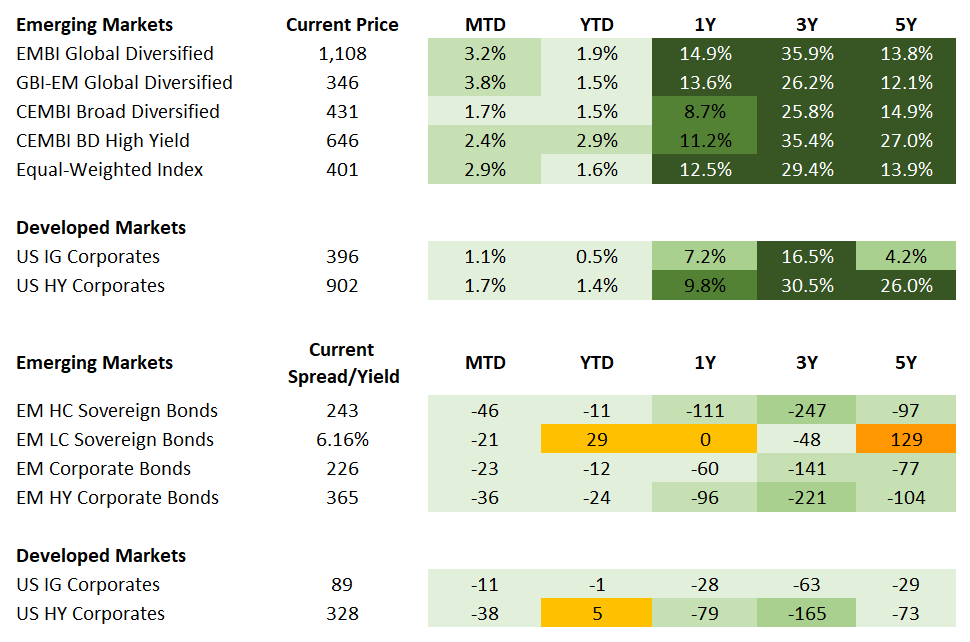
Emerging Markets (EM) fixed income came under broad-based pressure this week, reversing a portion of last week’s ceasefire-driven rally as the durability of the Iran-U.S. truce remained in question and risk sentiment softened across global markets. Local currency sovereign debt was the clear underperformer, while hard currency corporates proved the most resilient sub-asset class.
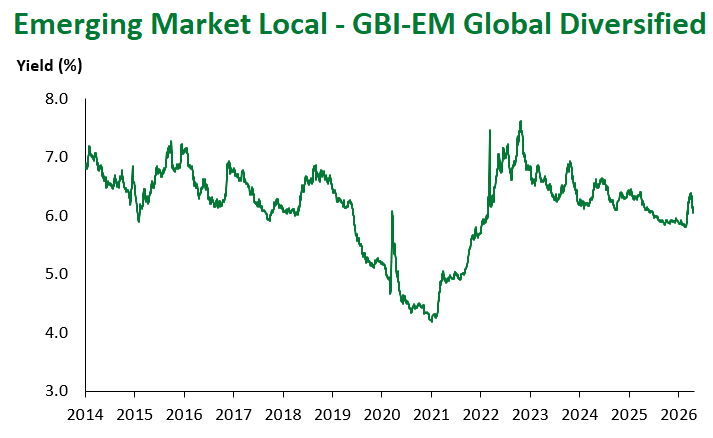
Local currency sovereign debt declined -1.34% at the index level, as a combination of U.S. dollar resilience and renewed geopolitical caution weighed on EM currencies and rates. At the country level, Colombia (+1.15%), the Dominican Republic (+1.67%), and Brazil (+0.89%) were the standout performers, each supported by idiosyncratic domestic catalysts and relatively constructive macro dynamics. On the other end of the spectrum, Thailand (-1.57%), Indonesia (-1.33%), and South Africa (-0.84%) were the primary laggards, weighed down by relatively higher exposure to the negative effects of a prolonged conflict in Iran.
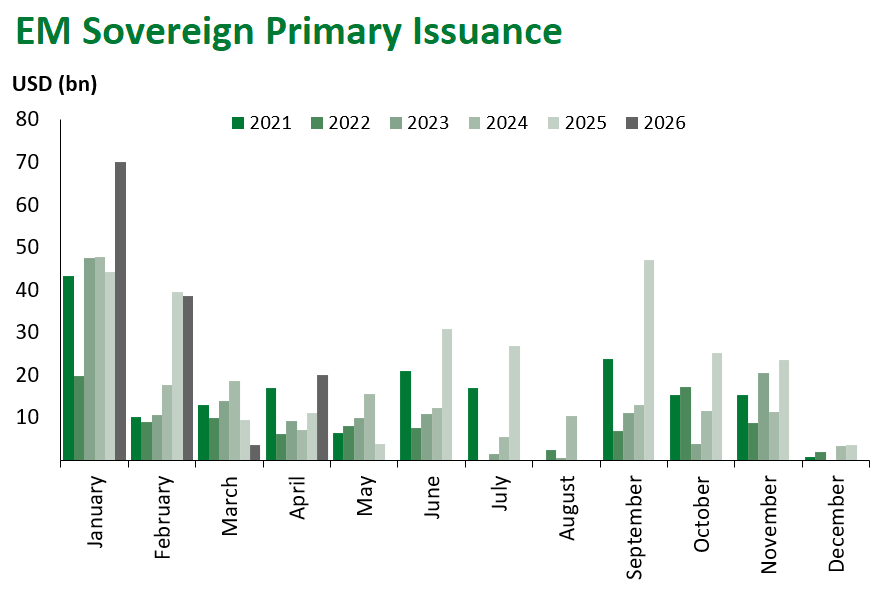
Hard currency sovereign bonds declined -0.38% at the index level, with high yield (-0.50%) underperforming investment grade (-0.25%). Regionally, Africa (-0.46%) and Latin America (-0.42%) lagged most, while Europe (-0.26%) and Asia (-0.34%) proved more resilient. At the country level, Senegal (+4.90%) and Mozambique (+2.45%) were notable outperformers. Senegal’s Eurobonds rebounded on bargain-hunting and short covering after recent selloffs, with investors taking comfort that IMF engagement remains ongoing despite elevated debt concerns. Mozambique’s bonds rallied from deeply distressed levels as value buyers stepped in following heavy recent losses, helped by intermittent optimism around LNG project restart prospects and continued servicing of external debt. In contrast, Lebanon (-5.73%) gave back a portion of its recent sharp recovery as the rally paused on profit-taking and renewed skepticism around restructuring timelines and recovery values after an extended, politically driven run-up. Venezuela (-1.90%) and Kenya (-1.73%) also underperformed amid renewed risk aversion and credit-specific dynamics.
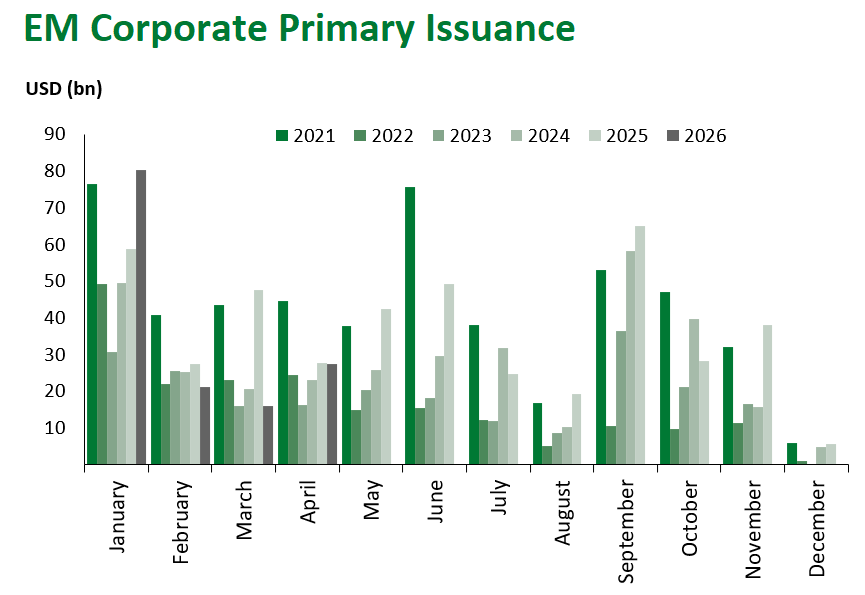
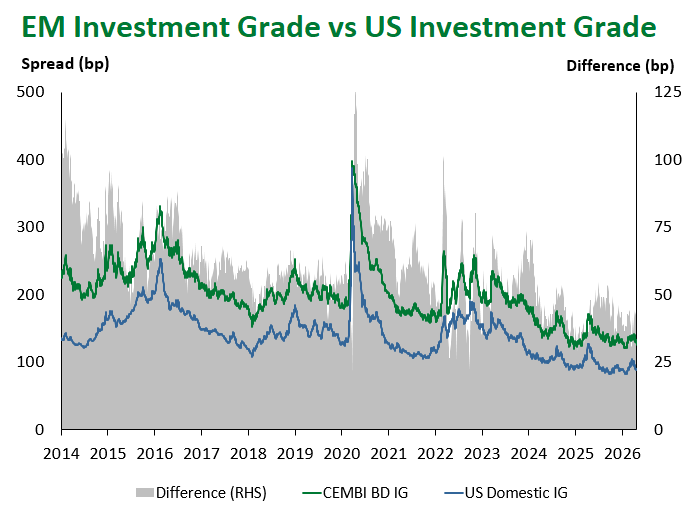
EM corporates were the relative bright spot, delivering a modest +0.01% at the index level. High yield (+0.09%) outperformed investment grade (-0.05%), with the CCC segment (+1.01%) leading all rating buckets while AAA (-0.23%) lagged. Regionally, the Middle East (+0.11%) and Europe (+0.11%) led gains, while Asia (-0.12%) was the lone regional decliner, consistent with the ongoing sensitivity of the region’s net energy importers to the prevailing macro backdrop. Jamaica (+0.76%) and Egypt (+0.47%) and were among the top corporate country contributors.
Primary market activity was solid, with nine issuers pricing approximately $5.95 billion in hard currency supply across investment grade and high yield. Notable deals included Qatar National Bank ($1 billion), Kaspi.kz of Kazakhstan ($600 million), Turk Eximbank ($650 million), a dual-tranche perpetual hybrid from Genting Berhad of Malaysia ($1.25 billion), a dual-tranche offering from Kazakhstan Temir Zholy ($1 billion), and high yield corporate prints from Dangote Fertiliser of Nigeria ($750 million) and Brazilian hospital operator Rede D’Or ($500 million).
The Week Ahead
The week ahead includes multiple key central bank decisions, including from the Fed, ECB, BOE and BOJ. All four systemic central banks are expected to keep rates on hold as policymakers continue to evaluate the economic impact of the Middle East war. Policy rate decisions are also due in Canada, Pakistan, Chile, Hungary, Brazil, Thailand, Colombia and Ukraine. Preliminary April CPI and/or 1Q GDP readings will be reported across DM and EM economies, including in the U.S., Eurozone and its member-states, Japan, Mexico, Poland, and Saudi Arabia, among others. Final April PMIs are due in the U.S., China, UK and Japan, as well as Eurozone economic and consumer confidence and the heavy slate of global corporate earnings continues. President Donald Trump will attend the White House Correspondents’ Association annual dinner, and King Charles III and Queen Camilla will begin a state visit to the U.S., which includes a White House State Banquet and a Congress address.
Fixed Income
Equities
Commodities
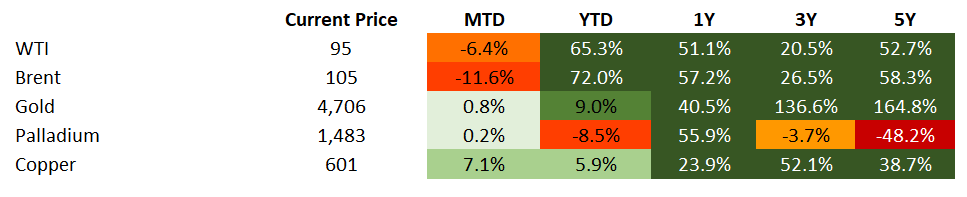
Source for data tables: Bloomberg, JPMorgan, Gramercy. EM Fixed Income is represented by the following JPMorgan Indicies: EMBI Global, GBI-EM Global Diversified, CEMBI Broad Diversified and CEMBI Broad High Yield. DM Fixed Income is represented by the JPMorgan JULI Total Return Index and Domestic High Yield Index. Fixed Income, Equity and Commodity data is as of Apr. 24, 2026 (mid-day).
Highlights
Bulgaria’s Prime Minister nominee Radev unlikely to become Europe’s “new Orban”
Event: With around 45% of the total vote, former President Rumen Radev’s center-left Progressive Bulgaria (PB) party won a resounding victory in last weekend’s snap elections, marking only the second time in almost 30 years that a political force has gained a simple majority (120+ seats in the 240-member Parliament).
Gramercy Comment: Mr. Radev’s strong mandate is likely to end a protracted period of parliamentary fragmentation and unstable government coalitions (Bulgaria has experienced eight snap elections since 2021) that have constrained policymaking in recent years, which is a credit-positive development. Furthermore, it opens the door to important long-delayed structural reforms such as revamping the judicial system and combatting corruption that has detracted from Bulgaria’s otherwise impressive economic progress in recent years and strong sovereign credit fundamentals. On the flip side, investors are concerned that the former president’s Russia friendly stance and his opposition to Bulgaria’s accession to the Eurozone (that successfully materialized on January 1) could lead to a deterioration in the diplomatic relationship between Sofia and Brussels. We believe such concerns to be overdone and do not expect Mr. Radev becoming a “new Orban” who might complicate common European efforts on Ukraine and other strategic priorities. It is important to note that, despite strong Russian influence and propaganda efforts in Bulgaria, the country’s public opinion remains firmly pro-European on balance. Mr. Radev’s massive victory reflects mainly the voters’ dissatisfaction with domestic issues such as political/judicial corruption associated with previous ruling parties/coalitions rather than any widespread anti-European sentiment. Accordingly, we expect foreign policy by the upcoming Radev administration to adhere to norms and align its responsibilities with Bulgaria’s allegiance to the EU, the Euro Area and NATO.
Romania Political Uncertainty Back in Focus
Event: The Social Democratic Party (PSD), the largest party in the government’s ruling coalition, withdrew its support for Prime Minister Ilie Bolojan, raising the prospect of collapse for the pro-European alliance that took office last year to keep the far right out of power. The friction within the coalition stems from a budget dispute, with PSD pushing for higher social benefits while the Liberals insist on greater austerity. Prime Minister Bolojan has refused to resign and will face a vote of confidence in the next 45 days unless an agreement is reached.
Gramercy Comment: Renewed governance challenges will pose headwinds to the policy agenda, risking access to EU recovery funds although with likely limited impact to this year’s budget. Importantly, President Nicursor Dan convened emergency consultations on Wednesday, stressing that Romania’s pro-Western direction is not in question and that all parties have ruled out cooperation with anti-Western forces – a key reassurance for investors given the country’s turbulent 2024 electoral episode. On the fiscal side, consolidation progress was underway with the deficit expected to narrow to around 6% of GDP this year from 8% of GDP in 2025. However, next year’s 4.5% of GDP target looks ambitious in a more fraught political backdrop. Rating agencies will likely keep negative outlooks in place and assess fiscal performance with increased risk of downgrades if fiscal slippage emerges.
Emerging Markets Technicals
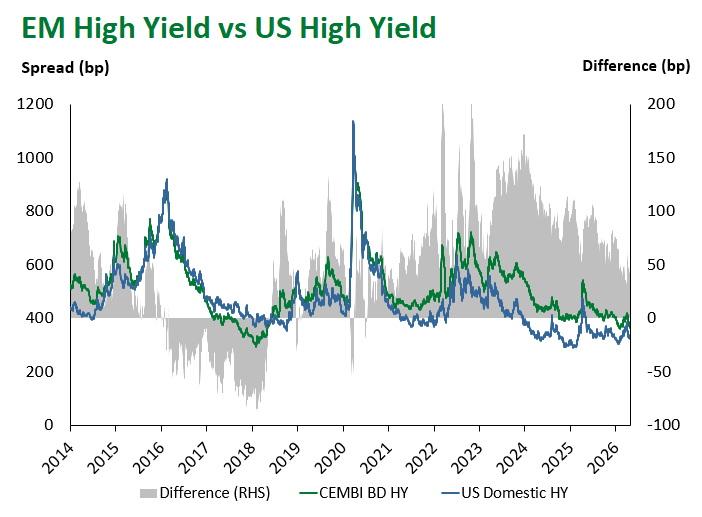
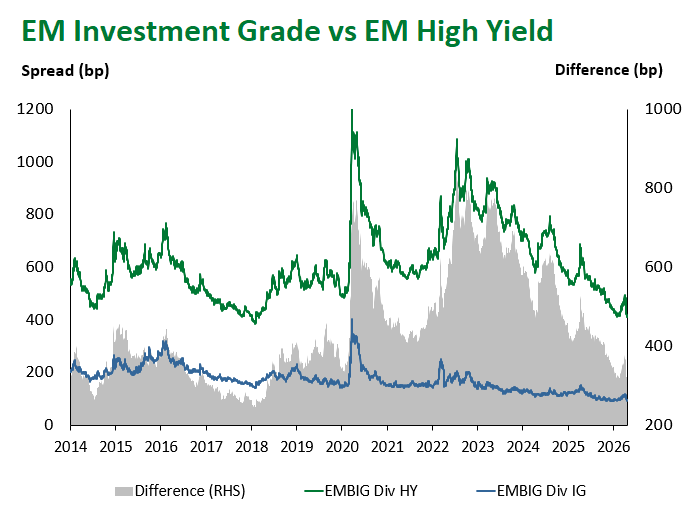
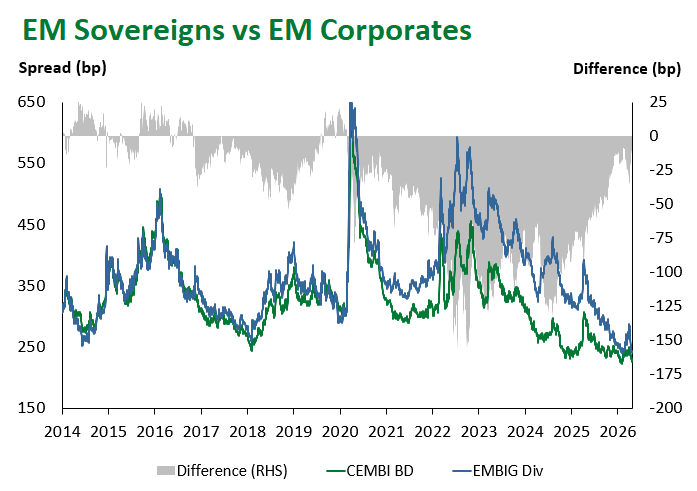
Emerging Markets Flows
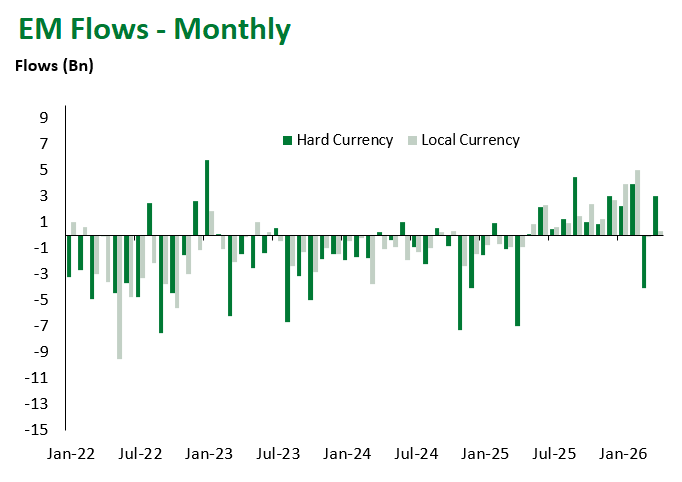
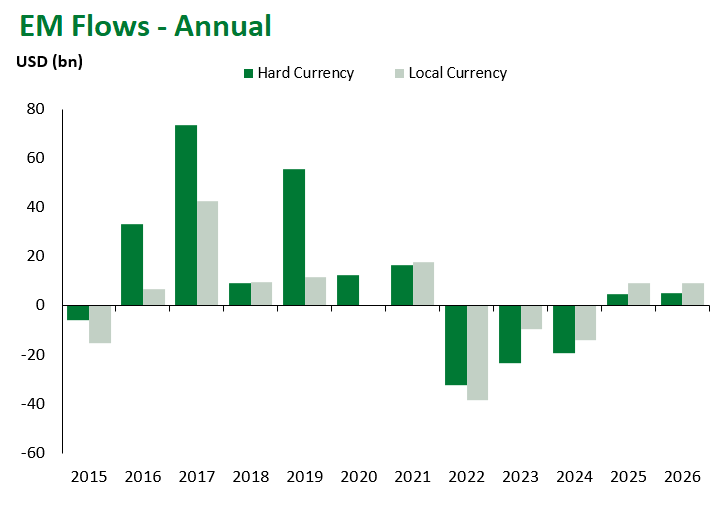
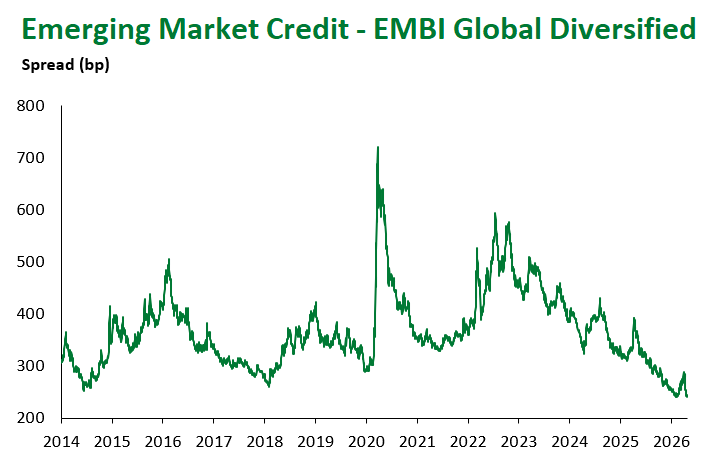
Source for graphs: Bloomberg, JPMorgan, Gramercy. As of Apr. 24, 2026.
For questions, please contact:
Kathryn Exum, CFA ESG, Director, Co-Head of Sovereign Research, [email protected]
Petar Atanasov, Director, Co-Head of Sovereign Research, [email protected]
This document is for informational purposes only. The information presented is not intended to be relied upon as a forecast, research or investment advice, and is not a recommendation, offer or solicitation to buy or sell any securities or to adopt any investment strategy. Gramercy may have current investment positions in the securities or sovereigns mentioned above. The information and opinions contained in this paper are as of the date of initial publication, derived from proprietary and nonproprietary sources deemed by Gramercy to be reliable, are not necessarily all-inclusive and are not guaranteed as to accuracy. This paper may contain “forward-looking” information that is not purely historical in nature. Such information may include, among other things, projections and forecasts. There is no guarantee that any forecasts made will come to pass. Reliance upon information in this paper is at the sole discretion of the reader. You should not rely on this presentation as the basis upon which to make an investment decision. Investment involves risk. There can be no assurance that investment objectives will be achieved. Investors must be prepared to bear the risk of a total loss of their investment. These risks are often heightened for investments in emerging/developing markets or smaller capital markets. International investing involves risks, including risks related to foreign currency, limited liquidity, less government regulation, and the possibility of substantial volatility due to adverse political, economic or other developments. References to any indices are for informational and general comparative purposes only. The performance data of various indices mentioned in this update are updated and released on a periodic basis before finalization. The performance data of various indices presented herein was current as of the date of the presentation. Please refer to data returns of the separate indices if you desire additional or updated information. Indices are unmanaged, and their performance results do not reflect the impact of fees, expenses, or taxes that may be incurred through an investment with Gramercy. Returns for indices assume dividend reinvestment. An investment cannot be made directly in an index. Accordingly, comparing results shown to those of such indices may be of limited use. The information provided herein is neither tax nor legal advice. Investors should speak to their tax professional for specific information regarding their tax situation.