


Executive Summary
Growth risk is now competing with inflation risk as the Fed tightens. A slightly firmer core PCE print all but locked in a December hike, and GDP and jobless claims pointed to a still-solid U.S. economy. Yet Treasury yields fell and metals weakened, as AI-driven equity swings, strain on AI borrowers and slower growth outside the U.S. raised the risk that the Fed tightens into a slowdown.
Lower yields lifted EM hard currency, but the dollar capped local markets. Sovereign spreads tightened, led by long-duration and higher-rated bonds, while corporates lagged. Local markets were roughly flat, with currencies driving the dispersion, most sharply in Colombia and Mexico.
Geopolitical risk is no longer lifting oil. Refinery strikes in Russia, a Houthi attack claim on Ras Tanura and Iranian warnings over Hormuz left Brent range bound as surplus expectations dominated ahead of OPEC+. For EM, the terms-of-trade story is shifting, which helps importers and squeezes exporters with thin fiscal buffers.
Market Overview
Macro Update
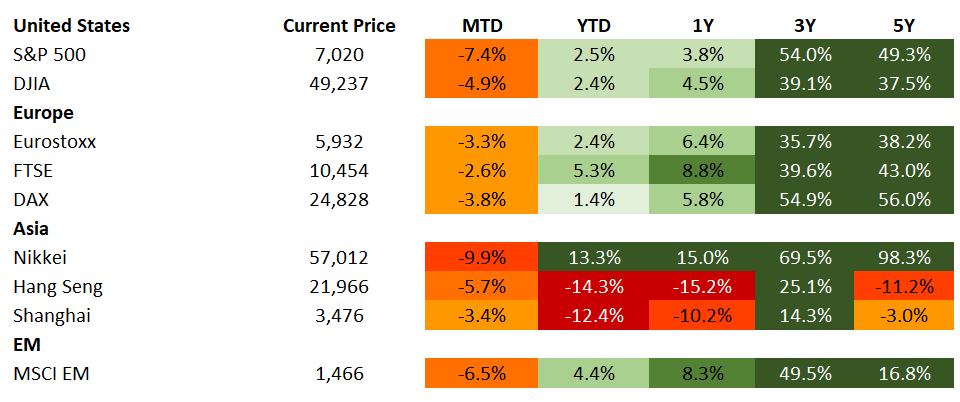
AI-driven volatility whipsawed U.S. markets this week. A policy-driven rally on Monday lasted one session before equities sold off midweek. As of Wednesday, the S&P 500 was still up on the week, hovering around 7,000. Washington then revived its tariff program under new legal authority. Policy can now lift markets and hit them within the same week, which makes any official backstop less dependable. U.S. credit spreads are widening again as strain on lower-rated AI borrowers deepens. The question is whether that slows AI borrowing or is offset by lower Treasury yields.
Core PCE was the print that mattered, and it all but locked in a December Fed hike, with a 25bp move to 4.25% now 95.5% priced in futures markets. October core rose 3.3% y/y, a tenth above consensus, and 0.3% m/m. The growth data were strong: third-quarter GDP was revised up to 4.3% annualized, and jobless claims fell to 189k. Yet the 10-year yield fell about 9bps to 4.8%, a sign that investors now see growth as the bigger risk even with the Fed tightening. For EM, the dollar near 19-month highs keeps local markets under pressure, with currencies rather than rates driving the losses.
Outside the U.S., the mix of slowing growth and sticky inflation is getting worse. Australia’s trimmed-mean inflation rose to 3.8% in October from 3.6%, and headline CPI climbed to 4.9%, partly on fuel and expiring electricity rebates. The Treasurer flagged growth well below 2% and unemployment likely peaking above 5%. Germany grew just 0.1% in the third quarter, yet the ECB is still discussing hikes.
Metals are sending the same growth warning. Copper fell 4.4% this week and gold 2.6%, while Brent steadied near $93 after sliding about 21% in November. Geopolitical risk rose this week but did little for oil. Ukraine hit two more Russian refineries in the Samara region, the Houthis claimed a strike on Saudi Arabia’s Ras Tanura refinery, and Tehran warned tankers away from the Strait of Hormuz as Washington imposed fresh sanctions, yet Brent held in a $90-93 range as expectations of a supply surplus ahead of Sunday’s OPEC+ meeting outweighed the disruption risk.
On trade policy, Washington’s revived tariff program is more a legal rebuild than a new escalation. USTR proposed Section 301 duties on 14 trading partners, largely restoring the deal-based rates lost with the Supreme Court’s February IEEPA ruling. On average, they lift duties on targeted partners by roughly 5 percentage points, and China’s proposed 20% returns it to about its pre-ruling level. The measures require a public hearing and are unlikely to take effect before January. The direct EM impact looks contained, though higher fallback rates for countries without finalized deals, such as India and Vietnam, keep pressure on. Mexico, excluded while USTR’s review continues, is a relative beneficiary.
EM country news was mixed. In Brazil, Congress approved about $10 billion in fiscal savings for 2027, and Lula reportedly backed a constitutional amendment to slow mandatory spending growth, helping the real steady while markets await clarity on cabinet changes. Venezuela published its long-awaited macroeconomic framework, putting public debt net of intra-public sector holdings just above $200 billion, an early step toward restructuring. In Türkiye, a roughly $10 billion drop in net reserves excluding swaps has put FX buffers back in focus.
The Week Ahead
Two weekend events will set the tone before markets open. Taiwan holds local elections on Saturday, November 28, a midterm test for President Lai’s DPP ahead of the 2028 presidential race, with implications for cross-strait signaling and North Asia risk. On Sunday, November 29, OPEC+ ministers meet to set the group’s 2027 production framework after Brent’s roughly 21% slide in November. In the U.S., November payrolls and University of Michigan sentiment on Friday are the last major data points before the December 9 FOMC, with JOLTS, the ADP employment report and the ISM surveys earlier in the week. With a December hike all but fully priced, the data matter more for whether the Fed signals further tightening into 2027. In Europe, November inflation and inflation expectations will test the ECB’s case for further hikes, alongside final PMIs and retail sales, while China’s November PMIs will show whether October’s slowdown carried into the fourth quarter. India, Poland and the Dominican Republic all have rate decisions next week, with the Reserve Bank of India expected to hike. On geopolitics, the watch-points are Russia’s response to Ukraine’s refinery strikes, NATO’s discussion of Poland’s proposal to intercept Russian missiles over Ukraine, whether the Saudi-Houthi exchange escalates, and how Iran responds to new U.S. sanctions around Hormuz.
Highlights
Venezuela publishes macro framework, a key step toward debt restructuring
Event: On November 24, the government published Venezuela Renace, a national recovery plan with macroeconomic projections to 2036. The plan identifies comprehensive public debt restructuring, including PDVSA, as a priority for its first phase (0-12 months), with a public debt exchange envisaged as a milestone within the first three years. Although, it provides no specific timetable for launching negotiations. It sizes total public debt at $237.5 billion, or just over $200 billion excluding debt owed within the public sector. It projects oil output more than doubling to 2.9mn b/d by 2036, alongside gradual fiscal consolidation that takes the primary deficit from 3.2% of GDP in 2026 to balance by 2031, supported by tax reform, spending restraint, and new fiscal rules. The plan does not address debt service or restructuring terms, which will depend on negotiations and the debt sustainability analysis being prepared by the government’s advisers. Sovereign and PDVSA bonds rose 2-3 points following the release.
Investment Implications: The plan is a constructive step, giving creditors their first official framework and establishing a macroeconomic baseline for future restructuring negotiations. However, it points to limited near-term repayment capacity with possible room for expansion over time. A significant part of the projected rise in dollar GDP, especially early on, reflects real exchange rate appreciation rather than higher hard-currency earnings, while lower assumed oil prices and front-loaded oil-sector capex defer the recovery in hydrocarbon tax revenue. Fiscal adjustment is gradual in pace but sizeable cumulatively, with public wages and pensions recovering and non-hydrocarbon public investment rising, reflecting the government’s stated emphasis on social and political acceptability. The key test will be how the IMF responds: whether it endorses the government’s growth and fiscal assumptions, and what it signals about the scale of debt relief required. The debt sustainability analysis, the beginning of IMF Article IV engagement, and the necessary U.S. licensing approvals to permit negotiations are the next milestones.
Hungary: Governance progress supports rating stabilization
Event: Moody’s revised Hungary’s outlook to Stable from Negative and affirmed its Baa2 rating, citing institutional reforms and improved relations with the EU that have materially reduced governance-related downside risks. The agency also highlighted improved access to EU resources, stronger investor sentiment and a more credible fiscal consolidation program as support for growth and debt sustainability. However, it cautioned that consolidation will become more difficult beyond 2027. Hungarian bonds were largely unchanged following the announcement. S&P (BBB-/Negative) and Fitch (BBB/Negative) are scheduled to review Hungary on November 27 and December 4, respectively.
Investment Implications: Moody’s decision validates the governance reset under the Magyar government, which has driven the rerating in Hungarian assets since the April election and is largely reflected in market pricing. The muted bond reaction reinforces this view. Attention now shifts to S&P and Fitch, with S&P the more consequential review given Hungary’s position at the lowest investment-grade notch. We see scope for both agencies to stabilize their outlooks, although further ratings improvements will depend increasingly on fiscal execution. Fiscal delivery remains the main constraint. The government targets a deficit reduction to 4.9% of GDP in 2027, versus the EC’s more cautious 5.2% forecast, with public debt still rising. The EC’s November 24 assessment called for stronger corrective action under the Excessive Deficit Procedure. Meanwhile, EU funding progress is tangible, with 126 of 127 recovery fund milestones positively assessed, although one outstanding tax-related benchmark leaves some disbursements conditional. Key tests are the upcoming rating reviews and evidence of sustained deficit and debt reduction from 2027.
Market Data
EM Credit Update
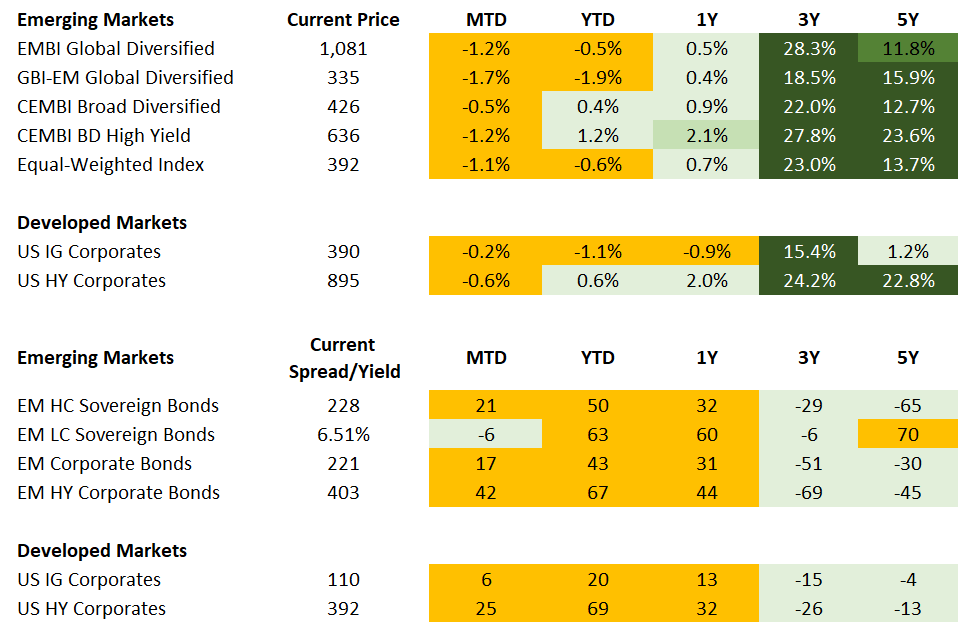
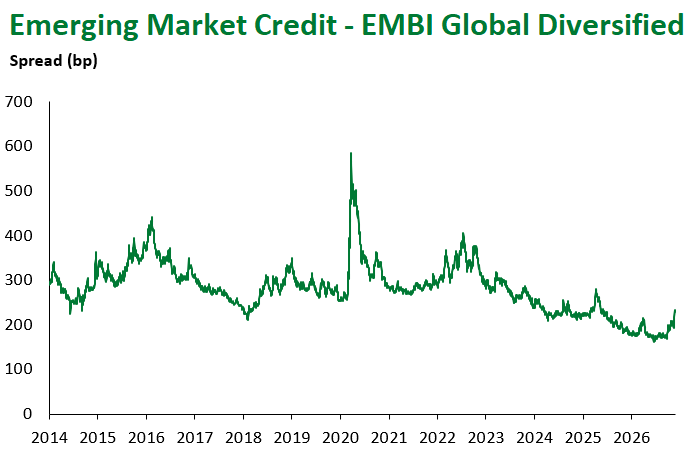
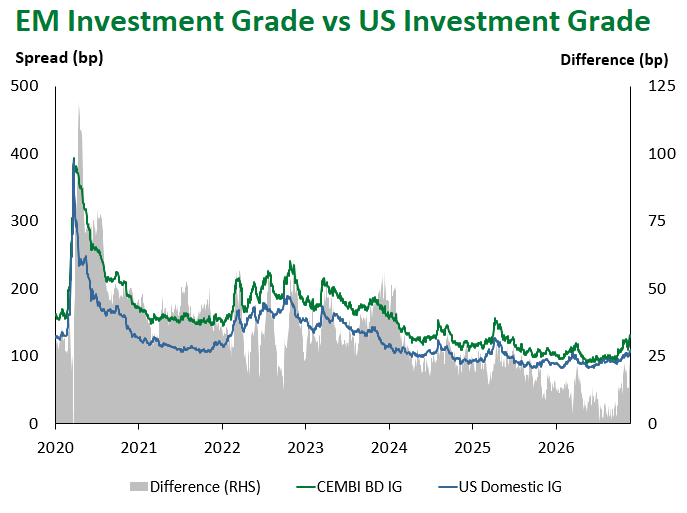
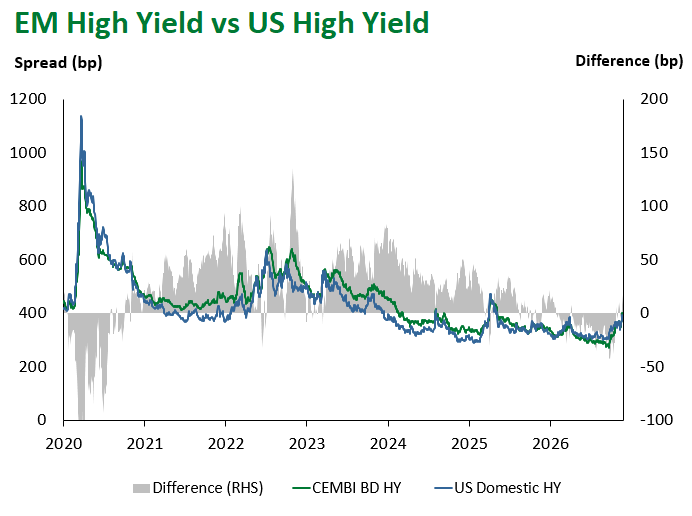
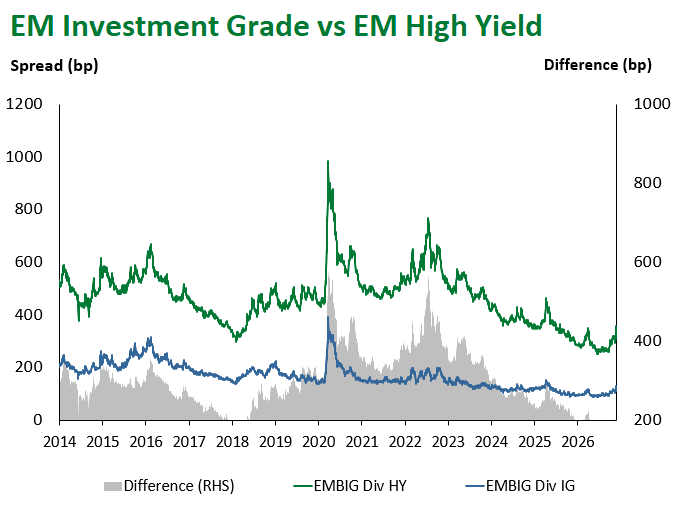
EM hard currency debt recovered part of last week’s losses as Treasury yields fell and spreads came in from Friday’s wides. The EMBI Global Diversified returned 0.44% for the week ending November 24, with investment grade (0.49%) slightly ahead of high yield (0.39%). The index spread tightened about 6bps to 228bps from 234bps on November 20. Bonds with more than 10 years of duration led, returning 0.61%. Single-B credits slipped 0.02% while higher-rated buckets gained 0.40% to 0.49%, so investors added duration but stayed selective on credit.
Latin America led the regions with a 0.73% return. Venezuela gained 7.7% after the government published its macroeconomic framework, and Brazil rose 1.29% as the fiscal package became law. Paraguay (0.84%) and Uruguay (0.73%) also outperformed, while Argentina (-0.90%) lagged. In Europe (0.36%), Poland returned 0.80% and Hungary 0.62%, the latter after Moody’s moved its outlook to stable from negative and affirmed Baa2. Africa was barely positive at 0.03%, with Angola (-0.52%), Cameroon (-0.24%), Gabon (-0.23%) and Nigeria (-0.08%) lower and Kenya (0.61%) and Côte d’Ivoire (0.59%) higher.
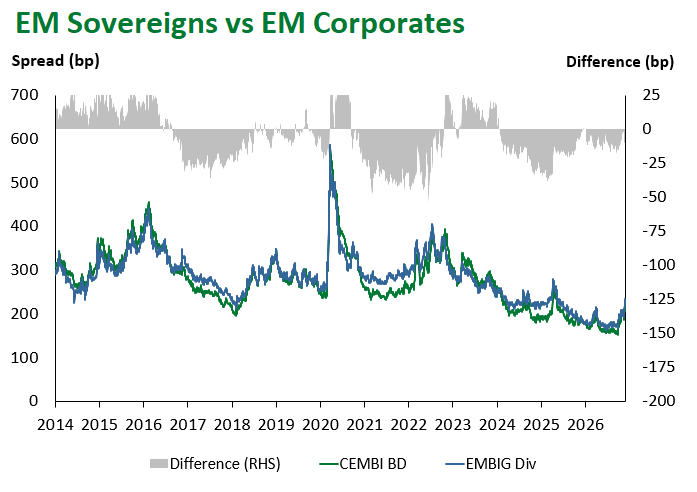
EM corporates lagged sovereigns. The CEMBI Broad Diversified returned 0.05%, with investment grade up 0.13% and high yield down 0.08%. The Middle East (0.18%) and Latin America (0.13%) led, and Europe (-0.19%) trailed. Ukraine (1.78%) and Ghana (1.35%) were the top performers, and Malaysia (-0.89%) and Türkiye (-0.59%) the weakest. High-yield corporates have yet to recover from last week’s selloff, so the risk-off move is reversing more slowly in corporates than in sovereigns.
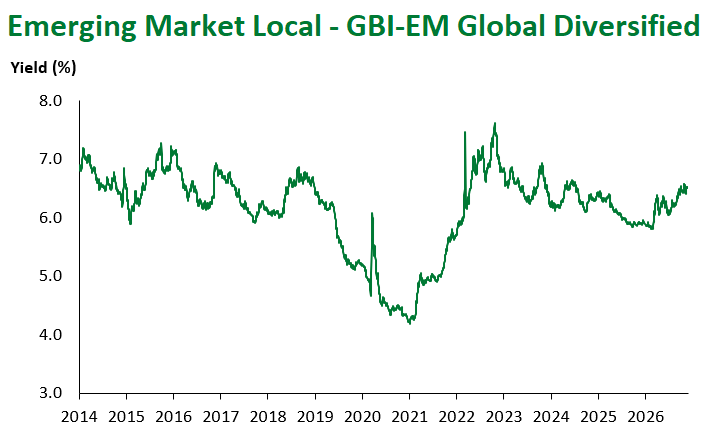
Local markets were roughly flat overall, but currency moves varied widely. The GBI-EM Global Diversified returned -0.10%. Colombia fell 4.15%, almost entirely on the peso (-3.68%), which weakened past 3,500 per dollar on oil and fiscal concerns. Mexico lost 1.48%, all from the peso, as headline bi-weekly inflation surprised to the upside. Brazil led with a 2.02% return, split between currency and bonds. Hungary returned 1.31%, mostly from the forint, after the central bank tempered its signal of near-term rate cuts and called recent forint volatility excessive.
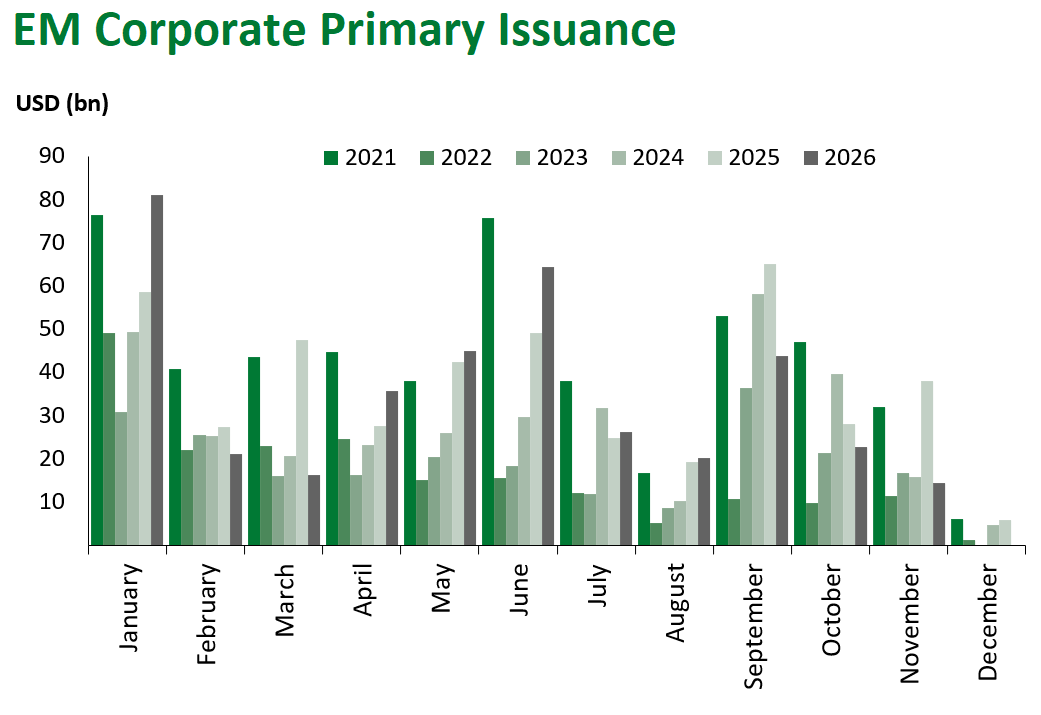
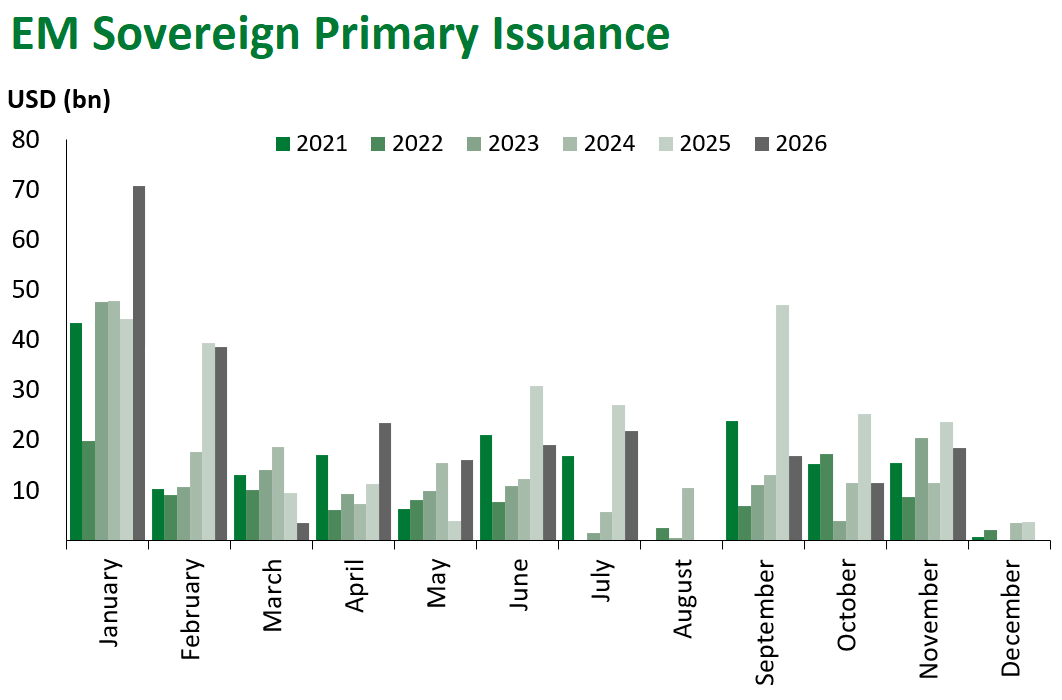
Primary activity was light, with $1.3 billion of dollar issuance across two deals. Guatemala was the only sovereign, pricing an $800 million 2039 bond at 6.80%, 33bps inside initial price thoughts. Qatar International Islamic Bank (QIIB) priced a $500 million five-year Reg S sukuk at T+120, 35bps inside IPT, on books above $1.45 billion at launch.
Fixed Income
Equities
Commodities

Source for data tables: Bloomberg, JPMorgan, Gramercy. EM Fixed Income is represented by the following JPMorgan Indicies: EMBI Global, GBI-EM Global Diversified, CEMBI Broad Diversified and CEMBI Broad High Yield. DM Fixed Income is represented by the JPMorgan JULI Total Return Index and Domestic High Yield Index. Fixed Income, Equity and Commodity data is as of November 25, 2026 (mid-day).
Emerging Markets Flows
Source for graphs: Bloomberg, JPMorgan, Gramercy. As of November 20, 2026.
For questions, please contact:
Kathryn Exum, CFA ESG, Director, Co-Head of Sovereign Research, [email protected]
Petar Atanasov, Director, Co-Head of Sovereign Research, [email protected]
This document is for informational purposes only. The information presented is not intended to be relied upon as a forecast, research or investment advice, and is not a recommendation, offer or solicitation to buy or sell any securities or to adopt any investment strategy. Gramercy may have current investment positions in the securities or sovereigns mentioned above. The information and opinions contained in this paper are as of the date of initial publication, derived from proprietary and nonproprietary sources deemed by Gramercy to be reliable, are not necessarily all-inclusive and are not guaranteed as to accuracy. This paper may contain “forward-looking” information that is not purely historical in nature. Such information may include, among other things, projections and forecasts. There is no guarantee that any forecasts made will come to pass. Reliance upon information in this paper is at the sole discretion of the reader. You should not rely on this presentation as the basis upon which to make an investment decision. Investment involves risk. There can be no assurance that investment objectives will be achieved. Investors must be prepared to bear the risk of a total loss of their investment. These risks are often heightened for investments in emerging/developing markets or smaller capital markets. International investing involves risks, including risks related to foreign currency, limited liquidity, less government regulation, and the possibility of substantial volatility due to adverse political, economic or other developments. References to any indices are for informational and general comparative purposes only. The performance data of various indices mentioned in this update are updated and released on a periodic basis before finalization. The performance data of various indices presented herein was current as of the date of the presentation. Please refer to data returns of the separate indices if you desire additional or updated information. Indices are unmanaged, and their performance results do not reflect the impact of fees, expenses, or taxes that may be incurred through an investment with Gramercy. Returns for indices assume dividend reinvestment. An investment cannot be made directly in an index. Accordingly, comparing results shown to those of such indices may be of limited use. The information provided herein is neither tax nor legal advice. Investors should speak to their tax professional for specific information regarding their tax situation.