


Executive Summary
The AI selloff sparked a Treasury rally and shifted EM losses from duration to credit. Neither Nvidia’s beat nor Anthropic’s record IPO stopped the slide. The S&P 500 fell for seven straight sessions and the VIX rose to about 30. Haven demand pulled the 10-year Treasury yield down about 20bps on the week to below 5.0%. Lower yields cushioned the higher-quality, longer-duration part of EM credit, while spreads did the damage further down the credit quality spectrum.
Falling Treasury yields didn’t help local markets amid USD strength. Hawkish Fed signals kept front-end yields anchored even as long yields fell, and haven demand took the DXY to its strongest since April 2025. Local currency sovereigns were again the weakest (-1.28%) as currency losses deepened.
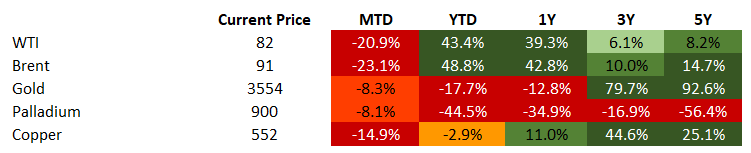
Oil’s slide toward $90 weighed on African high yield. With Middle East flows back near pre-war levels and the IEA projecting a fourth-quarter surplus, Brent is down about 20% in November. Africa was the weakest hard currency sovereign region (-1.22%), with oil exporters Angola and Nigeria leading the weakness in African high yield. Latin America (-1.13%) also lagged, as Brazil’s fiscal uncertainty and Argentina’s renewed dollar-bond selling added to the region’s pressure points.
Market Overview
Macro Update
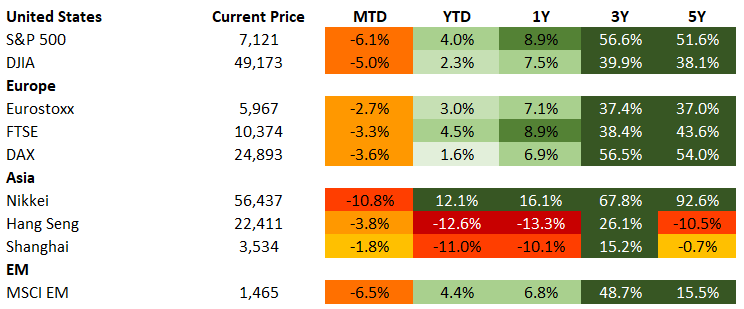
A global selloff in AI-linked stocks dominated the week, and neither Nvidia’s results nor a record IPO could stop it. Nvidia beat estimates on Tuesday in its first report since Jensen Huang’s resignation, guiding fourth-quarter revenue to about $130 billion, raising its 2028 growth outlook to roughly 75% and adding $150 billion to its buyback, but an initial after-hours gain of about 5% faded and the stock closed lower on Wednesday. Anthropic’s $81.3 billion IPO, the largest on record, opened at $111.50 on Thursday but closed at $97.17 and slipped below $90 in Friday trading. The S&P 500 fell for a seventh straight session on Friday, leaving it and the Nasdaq down about 5% on the week and the Nasdaq about 15% below its early-October record, the VIX around 30 for the first time since March. Investors have moved from asking whether AI demand is real to questioning the returns on the buildout and how it is financed, a shift that leaves even strong earnings unable to support valuations and raises the risk of broader de-risking across asset classes.
Fed officials kept on balance tightening rhetoric through the equity rout. Governor Waller said on Wednesday that a 50bps hike is probably necessary on December 9 unless the Committee explicitly signals another move in January, while New York Fed President Williams said the situation does not call for “dramatic action”. The minutes of the October meeting showed almost all participants saw further hikes as likely appropriate, with a couple open to more than 25bps in December and included a warning on risks tied to AI-related debt.
Futures price a 25bps December hike almost fully and another one by March 2027. Treasuries rallied on haven demand amid the global risk-off tone, with the 10-year yield down about 20bps on the week to around 4.95%. A Fed tightening into an equity drawdown raises the risk of a policy mistake, and with front-end yields anchored by hike expectations, the dollar keeps its carry advantage over EM even as long yields fall.
The dollar index (DXY) rose further to touch 104, its strongest since early April 2025 and on course for a fourth weekly gain as the AI selloff added a haven bid to the Fed-driven rally, but eased slightly into the close. USD/JPY held close to 160 for much of the week without intervention as data showed Japan’s economy contracted at a 0.1% annualized pace in the third quarter, its first decline in four quarters, before the yen firmed to below 159 on Friday after cooler than expected Japanese inflation data. A dollar supported by both a hawkish Fed and risk aversion is the main headwind for EM currencies, and a hawkish BoJ in December is the most likely trigger for a reversal in the yen.
Oil extended its slide despite continued uncertainty in the Middle East. Diplomacy appeared to stall again after Iran’s foreign minister met his Omani counterpart in Muscat without agreement, and Tehran said it could resume negotiations within two days if Washington halts hostilities, lifts the naval blockade and removes sanctions, a familiar set of conditionality. The Houthis kept up attacks on Saudi Arabia, with a strike on Thursday damaging a tower in Riyadh’s financial district, and Iran claimed three tankers hit mines near the Strait. Brent nevertheless traded around $90 into the close and was on course for a third straight weekly decline of about 3.5%, leaving it down roughly 20% in November, as Middle East flows recovered to near pre-war levels through alternative routes and the IEA projected that global supply will exceed demand in the fourth quarter for the first time since the conflict began. The oil market has shifted from pricing disruption to pricing surplus, which eases the terms-of-trade squeeze on EM energy importers even as second-round inflation keeps some of their central banks on alert.
In Europe, UK inflation edged up to 3.6% in October from 3.5%, with core steady at 2.8% and energy inflation at 19.4%, keeping the Bank of England on a tightening path, while the Bundesbank’s Nagel said further ECB rate adjustments may be needed after two hikes this year. Sticky energy-driven inflation leaves European central banks little room to respond to weaker risk assets, which limits the relief for CEE local rates.
China’s October data showed a domestic economy losing momentum behind the export boom. Industrial output growth slowed to 4.8% from 5.5%, retail sales rose just 0.4% and fixed-asset investment fell 8.1% in the first ten months, all below forecasts, with property investment down 21.6% and consumer inflation easing to 0.7%. Coming a week after Zhuhai Huafa’s missed payments, the data strengthen the case for further stimulus aimed at consumers. With growth increasingly dependent on AI-related exports just as investors question the AI buildout, China’s slowdown adds downside risk for EM Asia supply chains and for commodity exporters.
Brazil’s fiscal debate kept pressure on the BRL. The Senate approved President Lula’s roughly $10 billion fiscal package on Wednesday, although many analysts see it as too dependent on revenue increases, and Lula said on Thursday that he would name his ministers “when I want, on the day I want,” criticizing the market’s “hurry” for a finance minister. Vice President Geraldo Alckmin, seen as a fiscal conservative, and Piauí Governor Rafael Fonteles are the frontrunners according to Reuters sources, with a decision possibly next week. Meanwhile the BRL weakened to around 5.95, its weakest since April 2025. An Alckmin appointment would likely ease part of the fiscal premium, while further delay leaves Brazilian assets exposed at a time when global risk appetite is already fragile.
Elsewhere in EM, central banks defending weak currencies leaned hawkish. Bank Indonesia raised rates by 25bps this week after the rupiah hit an all-time low against the dollar, and the South African Reserve Bank held at 7.25% in a 4-3 vote, with three members favoring a hike, after inflation rose to 5.2% in October, its highest since May 2024; Sri Lanka’s central bank surprised markets by hiking 25bps to 9.0%, citing higher inflationary pressures due to second round effects of previous increases in energy prices. Angola, by contrast, cut for a fourth consecutive meeting. With the dollar at a 19-month high, the bar for EM easing has risen, and currency defense is again the priority for central banks with external vulnerabilities.
The Week Ahead
Thanksgiving compresses the U.S. calendar into the first half of the week: flash PMIs on Monday, then October PCE inflation, the second estimate of third-quarter GDP, jobless claims and the Beige Book on Wednesday, with markets closed on Thursday and closing early on Friday. PCE is the last major inflation input before the December 9 FOMC, where a 25bps hike is priced and the question is whether Chair Warsh signals more, as Governor Waller has demanded. Outside the U.S., the ECB publishes the accounts of its October meeting, the Bank of Korea decides after the Kospi’s 8% weekly fall, S&P reviews France after this week’s review of Italy, and OPEC+ ministers meet with Middle East flows back near pre-war levels and the IEA projecting a fourth-quarter surplus. In EM, Lula’s choice of finance minister could come as early as next week and China’s industrial profits will add to the picture of a domestic slowdown, while on Iran the watch-points are whether Qatari and Pakistani mediation revives talks and whether Houthi attacks on Saudi Arabia escalate. After Asia’s worst week since 2020, the key question for EM is whether the AI selloff stays an equity story or becomes a broader deleveraging that reaches credit and currencies, an environment that favors differentiation toward high real-rate and tightening-cycle markets over those where currency weakness is the main risk.
Highlights
Brazil’s initial fiscal package clears the Senate, but the BRL breaks 5.90 as markets await the new economic team
Event: The Senate approved the government’s initial fiscal adjustment bill on November 18 and sent it to the Chamber of Deputies, which Speaker Hugo Motta has scheduled to vote for next week. The administration was successful in avoiding major dilutions. The proposed measures target an improvement in the estimated 2027 primary balance of BRL 45–50 billion and should be seen as a first step in a gradual adjustment that would require further initiatives once a new economic team is appointed by President Lula. Nonetheless, markets have continued to sell off, with the BRL breaking through 5.90 against the USD this week, from around 5.20 in early October, even as the dollar has paused its broader rally. Lula has yet to name his finance minister and chief of staff, the two key appointments from a market perspective, with rumors circulating around four to five candidates. Vice President Geraldo Alckmin remains the most favored market pick for MinFin, while current Planning Minister Bruno Moretti’s standing appears has risen after steering the package through the Senate.
Investment Implications: The Senate vote is a meaningful step in the course correction we have argued is inevitable under Lula 4.0. The wide margin on the most contested provision shows the administration retains legislative room early in its fourth term, and with likely approval in the lower house next week, the package should support the 0.5% of GDP primary surplus target for 2027. However, the market has so far declined to reward it. Local investor sentiment remains bearish regarding Lula’s fiscal adjustment intentions, while foreign investors appear unwilling to step in until two catalysts provide clarity: 1) the choice of finance minister, and 2) the fiscal plan the new economic team brings with it. The current package relies mainly on revenue measures and leaves untouched the mandatory spending dynamics that drive Brazil’s medium-term fiscal trajectory. Continued market pressure makes a constitutional amendment on mandatory spending rules more likely, though approval would probably come only after the new team takes office in 2027. Appointments are therefore the decisive near-term variable, and the combination of finance minister and chief of staff matters more than the finance pick alone. Alckmin at Finance with Fernando Haddad as chief of staff would be the strongest signal of commitment to controlling mandatory spending. On the other hand, Camilo Santana as chief of staff would point to less discipline, and Moretti, despite his success with this bill, has shown a preference for ordinary legislation over constitutional reform, limiting the depth of adjustment one could expect from him. On the currency, we think a 6.0 handle would be a meaningful red flag for Lula, whose main economic priority is lowering the high interest rate burden on the economy: a weak BRL undermines inflation dynamics and the central bank’s room to resume easing after its November pause.
South Africa: Political fragmentation and inflation risks test market resilience
Event: The ANC recorded its weakest result since 1994 in the November 4 local elections, securing approximately 30.8% of the national vote, down from 46% in 2021. Seven of the eight largest metros now face coalition governments, with negotiations increasingly pointing toward ANC-led arrangements with ActionSA, the EFF and MK that would exclude the DA from Gauteng’s three metros, eThekwini and Buffalo City, even though the DA finished first in all three Gauteng metros. Coalition negotiations will shape the composition of local governments and the support behind mayoral candidates, with the resulting administrations offering an early indication of local governing stability and policy priorities. The results have also reignited debate within the ANC over its national partnership with the DA, although the DA reaffirmed on November 19 that it has no intention of leaving the Government of National Unity (GNU). Political uncertainty has coincided with renewed inflationary pressure. October CPI accelerated to 5.2% from 4.5%, prompting the SARB to hold the repo rate at 7.25% in a closely divided 4-3 vote. The rand has weakened more than 6% since the election, breaching 17.0/USD, touching its weakest level this year. Domestic bonds have also come under pressure, with the local government bond curve selling off and long-dated Eurobonds underperforming.
Investment Implications: The recent sell-off reflects a convergence of domestic political uncertainty, renewed inflation concerns and a less supportive external backdrop. Political risk began to enter market pricing in mid-November, as implied volatility rose sharply. The October inflation surprise and hawkish Fed minutes compounded the pressure, while the DA’s reaffirmation of its commitment to the GNU provided only temporary relief. On monetary policy, the narrow SARB vote, upside inflation surprise and continued rand weakness leave the balance of risks tilted toward further tightening, despite this week’s hold. The political risks, however, warrant differentiation. Fragmented municipal coalitions could undermine service delivery, investment and local growth, but do not in themselves constitute a sovereign credit deterioration. The national GNU remains the more important anchor for fiscal discipline and structural reform. Parliamentary arithmetic also provides some resilience: ActionSA’s participation could help offset the loss of the DA should the latter eventually exit. The more consequential risk is strategic rather than immediate: as the ANC’s electoral support continues to erode, it may increasingly view its partnership with the DA as an electoral liability ahead of 2029, potentially weakening political commitment to reform. The Moody’s and S&P reviews are a near-term test of confidence. The fiscal track record reinforced by the MTBPS supports the case for Moody’s to maintain its positive outlook, although the evolving political backdrop may argue for a more cautious assessment. Ultimately, the distinction between municipal fragmentation and national policy continuity will be critical for sovereign risk pricing. The conclusion of coalition negotiations and mayoral elections across the major metros, particularly in Gauteng, alongside any formal move by the ANC’s National Executive Committee to reconsider the national partnership with the DA, will be important signposts.
Market Data
EM Credit Update
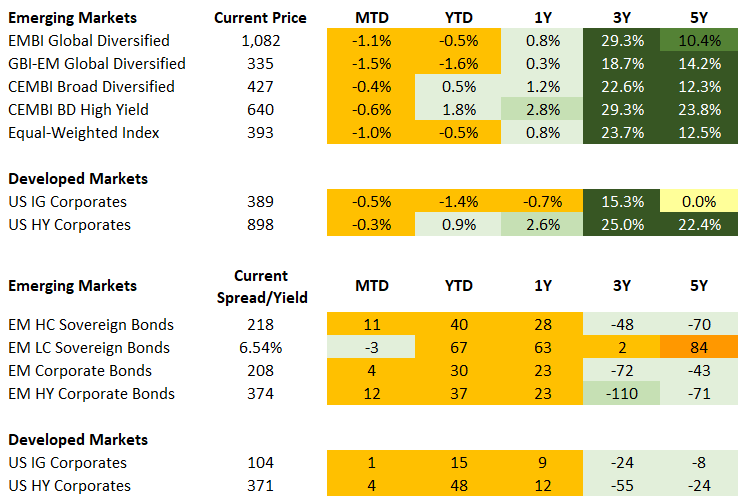
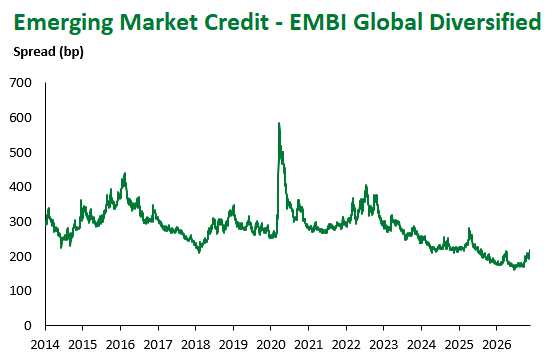
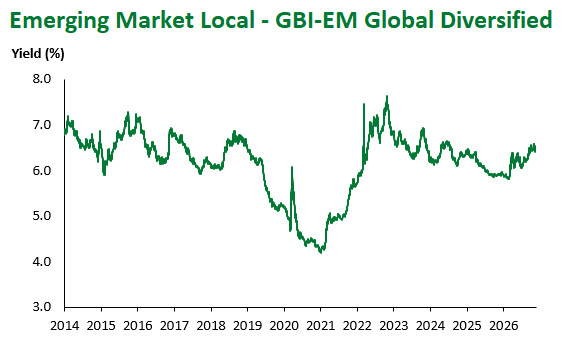
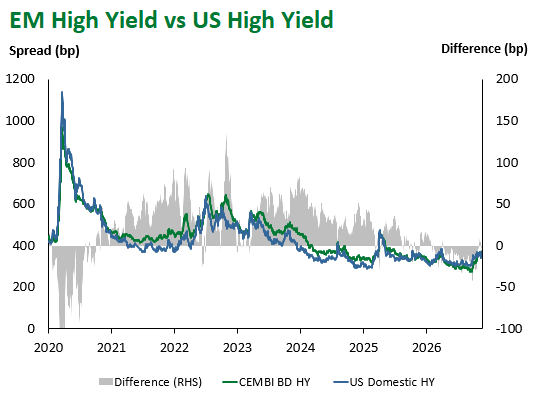
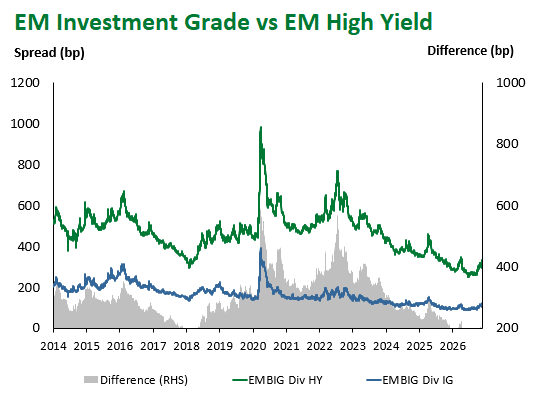
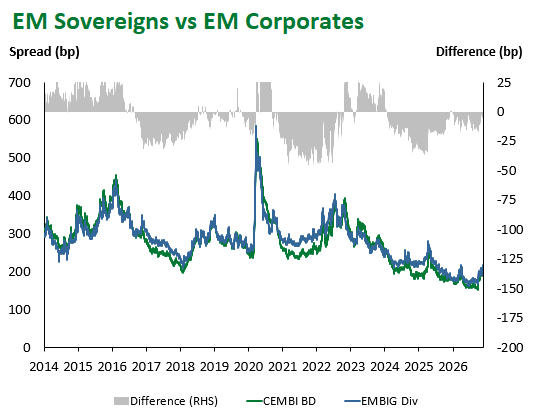
Emerging markets fixed income declined across all three sub-asset classes again, but the losses shifted from duration to credit as the dollar extended its breakout, the FOMC minutes kept a larger December hike in play and risk appetite faded around Nvidia’s results. Local currency sovereigns were again the weakest at -1.28% (GBI-EM Global Diversified), with currency losses deepening from the prior week, while hard currency sovereigns fell -0.79% and corporates -0.20%. Reversing last week’s pattern, high yield sharply underperformed investment grade in both sovereigns (-1.32% versus -0.19%) and corporates (-0.60% versus +0.05%), reflecting this week’s the flight to quality pattern.
Local currency sovereign debt returned -1.28%, with currency losses deepening across most markets. Brazil was the weakest as the real slid to its lowest level since April 2025, with President Lula, still without a finance minister, saying he would name his cabinet on his own timetable. South Africa was again among the worst performers, hit by both a weaker rand and a local bond selloff as gold broke below $3,800 and the Reserve Bank held rates despite October inflation jumping to 5.2%. Colombia, Mexico and Chile followed on FX, the peso’s slide ending Mexico’s stability of the prior week, while Peru and Egypt, last week’s only positive markets, reversed lower. Central and Eastern Europe sold off again as the euro touched a 19-month low against the dollar, with Hungary the weakest in the region. The Dominican Republic and China were the only gainers.
Hard currency sovereign bonds fell -0.79%, with high yield (-1.32%) underperforming investment grade (-0.19%) and returns falling steadily down the ratings from single-A (-0.04%) to CCC (-2.68%). Asia (-0.03%), last week’s weakest region, held up best, while Africa (-1.22%) and Latin America (-1.13%) lagged. Last week’s distressed rebound unwound, with Venezuela, Argentina, Lebanon and Ecuador among the worst performers, and Argentina’s country risk premium back above 850bps on renewed selling of dollar bonds and doubts over dollar availability for upcoming maturities. Ukraine fell sharply after Russia’s deputy foreign minister said there was no understanding on the timing or prospects of further talks, while several member states were reported to be opting out of the EU’s next round of financing for Kyiv, including a proposed EUR 45 billion loan for 2027. Angola and Nigeria led broader weakness in African high yield as Brent slipped toward $91, while Senegal and Paraguay steadied after last week’s selloff and Malaysia, India and China were among the few positive markets.
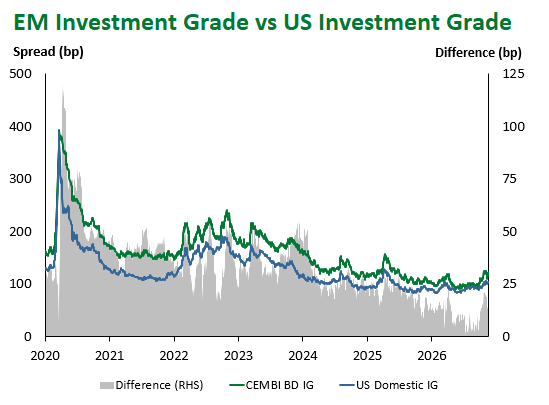
EM corporates declined -0.20%, with investment grade (+0.05%) edging higher and high yield (-0.60%) falling, inverting last week’s pattern. The rating split was the mirror image of the prior week, as AAA (+0.40%), AA (+0.33%) and single-A (+0.12%) credits gained while losses deepened from BB (-0.51%) through single-B (-0.86%) to C (-1.80%). Asia (+0.10%) was the only region in positive territory, while Europe (-0.34%), last week’s sole gainer, turned lower and Latin America (-0.62%) lagged again. The country leaderboard also flipped: Taiwan, last week’s weakest market, led alongside Iraq, Thailand and Singapore, while Ukraine, last week’s leader, was the weakest by a wide margin, followed by Argentina, Ghana, Morocco and Brazil.
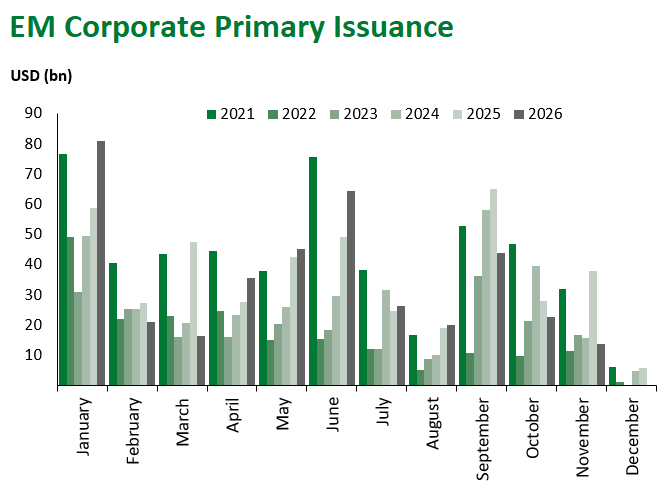
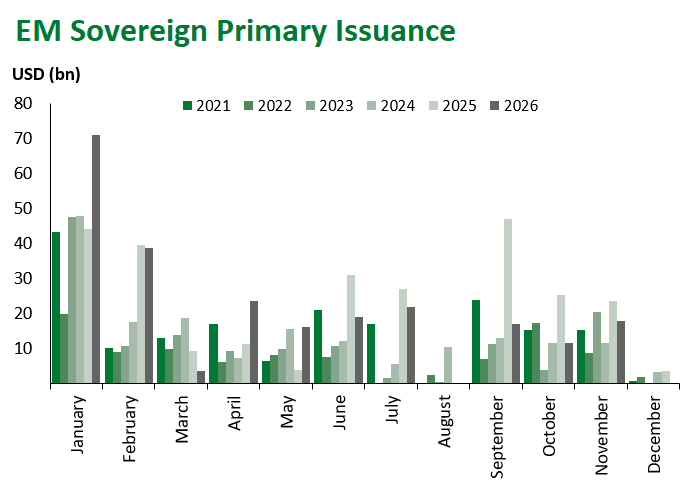
Primary market activity picked up further, with 17 issuers pricing approximately $12.8 billion in hard currency supply, up from $8.2 billion. Sovereigns accounted for around $5.2 billion: China priced a $2 billion three-year bond flat to Treasuries, 25bps inside initial guidance, while Uruguay (EUR 1.25 billion), Türkiye (a EUR 1.25 billion green bond) and Latvia (EUR 500 million) tapped the euro market. Hong Kong Mortgage Corporation raised $1.1 billion as part of a three-currency offering, Millicom ($900 million) and PT Freeport Indonesia ($750 million) led corporate supply, and Abu Dhabi Commercial Bank priced a $700 million AT1. Euro-denominated deals made up more than 40% of volume.
Fixed Income
Equities
Commodities
Source for data tables: Bloomberg, JPMorgan, Gramercy. EM Fixed Income is represented by the following JPMorgan Indicies: EMBI Global, GBI-EM Global Diversified, CEMBI Broad Diversified and CEMBI Broad High Yield. DM Fixed Income is represented by the JPMorgan JULI Total Return Index and Domestic High Yield Index. Fixed Income, Equity and Commodity data is as of November 20, 2026 (mid-day).
Emerging Markets Flows
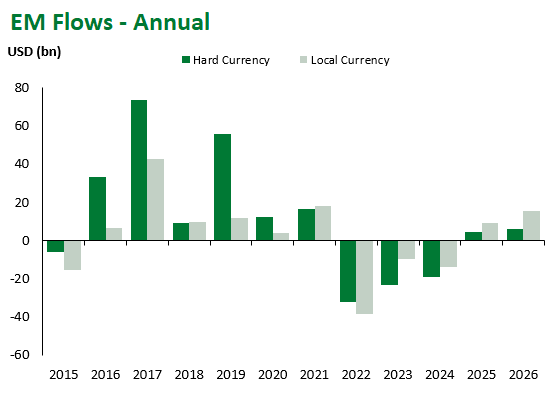
Source for graphs: Bloomberg, JPMorgan, Gramercy. As of November 20, 2026.
For questions, please contact:
Kathryn Exum, CFA ESG, Director, Co-Head of Sovereign Research, [email protected]
Petar Atanasov, Director, Co-Head of Sovereign Research, [email protected]
This document is for informational purposes only. The information presented is not intended to be relied upon as a forecast, research or investment advice, and is not a recommendation, offer or solicitation to buy or sell any securities or to adopt any investment strategy. Gramercy may have current investment positions in the securities or sovereigns mentioned above. The information and opinions contained in this paper are as of the date of initial publication, derived from proprietary and nonproprietary sources deemed by Gramercy to be reliable, are not necessarily all-inclusive and are not guaranteed as to accuracy. This paper may contain “forward-looking” information that is not purely historical in nature. Such information may include, among other things, projections and forecasts. There is no guarantee that any forecasts made will come to pass. Reliance upon information in this paper is at the sole discretion of the reader. You should not rely on this presentation as the basis upon which to make an investment decision. Investment involves risk. There can be no assurance that investment objectives will be achieved. Investors must be prepared to bear the risk of a total loss of their investment. These risks are often heightened for investments in emerging/developing markets or smaller capital markets. International investing involves risks, including risks related to foreign currency, limited liquidity, less government regulation, and the possibility of substantial volatility due to adverse political, economic or other developments. References to any indices are for informational and general comparative purposes only. The performance data of various indices mentioned in this update are updated and released on a periodic basis before finalization. The performance data of various indices presented herein was current as of the date of the presentation. Please refer to data returns of the separate indices if you desire additional or updated information. Indices are unmanaged, and their performance results do not reflect the impact of fees, expenses, or taxes that may be incurred through an investment with Gramercy. Returns for indices assume dividend reinvestment. An investment cannot be made directly in an index. Accordingly, comparing results shown to those of such indices may be of limited use. The information provided herein is neither tax nor legal advice. Investors should speak to their tax professional for specific information regarding their tax situation.