


Contents
Market Overview
Macro Update
Middle East headlines remained the key market driver this week. President Donald Trump suggested that a deal with Iran to re-open the Strait of Hormuz may be “closer than ever” and demanded an Iranian response to the latest proposal by Friday. Meanwhile, tensions seemed to flare up as both sides accused the other of violating the tenuous ceasefire and prospects for a durable resolution remain unclear. In Lebanon, Israel’s strike on Beirut, the first such attack since the start of last month’s ceasefire, also underscored the fragility of regional de-escalation.
Elsewhere, more than 30 European leaders and Canada’s Prime Minister Mark Carney met in Armenia to discuss how to strengthen collective security against a backdrop of rising tensions with the U.S. In a show of unity following the United Arab Emirates’ sudden departure from OPEC a few days ago, the oil cartel announced a modest production target increase that may prove hard to deliver if disruption in Hormuz persists.
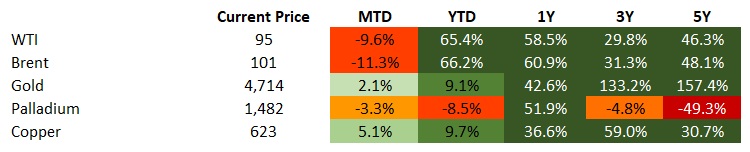
Global markets met with optimism reports that the U.S. and Iran might be getting closer to a potential diplomatic agreement to end the 10-week conflict, sending oil prices lower and equities higher; though escalation risks remain on the table. Brent crude, the global oil benchmark, tumbled to as low as $97 per barrel, from as high as $126 reached last week, but finished the week at around $100.
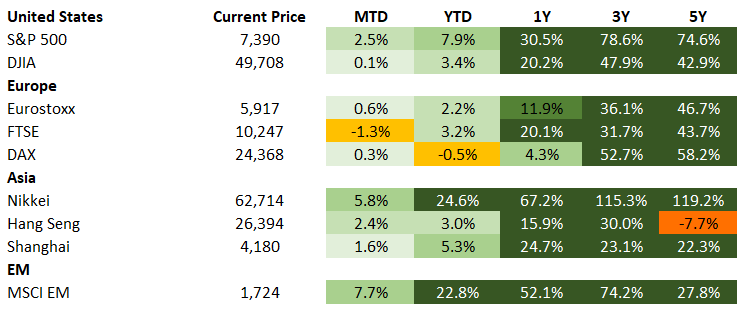
Supported by strong corporate earnings and signs of economic resilience, in addition to war resolution optimism, stock markets pushed toward fresh all-time highs. Looking through the geopolitical noise, the S&P 500 is on track for its sixth straight week of gains, the longest winning run since 2024. The U.S. treasuries curve flattened, led by the belly and long-end outperforming, with the 10Y benchmark yield 2bps lower to 4.35%. The USD was stable on the week at around 98 on the DXY. Gold and silver spot prices continued to recover, rising to around $4,700 and 80 per oz, respectively.
In terms of notable macro data, U.S. employers added to payrolls for a second month in April, marking the first back-to-back advance in nearly a year, with non-farm payrolls rising 115K last month, considerably above the consensus estimate of 65K. The unemployment rate was unchanged at 4.3%.
Meanwhile, the April ISM services index showed that the U.S. service economy expanded at a more moderate pace as orders growth slowed and input prices remained sharply higher. Initial jobless claims rebounded slightly to 200K, from 190K last week, but came in below consensus, signaling that layoffs remained limited. In contrast with the resilient macro picture painted by hard data, the so-called soft data (i.e. forward-looking sentiment) as represented by the May preliminary University of Michigan consumer sentiment fell to a second straight record low, mostly due to concerns about the impact of inflation on personal finances and buying conditions.
Elsewhere, final April manufacturing and services PMIs were revised stronger, but remained in contractionary (<50) territory; March retail sales came in line with expectations (+1.2% YoY). In China and India, final April PMIs painted a stronger picture, accelerating from the prior month and firmly in expansionary territory, especially in the case of India. April headline inflation came hotter than expected in Asian economies such as the Philippines, Thailand, and Vietnam, highlighting price pressures from the global energy price shock.
EM Credit Update
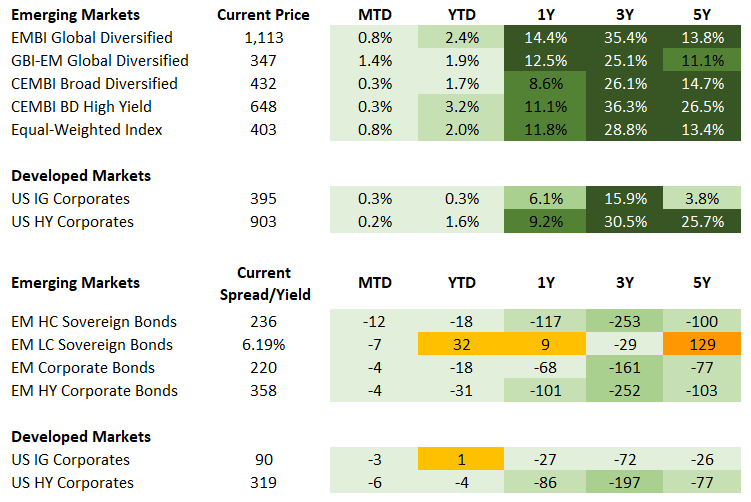
Emerging Markets (EM) fixed income delivered broad-based gains this week, with all three major sub-asset classes posting positive returns as ceasefire optimism and moderating U.S. dollar strength provided a constructive backdrop. Risk sentiment remained sensitive to headlines from the Iran-U.S. diplomatic track, but the overall tone was one of cautious relief.
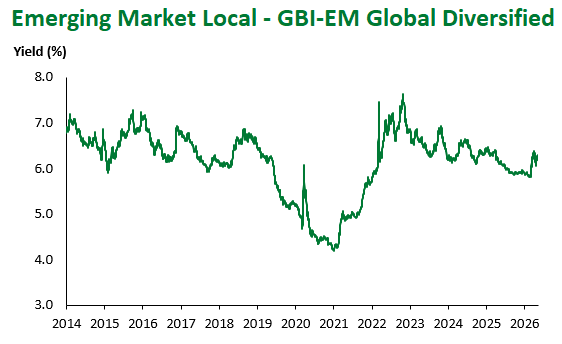
Local currency sovereign debt was the standout performer, rising +1.14% on the week, aided by the softer dollar and improving risk appetite. At the country level, Egypt (+5.04%) and South Africa (+3.86%) led gains, continuing to benefit from easing Middle East tensions and their favorable positioning as the de-escalation narrative gained traction. Hungary (+3.77%) also outperformed, with the forint extending its post-election appreciation rally as the new pro-EU government begins to take shape. The week’s clear laggard was Colombia (-3.49%), which underperformed sharply, weighed down by a combination of fiscal concerns, political uncertainty, and continued pressure on the peso. Turkey (+1.61%) posted modest gains despite ongoing inflation headwinds.
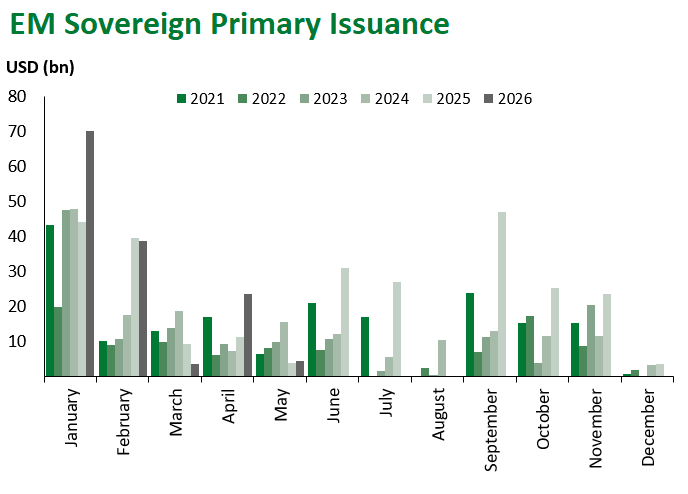
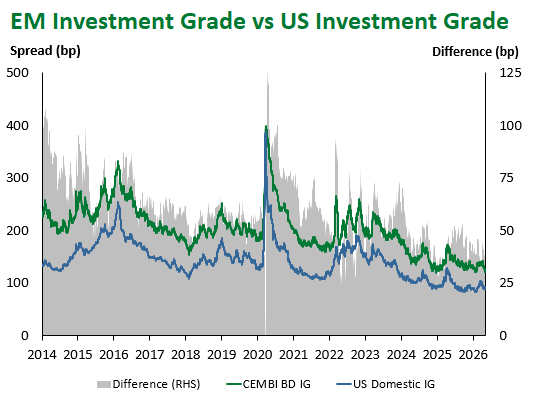
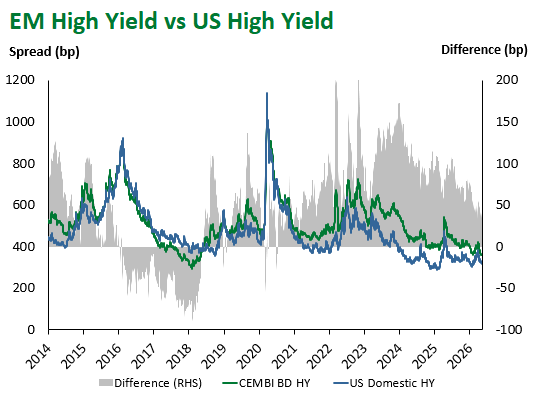
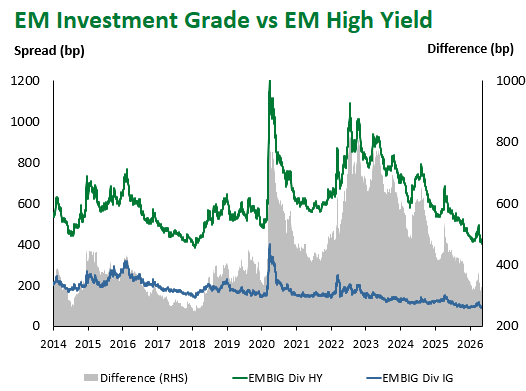
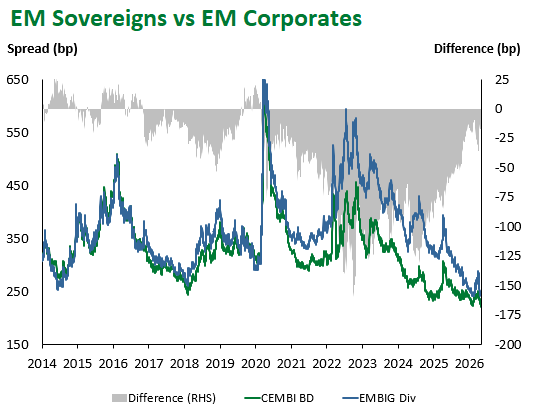
Hard currency sovereign bonds advanced +0.52% at the index level, with high yield (+0.72%) again outperforming investment grade (+0.29%). Regionally, Africa (+1.17%) led, supported by strong gains in Mozambique (+2.91%), Kenya (+2.83%), and Sri Lanka (+2.70%), while Latin America (+0.19%) lagged. Lebanon continued its remarkable run, surging +3.78% as investors markup recovery values on improved geopolitical prospects for the country. Venezuela (+2.10%) also outperformed for another week. On the negative side, Senegal (-1.76%) was the weakest performer in the index, while Colombia (-0.67%) and Suriname (-0.59%) also declined. By rating, CCC-rated credits led (+1.39%), while BBBs (+0.29%) lagged.
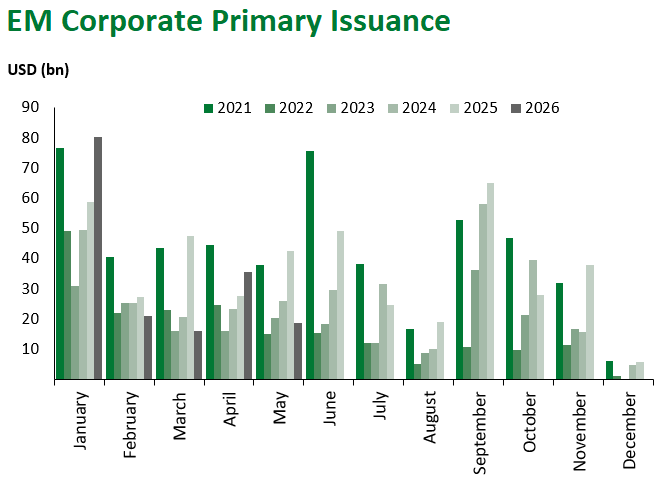
EM corporates delivered positive but more measured returns, with the index up +0.21%. High yield (+0.24%) modestly outperformed investment grade (+0.19%). Regionally, Africa (+0.26%) and Asia (+0.26%) led, while the Middle East (+0.15%) and Europe (+0.16%) lagged. Morocco was the standout at the country level (+0.84%), while Paraguay (-1.36%) was the notable underperformer. By rating, the B (+0.32%) and CCC (+0.33%) buckets outperformed, while AAA (+0.11%) and AA (+0.10%) segments lagged. Across the curve, longer-duration bonds outperformed, with the 10+ year segment gaining +0.34% versus +0.14% for the 1-3-year bucket.
Primary market activity was robust, with approximately 28 issuers pricing roughly $24 billion in hard currency supply across the week – a strong signal of returning market confidence. Mexico dominated issuance, with Cox Mexico pricing a $2 billion dual-tranche offering (7.125% 2032 and 7.75% 2036) in the utilities space, Esentia Gas Enterprises pricing a $2 billion dual-tranche investment grade deal, and Banco Nacional de Comercio Exterior and Banca Mifel each bringing subordinated transactions. Saudi Arabia’s Public Investment Fund (PIF) raised $7 billion across a triple-tranche transaction (2029, 2033, and 2056 maturities) in one of the week’s most prominent sovereign-linked deals. Ecuador returned to the market with a $1 billion dual-tranche sovereign offering (2034 and 2039). Bolivia priced a $1 billion sovereign bond at 9.75%, highlighting continued access for frontier issuers despite elevated yields. In Asia, Hong Kong priced a EUR750 million and USD500 million dual-currency sovereign transaction, Bank of East Asia raised $800 million in a subordinated IG deal, and MGM China and Studio City each brought HY corporate deals in the Macau gaming sector. Other notable transactions included a $500 million deal from Parex Resources of Colombia, a $625 million high yield offering from Oceanica Engenharia of Brazil, and a $450 million print from Golomt Bank of Mongolia.
The Week Ahead
In addition to developments in the Middle East, next week investors will focus on President Donald Trump’s high stakes visit to China for meetings with his Chinese counterpart Xi Jinping. In parallel, U.S. Treasury Secretary Scott Bessent is scheduled to visit Japan to meet with top officials including Prime Minister Sanae Takaichi. The Fed’s leadership transition will also be in the spotlight as the U.S. Senate returns from recess and is expected to vote a motion related to Kevin Warsh’s nomination as Fed Chair and Jerome Powell’s term ends. In Europe, Russia holds its Victory Day military parade, commemorating the end of World War II, as Moscow and Kyiv continue to exchange air strikes ahead of the parade on May 9. Peter Magyar will take the oath of office as Hungary’s new prime minister. In the world of macro data, April inflation data will be reported in the U.S., China, Germany, France, and India, among others. Other U.S. data releases include initial jobless claims and April retail sales and in the Euro area and the UK, 1Q GDP estimates are due as well as March industrial production.
Fixed Income
Equities
Commodities
Source for data tables: Bloomberg, JPMorgan, Gramercy. EM Fixed Income is represented by the following JPMorgan Indicies: EMBI Global, GBI-EM Global Diversified, CEMBI Broad Diversified and CEMBI Broad High Yield. DM Fixed Income is represented by the JPMorgan JULI Total Return Index and Domestic High Yield Index. Fixed Income, Equity and Commodity data is as of May 8, 2026 (mid-day).
Highlights
Constructive Trump-Lula meeting signals goodwill to manage challenging bilateral issues
Event: U.S. and Brazilian Presidents Donald Trump and Luiz Inacio Lula da Silva met in Washington to discuss tariffs, critical minerals, organized crime, and regional issues.
Gramercy Commentary: The meeting lasted around three hours, and the overall tone appeared to be constructive. The face-to-face interaction between the two leaders follows previous phone calls that have successfully de-escalated their relationship and signals that both administrations are open to engagement despite significant ideological and foreign policy differences. An agreement on critical minerals is the White House’s top priority, while a broad trade deal remains unlikely. However, given the seemingly improving personal relationship between the two presidents that limits the risk of abrupt escalations, Section 301 tariffs on Brazilian exports to the U.S. will likely be less onerous than previously feared. In any case, the constructive tone between Trump and Lula that has replaced their earlier public spats has reassured markets, contributing to the general strong investor sentiment on Brazil. Risk appetite is also underpinned by resilient fundamentals and recent positive terms of trade developments that have driven close to a 40% year-over-year increase in the country’s trade surplus in April. Going forward, continued constructive market sentiment hinges mostly on domestic fiscal and political dynamics ahead of presidential and congressional elections in October.
Argentina ratings upgraded to B-
Event: Fitch lifted Argentina’s ratings one notch to B- with a stable outlook, citing structurally improved fiscal and external balances, tangible progress on economic reforms, and stronger prospects for FX reserve accumulation. The agency also noted expectations that the country will secure adequate financing to near-term cover debt obligations. Key downside factors include sizeable debt maturities, disinflation resistance, uneven growth dynamics, and electoral uncertainty. Eurobonds rallied moderately on the news.
Gramercy Commentary: The upgrade into the B-category should catalyze marginal demand for Argentine debt, though investor confidence remains a critical variable. Markets will continue to focus on reserve accumulation progress, the scope of the external financing envelope, and evolving political dynamics. A sustained compression in country risk premium will require the authorities to demonstrate further progress on accumulation targets and pre-finance a meaningful portion of next year’s obligations, all while keeping economic and political risks contained.
Venezuela receives U.S. license to hire restructuring advisors
Event: The U.S. Treasury issued an OFAC general license authorizing the Venezuelan government and PDVSA to engage financial, legal, and consulting services in connection to debt restructuring. Restrictions on direct creditor negotiations remain in place. Following the news, it was announced that White & Case was hired by PDVSA to protect its interests in the pending CITGO sale.
Gramercy Commentary: The development marks another constructive step forward, enabling preparatory groundwork for debt negotiations to commence. Resolving Venezuela’s sustainable debt overhang will be essential to accelerating economic recovery and stabilization. Key milestones to watch include the announcement of additional advisory mandates, initial IMF engagement, and future licenses permitting direct creditor negotiations and restructuring execution.
Emerging Markets Technicals
Emerging Markets Flows
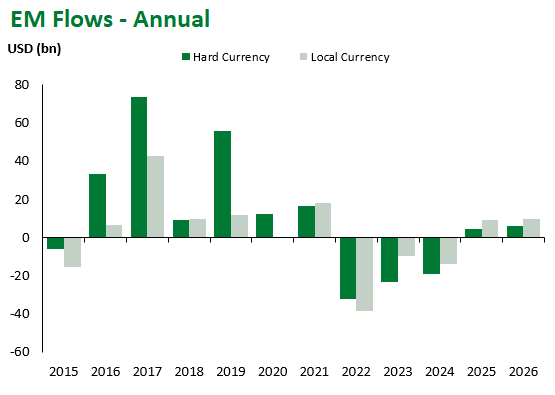
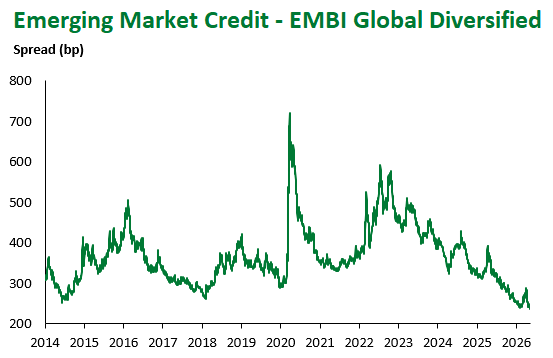
Source for graphs: Bloomberg, JPMorgan, Gramercy. As of May 8, 2026.
For questions, please contact:
Kathryn Exum, CFA ESG, Director, Co-Head of Sovereign Research, [email protected]
Petar Atanasov, Director, Co-Head of Sovereign Research, [email protected]
This document is for informational purposes only. The information presented is not intended to be relied upon as a forecast, research or investment advice, and is not a recommendation, offer or solicitation to buy or sell any securities or to adopt any investment strategy. Gramercy may have current investment positions in the securities or sovereigns mentioned above. The information and opinions contained in this paper are as of the date of initial publication, derived from proprietary and nonproprietary sources deemed by Gramercy to be reliable, are not necessarily all-inclusive and are not guaranteed as to accuracy. This paper may contain “forward-looking” information that is not purely historical in nature. Such information may include, among other things, projections and forecasts. There is no guarantee that any forecasts made will come to pass. Reliance upon information in this paper is at the sole discretion of the reader. You should not rely on this presentation as the basis upon which to make an investment decision. Investment involves risk. There can be no assurance that investment objectives will be achieved. Investors must be prepared to bear the risk of a total loss of their investment. These risks are often heightened for investments in emerging/developing markets or smaller capital markets. International investing involves risks, including risks related to foreign currency, limited liquidity, less government regulation, and the possibility of substantial volatility due to adverse political, economic or other developments. References to any indices are for informational and general comparative purposes only. The performance data of various indices mentioned in this update are updated and released on a periodic basis before finalization. The performance data of various indices presented herein was current as of the date of the presentation. Please refer to data returns of the separate indices if you desire additional or updated information. Indices are unmanaged, and their performance results do not reflect the impact of fees, expenses, or taxes that may be incurred through an investment with Gramercy. Returns for indices assume dividend reinvestment. An investment cannot be made directly in an index. Accordingly, comparing results shown to those of such indices may be of limited use. The information provided herein is neither tax nor legal advice. Investors should speak to their tax professional for specific information regarding their tax situation.