


Executive Summary
The Democratic sweep weakened the dollar, and EM local currency led the week. The result helped push the dollar lower, and local currency sovereigns gained 1.13%, well ahead of hard currency sovereigns (+0.34%) and corporates (+0.29%). Currency gains drove most markets.
Oil’s steepest weekly fall since 2020 lifted frontier energy importers. Brent dropped below $95 on Wednesday on hopes of de-escalation, and frontier credits topped the hard currency table, including importers Egypt, Kenya, Sri Lanka and Pakistan. Oil relief didn’t help Latin America as markets where the Trump administration has been especially active such as Argentina and Venezuela struggled.
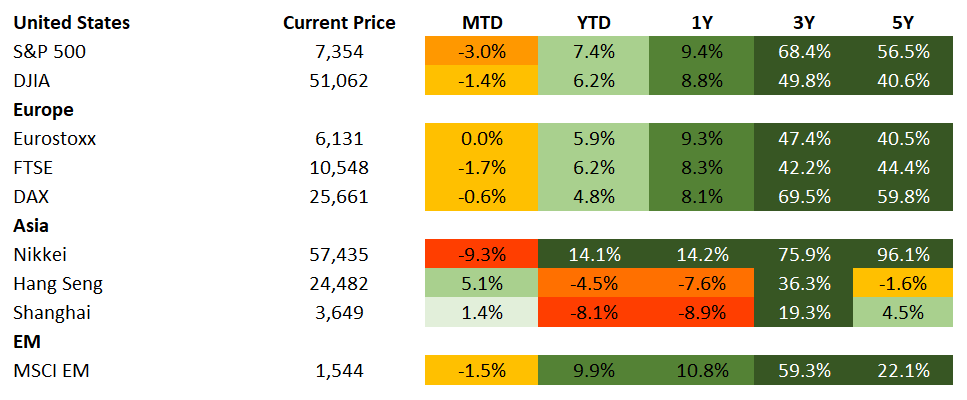
The AI rout pressured equities, while strong U.S. data pushed credit toward quality. The Nasdaq 100’s worst day since 2020 didn’t spread into EM credit: Taiwan was among the top corporate performers and Asia finished positive. Strong payrolls lifted December hike odds to around 80% and the 2-year yield about 5bp, and EM credit leaned toward quality: IG beat HY in sovereigns (+0.48% vs. +0.22%) and corporates (+0.43% vs. +0.07%), and the 1-3 year bucket was the only part of the sovereign curve to decline, while the long end led.
Market Overview
Macro Update
Democrats swept Tuesday’s U.S. midterm elections, winning control of both chambers of Congress by a wider margin than expected and repricing two of the year’s dominant market trades. The party secured at least 54 Senate seats and is on course for its largest House majority since 2008, with Vice President Vance blaming the Iran war for the losses. Markets read the result through two channels: a faster path to de-escalation in the Gulf, which sent oil to its steepest weekly fall since 2020, and tighter scrutiny of the AI data-center buildout, which triggered the worst day for U.S. technology stocks since March 2020. The new Congress does not sit until January, but for global investors the vote has shifted the balance of risks on oil, AI and U.S. fiscal policy.
Crude led the repricing. Brent fell 8.7% on Wednesday to below $95 per barrel, its lowest close since August 31, and closed the week around $97 as traders bet a weakened Trump administration would move toward a deal with Iran. However, Iran called Washington’s reply to its seven conditions for reopening Hormuz “unconvincing,” and data show attacks on oil-carrying ships still running close to a record pace. President Trump told the Financial Times he has no immediate plans for new strikes, while The New York Times reported that U.S. air and naval forces are ready to resume the war on his orders. With spot premiums for Middle Eastern crude already back at pre-war levels, the market is pricing a settlement that has not been reached, which leaves oil exposed to a sharp reversal if diplomacy stalls.
Thursday brought the worst day for U.S. technology stocks since March 2020. The Nasdaq 100 fell 6.4%, the S&P 500 lost 4.4% and the Philadelphia semiconductor index dropped 12.3%, its second-largest decline on record, as Democratic gains in key data center states stoked fears of tighter AI regulation and a slower buildout, compounded by a weak outlook from Qualcomm.
In the meantime, U.S. data offered no reason for the Fed to step back. October payrolls rose 165,000, almost three times the consensus, September was revised up to 60,000 and the unemployment rate fell to 4.1%, although long-term unemployment rose. The 2-year yield rose about 5bps to roughly 4.52% after the release while the benchmark 10-year was almost unchanged at about 3bps to around 4.85%, with futures putting the odds of a December hike near 80%, from 70% before the payrolls release. All else equal, a tightening Fed and the prospect of heavier treasury supply next year could limit the space for further fall in U.S. yields over the near-term, even with oil retreating.
The Bank of England raised Bank Rate by 25bps to 4% in an 8-1 vote, its first increase since August 2023, with Catherine Mann voting for 50bps, and warned that at least one further hike is likely if the U.S.-Iran conflict continues, with energy accounting for most of the inflation overshoot. Sterling’s trade-weighted index reached its highest since the 2016 EU referendum, helped by a weaker dollar after the midterms. With the BoE and the Bank of Canada already hiking and December moves priced for the Fed and the ECB, softer oil has yet to change the direction of developed market rates, which limits the relief for EM local markets.
In Brazil, COPOM unanimously held the Selic at 13.75% on Wednesday, ending a run of five consecutive cuts and citing a deterioration in inflation expectations after the election, a significant increase in uncertainty and the need for “serenity and cautiousness.” Lula has yet to name his economic team for the new term or set out a fiscal plan, which is the key focus for markets.
The Week Ahead
October CPI on Tuesday is the main test for the Fed’s December hike after September’s 3.7% headline reading, followed by PPI on Friday, and the Treasury sells 3-, 10- and 30-year debt in the first auctions since the refunding opened the door to larger issuance in 2027. China releases October CPI and PPI on Monday, trade data on Tuesday and credit data on Friday, and Applied Materials and Cisco report on Thursday ahead of Nvidia’s results on November 17, the next test for the AI trade after this week’s rout. On Iran, the watch-points are whether President Trump moves toward a deal or new strikes now that the election is behind him, along with Qatar’s mediation and the pace of attacks on tankers near Hormuz. In Brazil, attention turns to Lula’s choice of finance minister and fiscal framework. For EM investors, the week will show whether the oil relief and the AI selloff extend, the two moves now setting the direction for energy importers and EM Asia into year-end.
Highlights
COPOM pauses easing as Lula’s team lines up fiscal measures; the president’s address to the nation and economic team appointments are the next tests
Event: The COPOM, the Monetary Policy Committee of Brazil’s central bank, kept the Selic policy interest rate unchanged at 13.75% as expected by market consensus, ending five consecutive 25bps cuts. The statement offered no forward guidance and did not rule out future easing, but cited a more adverse external backdrop, inflation above the tolerance band, rising inflation expectations, continued caution over fiscal policy, second-round effects from oil supply shocks, resilient services inflation, and a persistently weak currency, even as domestic activity slows more sharply. Notably, it described the current policy stance as “substantially contractionary” and appropriate for a more uncertain environment. Meanwhile, Vice President Geraldo Alckmin is gaining ground as the potential finance minister, with Piauí Governor Rafael Fonteles as a strong alternative.
Investment Implications: This week’s developments are broadly consistent with the view we set out after the runoff: some fiscal course correction is inevitable, and the extraordinarily high real interest rate burden on the economy and the government’s balance sheet makes it a priority for the new administration. The COPOM’s pause makes that link explicit. With post-election currency weakness and rising inflation expectations, the central bank has signaled that further easing will depend on the fiscal side, so the path to lower rates now runs through the credibility of the administration’s package rather than through monetary policy. The early signals are encouraging: a bill anchoring compliance to the midpoint of the fiscal target and expanding spending freezes is a meaningful step toward restoring the framework’s credibility, and both leading candidates for finance minister would signal a course correction, with Alckmin likely to bring better-known private-sector names into the ministry and therefore the stronger market signal. The proposed taxation of currently exempt instruments, applied to new issuance, should also be a supportive technical for local government bonds. We also take comfort that Lula is unlikely to endorse measures that undermine the central bank’s commitment to low inflation, given his working relationship with Governor Galípolo and a shared interest in avoiding headlines that weaken the BRL. Board nominations will likely be coordinated with Galípolo, and any discussion of raising the inflation target is likely to be deferred to 2027. The main medium-term risk lies there. Lula can appoint up to six directors through 2027, and slower growth or a further fall in his approval could revive pressure for a higher target and more dovish appointments. Net, if the November 8 address that Lula is expected to give, the composition of the package, and the cabinet appointments in late November confirm a credible course correction, we see scope for local rates to retrace part of the post-election selloff and for the BCB to resume easing in 2027. A diluted package or a finance minister read as fiscally accommodative would likely extend the repricing.
Paraguay’s Ueno Bank crisis triggers Peña resignation
Event: On November 5, President Santiago Peña announced his resignation as Congress began debating impeachment proceedings following the collapse of Ueno Bank. Opposition lawmakers, joined by dissenting members of the ruling Colorado Party, had filed impeachment charges against Peña and Vice President Pedro Alliana, while Colorado Party leader Horacio Cartes publicly backed Peña’s removal. The crisis marks a significant rupture within the Colorado Party, which has dominated Paraguayan politics for decades. Earlier, on November 4, Peña nominated Raúl Vera Bogado, an economist and former BCP governor, to lead the central bank following the resignation of his predecessor after the BCP moved to resolve Ueno Bank, one of Paraguay’s largest banks by deposits and customer base, for breaching minimum solvency requirements. The outgoing governor’s previous management role at Ueno’s predecessor, alongside Peña’s past links to the bank’s parent group, had drawn the resolution into the political arena. Alliana is next in line to assume the presidency. If he does not take office, congressional leader Basilio Núñez would be next in the succession process. Paraguayan bonds underperformed lower-beta regional peers earlier in the week, with losses extending moderately following Peña’s resignation.
Investment Implications: Peña’s resignation shifts the focus to the leadership transition and the extent of policy continuity under a new administration. Alliana remains constitutionally next in line, but the lower house has also convened to consider impeachment charges against him, increasing uncertainty around his ability to assume the presidency and bringing a potential succession by Senate President Basilio Núñez into sharper focus. Both Alliana and Núñez are members of the ruling Colorado Party, suggesting broad policy continuity under either scenario, although investors will scrutinize the implications more closely under a Núñez-led transition. Any changes at the Ministry of Finance will be an important signal, with continuity remaining the base case at this stage. Separately, Vera Bogado’s nomination brings experienced leadership to the central bank at a sensitive point in the Ueno resolution. The deposit guarantee scheme provides a buffer for covered depositors, although potential losses on uninsured balances and substantial public-sector deposits remain sources of contingent fiscal risk. Fiscal execution also warrants attention, given supplier arrears recognized this year and a deficit trajectory that remains above the fiscal rule through 2027. The guaraní is another sensitivity, reflecting the high foreign-currency share of public debt. Overall, Paraguay’s relatively strong sovereign balance sheet remains an important source of support for spreads, with public debt below 40% of GDP.
Market Data
EM Credit Update
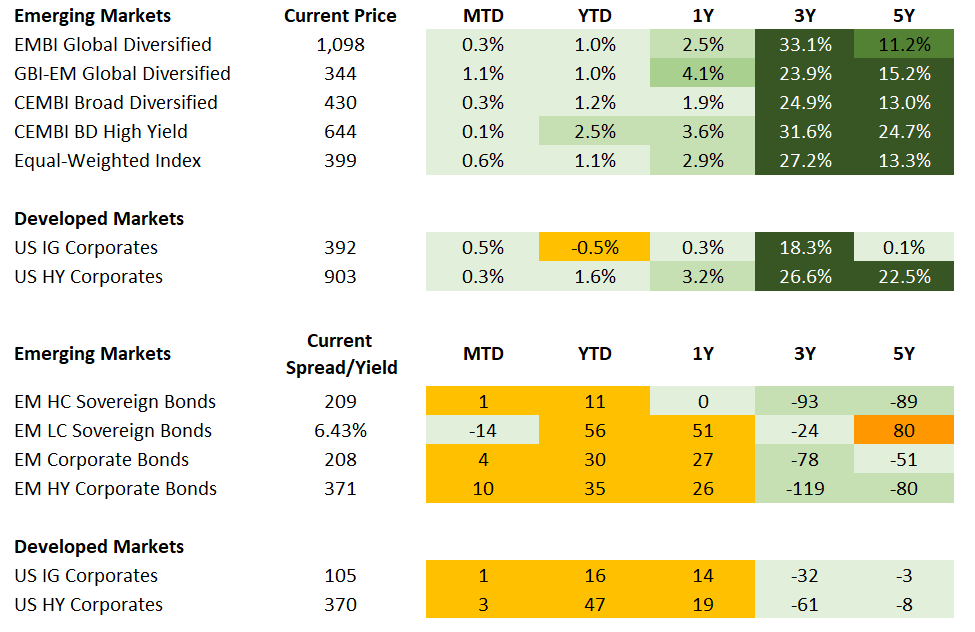
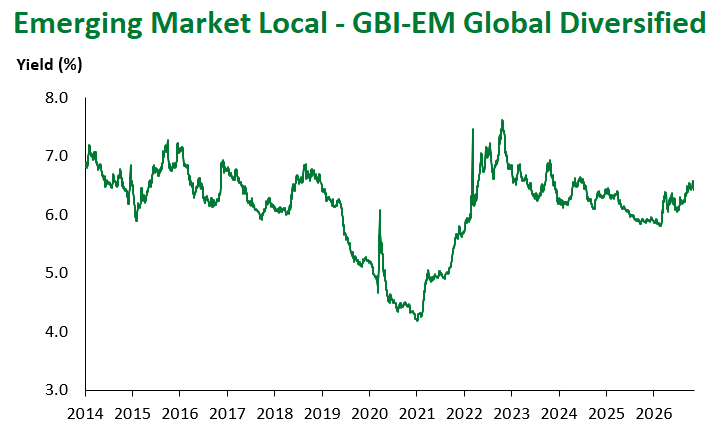
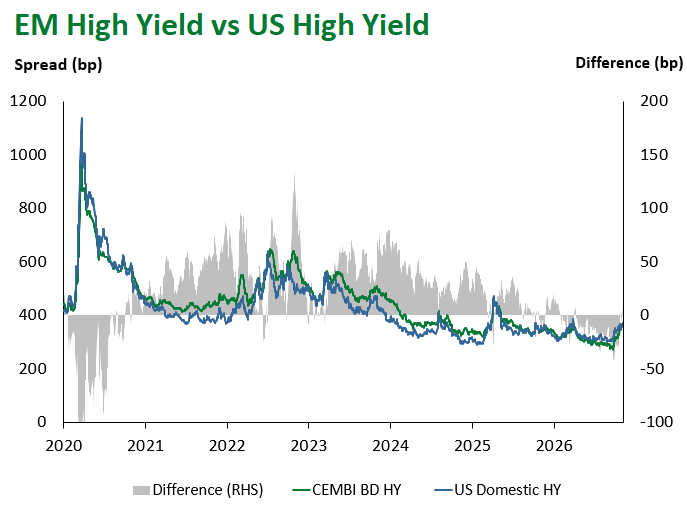
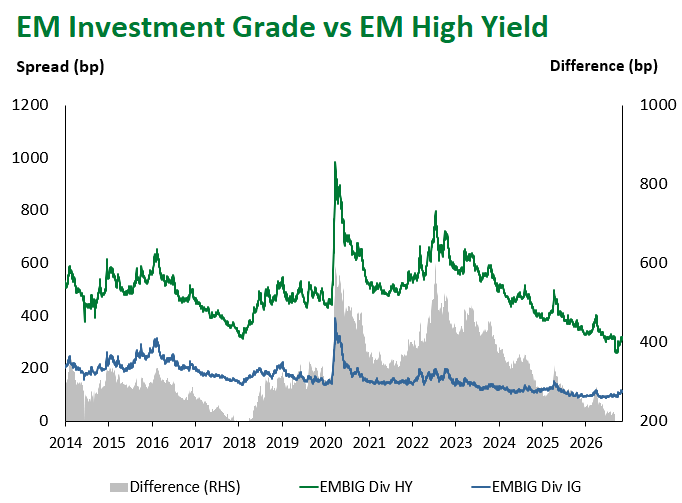
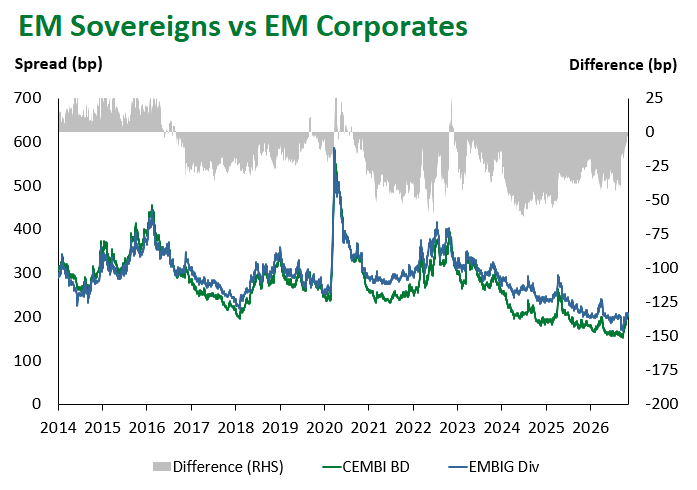
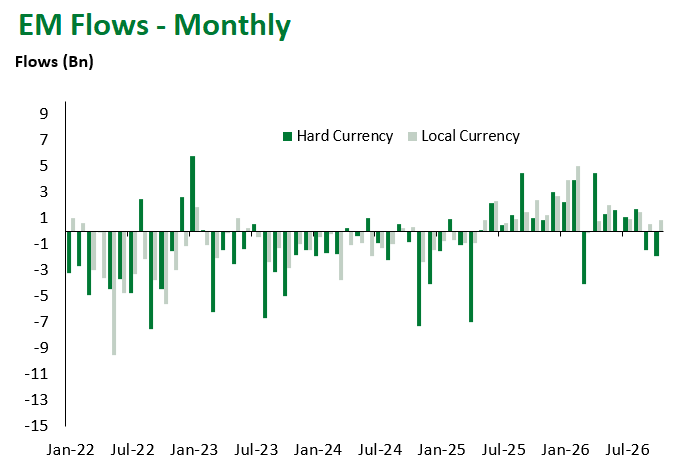
Emerging markets fixed income advanced across all three sub-asset classes this week, with local currency debt the clear leader as markets digested the Democratic sweep of both chambers of Congress in the U.S. midterms and the dollar finished the week weaker despite a partial rebound after November 4. Local currency sovereigns rose +1.13%, well ahead of hard currency sovereigns (+0.34%) and corporates (+0.29%). In the dollar space, investment grade outperformed high yield in both sovereigns and corporates, and the long end led the sovereign curve. The gains were broad, but the distressed tail moved sharply against the market. Venezuela and Argentina posted the largest declines in the sovereign index, and the unrated and CCC cohorts were the only rating segments in negative territory.
Local currency sovereign debt returned +1.13% at the index level, with currency appreciation contributing positively in most markets on the back of the weaker dollar. Egypt (+4.24%) was the standout, almost entirely on currency gains. South Africa and the Czech Republic followed on a local rates rally, with Poland and Mexico also posting solid price-driven gains, while Chile’s advance was currency-led. Latin America was split: Colombia and Brazil were the weakest markets in the index, as currency losses more than offset gains in local bond prices, and Uruguay also finished lower. Türkiye posted a modest gain, with carry absorbing a weaker lira.
Hard currency sovereign bonds gained +0.34%, with investment grade (+0.48%) outperforming high yield (+0.22%). Regionally, Africa led, followed by the Middle East, Europe, and Asia, while Latin America was the only region in the red, with the loss concentrated in two names. Venezuela (-8.50%) sold off on reports that Secretary of State Marco Rubio, the architect of the administration’s Venezuela policy, may leave, raising the risk of a softer or less predictable U.S. stance. Argentina (-4.73%) fell on a spike in overnight peso repo rates and mounting concern over roughly $25 billion of hard currency debt payments due in 2027. Paraguay also lagged as the Ueno Bank collapse turned into a political crisis that ended with President Peña’s resignation, and Ecuador finished lower as well. Frontier credits dominated the top of the table: Gabon, Egypt, and Kenya led, followed by Mozambique, Sri Lanka, Ukraine, and Pakistan. By rating, every investment grade and BB/B bucket advanced, while unrated (-5.92%), weighed down by Venezuela, and CCC were the only negative segments. Along the curve, the long end outperformed, while the 1-3 year segment was the only one to decline.
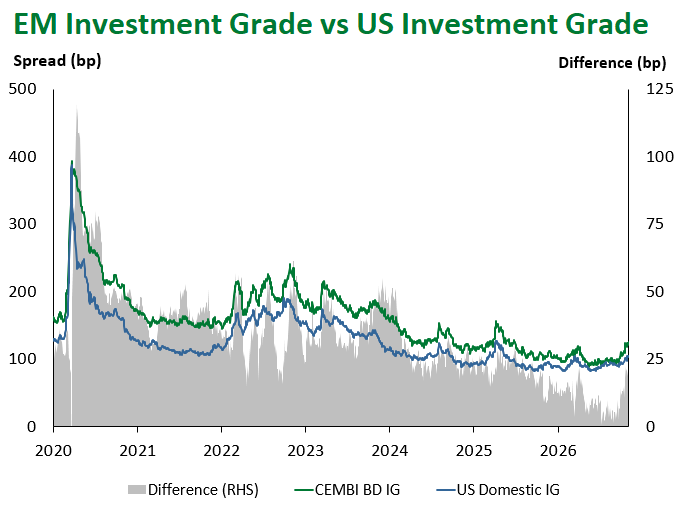
EM corporates delivered +0.29%, with investment grade (+0.43%) well ahead of high yield (+0.07%). Regional performance was tightly grouped, with the Middle East, Asia, Africa, and CEEMEA all posting similar gains and Europe slightly behind, while Latin America was again the only region in negative territory. The largest drag came from Paraguay, where the central bank put Ueno Bank into resolution after its capital fell below half the required solvency level, while Argentine corporates sold off alongside the sovereign and Costa Rica also lagged. Ukraine led at the country level, followed by Israel, Taiwan, Morocco, and Iraq. By rating, the C bucket was the strongest performer, in contrast to sovereigns, while BB and B were marginally negative and the investment grade buckets all advanced.
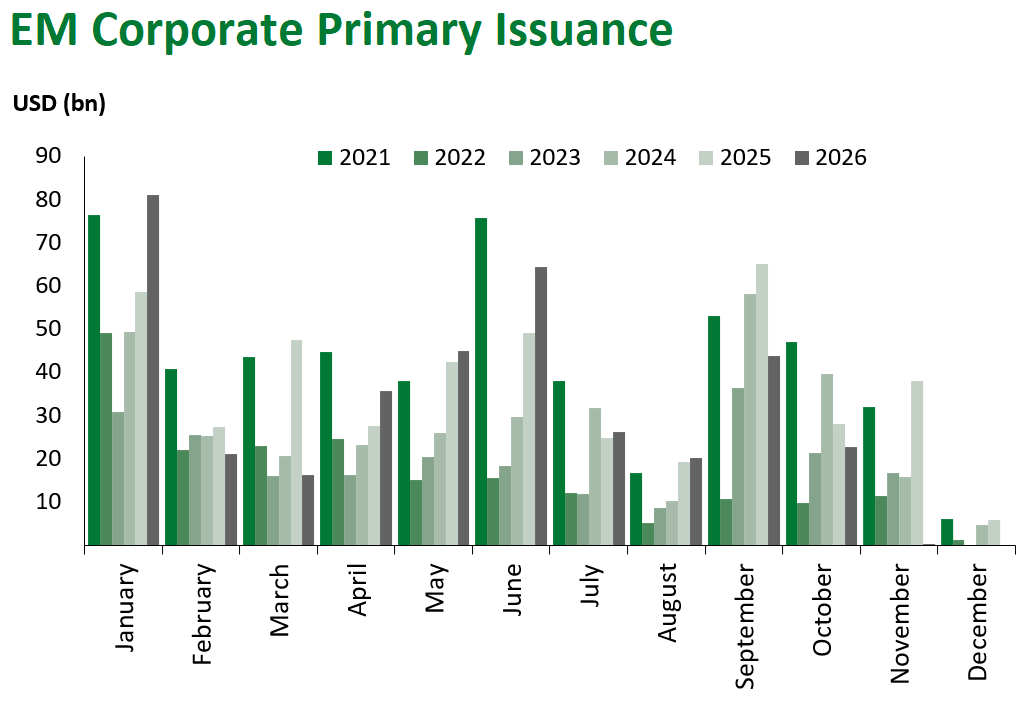
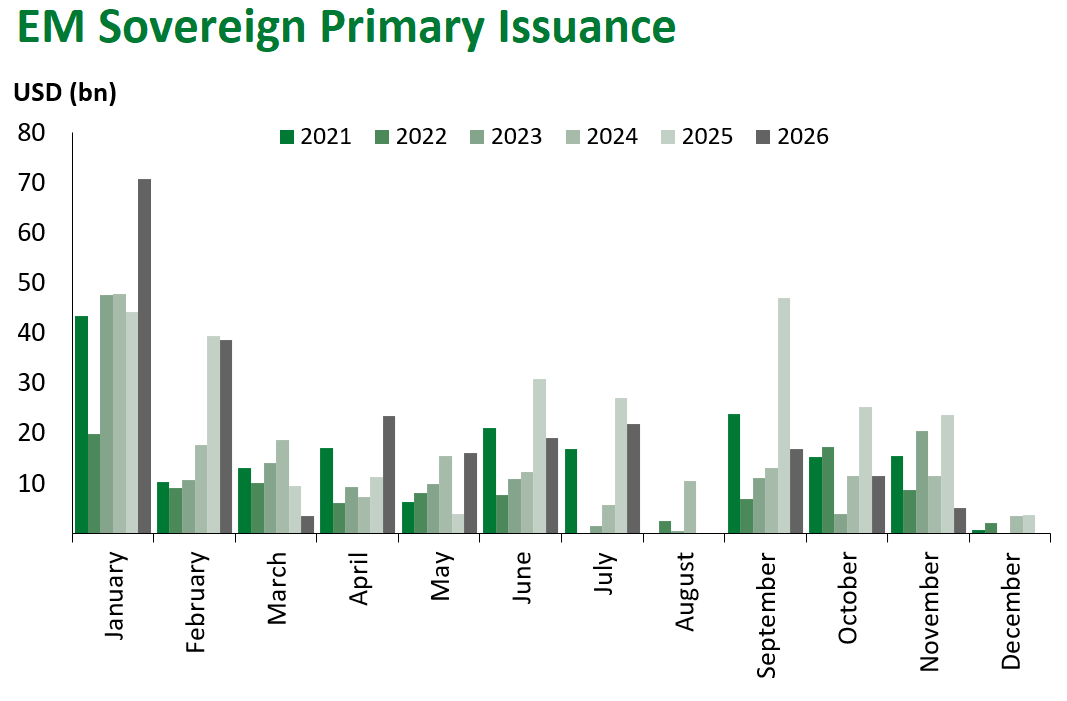
Primary market activity was light, with two issuers pricing approximately $5.4 billion of hard currency supply, almost all of it from a single sovereign. Romania raised EUR4.5 billion (roughly $5.0 billion) across 2030, 2034, and 2038 tranches, the longest in sustainable format. The only high yield deal came from Honduras’s Distrito Central municipality, which priced a $375 million five-year bond.
Fixed Income
Equities
Commodities
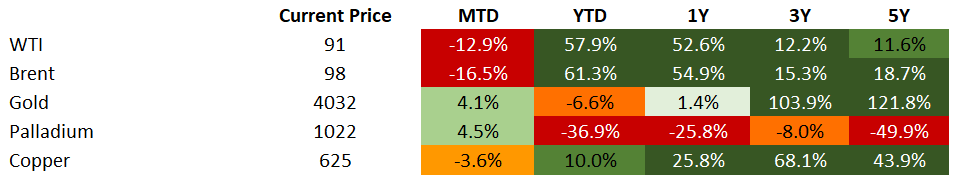
Source for data tables: Bloomberg, JPMorgan, Gramercy. EM Fixed Income is represented by the following JPMorgan Indicies: EMBI Global, GBI-EM Global Diversified, CEMBI Broad Diversified and CEMBI Broad High Yield. DM Fixed Income is represented by the JPMorgan JULI Total Return Index and Domestic High Yield Index. Fixed Income, Equity and Commodity data is as of November 6, 2026 (mid-day).
Emerging Markets Flows
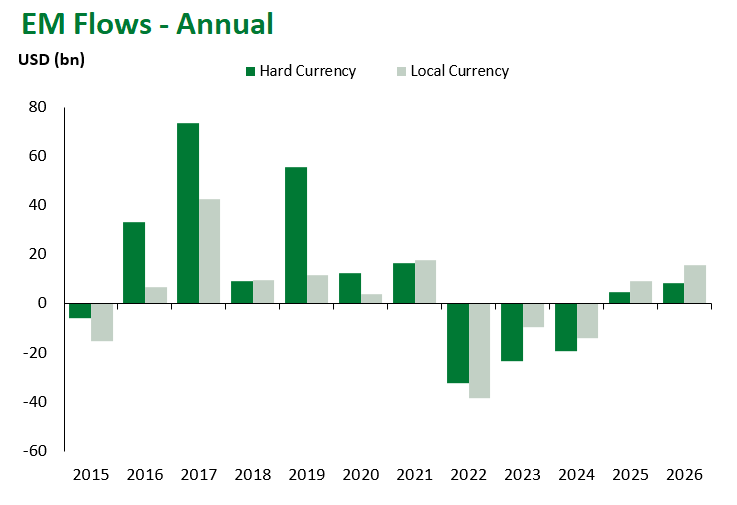
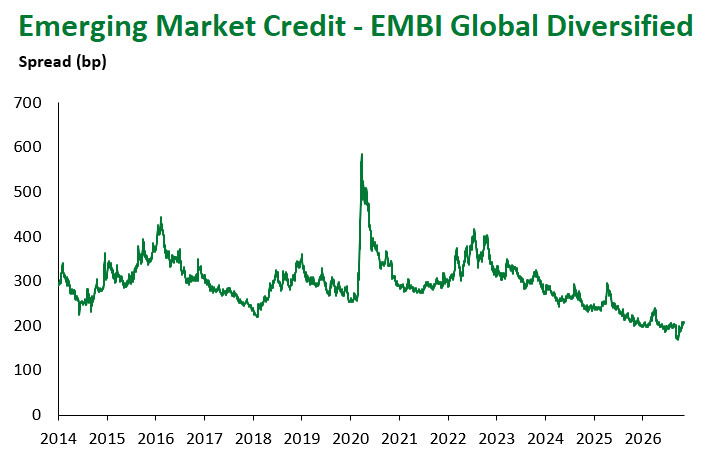
Source for graphs: Bloomberg, JPMorgan, Gramercy. As of November 6, 2026.
For questions, please contact:
Kathryn Exum, CFA ESG, Director, Co-Head of Sovereign Research, [email protected]
Petar Atanasov, Director, Co-Head of Sovereign Research, [email protected]
This document is for informational purposes only. The information presented is not intended to be relied upon as a forecast, research or investment advice, and is not a recommendation, offer or solicitation to buy or sell any securities or to adopt any investment strategy. Gramercy may have current investment positions in the securities or sovereigns mentioned above. The information and opinions contained in this paper are as of the date of initial publication, derived from proprietary and nonproprietary sources deemed by Gramercy to be reliable, are not necessarily all-inclusive and are not guaranteed as to accuracy. This paper may contain “forward-looking” information that is not purely historical in nature. Such information may include, among other things, projections and forecasts. There is no guarantee that any forecasts made will come to pass. Reliance upon information in this paper is at the sole discretion of the reader. You should not rely on this presentation as the basis upon which to make an investment decision. Investment involves risk. There can be no assurance that investment objectives will be achieved. Investors must be prepared to bear the risk of a total loss of their investment. These risks are often heightened for investments in emerging/developing markets or smaller capital markets. International investing involves risks, including risks related to foreign currency, limited liquidity, less government regulation, and the possibility of substantial volatility due to adverse political, economic or other developments. References to any indices are for informational and general comparative purposes only. The performance data of various indices mentioned in this update are updated and released on a periodic basis before finalization. The performance data of various indices presented herein was current as of the date of the presentation. Please refer to data returns of the separate indices if you desire additional or updated information. Indices are unmanaged, and their performance results do not reflect the impact of fees, expenses, or taxes that may be incurred through an investment with Gramercy. Returns for indices assume dividend reinvestment. An investment cannot be made directly in an index. Accordingly, comparing results shown to those of such indices may be of limited use. The information provided herein is neither tax nor legal advice. Investors should speak to their tax professional for specific information regarding their tax situation.