


Executive Summary
The Fed repricing made it a duration selloff. Hot core CPI and hawkish remarks from Waller and Logan left about 27bps priced for December 9. The 2-year rose roughly 30bps on the week to about 4.85%, and the 10-year moved back above 5%. EM fixed income fell in all three sub-asset classes, and in the dollar space duration drove the losses.
The dollar breakout hit local markets through currencies. With the DXY above 103 for the first time since May 2025, local currency sovereigns were the clear underperformer (−1.00%), almost entirely on FX.
The AI selloff and Nvidia’s leadership shock made Asia the weak spot. Chipmakers sold off again, the S&P 500 and Nasdaq 100 gave up their early-week gains, and the VIX stayed above 20 after Jensen Huang resigned. In EM credit, Asia was the weakest region in hard currency sovereigns (−0.68%) and lagged in corporates (−0.44%), with Taiwan the worst corporate market. The Middle East (−0.15%) and Africa (−0.23%) were the most resilient sovereign regions.
Market Overview
Macro Update
A hotter-than-expected October CPI print and hawkish Fed commentary put further tightening back at the center of the market’s agenda this week. CPI rose 0.4% on the month and core 0.3%, both a tenth above consensus and the third straight 0.3% core reading, although a gap in last year’s data meant no official annual rate was published. Governor Waller backed a December hike and left the door open to 50bps, saying a half-point move should be considered if core came in around 0.3%, while Dallas Fed President Logan called for at least two more hikes, leaving markets pricing roughly 27bps for the December 9 meeting. Treasuries sold off across the curve, also pressured by a 10-year auction that drew underwhelming demand. The 2-year finished around 30bps higher on the week at around 4.85%, and the 10-year yield moved back above 5% for the first time since late October to around 5.13%.
October PPI came in softer than expected on the headline, rising 0.3% against a 0.4% forecast and providing a small measure of relief after the hot CPI print, although annual producer inflation reached 6.5%. With the last major inflation data before December 9 now in, the Fed is on course for its second hike of the cycle, and the debate over its size keeps pressure on the front-end rate differentials that matter most for EM local markets.
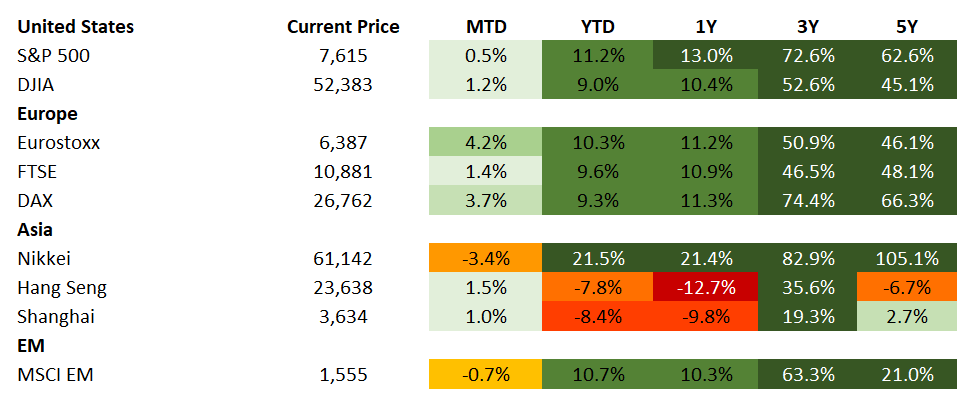
After initially attempting to rebound, another selloff in chipmakers weighed on stocks, overshadowing the softer producer inflation data that eased concerns about aggressive Fed rate hikes. The S&P 500 and Nasdaq 100 wiped out earlier gains as short-dated Treasuries outperformed.
The VIX, which spiked last week to its highest level since early April, partially retreated but remained above the psychological 20 level. Dip buyers’ hesitation signals anxiety around the AI trade as it lost its most prominent figure. Nvidia co-founder Jensen Huang resigned as CEO on Thursday following reports of affairs, including one with a woman suspected of being a Chinese spy, that have prompted investigations by the FBI and Congress, with CFO Colette Kress named interim CEO. The stock opened about 13% lower and has lost around 25% over the last month. Nvidia’s results due next Tuesday, its first under interim leadership, will provide the next market watch point on the outlook for AI names.
The U.S. dollar was the main transmission channel to EM. The DXY Index reached its highest level since May 2025, breaking out of a 17-month range, to above 103. Japan’s Finance Minister Katayama warned of “sharp, one-sided moves” and said Tokyo would work closely with the U.S. Treasury. Gold was on track for its worst week since June, falling to a 13-month low near $3,900 per ounce. A dollar breakout driven by Fed hikes keeps pressure on EM currencies, and the yen’s return to the level that triggered intervention in the summer adds the risk of a reversal if Tokyo acts.
Oil steadied after last week’s collapse as diplomacy and escalation pulled in opposite directions. After meeting Qatar’s prime minister on Monday, President Trump said the war was “effectively over” militarily and that he would hold off on fresh strikes while keeping the naval blockade in place, but Tehran denied any talks and said Hormuz will stay closed until its seven conditions are met. Brent dipped to around $90 per barrel midweek on a partial recovery in Middle East production and speculation about U.S.–Iran talks, but then recovered back to around $96 after Trump said the U.S. could forgo a deal and the Houthis claimed fresh strikes on Saudi Arabia’s oil infrastructure.
In Europe, euro area third-quarter GDP was confirmed at 0.4% QoQ, above expectations, keeping a December ECB hike in play, while UK data showed hiring slowing in the run-up to last month’s budget and 10-year gilt yields rose to 5.35%. With euro area growth holding up and gilt yields climbing alongside Treasuries, the tightening bias across developed markets offers little relief for CEE local rates or for global duration more broadly.
In China, credit stress resurfaced alongside the export boom. Zhuhai Huafa Group, a Guangdong government-owned conglomerate with around $62 billion of debt, missed payments on two trust products, triggering the worst onshore credit selloff in two years and testing assumptions about implicit support for local SOEs. October trade data underlined the strength of the external engine: exports rose 35.2% from a year earlier, led by a 137% surge in semiconductor shipments, and the surplus for the first ten months reached $1.04 trillion, crossing $1 trillion for a second straight year.
Across EM, the energy shock is still pushing central banks toward tightening even as oil falls. Peru’s central bank raised rates by 25bps to 4.50%, its first hike in nearly four years, after inflation jumped to 5.3% in October. Second-round inflation in energy importers and a Fed back in hiking mode leave little room for EM easing into year-end, favoring markets with high real rates and credible central banks.
The Week Ahead
Nvidia reports on Tuesday, its first results under interim CEO Colette Kress and the main test for an AI trade hit by both the post-midterm regulatory scare and this week’s leadership shock. A heavy schedule of Fed speakers ahead of the December 9 meeting will test whether the hawkish tone from Waller and Logan spreads to the broader committee, and Wednesday’s minutes of the October FOMC will be read for the case for a 50bps move, while further detail on the Treasury’s issuance guidance will matter for the long end. Outside the U.S., the ECB and BoE both have further tightening on the table, intervention risk remains elevated with USD/JPY near 160, and S&P’s review of Italy’s rating after Friday’s close will set the tone for European sovereigns. Several major economies also release October inflation data, alongside Japan’s third-quarter GDP and China’s October activity data. In EM, Lula’s choice of finance minister is the key signal for Brazil’s fiscal outlook, and onshore credit markets in China will be watched for spillovers from Zhuhai Huafa’s missed payments. On Iran, the watch-points are whether the blockade and Qatari mediation produce talks, and whether Houthi attacks on Saudi infrastructure escalate.
Highlights
Abu Dhabi talks on Russia-Ukraine yield a prisoner swap but no breakthrough on the key issues, as Moscow tries to widen the agenda to European security
Event: U.S.-mediated trilateral talks in Abu Dhabi, the first direct discussions between Russian and Ukrainian officials in nine months, ended mid-week with an agreement on a prisoner exchange but no significant progress toward a ceasefire or territorial compromise, with Russia reiterating its demand for territories in Donbas that it has failed to conquer since 2022. U.S. envoys Steve Witkoff and Jared Kushner then met President Putin in Moscow and planned to meet President Zelenskyy in Dublin, but Russia has ruled out any territorial compromises and rejected any post-war deployment of foreign peacekeepers, highlighting that the room for a credible peace settlement remains limited. Meanwhile, both sides appear to be escalating on the ground as Ukraine struck Russia’s largest refinery at Omsk for a third time and Russia is reportedly preparing to step up strikes on Ukraine’s grain silos and food-processing plants.
Investment Implications: This week’s outcome is consistent with the cautious view we set out in October: both sides are signaling willingness to talk, but each still appears to be waiting to negotiate from a position of strength, and Putin’s televised restatement of maximalist positions on territory and security guarantees leaves little room for a near-term comprehensive deal. Moscow’s success in widening the agenda to European security is, in our view, the more consequential development for the medium term: it lengthens and complicates the process, raises the risk of pressure on Kyiv and Europe for concessions beyond Ukraine’s borders, and makes Europe’s ability to speak with one voice, which Washington and Moscow are now explicitly pushing for, a key variable. The most plausible near-term positive catalyst remains a narrower energy and maritime ceasefire, which would protect what is most at stake economically for both sides: Ukraine’s agricultural exports and processing base, a key source of budget revenue and foreign exchange now explicitly in Russia’s sights, and Russia’s refining capacity, which Ukraine’s long-range strikes continue to erode. Absent such a partial deal, we expect escalation on both fronts over the winter, while fresh Starlink restrictions add to the questions about the reliability of U.S. support that we flagged last month. For Ukraine sovereign bonds, we continue to see upside from a negotiated settlement as an option rather than a base case.
Paraguay: Alliana assumes presidency as Fitch places rating on negative watch
Event: The Senate impeached and removed Peña despite his initial offer to resign, stripping Peña of impunity. Vice President Pedro Alliana assumed the presidency after surviving a separate impeachment attempt. Peña’s nomination of Raúl Vera Bogado to lead the BCP lapsed following his removal. Alliana subsequently nominated Jorge Luis Schreiner, a former chair of the National Securities Commission and BCP board member, whose appointment was approved by the Senate. Fitch placed Paraguay’s BB+ rating on Rating Watch Negative, removing its positive outlook. The agency cited potential spillovers from the Ueno resolution to the banking system, public finances, growth and policy continuity, although it does not anticipate broader financial stability risks. Fitch also flagged fiscal deterioration, with the deficit projected to widen to 3.2% of GDP in 2026 and 3.9% in 2027, from 2.0% in 2025. Paraguay eurobonds underperformed low beta LatAm peers this week.
Investment Implications: Alliana’s succession preserves Colorado Party control and broad policy continuity, but the shift in the party’s internal balance of power introduces some uncertainty around governance and policy execution. His investigation and reliance on the Cartes faction, which backed Peña’s removal and is widely seen as seeking to reassert its influence, raise questions about the administration’s direction. Any changes at the Ministry of Finance will be an important signal. Schreiner brings relevant regulatory experience to the BCP, but restoring institutional credibility and FX market predictability will be important priorities. Fitch’s Rating Watch Negative, typically resolved within six months, puts the focus on potential sovereign costs from the Ueno resolution. Containing fiscal exposure and broader banking spillovers would help stabilize the rating. Paraguay’s relatively low public debt remains an important anchor for ratings and spreads, but containing contingent liabilities and maintaining fiscal discipline will be key.
Market Data
EM Credit Update
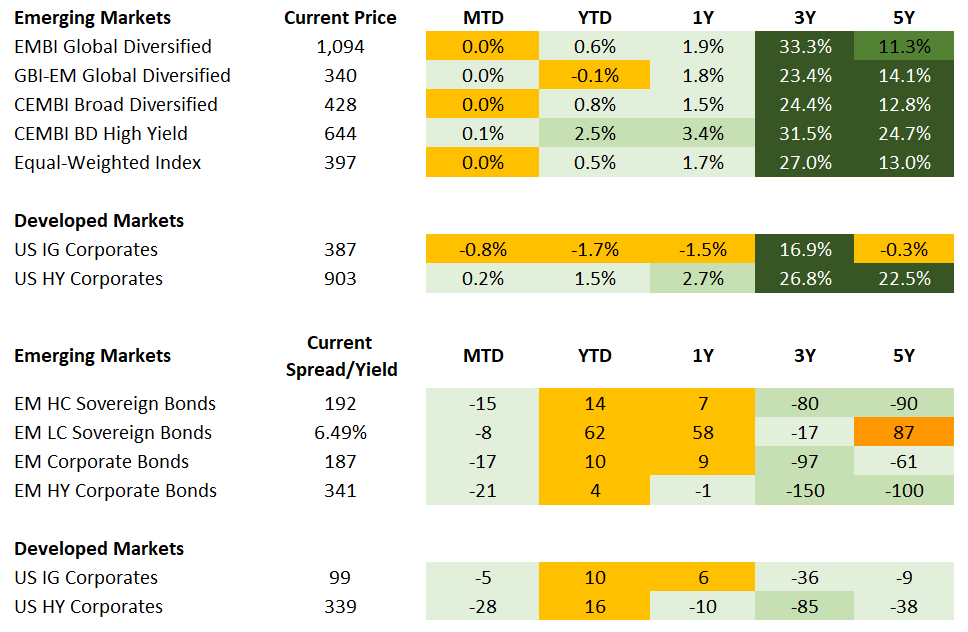
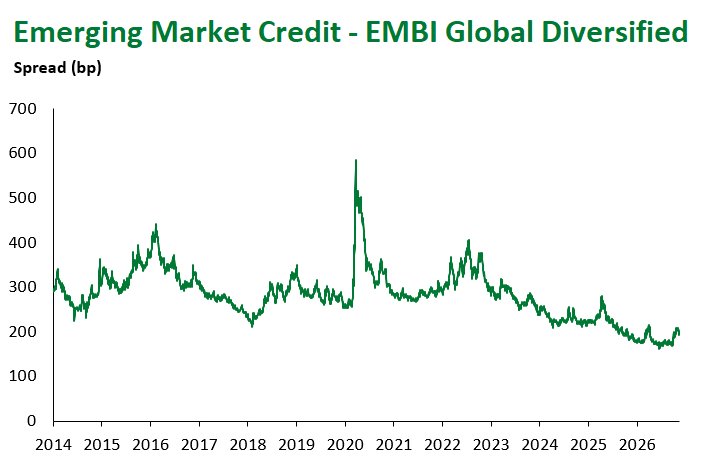
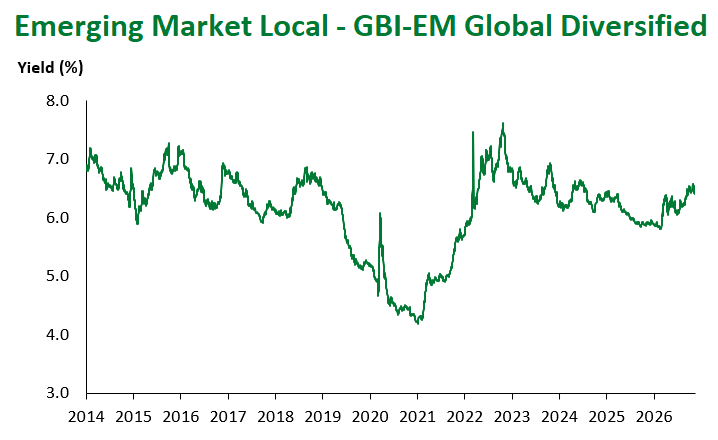
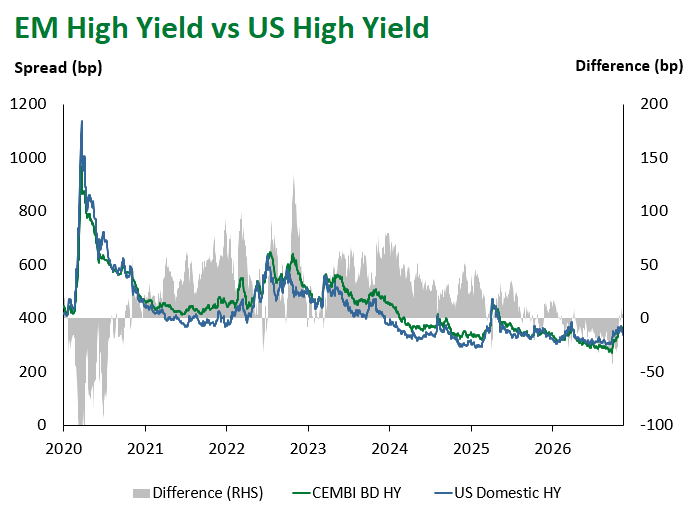
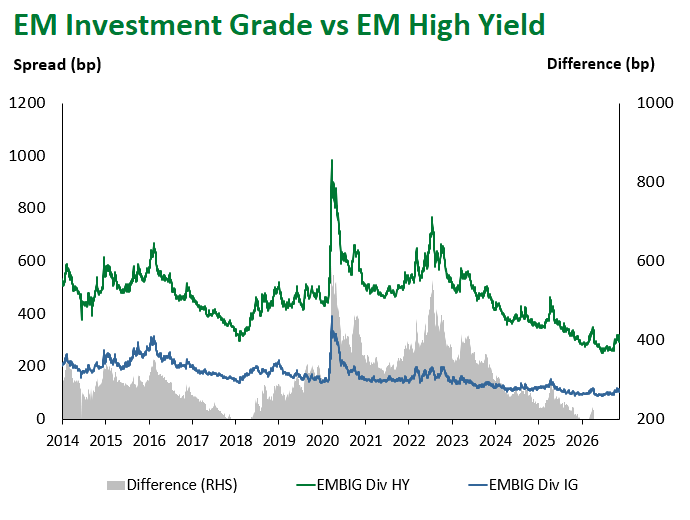
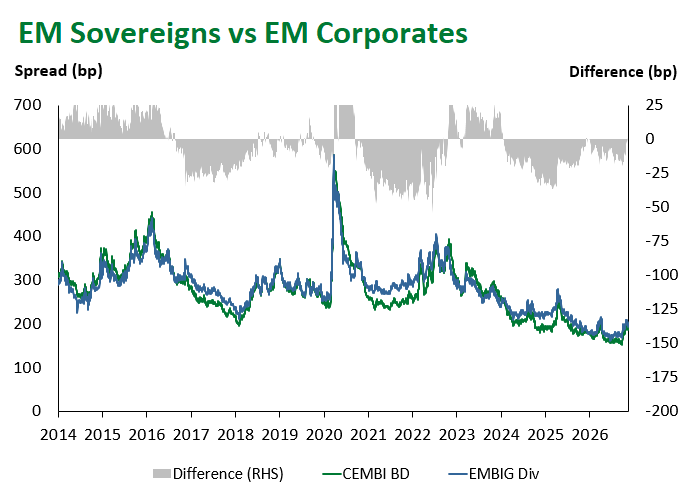
Emerging markets fixed income declined across all three sub-asset classes as the hawkish Fed repricing lifted Treasury yields and the dollar. Local currency sovereigns were the clear underperformer at -1.00% (GBI-EM Global Diversified), driven almost entirely by currency weakness, while hard currency sovereigns fell -0.40% and corporates -0.30%. Losses in the dollar space were driven by duration rather than credit, with sovereign returns ranging from +0.04% in 1-3 year paper to -0.88% at 10+ years, and investment grade lagging high yield, which finished flat in both sovereigns and corporates.
Local currency sovereign debt returned -1.00%, with currency losses in most markets. South Africa was the weakest, hit by both a weaker rand and a local bond selloff, followed by Brazil and Chile on FX. Central and Eastern Europe sold off broadly, led by the Czech Republic and Poland. Peru and Egypt were the only positive markets, both supported by currency gains, while Mexico was roughly flat as peso gains offset lower local bond prices.
Hard currency sovereign bonds fell -0.40%, with high yield (+0.03%) outperforming investment grade (-0.87%). The Middle East (-0.15%) and Africa (-0.23%) were the most resilient regions, while Asia (-0.68%) was the weakest. Argentina rebounded from the prior week’s election-driven selloff after rolling over 103% of maturities at its November local auction, and Ecuador, Lebanon and Venezuela also posted strong gains. Senegal underperformed after Moody’s warned its planned restructuring will very likely be treated as a default, and Paraguay fell after Fitch placed its BB+ rating on Rating Watch Negative following the collapse of Ueno Bank, citing a potential fiscal cost of up to 1.5% of GDP. Peru lagged in a week it brought new long-dated supply, alongside duration-heavy investment grade names such as Uruguay, Malaysia, Chile and Mexico.
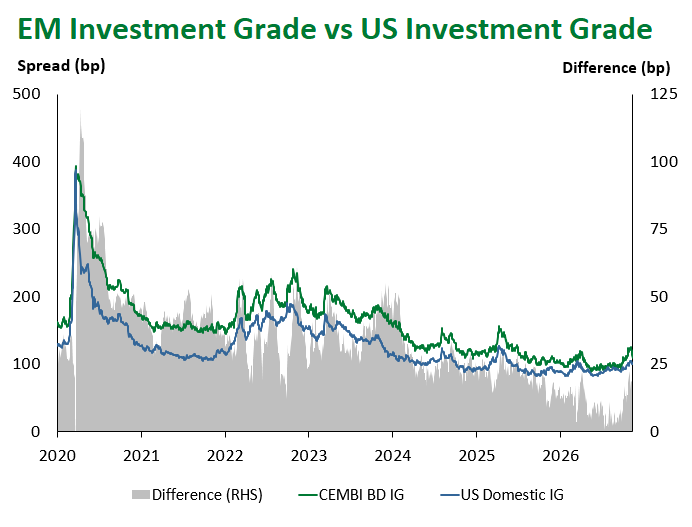
EM corporates declined -0.30%, with high yield (+0.01%) outperforming investment grade (-0.50%) as shorter duration limited the impact of higher rates. Europe (+0.12%) was the only region in positive territory, while Asia (-0.44%) and Latin America (-0.33%) lagged. Ukraine, Türkiye and Hungary led at the country level, while Taiwan was the weakest, followed by the Czech Republic, Thailand, Brazil and Colombia. Losses were concentrated in higher-rated credits, from AAA (-1.00%) through BBB (-0.47%), while BB and B were essentially flat.
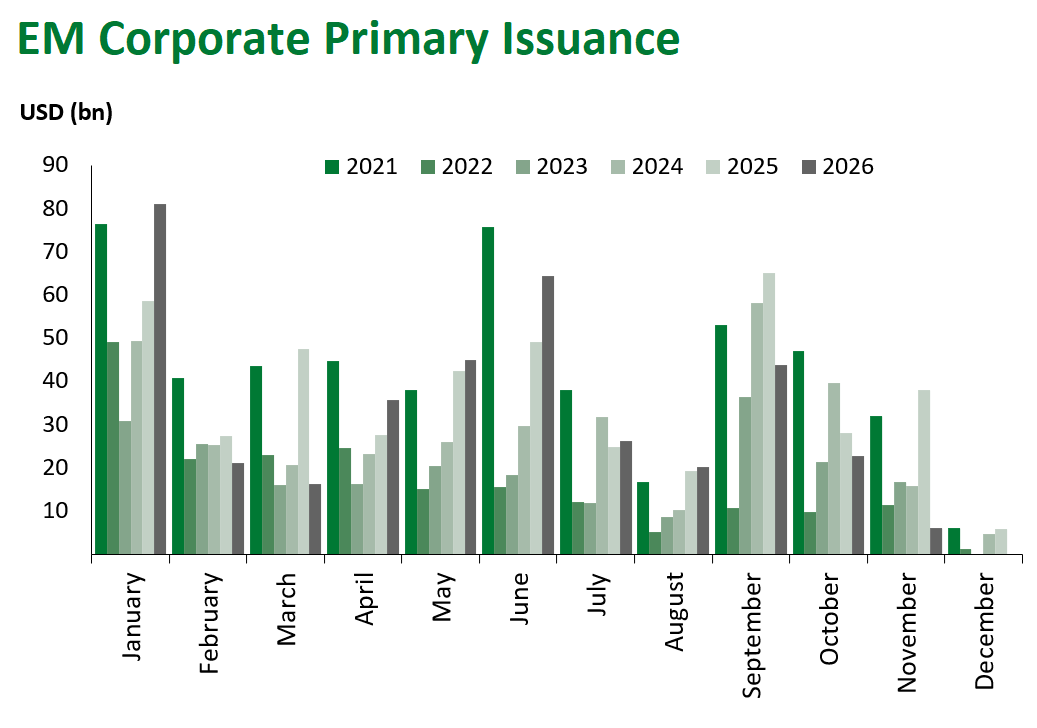
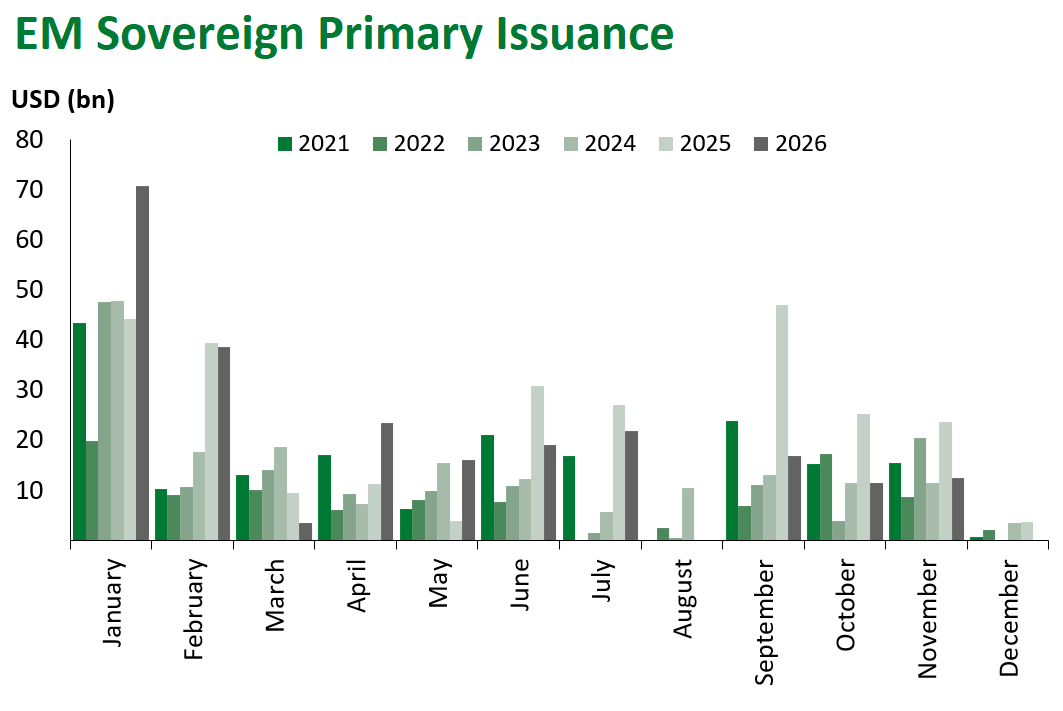
Primary market activity picked up, with six issuers pricing approximately $8.2 billion in hard currency supply. Peru accounted for more than half with a $4.5 billion dual-tranche sustainable bond, its first international issuance in over a year, priced well inside initial guidance. Ecopetrol returned to the market for the first time in two years with a $2 billion 8-year bond. The remainder came from financials, mostly Gulf sukuk issuers (Al Rayan, Boubyan Bank and Al Rajhi), alongside a EUR 350 million AT1 from Slovenia’s Nova Ljubljanska Banka.
Fixed Income
Equities
Commodities
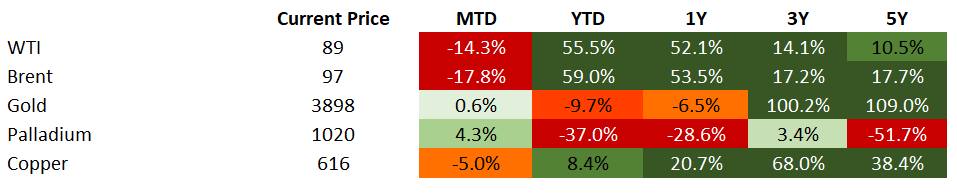
Source for data tables: Bloomberg, JPMorgan, Gramercy. EM Fixed Income is represented by the following JPMorgan Indicies: EMBI Global, GBI-EM Global Diversified, CEMBI Broad Diversified and CEMBI Broad High Yield. DM Fixed Income is represented by the JPMorgan JULI Total Return Index and Domestic High Yield Index. Fixed Income, Equity and Commodity data is as of November 13, 2026 (mid-day).
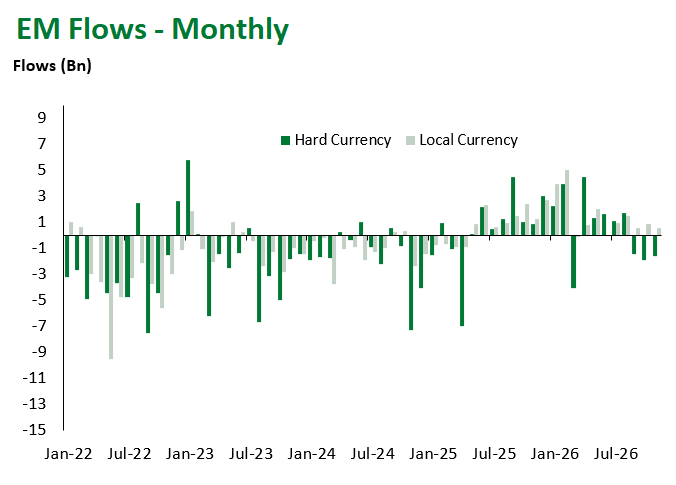
Emerging Markets Flows
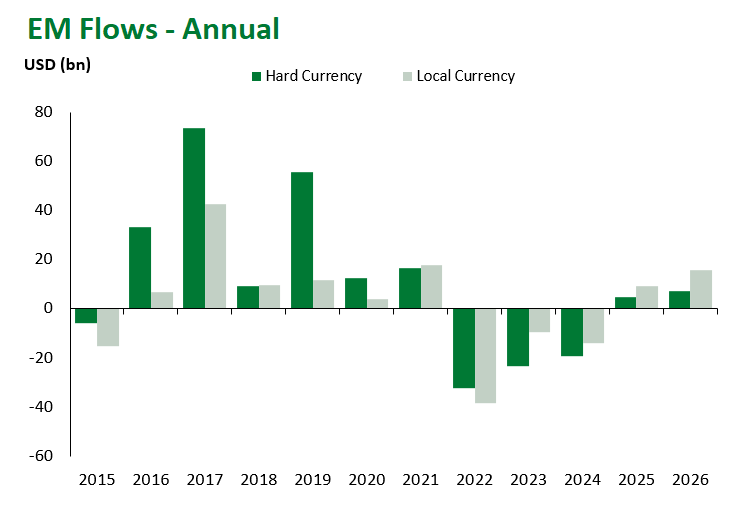
Source for graphs: Bloomberg, JPMorgan, Gramercy. As of November 13, 2026.
For questions, please contact:
Kathryn Exum, CFA ESG, Director, Co-Head of Sovereign Research, [email protected]
Petar Atanasov, Director, Co-Head of Sovereign Research, [email protected]
This document is for informational purposes only. The information presented is not intended to be relied upon as a forecast, research or investment advice, and is not a recommendation, offer or solicitation to buy or sell any securities or to adopt any investment strategy. Gramercy may have current investment positions in the securities or sovereigns mentioned above. The information and opinions contained in this paper are as of the date of initial publication, derived from proprietary and nonproprietary sources deemed by Gramercy to be reliable, are not necessarily all-inclusive and are not guaranteed as to accuracy. This paper may contain “forward-looking” information that is not purely historical in nature. Such information may include, among other things, projections and forecasts. There is no guarantee that any forecasts made will come to pass. Reliance upon information in this paper is at the sole discretion of the reader. You should not rely on this presentation as the basis upon which to make an investment decision. Investment involves risk. There can be no assurance that investment objectives will be achieved. Investors must be prepared to bear the risk of a total loss of their investment. These risks are often heightened for investments in emerging/developing markets or smaller capital markets. International investing involves risks, including risks related to foreign currency, limited liquidity, less government regulation, and the possibility of substantial volatility due to adverse political, economic or other developments. References to any indices are for informational and general comparative purposes only. The performance data of various indices mentioned in this update are updated and released on a periodic basis before finalization. The performance data of various indices presented herein was current as of the date of the presentation. Please refer to data returns of the separate indices if you desire additional or updated information. Indices are unmanaged, and their performance results do not reflect the impact of fees, expenses, or taxes that may be incurred through an investment with Gramercy. Returns for indices assume dividend reinvestment. An investment cannot be made directly in an index. Accordingly, comparing results shown to those of such indices may be of limited use. The information provided herein is neither tax nor legal advice. Investors should speak to their tax professional for specific information regarding their tax situation.