


Executive Summary
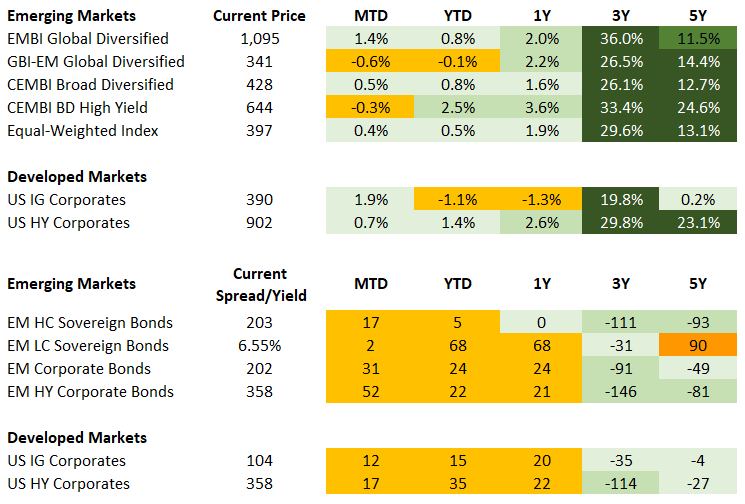
Hawkish central banks capped the duration rally, so spreads drove returns. The Fed held with two dissents for a hike, GDP and core PCE ran hot, the BoJ raised its core inflation forecast for next year, and the Bank of Canada hiked. Even after Friday’s dip to a seven-week low, Treasuries ended rangebound. Hard currency sovereigns led EM (+0.47%); returns rose steadily out the curve, from +0.16% in 1-3-year paper to +0.74% at 10+ years, a sign of spread compression at the long end.
Oil near a six-month high split EM by energy balance. Houthi attacks on Saudi infrastructure and reports of U.S. military planning lifted Brent to about $117, its highest since late April. Egypt (-1.77%) was among the weakest local markets, down on both currency and bond prices. On the other side, oil-linked credits rallied.
Lula’s upset made Brazil the worst EM market in all three sub-asset classes. Lula won 51.8% to 48.2%, against prediction markets that had about 80% on Bolsonaro. The Ibovespa fell nearly 14% and the BRL lost about 8% vs. USD on Monday, but the overall reaction has been less than feared, suggesting markets are giving some benefit of the doubt to the Lula 4.0 administration.
Market Overview
Macro Update
The Fed held rates at 3.75-4.00% on Wednesday in a 10-2 vote, with Cleveland Fed President Hammack and Governor Cook dissenting in favor of a 25bps hike, and the statement said the FOMC “will deliver price stability.” Chair Warsh communicated very little during his post-decision press conference and insisted that politics played no role in holding six days before the midterms.
This week’s data supported the hawks: third-quarter GDP grew at a 3.4% annualized pace, above the 3.2% consensus and up from 2.2% in the second quarter, and September core PCE rose 0.3% on the month, lifting the annual rate to 3.1%. Futures price a December hike at around 75% and around two full 25bps hikes altogether on a 1-year time horizon.
Elsewhere in central bank policy, the Bank of Canada raised its policy rate by 25bps to 2.50%, citing inflation risks from energy prices and cost pass-through. The ECB held its deposit rate at 2.50% unanimously after discussing another increase, with futures still pricing about an 80% chance of a December hike, although the decision was overshadowed by President Lagarde’s announcement that she will step down on February 7, 2027, well before her term ends in October 2027.
On Friday, the Bank of Japan held at 1.25% in an 8-1 vote, with board member Takata dissenting in favor of 1.5%, but said for the first time that underlying inflation has reached its 2% target, raised its core inflation forecast for the coming fiscal year to 2.6% from 2.4% and agreed to more than double the pace of its ETF sales from January, opening the door to a December hike. Every dissent at the Fed and the BoJ this week favored higher rates. A developed-market tightening bias into year-end limits how much relief softer U.S. yields can bring to EM local markets, and the ECB leadership transition adds uncertainty while French spreads remain wide.
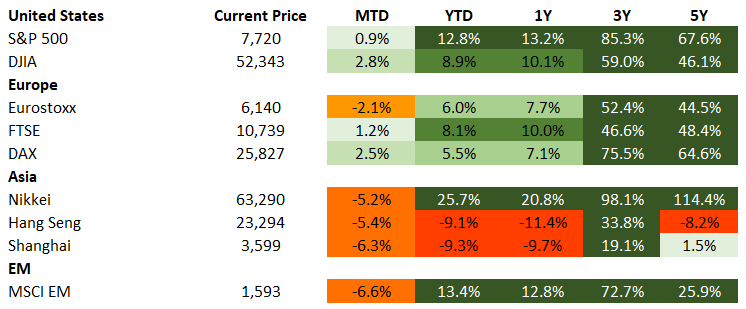
Earnings from the largest technology companies split the AI trade. Alphabet posted its first top- and bottom-line miss in nearly four years and suffered its worst day ever on Thursday, falling more than 12%, as the company said 2027 capex will “increase significantly.” Microsoft beat expectations, but its quarterly capex came in below consensus, which hit AI infrastructure suppliers. Amazon’s earnings miss deepened the selloff, with the Nasdaq 100 falling around 2.5% into the close.
Investors are now separating AI spenders that can fund the buildout from cash flow from those that cannot. Chair Warsh noted on Wednesday that market participants are “becoming somewhat more discerning in their capital allocations.” That scrutiny extends to EM Asia’s AI hardware exporters, whose earnings depend on the pace of hyperscaler spending.
Treasuries rallied as the tech selloff deepened. After reaching about 5.04% around the Fed decision, the 10-year yield fell to around 4.95% into the close on Friday, a seven-week low, and the 2-year dropped around 7bps vs. last week to about 4.60%. The dollar eased on Friday (DXY under 102) as the Japanese yen and Swiss franc led, and gold slipped firmly below $4,000, touching a 1y low. All else equal, lower U.S. yields ease the external financing pressure on EM sovereigns that has built since September.
Oil swung between escalation and diplomacy. The Houthis claimed new attacks on Saudi Arabia’s Ras oil processing infrastructure, while Vice President Vance reached out by letter to senior Iranian official Mohsen Rezaee, so far without a response, and Brent eased on the diplomatic signal. However, reports that U.S. officials had briefed President Trump on military options pushed Brent back up to around $117 into the close, its highest since late April and on course for a fourth consecutive monthly gain. With strikes possible after Tuesday’s midterms, the oil premium is tracking the military calendar more than physical supply, which keeps EM energy importers exposed.
European fiscal stress eased slightly. Moody’s left France’s Aa3 rating unchanged with a negative outlook late on October 23, sparing Paris a downgrade that markets had largely priced. The 10-year OAT–Bund spread, which reached about 176bps at the open that day with OAT yields near 5.14%, the highest since July 2002, narrowed to around 150bps this week. Moody’s baseline assumes a deficit-reducing 2027 budget passes, possibly by executive order, as protests continue. In the UK, Chancellor John Healey’s first budget cut fiscal headroom to £15 billion from £23.6 billion in March, largely on higher borrowing costs, but kept the fiscal rules intact, and gilt yields eased slightly. The Bank of England is expected to raise rates to 4% next Thursday. Both outcomes bought time for European duration without resolving the underlying fiscal pressure, and France remains the swing factor for CEE assets priced off Bunds.
President Lula’s comeback victory in Sunday’s presidential election runoff in Brazil triggered one of the sharpest one-day selloffs in Brazilian market history. Lula won 51.79% of the vote against 48.21% for Senator Flávio Bolsonaro, reversing the first-round result after final polls showed a tie and prediction markets had given Bolsonaro roughly an 80% chance. On Monday the Ibovespa fell nearly 14% and the BRL lost about 8% against the dollar, its steepest one-day decline since 1999. For EM investors, the episode puts Brazil’s fiscal trajectory, with public debt above 80% of GDP, back at the center of local market pricing, with the spotlight now on Lula’s fiscal plans and economic team appointments.
The Week Ahead
The U.S. midterm elections on Tuesday dominate the week, with Democrats widely expected to win the House, control of the Senate less certain, and the post-election period now carrying the risk of renewed U.S. strikes on Iran. Treasury publishes its borrowing estimates on Monday and its quarterly refunding on Wednesday, where any change to guidance on coupon auction sizes or buybacks will matter for the long end, and Friday’s October jobs report follows September’s 29,000 gain with a December Fed hike largely priced. Brazil’s Copom meets on Wednesday for the first time since the election, as does Poland’s central bank, and the Bank of England is expected to raise rates to 4% on Thursday, its first hike in more than three years, with the RBA, Riksbank and Norges Bank also deciding. ISM manufacturing and services, euro area flash October inflation and earnings from Apple, AMD and Palantir round out the calendar, and China’s National People’s Congress Standing Committee meets from Monday to Friday. With the election and the refunding falling in the same week as payrolls, U.S. event risk will set the tone for EM after Brazil’s election shock.
Highlights
Lula’s unprecedented election comeback stuns markets; fiscal adjustment path repricing is under way, but some course correction still likely
Event: Incumbent President Lula staged an improbable comeback in Brazil’s presidential election runoff on October 25, defeating right-wing Senator Flávio Bolsonaro with 51.8% of the vote and a lead of nearly 4.4 million votes, after trailing Bolsonaro by more than 2.2 million votes in the first round on October 4. Lula becomes the first candidate since Brazil’s return to democracy in the 1980s to lose the first round and win the runoff, defying polls that had pointed the other way. Lula’s fourth term begins on January 5, 2027. Meanwhile, facing a court order to surrender his passports, Flávio Bolsonaro and his immediate family fled Brazil two days following his defeat and arrived in Florida.
Investment Implications: Lula’s re-election stunned markets that had positioned for a Bolsonaro victory following the Senator’s significant first-round outperformance and his lead in runoff polling. Fiscal framework sustainability is the main challenge in Brazil’s otherwise solid sovereign credit profile, and the post-election negative market reaction reflects a repricing of the fiscal adjustment path and medium-term inflation expectations relative to the pre-runoff base case of a reformist Bolsonaro administration supported by a center-right leaning Congress. We would nonetheless caution against extrapolating the reaction into a scenario of unchecked fiscal deterioration. Although the adjustment path is likely to be far more gradual under Lula, we believe some fiscal course correction is inevitable given Brazil’s starting position and the likelihood of acute market pressures if the main sources of fiscal concerns are not addressed. Most notably, the burden of very high real interest rates on the economy and the government’s balance sheet is significant, with the central bank’s Selic policy rate at 13.75% and real interest rates around 10%. We expect lowering those rates to be a top priority for the new administration, one that can only be achieved through credible policy measures that address market concerns about the fiscal trajectory. The incoming Congress, which shifted toward the center-right in the October 4 vote, should also act as a check on fiscal expansion. The key early tests for Lula 4.0’s policy direction and the main drivers of market sentiment in the coming weeks will be signaling on his incoming economic team and chief of staff appointments. A credible finance minister and a chief of staff who can build working relationships with Congress’ leadership will be important, as the incoming Senate will be the most opposition-heavy Lula has ever faced. All else equal, early signals on strengthening the fiscal framework would help stabilize local rates and the BRL, while choices signaling a looser fiscal stance would likely extend near-term weakness in sovereign assets.
Machado’s return to Venezuela raises pressure for elections as Washington lays out an “institutions-first” path to a potential 2027 vote
Event: After nearly a year in exile and seven failed attempts to return, opposition leader and 2025 Nobel Peace laureate María Corina Machado (MCM) arrived in Venezuela on October 25, with thousands of supporters lining the route of her motorcade to Caracas. Her return marks the most significant step toward a political transition since Maduro’s capture on January 3. Machado remains the country’s most popular political leader, and a Bloomberg News poll this month showed her beating interim President Delcy Rodríguez by a landslide were elections held today. Secretary of State Rubio said the U.S. had secured assurances weeks ago that Machado could return safely, but made clear that the negotiations between National Assembly President Jorge Rodríguez and opposition negotiator Dinorah Figuera, from which Machado has complained of being excluded, are the only path, with armed conflict or a return to the old status quo as the alternatives, and warned Machado’s supporters that “you’re not going to street protest your way into a democracy.” A senior State Department official set out the U.S. administration’s sequence: a new Supreme Court (TSJ) by the end of 2026 and a new electoral council (CNE) in early 2027, with no election date possible before the new CNE is in place. Interim President Delcy Rodríguez would then declare the presidency vacant, starting a six-month clock to an election.
Investment Implications: Machado’s return reshapes Venezuela’s political dynamics and increases pressure for elections, putting the political agenda back at the center and further constraining the room for maneuver of the Rodríguez interim administration. From a creditor perspective, we see this as a medium-term positive. As we argued following the U.S.-Venezuela oil agreement in September, a constitutionally legitimate government is a precondition for a sustainable debt restructuring, and the deal’s main risk for bondholders was that it reduced the urgency of political normalization. Machado’s pledge to honor existing oil agreements also eases a key concern we had flagged, that commitments signed by an interim authority could be revisited by a future elected government. Equally important, Washington has for the first time set out a concrete roadmap, replacing the open-ended “not ready yet” rhetoric of September with observable milestones. On the stated sequence, the earliest plausible election date is mid-2027, and more realistically the second half of the year. The process hinges on the vacancy declaration, the transition therefore depending on the interim president triggering her own exit. Any slippage there would be a signal that the process could be stalling. Meanwhile, Washington’s endgame seems to envisage political reconciliation with Chavismo surviving as a majority party, and with Rubio ruling out a Plan B, a Machado-led mobilization outside the negotiating framework is now the main domestic risk to the U.S. plan. Machado joining the talks and lending them legitimacy would be the most constructive outcome for bondholders, while a standoff between a mobilized opposition and a Washington-backed interim administration would likely mean heightened political noise, headline volatility, and delays. Next, we see Machado’s return and the U.S. roadmap as improving the medium-term outlook for recovery values on VENZ and PDVSA bonds, but with the path to an elected government stretching into at least the second half of 2027, investors should be patient on the timing of a definitive restructuring. The near-term markers are the new TSJ by year-end, the CNE in early 2027, and above all the vacancy declaration.
South Africa’s MTBPS reinforces fiscal credibility, sustaining upgrade momentum
Event: On October 21, Finance Minister Godongwana presented the 2026 Medium-Term Budget Policy Statement (MTBPS), reinforcing the fiscal consolidation trajectory. Gross debt stabilized at 78.4% of GDP in 2025/26, below the 78.9% peak projected in February, while stronger corporate income tax, dividends tax and VAT lifted the 2026/27 revenue forecast. The consolidated deficit is projected to narrow from 3.9% of GDP to 2.5% by 2029/30, with the primary surplus rising from 1.7% to 2.9%. Growth remains the key constraint. The 2026 forecast was cut to 1.2%, with recovery to 2% by 2029. Treasury also published draft legislation for a principle-based fiscal anchor requiring successive administrations to set fiscal objectives and explain material deviations to Parliament. Moody’s called the MTBPS credit positive, citing a second consecutive statement without upward deficit revisions and the potential for the anchor to support fiscal discipline through the 2027-29 electoral cycle. Markets responded positively, with the SAGB curve bull-flattening as shrinking supply and a strong auction offset mixed macro data and mid-week ZAR weakness.
Investment Implications: The MTBPS strengthens fiscal credibility by showing that consolidation remains on track despite a weaker external environment. Debt has peaked below February’s projection, extending a track record that has supported S&P’s November 2025 upgrade, Fitch’s June 2026 upgrade (the agency’s first in almost 21 years) and Moody’s positive outlook. However, stronger fiscal execution does not resolve the structural growth constraint. The inflationary backdrop and tight monetary conditions remain additional headwinds to a sustained growth recovery, reinforcing the importance of structural reforms to lift potential growth. At 1.2% growth in 2026, debt stabilization depends on sustained primary surpluses and resilient revenue collection, some of which may reflect cyclical factors. The proposed fiscal anchor adds institutional support but stops short of a binding numerical rule. Its credibility will depend on implementation across administrations, particularly through the 2029 election cycle and amid potential strains within the Government of National Unity. The next rating decisions are near-term catalysts: Moody’s and S&P review South Africa on November 27, followed by Fitch on December 11. Moody’s, at Ba2 with a positive outlook, offers the clearest potential for further action. The broader direction remains constructive, but sustained upgrades will increasingly require stronger growth and evidence that fiscal gains can be maintained.
Senegal’s politics complicate IMF and restructuring path
Event: On October 23, Pastef rejected the government’s revised 2026 budget in the National Assembly finance committee, reflecting long-running divisions between President Faye and Pastef leader and National Assembly President Sonko. The revised budget cuts real GDP growth to 2.7% from around 5% and widens the deficit to 7.6% of GDP from 5.4%, driven by a revenue shortfall and additional spending needs, primarily energy subsidies and security. Pastef conditioned its support on reversing cuts to health, education and water investment, and ensuring subsidy reductions do not raise household and business energy costs. On October 27, Sonko agreed to return the text to committee at Finance Minister Diba’s request, opening the door to negotiations. However, Sonko has also threatened to reject the separate 2027 budget, leaving the fiscal agenda exposed to the same political divisions. Senegalese Eurobonds are down roughly 1-2 points across the curve this week.
Investment Implications: The dispute puts political cohesion directly on the critical path to IMF program approval. Senegal must address past debt misreporting, secure financing assurances from partners and demonstrate credible fiscal adjustment. A compromise that protects social and capital spending while diluting energy subsidy reform could weaken the adjustment underpinning debt sustainability, increasing pressure on external creditors given the exclusion of domestic CFA debt from the restructuring perimeter. The return to committee reduces the immediate risk of legislative deadlock but leaves the underlying conflict unresolved. The government’s target of reaching agreements in principle with official creditors and bondholders by December remains ambitious, while IMF Board approval depends on parliamentary negotiations outside the executive’s control. The 2027 budget presents a second near-term test of fiscal execution. Should the parliamentary impasse extend the IMF approval timeline beyond November, Senegal’s near-term repayment capacity could come under pressure.
Market Data
EM Credit Update
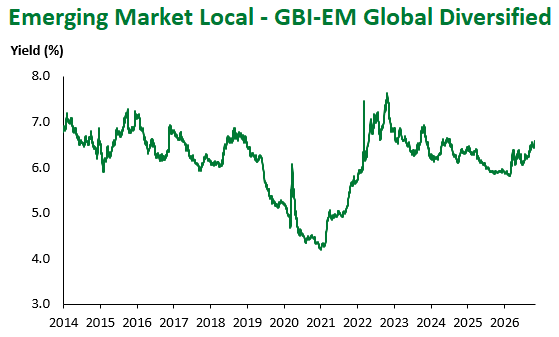
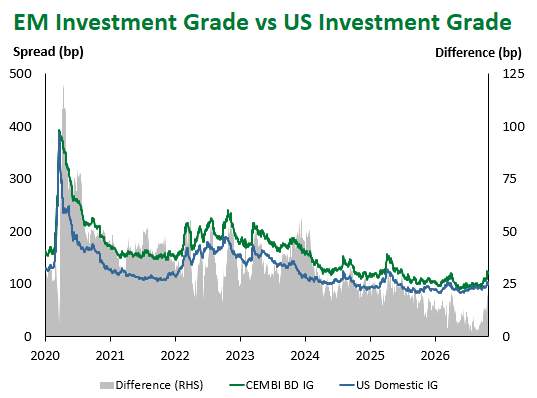
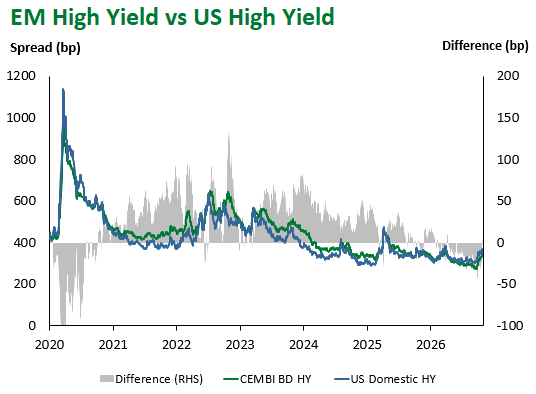
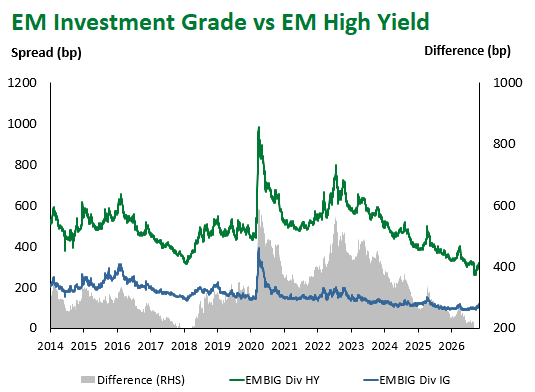
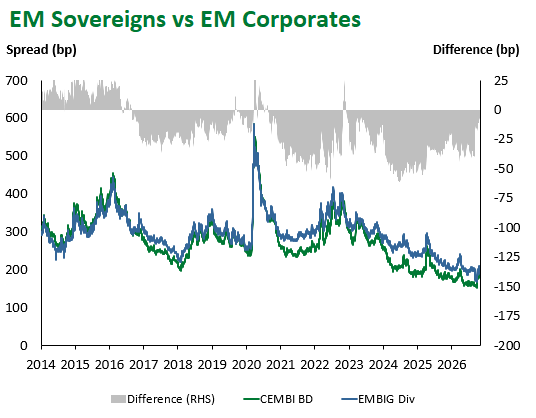
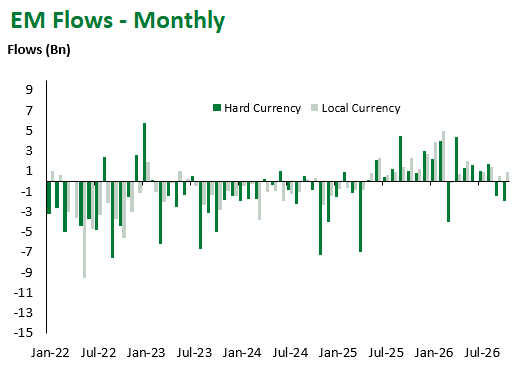
Emerging markets fixed income traded with a firmer tone this week, though investors were more selective about where they added risk. With U.S. Treasury rates rangebound, returns were driven by spreads rather than duration. Hard currency sovereigns led at +0.47%, corporates were marginally positive at +0.09%, and local currency sovereigns fell 1.01%, a decline driven almost entirely by a sharp selloff in Brazil following President Lula’s surprise victory in the second round of the presidential election. Brazil was the weakest market across all three sub-asset classes. Investor discipline was most visible in corporates, where investment grade (+0.20%) outperformed high yield (-0.08%) and the B-rated bucket was the weakest segment.
Local currency sovereign debt returned -1.01% (GBI-EM GD). Brazil (-11.38%) more than accounted for the headline loss, as markets unwound the rally that followed Flávio Bolsonaro’s first-round lead, with currency (-6.51%) and local bond prices (-5.39%) contributing almost equally. Egypt (-1.77%) and Indonesia (-1.61%) were the next weakest markets, Egypt on both FX and price and Indonesia mainly on a local bond selloff. Currency weakness was also the common drag across Central Europe, including the Czech Republic, Poland, and Serbia, as well as in the Philippines. Colombia led gains, largely on FX, followed by Hungary and Thailand, where local rates rallied, and Malaysia on currency strength.
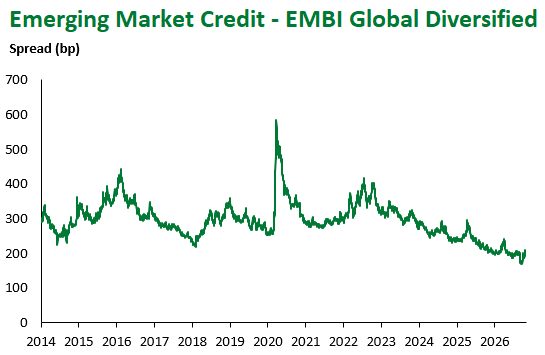
Hard currency sovereign bonds gained +0.47%, with high yield (+0.53%) modestly outperforming investment grade (+0.40%). Africa (+1.20%) led regionally, followed by the Middle East, Europe, and Asia, while Latin America (+0.06%) was roughly flat as losses in Brazil (-1.45%) on the election result and Argentina (-1.20%) offset gains elsewhere in the region. Frontier credits dominated the top of the table, led by Senegal (+3.76%) and Ukraine (+2.03%), with Mozambique, Angola, Ecuador, and Kenya also posting strong gains. CCC (+0.97%) and B (+0.69%) led by rating, with the unrated bucket (-0.13%) the only segment in negative territory. Returns rose steadily out the curve, from +0.16% in 1-3 year paper to +0.74% at 10+ years, which with Treasuries rangebound points to spread compression at the long end. Colombia gained despite pricing $5.2 billion of new supply.
EM corporates returned +0.09%, with investment grade (+0.20%) outperforming high yield (-0.08%). Africa (+0.36%) led regionally, with Asia and the Middle East also positive, while Latin America (-0.04%) and Europe (-0.27%) lagged. Iraq (+1.50%) and Ghana (+1.21%) were the top performers, followed by Morocco, Zambia, and Ukraine. Brazil (-0.60%) was the weakest market, tracking the post-election sovereign selloff, with Argentina, the UAE, and China also in negative territory. By rating, BBB led the investment grade cohorts while the B bucket (-0.30%) was the weakest; the C bucket’s gain reflected idiosyncratic moves rather than broader appetite for distressed risk.
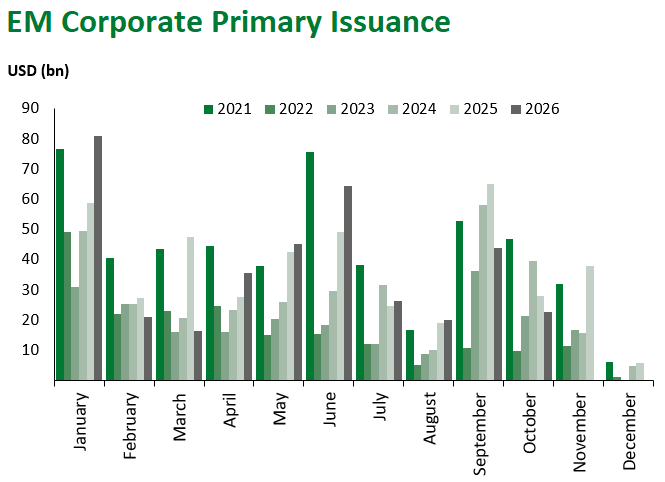
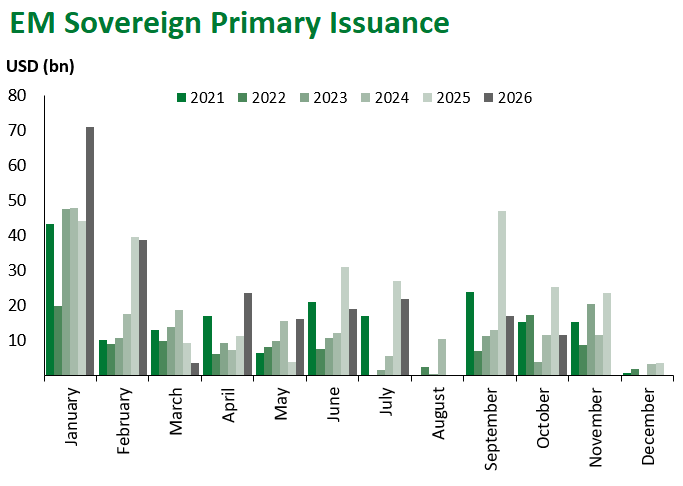
Primary market activity picked up, with nine issuers pricing approximately $10.5 billion in hard currency supply. Colombia’s $5.2 billion three-tranche deal accounted for half the volume, with Slovenia and Egypt adding smaller sovereign supply. Corporate issuance was led by investment grade names, including Samsung Life’s $1.5 billion Tier 2 and a $1 billion dual-tranche from Sands China, while high yield supply was limited to Pearl Petroleum of Iraq and Telecom Services Trinidad & Tobago.
Fixed Income
Equities
Commodities
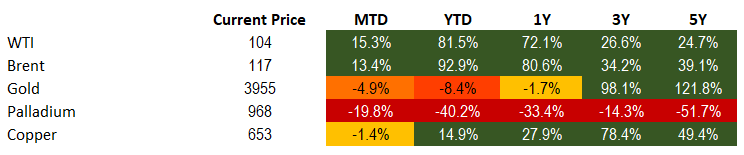
Source for data tables: Bloomberg, JPMorgan, Gramercy. EM Fixed Income is represented by the following JPMorgan Indicies: EMBI Global, GBI-EM Global Diversified, CEMBI Broad Diversified and CEMBI Broad High Yield. DM Fixed Income is represented by the JPMorgan JULI Total Return Index and Domestic High Yield Index. Fixed Income, Equity and Commodity data is as of October 30, 2026 (mid-day).
Emerging Markets Flows
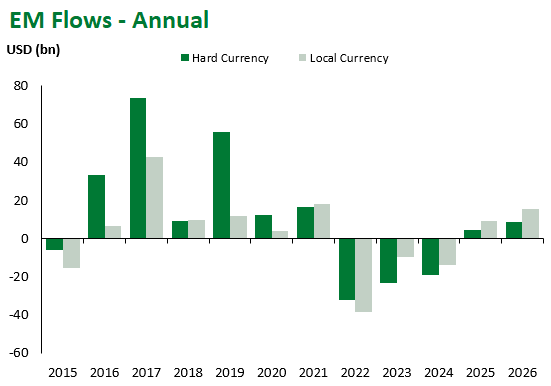
Source for graphs: Bloomberg, JPMorgan, Gramercy. As of October 30, 2026.
For questions, please contact:
Kathryn Exum, CFA ESG, Director, Co-Head of Sovereign Research, [email protected]
Petar Atanasov, Director, Co-Head of Sovereign Research, [email protected]
This document is for informational purposes only. The information presented is not intended to be relied upon as a forecast, research or investment advice, and is not a recommendation, offer or solicitation to buy or sell any securities or to adopt any investment strategy. Gramercy may have current investment positions in the securities or sovereigns mentioned above. The information and opinions contained in this paper are as of the date of initial publication, derived from proprietary and nonproprietary sources deemed by Gramercy to be reliable, are not necessarily all-inclusive and are not guaranteed as to accuracy. This paper may contain “forward-looking” information that is not purely historical in nature. Such information may include, among other things, projections and forecasts. There is no guarantee that any forecasts made will come to pass. Reliance upon information in this paper is at the sole discretion of the reader. You should not rely on this presentation as the basis upon which to make an investment decision. Investment involves risk. There can be no assurance that investment objectives will be achieved. Investors must be prepared to bear the risk of a total loss of their investment. These risks are often heightened for investments in emerging/developing markets or smaller capital markets. International investing involves risks, including risks related to foreign currency, limited liquidity, less government regulation, and the possibility of substantial volatility due to adverse political, economic or other developments. References to any indices are for informational and general comparative purposes only. The performance data of various indices mentioned in this update are updated and released on a periodic basis before finalization. The performance data of various indices presented herein was current as of the date of the presentation. Please refer to data returns of the separate indices if you desire additional or updated information. Indices are unmanaged, and their performance results do not reflect the impact of fees, expenses, or taxes that may be incurred through an investment with Gramercy. Returns for indices assume dividend reinvestment. An investment cannot be made directly in an index. Accordingly, comparing results shown to those of such indices may be of limited use. The information provided herein is neither tax nor legal advice. Investors should speak to their tax professional for specific information regarding their tax situation.