

Executive Summary
Treasuries rallied despite firmer inflation, and EM gained across all three sub-asset classes, led by duration and quality. The 10-year touched 5.34% after the September CPI print before ending the week near 5.10%, as investors focused more on geopolitical risk and the AI trade than on the price data. Hard currency sovereigns led (+0.68%), with the 10+ year bucket up 1.53% and investment grade ahead of high yield, while CCC and unrated sovereigns were the only negative segments. Primary market activity picked up to about $6.5 billion, mostly Asian investment grade.
The Iran conflict drew in Saudi energy infrastructure, and U.S.-Ukraine relations deteriorated sharply. Houthi strikes damaged Aramco’s headquarters and targeted Riyadh. Oil moved sharply higher late in the week after an Iranian state media report suggested Saudi Arabia’s Yanbu terminal and East-West pipeline had been targeted again, with Brent near $109 and WTI near $101. In Europe, Washington threatened to suspend intelligence sharing with Kyiv, raising the question of a broader U.S.-Europe rift. Ukraine (-4.69%) was the weakest hard currency sovereign by a wide margin.
The IMF raised its global growth forecast but pointed to an increasingly uneven world economy. At the Bangkok Annual Meetings, the Fund lifted its 2026 forecast to 3.1% from 3.0%, as AI investment and fiscal support offset part of the energy shock, and projected global inflation at 4.7%. Growth is now concentrated in 32 countries that account for 95% of the global total, down from 54 in April. China was cut to 4.5%, India raised to 7.0% and the Gulf downgraded sharply. That divergence was visible in EM this week, with dispersion across countries in every sub-asset class.
Market Overview
Macro Update
U.S. Treasuries rallied this week even as September inflation data came in firmer than expected, an indication that investors are currently more focused on geopolitical risk and the durability of the AI trade than on the price data itself. Headline CPI rose 0.6% on the month and 3.7% year-on-year, with gasoline accounting for about half of the increase, while core CPI rose 0.3% against a 0.2% consensus, lifting the annual rate to 2.6% from 2.4% on broad-based gains. Producer prices rose 1.3%, the largest monthly increase in over four years, with core PPI up 0.7%, and retail sales grew 0.8%, well ahead of expectations.
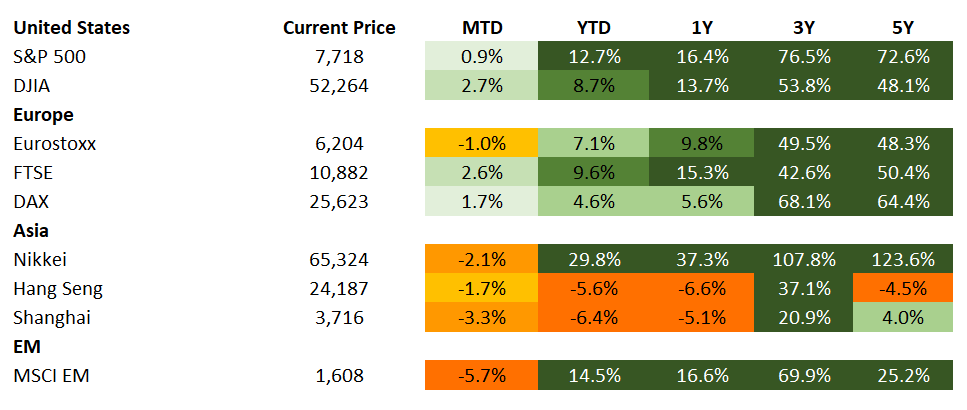
After touching 5.34%, the 10-year yield posted its largest one-day decline since June and ended the week near 5.10%, while the 30-year eased to around 5.44%. Markets now price about a 17% probability of a Fed hike in October and 88% by December. The data leave the Fed in a more difficult position, as the energy-driven rise in headline inflation is increasingly feeding into core measures, making a further hike by year-end increasingly likely. Equities were volatile on weakness in chipmakers and AI infrastructure names, and the DXY eased to around 102.
In the Middle East, the most significant development was the escalation of Houthi attacks on Saudi Arabia, which has drawn the kingdom’s energy infrastructure more directly into the conflict. A Houthi strike damaged Aramco’s headquarters in Dhahran and repeated attacks targeted Riyadh, prompting Saudi strikes on Houthi fuel facilities in Yemen, while President Trump said the U.S. may join the campaign. Iran also stepped up attacks on tankers in the Strait of Hormuz. Oil moved sharply higher late Friday after an Iranian state media report suggested the Yanbu terminal and the East-West pipeline, Saudi Arabia’s main route for bypassing Hormuz, had been targeted again, with Brent trading near $109 per barrel and WTI near $101, up about $4 and $7.5 on the week, respectively. President Trump’s pledge not to strike Iran before the November 3 midterms has pushed back the risk of direct U.S. military action, but the conflict is now spreading through proxies, increasing the risk to Gulf production and export infrastructure.
Relations between Washington and Kyiv deteriorated sharply, raising the question of whether the dispute develops into a broader rift between the U.S. and Europe. The administration threatened to suspend intelligence sharing and European purchases of U.S. weapons for Ukraine unless Kyiv halts strikes on Russian refineries, and Trump said he finds Zelensky more difficult to deal with than Putin, while EU leaders rallied around Zelensky in Brussels. If Europe is increasingly left to fill the gap, the fiscal cost and political strain within the alliance would rise, with implications for European defense spending and Central and Eastern European assets.
At the IMF and World Bank Annual Meetings in Bangkok, the Fund raised its 2026 global growth forecast to 3.1% from 3.0% in July, as AI investment and fiscal support offset part of the energy shock, and projected global inflation at 4.7%. The details point to an increasingly uneven global economy, with 32 countries now accounting for 95% of global growth compared with 54 in April. China’s forecast was cut to 4.5% and India’s raised to 7.0%, while the Gulf economies were downgraded sharply. For EM investors, this places a greater premium on country selection, as the gap between those exposed to the energy shock and those benefiting from the AI investment cycle continues to widen.
In Latin America, Brazil’s presidential runoff narrowed to a technical tie, with the latest Datafolha poll showing Flávio Bolsonaro at 51% of valid votes against 49% for President Lula and prediction-market odds of a Bolsonaro win falling below 80%, prompting Brazilian assets to give back part of the previous week’s rally. In Mexico, the peso fell to its weakest level since November 2025 as the unwinding of carry trades that followed Banxico’s dovish minutes extended into this week.
Across EM Asia, higher energy costs continued to push policy in a tighter direction. India’s 10-year yield rose to 7.4%, its highest since March 2023, as the RBI’s defense of the rupee drained liquidity, and Citi now expects Bank Indonesia to hike by 50bps after MSCI warned it may remove Indonesia’s equity market from EM status. In China, producer prices rose 5.0% year-on-year in September, a four-year high, while consumer prices rose only 0.9%, a gap that points to squeezed margins and weak household demand. In Türkiye, fund industry outflows following the collapse of two asset managers are limiting smaller companies’ access to the lira corporate bond market.
The Week Ahead
Next week opens with China’s third-quarter GDP and September activity data on Monday and its loan prime rate decision on Tuesday. With the Fed in its blackout period ahead of the October 27-28 FOMC, U.S. housing data and Friday’s flash PMIs will be the main releases, while in Europe attention turns to UK CPI and Moody’s review of France. In EM, Bank Indonesia meets on Wednesday, with Citi expecting a 50bps hike, and the central banks of Türkiye, Korea and Russia also announce rate decisions, while Hungary presents its 2027 budget. Brazil enters the final week before the October 25 runoff with the race in a technical tie. On the geopolitical front, markets will be watching whether attacks on Saudi energy infrastructure, including the Yanbu export route, intensify, the pace of tanker attacks in Hormuz, and whether the dispute between Washington and Kyiv widens into a broader transatlantic rift.
Highlights
Türkiye corporates: macro pressure is exposing weaker balance sheets with stress test cases emerging
Event: High interest rates, elevated inflation and energy costs, weak domestic demand and real TRY appreciation are squeezing Turkish corporate margins, cash flows and balance sheets. With the policy rate still at 37%, financing conditions remain restrictive even as inflation moderates. Higher energy and labor costs weigh especially on exporters competing in hard-currency markets. The strain is now showing up in reported fundamentals: several issuers are posting margin erosion, weaker cash generation and rising leverage, and higher financing costs, compounded by elevated UST yields, are making deleveraging and refinancing harder. Vestel was the poster child for Turkish corporate distress through the summer, with bonds trading in the low 20s after prolonged cash burn, thin margins and reliance on bank funding drove a sharp rise in leverage. Zorlu Enerji is emerging as the next key test. Its operating profile is different, with regulated and inflation-linked distribution revenues, but contagion risk from its sister company Vestel (both share the same parent), high interest costs, elevated leverage and negative cash generation have forced it into a comprehensive review of its capital structure. ZOREN 2030 bonds are down around 7 points MTD to the low-50s, and a $60.5 million coupon due on October 23 is the immediate litmus test.
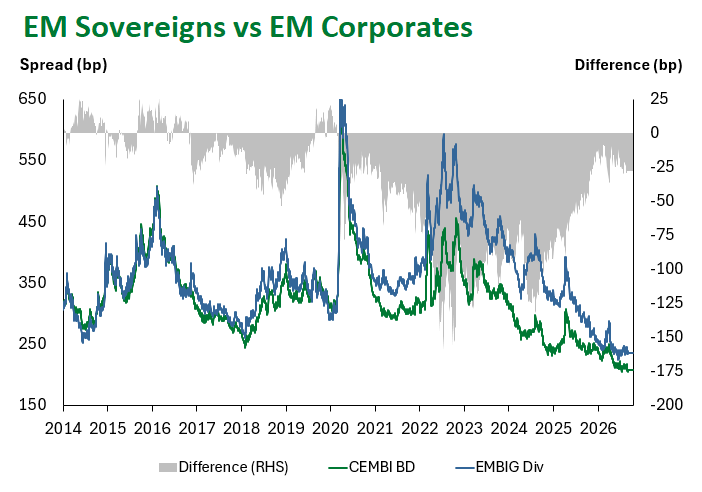
Investment Implications: Credit markets are already reflecting these concerns. Turkish corporates now trade at the widest spreads in the JPM CEMBI Broad Diversified Index and have meaningfully underperformed the broader index over the past month, with a growing share of the USD non-financial universe at double-digit yields. In our view, Türkiye shows how higher rates feed through to corporate credit: gradually at first, then more quickly for issuers that combine high leverage, weak cash generation and near-term refinancing needs. With funding costs this high and margins under strain, weaker Turkish issuers have limited time to repair their balance sheets before refinancing becomes a binding constraint. Selectivity is critical. We favor issuers with strong liquidity, a meaningful share of hard-currency revenues and little need to access markets in the near term. Leveraged, energy-intensive and domestically focused businesses with weak cash generation are where we would expect stress to surface next.
EM corporates: earnings momentum keeps balance sheets on solid footing, though gains are concentrated in a few sectors
Event: EM corporates are on track for one of their strongest years of earnings growth in more than a decade, according to J.P. Morgan, with consensus expecting EBITDA to rise by about a third in 2026. Second-quarter results support that view, as both revenue and EBITDA growth picked up from the first quarter on a year-over-year basis. The gains, however, are uneven. Industrials and the commodity sectors account for most of the increase, while other sectors are growing more modestly and transport earnings declined. Regionally, Latin America and Asia posted the largest gains, with the Middle East and Africa lagging. Net leverage remains low, at under 1x for investment grade and below 2.5x for high yield and compares favorably with developed-market corporates. Interest coverage in high yield has also improved noticeably since the end of last year.
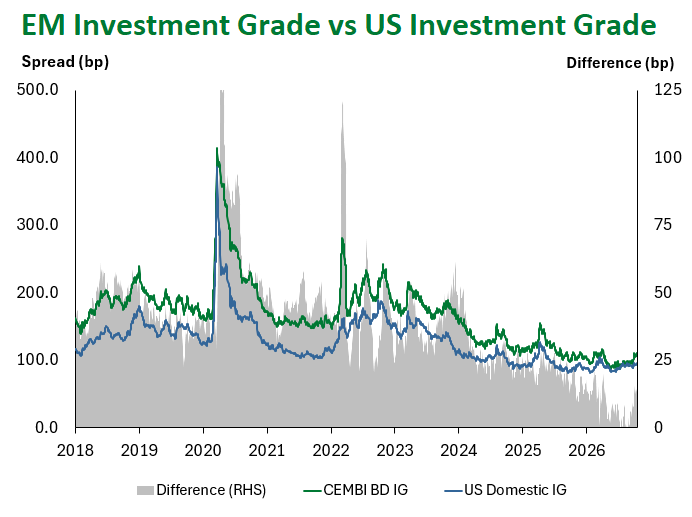
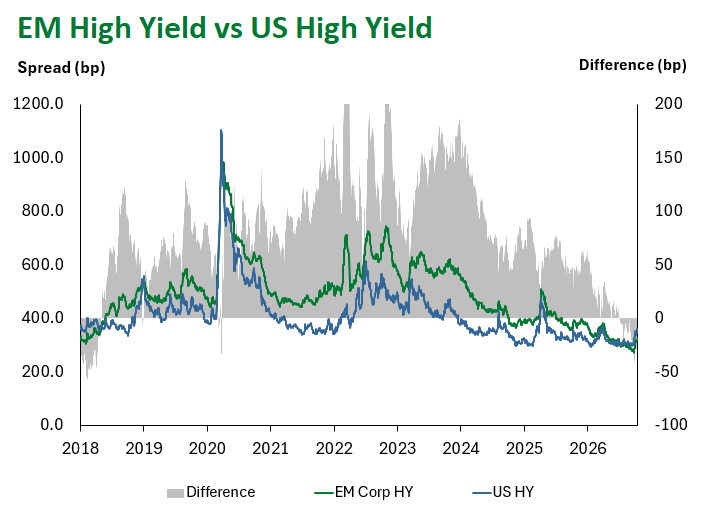
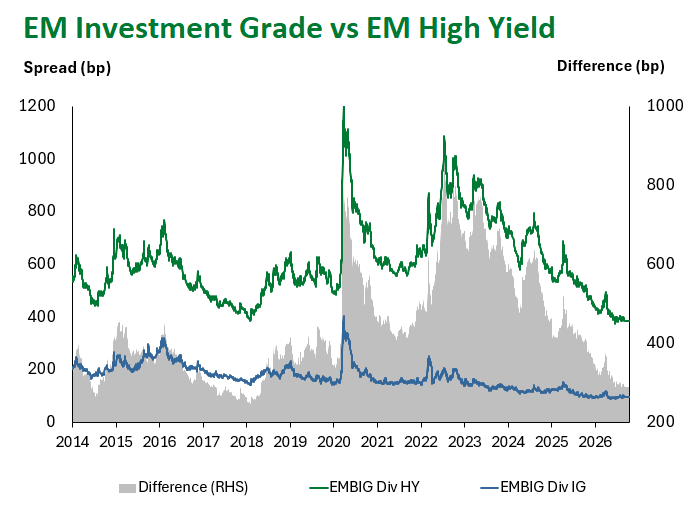
Investment Implications: Strong fundamentals help explain why recent pressure in EM corporates has been limited to the weaker end of the market. Recent spread widening appears driven more by rates than by any deterioration in credit quality, and at current yields, we believe carry adequately compensates for risk in most of the credits we own. That said, these metrics reflect where balance sheets stand today. Higher funding costs have yet to reach most issuers and will affect the most vulnerable borrowers first. Further, because this year’s earnings strength is concentrated in a limited number of large issuers, many companies outside those sectors, particularly in EM Europe, have less of a buffer than the headline figures imply. For that reason, we pay closer attention to upcoming maturities than to headline credit ratios. We continue to prefer high-quality investment grade and BB and crossover credits and remain cautious on single-B and CCC issuers with refinancing needs over the next two years.
Market Data
EM Credit Update
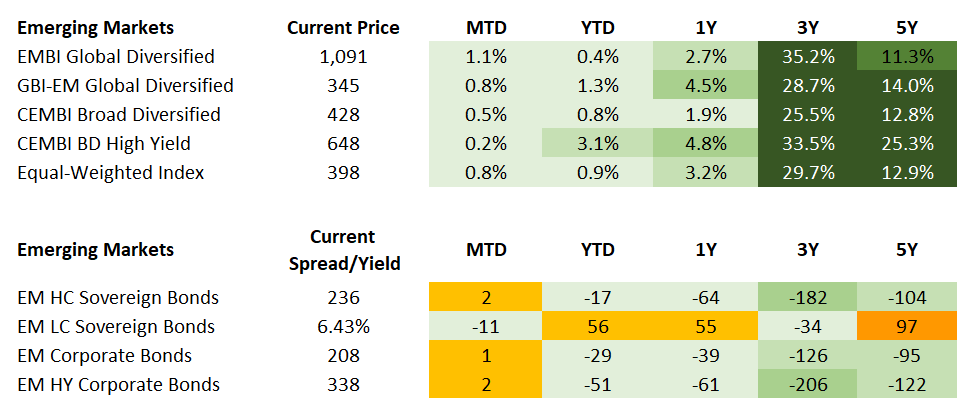
Emerging markets fixed income posted gains across all three sub-asset classes for a second consecutive week, supported by the rally in U.S. Treasuries, with hard currency sovereigns leading at +0.68%, followed by corporates at +0.34% and local currency sovereigns at +0.28%. Returns were strongest in longer-dated and higher-rated bonds, as the 10+ year EMBIGD bucket returned +1.53% against +0.06% for 1-3 year paper, while CCC (-1.36%) and unrated (-0.88%) sovereigns were the only segments to finish in negative territory.
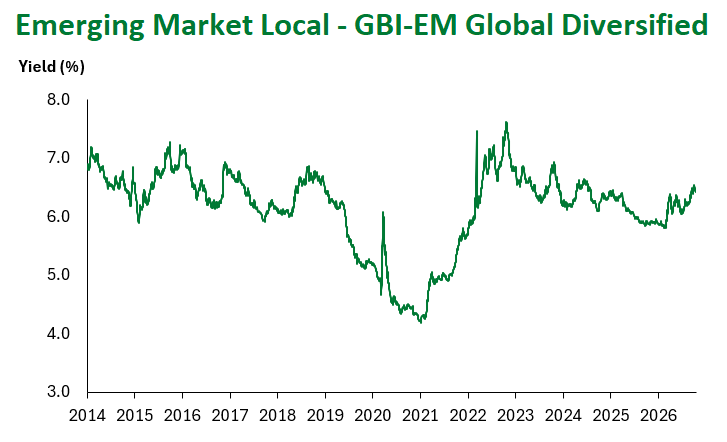
Local currency sovereign debt returned +0.28% (GBI-EM Global Diversified), with currency moves accounting for most of the dispersion across markets. Colombia (+2.08%) led on the back of FX gains, followed by South Africa (+1.90%), where both bonds and the rand contributed, and Hungary (+1.53%), where the 10-year yield fell to its lowest level since July ahead of next week’s 2027 budget presentation. Mexico (-2.09%) and Egypt (-1.47%) were the weakest markets, both on currency losses, while Brazil (-1.27%) gave back part of its post-election rally as runoff polls tightened.
Hard currency sovereign bonds rose +0.68%, with investment grade (+0.97%) outperforming high yield (+0.42%), and Africa (+0.85%) and the Middle East (+0.85%) leading regionally while Europe (+0.44%) lagged on Ukraine. Bahrain (+1.65%), South Africa (+1.60%) and Senegal (+1.51%) were among the strongest performers, and Ethiopia (+1.16%) rose after its central bank governor said the country aims to complete its Eurobond restructuring by December. Ukraine (-4.69%) was the weakest performer, as bonds fell to six-month lows amid the escalating dispute with Washington over intelligence sharing and strikes on Russian refineries, while Venezuela (-1.11%) and Argentina (-0.69%) also declined.
EM corporates gained +0.34%, with investment grade (+0.48%) outperforming high yield (+0.12%) and the asset class’s shorter duration limiting its gains relative to sovereigns. Africa (+0.52%) led regionally, while Asia (+0.25%) lagged as the regional CDS index widened to its highest level since May following the U.S. CPI release. At the country level, Kazakhstan (+1.00%) and Morocco (+0.95%) outperformed, while Ukraine (-1.74%) and Paraguay (-0.96%) were the weakest markets.
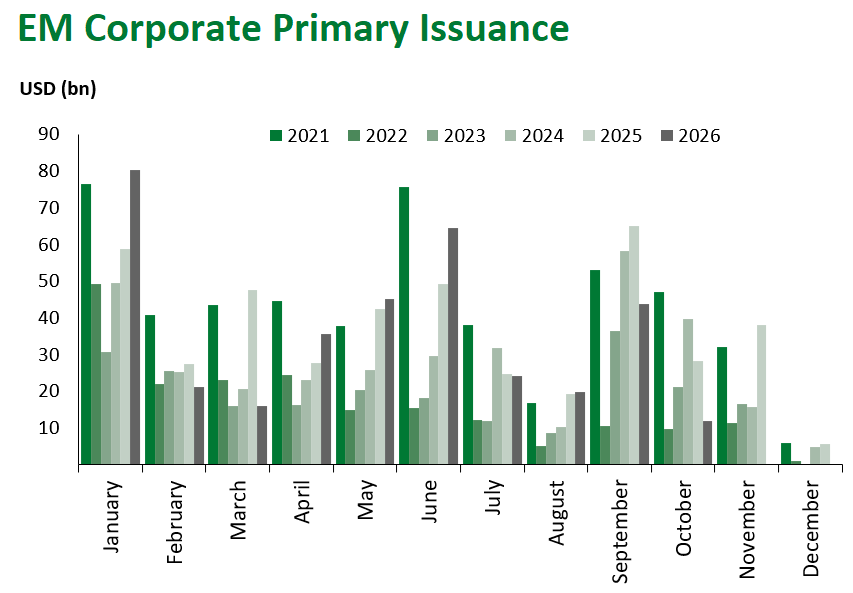
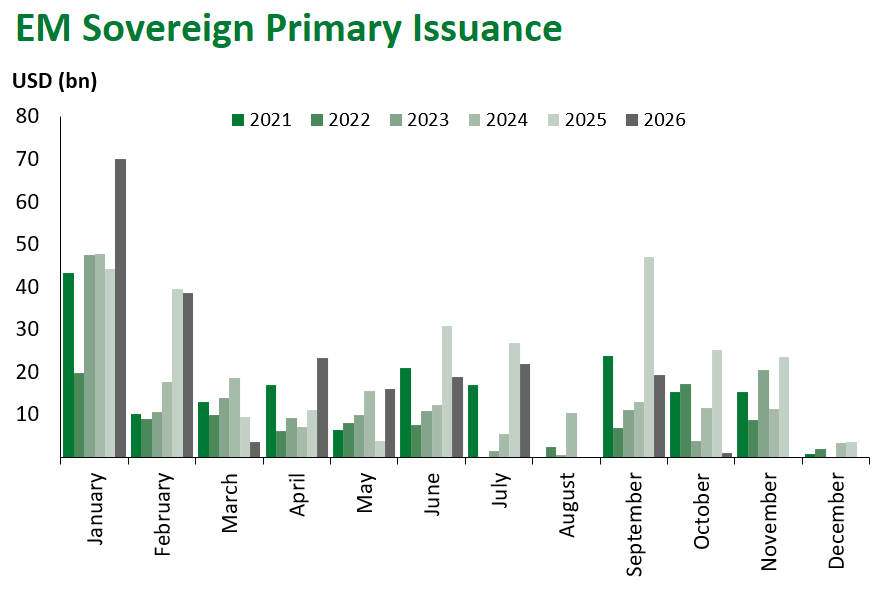
Primary market activity picked up, with 12 issuers pricing approximately $6.5 billion in hard currency supply, nearly all investment grade and close to three-quarters from Asia. Tencent’s $1.8 billion two-tranche deal was the largest of the week, financials accounted for half of the issuers, and Gabon was the only sovereign, raising $580 million of amortizing 2034 bonds at 12.80%.
Fixed Income
Equities
Commodities

Source for data tables: Bloomberg, JPMorgan, Gramercy. EM Fixed Income is represented by the following JPMorgan Indicies: EMBI Global, GBI-EM Global Diversified, CEMBI Broad Diversified and CEMBI Broad High Yield. DM Fixed Income is represented by the JPMorgan JULI Total Return Index and Domestic High Yield Index. Fixed Income, Equity and Commodity data is as of October 16, 2026 (mid-day).
Emerging Markets Flows
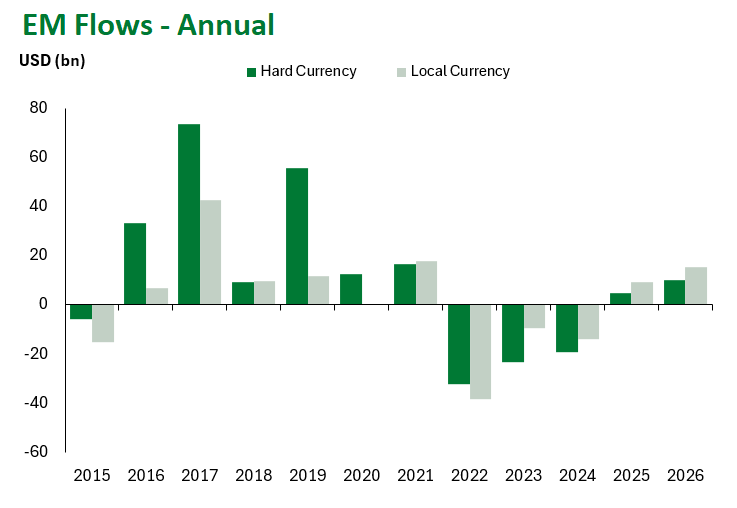
Source for graphs: Bloomberg, JPMorgan, Gramercy. As of October 16, 2026.
For questions, please contact:
Kathryn Exum, CFA ESG, Director, Co-Head of Sovereign Research, [email protected]
Petar Atanasov, Director, Co-Head of Sovereign Research, [email protected]
This document is for informational purposes only. The information presented is not intended to be relied upon as a forecast, research or investment advice, and is not a recommendation, offer or solicitation to buy or sell any securities or to adopt any investment strategy. Gramercy may have current investment positions in the securities or sovereigns mentioned above. The information and opinions contained in this paper are as of the date of initial publication, derived from proprietary and nonproprietary sources deemed by Gramercy to be reliable, are not necessarily all-inclusive and are not guaranteed as to accuracy. This paper may contain “forward-looking” information that is not purely historical in nature. Such information may include, among other things, projections and forecasts. There is no guarantee that any forecasts made will come to pass. Reliance upon information in this paper is at the sole discretion of the reader. You should not rely on this presentation as the basis upon which to make an investment decision. Investment involves risk. There can be no assurance that investment objectives will be achieved. Investors must be prepared to bear the risk of a total loss of their investment. These risks are often heightened for investments in emerging/developing markets or smaller capital markets. International investing involves risks, including risks related to foreign currency, limited liquidity, less government regulation, and the possibility of substantial volatility due to adverse political, economic or other developments. References to any indices are for informational and general comparative purposes only. The performance data of various indices mentioned in this update are updated and released on a periodic basis before finalization. The performance data of various indices presented herein was current as of the date of the presentation. Please refer to data returns of the separate indices if you desire additional or updated information. Indices are unmanaged, and their performance results do not reflect the impact of fees, expenses, or taxes that may be incurred through an investment with Gramercy. Returns for indices assume dividend reinvestment. An investment cannot be made directly in an index. Accordingly, comparing results shown to those of such indices may be of limited use. The information provided herein is neither tax nor legal advice. Investors should speak to their tax professional for specific information regarding their tax situation.