


Executive Summary
Treasuries calmed after record highs, and EM rallied across the board. The 10-year touched 5.35%, its highest since 2002, before strong auctions steadied the curve; foreign buyers took 80.3% of the 10-year sale. EM fixed income gained in all three sub-asset classes, with local currency leading. Issuers still held back, with only about $4 billion priced this week.
Trump’s pledge pushed Iran escalation risk past November 3, and the Middle East was EM’s only losing region. Brent briefly topped $105 on reports of strike planning and a Gulf hurricane, then modestly pared gains after Trump ruled out an attack before the midterms. In hard currency, the Middle East was the only region in negative territory (−0.13%), and Lebanon (−5.59%) was the clear underperformer.
Brazil’s first-round credit-positive surprise made Latin America the standout region. Flávio Bolsonaro’s lead set off the Ibovespa’s biggest one-day gain since 2020, pushed the BRL more than 4% stronger and pulled local yields lower. Brazil led the local currency index (+8.47%), split about evenly between currency and bond prices. It also rose 1.23% in hard currency sovereigns and was the top corporate market (+0.95%). The rally spread across the region and LatAm led gains across all EM asset classes this week.
Market Overview
Macro Update
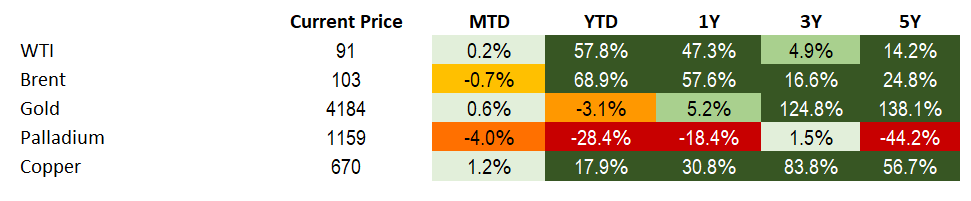
Oil spiked and then retreated this week as the timing of U.S. military risk shifted. Early in the week, reports emerged that the Pentagon was identifying targets in Iran for possible strikes before the November 3 midterms, while Iranian attacks on tankers in the Strait of Hormuz continued. Brent rose more than 5% intraday on Thursday to above $105 per barrel, alongside Hurricane Isaias, the first Atlantic hurricane of the season, shutting in about a quarter of U.S. Gulf of Mexico oil output.
Prices pared gains modestly after President Trump posted that the U.S. was having “productive discussions” with Iran and would not attack “at any time prior to the Midterm Elections”. The pledge postpones the escalation risk, but an Israeli official told Axios that the chances of renewed U.S. action increase significantly after the vote. For markets, November 3 has become a geopolitical date as well as a political one, and the oil risk premium could rebuild as it approaches.
Treasuries set new extremes before buyers returned. The 10-year yield reached 5.35%, its highest since 2002, and the 30-year traded near 5.67%, close to its own 24-year high. Demand at this week’s auctions then steadied the curve: the $39 billion 10-year sale cleared at 5.30%, the highest auction yield since 2000, with indirect bidders, a group that includes foreign central banks, taking 80.3% against a 72.4% average, and Thursday’s $22 billion 30-year sale also drew solid demand. Together with the easing in oil, that pulled the 10-year back to below 5.30% into the close.
With 10-year breakevens near 2.35% and real yields up to about 2.90%, the move continues to reflect term premium, and inflation expectations remain contained. Strong foreign demand at these levels suggests buyers are willing to step in near current yields, which, if sustained, could ease the pressure on EM dollar issuers that have had to price new deals off an unstable Treasury curve.
Meanwhile, the Fed’s guidance turned more hawkish. Minutes from the September meeting showed most participants judged that another increase would likely be appropriate by year-end, with many describing a higher path as prudent insurance against persistent inflation. Governor Waller, who argued for holding rates in early September, said on Thursday that he anticipates additional hikes, which need not come at consecutive meetings but “should be in place in an acceptable period of time.”
Futures assign about an 85% probability to at least one more hike by December and roughly 20% to two, while an October move remains unlikely after Vice Chair Jefferson and New York Fed President Williams stressed patience. Next week’s September CPI, where consensus looks for a 0.2% monthly and 2.5% annual rise in core, is the next test. A possible hiking cycle keeps the dollar supported and front-end differentials narrowing, the channel that did most of the damage to EM local markets in late September. The USD was set for its longest weekly advance since early 2025, maintaining a 102-handle on the DXY index.
Brazil produced the week’s largest EM move. Senator Flávio Bolsonaro took the presidential election first round with 47.0% of the vote against 45.2% for President Lula, after almost every poll had shown Lula ahead, and prediction markets now give him better than an 80% chance of winning the October 25 runoff. On Monday the Ibovespa jumped 7.7% to a record high, its biggest one-day gain since March 2020, the BRL strengthened more than 4% to just under R$5 per dollar, and local yields fell meaningfully, in line with Gramercy’s predictions. Gains by centrist parties in Congress and important endorsements for Bolsonaro added to the rally.
Elsewhere in EM, the tightening camp grew. The Reserve Bank of India delivered its first hike since February 2023, a unanimous 25 basis point move to 5.50%, shifted its stance to “calibrated tightening” and said cuts are off the table, citing elevated oil prices, a weaker rupee and an inflation outlook that is no longer benign. The rupee still slipped to around 97 per dollar after the decision, and Governor Malhotra said the central bank would act against excessive volatility while arguing the currency may be undervalued. Poland’s central bank held at 3.75% despite rising inflation, and Peru’s held at 4.25%. Rate hikes among energy importers with weaker currencies leave high-real-rate markets such as Brazil as the main candidates for EM duration gains.
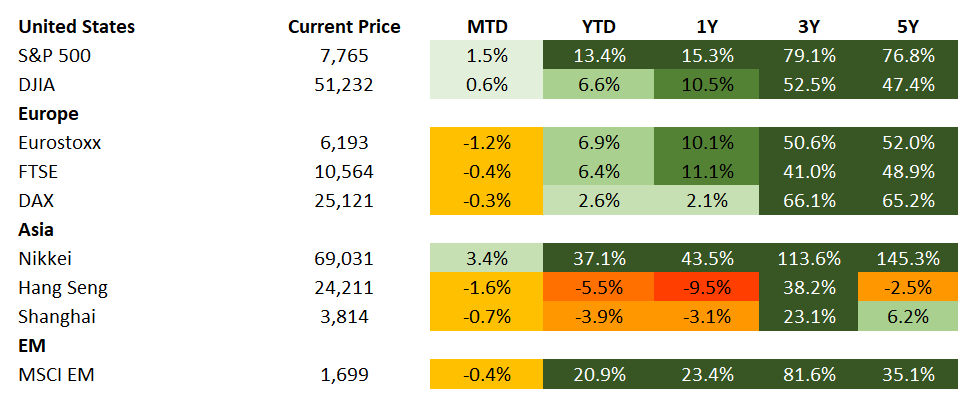
Equities set records early in the week before the AI trade wobbled. On Thursday, a Financial Times report that OpenAI told investors its annualized revenue was approaching $50 billion at the end of September, about $20 billion below figures widely reported last month, sent the Nasdaq down 1.3% and the Philadelphia semiconductor index down 3.4%, with Oracle and Broadcom each falling more than 4% on concerns over the financing of AI infrastructure. Tech stocks rebounded on Friday, leaving the major indices on course for weekly gains.
France remained the focal point of European sovereign stress even though the record wide French government bond spreads over Bunds narrowed somewhat as investors reassessed the speed of the move. The government presented a €43 billion consolidation package on October 1 and filed its 2027 budget this week into a fragmented National Assembly, which takes it up on October 13, with the budget vote one of the main near-term catalysts for European duration and the euro.
Refined product markets got some relief late in the week. China resumed fuel exports after a brief Golden Week halt, approving around 3.7 million tons of diesel, gasoline and jet fuel for October, below the roughly 4 million tons expected for September, and the International Energy Agency agreed to accelerate the release of emergency stocks and prioritize diesel. Analysts expect only modest easing while Middle East supply stays disrupted, and Thursday’s diesel spike showed how quickly product markets react to geopolitical risk. For fuel-importing EM economies, pass-through risk stays elevated into the fourth quarter even if crude stabilizes.
The Week Ahead
U.S. data will test the Fed’s hawkish turn: September CPI on Wednesday, with consensus looking for a 0.2% monthly rise in core, followed by PPI and retail sales on Thursday and the Beige Book. The IMF and World Bank Annual Meetings open in Bangkok on Monday, and Tuesday’s World Economic Outlook and Global Financial Stability Report, which Managing Director Georgieva has signaled will not make easy reading after two growth downgrades this year tied to the Iran war, will frame the discussion of energy prices, record public debt and bond-market stress. Third-quarter earnings begin Tuesday with JPMorgan, Goldman Sachs, Citigroup and Wells Fargo, followed by Bank of America and Morgan Stanley on Wednesday, with investors watching how much higher yields have weighed on credit demand, and China releases September CPI and PPI on Wednesday. In Europe, the French National Assembly begins debating the 2027 budget on Tuesday. On Iran, the watch-points are whether Trump’s pledge holds against continued tanker attacks and reported proxy attacks in Saudi Arabia, and what comes of the discussions with Tehran. In EM, Brazil enters the last two weeks of the runoff campaign, with polling and coalition-building in Congress driving the BRL. The U.S. CPI print and the IMF’s assessment will set the tone for EM risk appetite heading into a heavy second half of October.
Highlights
Bolsonaro’s first-round outperformance makes him favorite in the presidential election runoff, providing a political tailwind for Brazilian assets
Event: Senator Flávio Bolsonaro significantly outperformed expectations in the first round of Brazil’s presidential election last Sunday, finishing with roughly 47% of the vote against President Lula’s 45%. Pre-election polls had pointed to a 3–5 pp Lula lead in the first round, implying a swing of some 5–7 pp in Bolsonaro’s favor. The two will meet in the runoff on October 25. Legislative and gubernatorial races also saw gains for center-right and centrist candidates at the expense of the left, signaling a likely broader shift toward market-friendly economic policies from 2027.
Investment Implications: The first-round outcome and subsequent endorsements by political parties and former presidential race rivals reinforce Flavio Bolsonaro’s strong momentum for the runoff on October 25. We see Bolsonaro as a solid favorite in the runoff. A right-wing president backed by a conservative-leaning Congress is the best-case scenario for Brazil’s fiscal and reform outlook from a market perspective. As such, we expect markets to price a significantly stronger fiscal adjustment trajectory and a re-anchoring of medium-term inflation expectations, addressing the main weakness in Brazil’s otherwise robust sovereign profile and the principal reason that term premium remains elevated. With the Selic at a highly restrictive 13.75% and real rates around 9–10%, all else equal, that repricing should open the door to a sizable BCB easing cycle in 2027, which we see taking the terminal rate lower to a 10–11% range despite a more challenging external backdrop. On the FX front, we also see further upside and expect the BRL to move over time toward a mid-4s handle vs. the USD upon confirmation of a Bolsonaro victory and announcement of specific fiscal measures by the new economic team. Lower rates and a stronger currency should reinforce each other: the fiscal repricing that compresses the term premium also supports the BRL, while a stronger BRL in turn helps anchor inflation expectations. Hard-currency bonds stand to benefit too, as a stronger fiscal path and a likely improved relationship with Washington are both credit-positive, but local currency remains our preferred expression, capturing lower rates and FX appreciation on top of double-digit carry. We have flagged Brazil local debt as one of the most asymmetric opportunities in EM under a Bolsonaro scenario, and we now see the beginning of a structural repricing materializing with Brazilian assets well placed to outperform peers over the coming months, in our view.
IMF Staff-Level agreement keeps Pakistan’s program on track, focus shifting to reform durability
Event: On October 7, IMF staff and the Pakistani authorities reached a staff-level agreement on the fourth review of the 37-month EFF and the third review of the 28-month RSF, alongside completion of the 2026 Article IV consultation. Subject to Executive Board approval, the reviews will release about $1.0 billion under the EFF and $210 million under the RSF, bringing total disbursements under both arrangements to about $5.7 billion. Staff assessed program implementation as broadly on track despite a difficult external backdrop, noting that FY26 growth is estimated at 3.6% after energy price shocks and supply disruptions slowed momentum, headline inflation eased to about 10.3% in September after a May peak, the current account was broadly balanced on strong remittances, and gross reserves rose to about $21.5 billion by the end of September. The statement also cited sovereign rating upgrades and renewed market access as signs of stronger policy credibility. Forward commitments center on delivering the FY27 budget anchored by a 2%-of-GDP underlying primary surplus, keeping monetary policy tight until inflation returns durably to the SBP’s target range, and making timely energy tariff adjustments to prevent renewed circular debt. Staff also called for prompt phase-out of the fuel support scheme, which it described as costly and poorly targeted. Market reaction was muted, as the agreement was largely expected.
Investment Implications: The agreement is credit-positive and confirms that Pakistan has absorbed the Middle East energy shock without derailing the program, a meaningful test given the country’s oil import dependence and track record of program slippage under external stress. Reserve accumulation to roughly $21.5 billion and a balanced current account mark a substantial improvement in external liquidity relative to the 2023 near-default episode, and the stated rating upgrades and return to market access reinforce that the stabilization is gaining credibility. The key question now is durability. With the EFF set to expire in roughly a year, the remaining reviews will coincide with the FY28 budget cycle, and Pakistan’s history suggests reform momentum has tended to fade as program anchors fall away. Several pressure points are already visible. The fuel support scheme the Fund wants unwound points to political resistance to passing through energy costs. Inflation, while off its peak, remains above the SBP’s target range, and revenue performance still relies heavily on administrative measures rather than base broadening. Elevated gross financing needs and rollover risk also leave the sovereign exposed if global financial conditions tighten or oil prices stay high. Whether the authorities seek a successor arrangement, and on what terms, will be the clearest signal of commitment to sustaining the adjustment beyond the current program. Near-term catalysts are Executive Board approval, the pace of fuel subsidy withdrawal and energy tariff adjustments, and FY27 revenue collection against targets.
Market Data
EM Credit Update
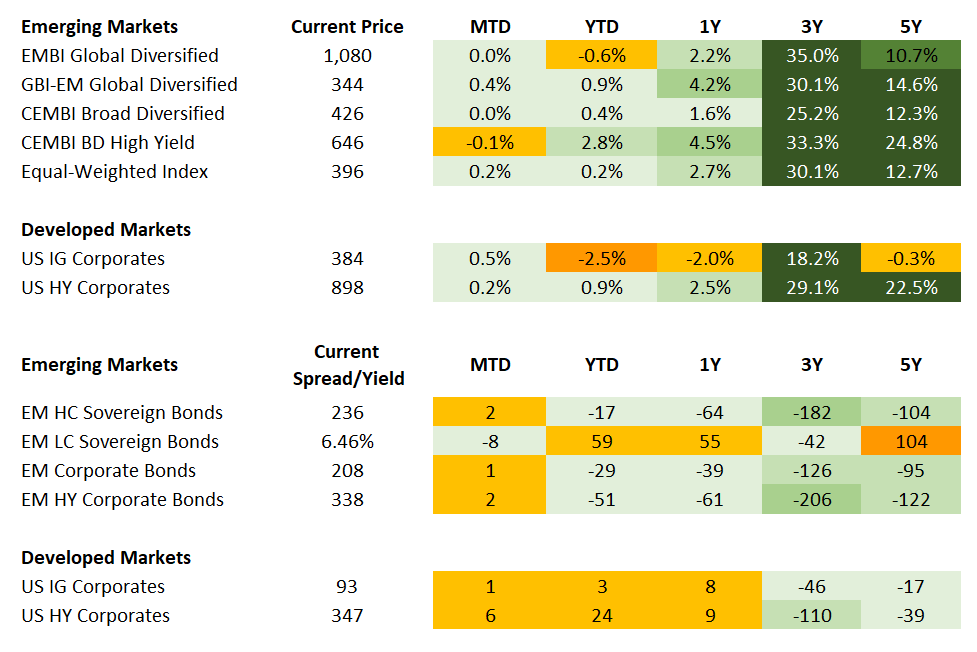
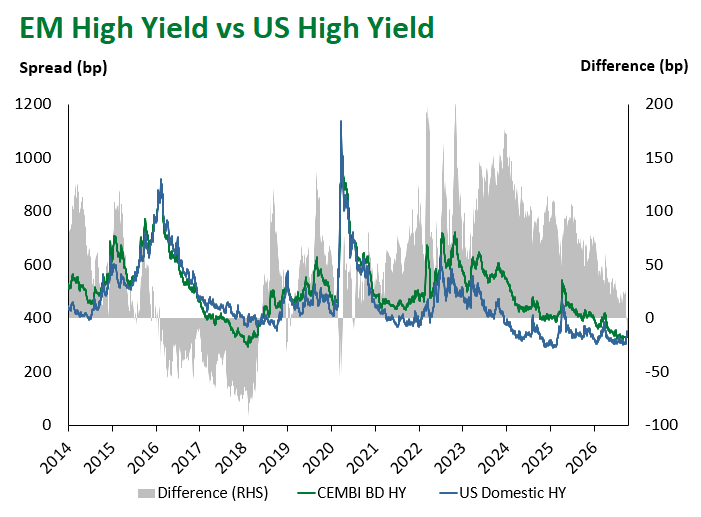
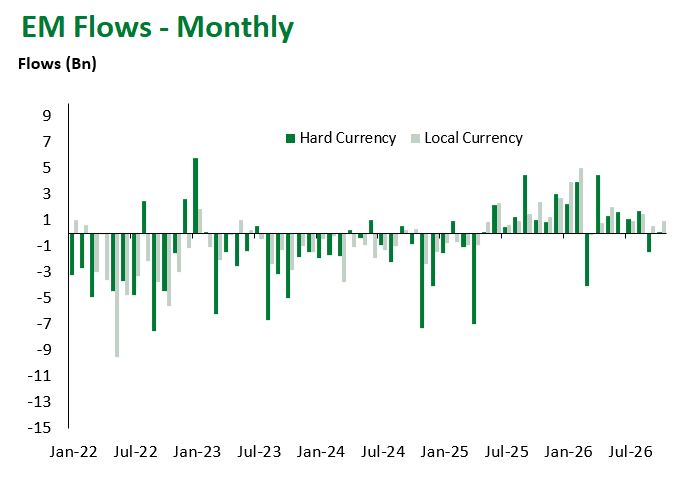
Emerging markets fixed income posted gains across all three sub-asset classes this week as acute volatility in U.S. Treasury rates calmed, with local currency debt leading and Latin America the standout region across sovereigns and corporates.
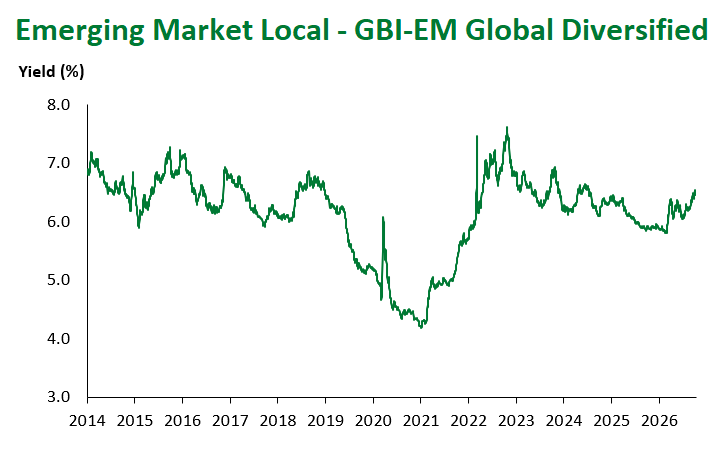
Local currency sovereign debt rose +0.86% at the index level, the best-performing EM sub-asset class on the week. Gains were concentrated in Latin America, led by Brazil (+8.47%), which rallied on the first-round presidential election result, with currency appreciation and price gains contributing roughly equally. Mexico (+3.12%) and Colombia (+3.11%) also posted strong gains, with Colombia’s move almost entirely FX-driven. In contrast, the Dominican Republic (-2.53%) was the weakest performer, losing ground on both currency and price, while Poland (-0.37%), Serbia (-0.21%), and the Czech Republic (-0.17%) also finished lower, with currency weakness the common driver across Central and Eastern Europe.
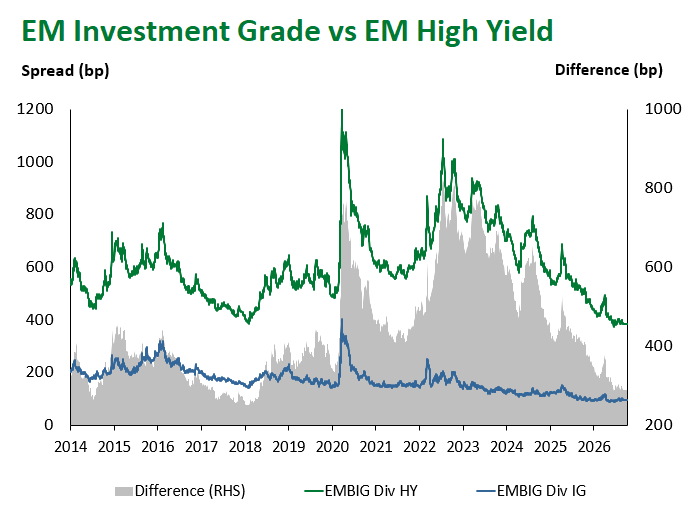
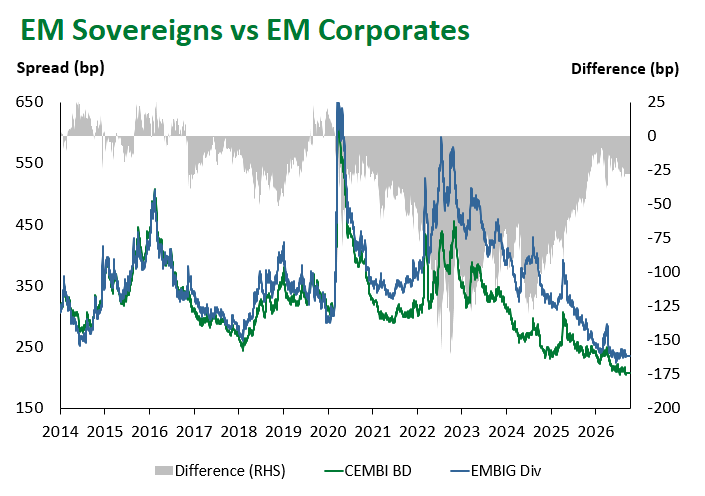
Hard currency sovereign bonds rose +0.56%, with high yield (+0.73%) outperforming investment grade (+0.37%). Latin America (+1.25%) led regionally, followed by Europe (+0.51%), while Asia (+0.08%) and Africa (+0.02%) were roughly flat and the Middle East (-0.13%) was the only region in negative territory. At the country level, Venezuela (+8.41%) led gains, followed by Argentina (+2.90%), Ukraine (+1.55%), Brazil (+1.23%), and Romania (+1.08%). Lebanon (-5.59%) was the clear underperformer, with Kenya (-0.45%), Suriname (-0.44%), and Zambia (-0.41%) also lagging. By rating, CCC (+1.33%) outperformed, and along the curve the 1–3 year bucket (+0.74%) led while the 3–5 year segment (+0.41%) lagged.
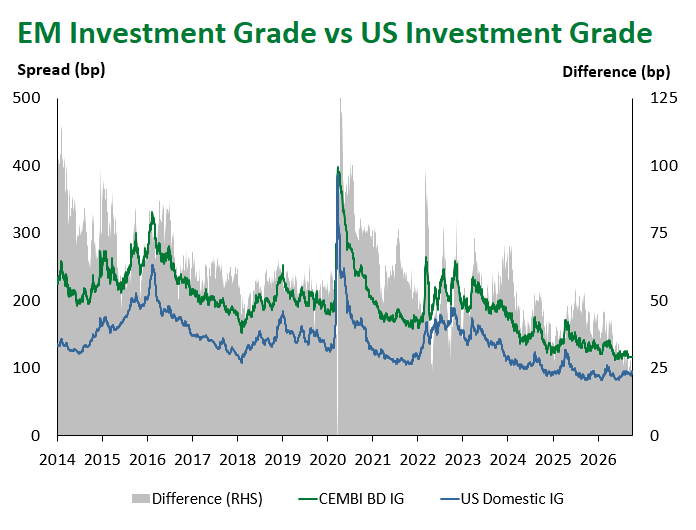
EM corporates gained +0.19%, with high yield (+0.21%) marginally ahead of investment grade (+0.18%). Latin America (+0.57%) again led regionally, while Asia (+0.08%), Africa (+0.07%), and the Middle East (-0.02%) lagged. Brazil (+0.95%) was the top performer, tracking the post-election sovereign rally, followed by Argentina (+0.74%), Jamaica (+0.70%), and Colombia (+0.62%), while Ghana (-1.03%), Israel (-0.76%), and Ukraine (-0.76%) trailed. By rating, BB (+0.39%) led and C-rated credits (-2.55%) lagged. Along the curve, the 5–7 year segment (+0.29%) outperformed the 1–3 year bucket (+0.05%).
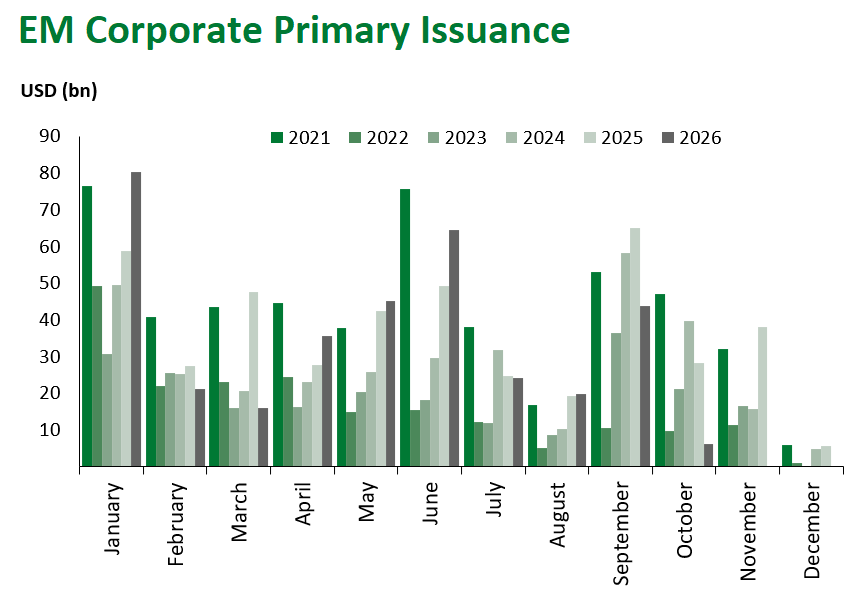
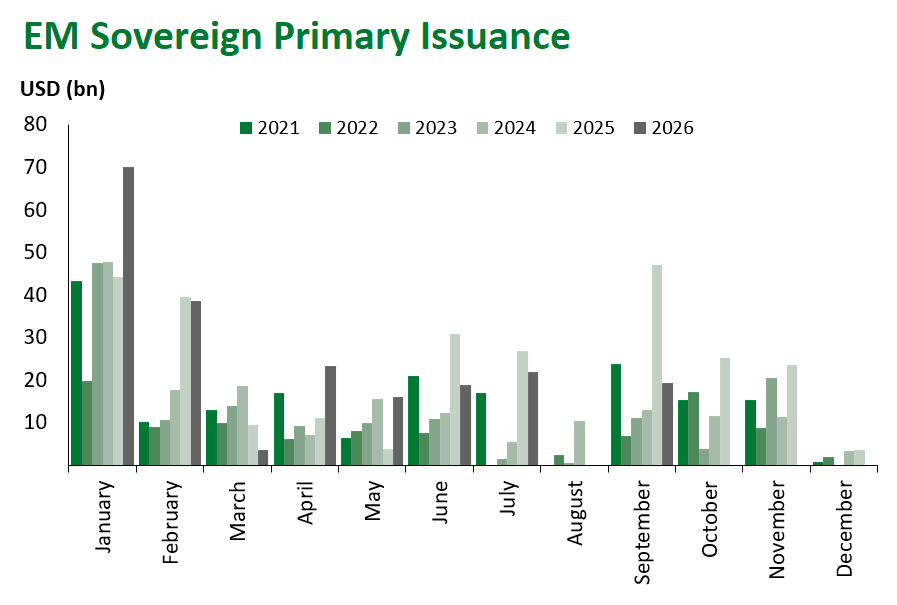
Primary market activity was light, with four issuers pricing six USD tranches for approximately $4 billion in hard currency supply, predominantly investment grade. Yinson Azaela’s $1.46 billion Angola-linked 2040 bond was the largest deal of the week, while DBS Bank raised $1.5 billion across three tranches and Banco de Credito del Peru priced a $500 million Tier 2. Laos was the lone sovereign and only high yield issuer, raising $500 million at 9.625%.
Fixed Income
Equities
Commodities
Source for data tables: Bloomberg, JPMorgan, Gramercy. EM Fixed Income is represented by the following JPMorgan Indicies: EMBI Global, GBI-EM Global Diversified, CEMBI Broad Diversified and CEMBI Broad High Yield. DM Fixed Income is represented by the JPMorgan JULI Total Return Index and Domestic High Yield Index. Fixed Income, Equity and Commodity data is as of October 9, 2026 (mid-day).
Emerging Markets Flows
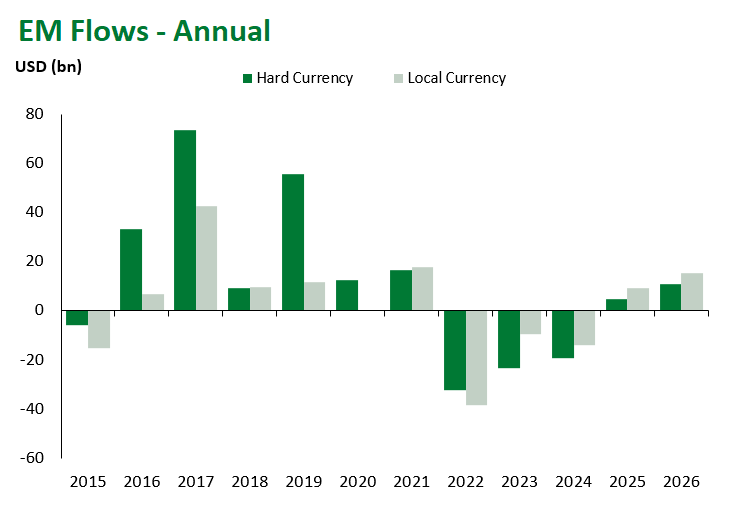
Source for graphs: Bloomberg, JPMorgan, Gramercy. As of October 9, 2026.
For questions, please contact:
Kathryn Exum, CFA ESG, Director, Co-Head of Sovereign Research, [email protected]
Petar Atanasov, Director, Co-Head of Sovereign Research, [email protected]
This document is for informational purposes only. The information presented is not intended to be relied upon as a forecast, research or investment advice, and is not a recommendation, offer or solicitation to buy or sell any securities or to adopt any investment strategy. Gramercy may have current investment positions in the securities or sovereigns mentioned above. The information and opinions contained in this paper are as of the date of initial publication, derived from proprietary and nonproprietary sources deemed by Gramercy to be reliable, are not necessarily all-inclusive and are not guaranteed as to accuracy. This paper may contain “forward-looking” information that is not purely historical in nature. Such information may include, among other things, projections and forecasts. There is no guarantee that any forecasts made will come to pass. Reliance upon information in this paper is at the sole discretion of the reader. You should not rely on this presentation as the basis upon which to make an investment decision. Investment involves risk. There can be no assurance that investment objectives will be achieved. Investors must be prepared to bear the risk of a total loss of their investment. These risks are often heightened for investments in emerging/developing markets or smaller capital markets. International investing involves risks, including risks related to foreign currency, limited liquidity, less government regulation, and the possibility of substantial volatility due to adverse political, economic or other developments. References to any indices are for informational and general comparative purposes only. The performance data of various indices mentioned in this update are updated and released on a periodic basis before finalization. The performance data of various indices presented herein was current as of the date of the presentation. Please refer to data returns of the separate indices if you desire additional or updated information. Indices are unmanaged, and their performance results do not reflect the impact of fees, expenses, or taxes that may be incurred through an investment with Gramercy. Returns for indices assume dividend reinvestment. An investment cannot be made directly in an index. Accordingly, comparing results shown to those of such indices may be of limited use. The information provided herein is neither tax nor legal advice. Investors should speak to their tax professional for specific information regarding their tax situation.