


Executive Summary
The 5% Treasury line broke decisively. A five-year-high flash PMI plus hawkish Fed speak pushed the 10Y to ~5.20% (highest since 2007) and the 30Y ~5.50%, with two-thirds odds now on an October hike; EM fixed income fell with the 10+ year bucket flipping from last week’s only positive segment to the weakest and HY underperforming IG in sovereigns for a second straight week.
The synchronized dollar and yields shock enhanced oil sensitivity and hit CEE duration. As the DXY revisited ~101 and Brent’s early-week slide toward $98 met the global dollar bid, Colombia (-5.31%) was the LC outlier as the peso lost close to 5%, reversing some of its summer rally that we have flagged as running ahead of fundamentals while CEE (Romania -2.61%, Hungary -2.37%, Poland -2.28%) were hit on both FX and price legs as Bunds imported the U.S. term-premium shock.
Despite the volatile macro backdrop, EM issuers rushed to reopen the primary market. With UNGA diplomacy whipsawing oil and inflation outlooks, $18.0 billion of new bonds priced across 24 tranches with nearly half sovereign, including Qatar’s $3 billion, the Dominican Republic’s $1.6 billion, and Türkiye’s $1.5 billion a week after its local fund liquidations, a sign that market access is holding even as secondary prices fall.
Market Overview
Macro Update
The 5% line in the benchmark 10Y U.S. Treasuries was breached this week on Wednesday’s S&P Global flash PMI, which showed U.S. business activity racing to a five-year high. The composite index jumped to 58.4 from 56.0, the strongest since July 2021, with manufacturing at 57.0 (its best since May 2022), factory hiring at the fastest pace since early 2021, and input costs rising at the steepest rate in four years. Reinforced by hawkish remarks from Governor Barr and New York Fed President Williams that more tightening will be needed, the UST curve bear-steepened with the 10-year yield closing the week around 5.20%, its highest since 2007; the 30-year reached above 5.50%, a post-2004 peak, the 2-year hit a cycle high near 4.90%. Fed funds futures now assign roughly a two-thirds probability to a hike at the October 27–28 meeting, six days before the U.S. midterms. For EM assets, a 10-year above 5% make the global macro backdrop more challenging, compressing the carry cushion that has protected local markets and raising the bar for hard currency duration to perform.
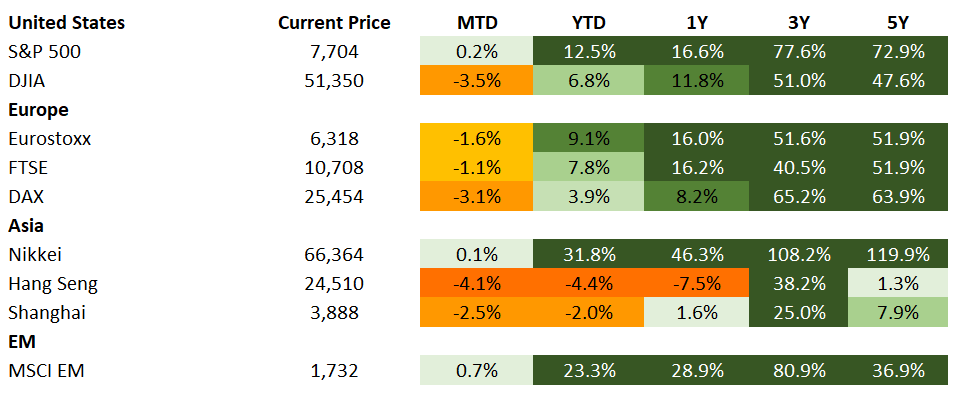
The repricing was global and synchronized. Bund yields set new cycle highs, while the Germany-France spread widened past 110bps and Japan’s 10-year JGB yield reached 3.075%, a level last seen in 1996. The dollar followed U.S. yields higher, revisiting the June-July highs of ~101 on the DXY; the JPY weakened to around 159 but regained some ground after U.S. Treasury Secretary Bessent discussed the desirability of a strong currency with Japan’s Finance Minister. Gold dropped 1.6% to around $4,280 as real yields climbed. Equities were volatile but rebounded into the close as oil prices moderated, with tech shares leading gains in the S&P 500.
Diplomacy at the UN General Assembly (UNGA) produced the week’s sharpest headline whipsaw. Hopes built early: President Trump acknowledged receiving a list of Iranian demands to end the war, said he was open to meeting President Pezeshkian, and convened Gulf leaders plus Iraq, Jordan, and Egypt in New York, before disclosing that U.S. and Iranian representatives had held a three-hour “very good meeting” on the sidelines, while adding that he faced a “big decision” between a deal and “annihilating” Iran. Pezeshkian then told the Assembly that Tehran would fight “until our last breath” and reports emerged that Iran had given Washington one week to meet its demands, chiefly lifting the naval blockade.
By the end of UNGA week, reports emerged that negotiators were discussing a phased agreement, Hormuz navigation in exchange for ending the blockade, keeping the diplomatic track alive. Crude traced the diplomatic arc almost tick for tick. Brent fell for five consecutive sessions to below the $100 per barrel mark by mid-week as risk premium drained on UNGA hopes, then reversed on Iran’s defiance touching $108 intraday, before falling again to around $104 into the close on revived hopes for a diplomatic way to end the war.
The physical picture, by contrast, continued to normalize. Saudi Arabia’s East-West pipeline restarted, Hormuz shuttle flows persisted, and U.S. crude inventories built unexpectedly, though European diesel held near record highs and a White House denial of a reported 90-day U.S. diesel export ban did little to calm product markets. JPMorgan told clients it no longer holds a baseline oil forecast, the first such admission since the war began. For some EM economies, the refined-product channel can become a stress point. Bolivia’s 83% diesel price increase after ending its subsidy this week illustrates the fiscal and social pressure building in energy-importing frontier economies.
President Xi’s state visit to Washington was heavy on symbolism and light on substance. President Trump greeted Xi personally at Joint Base Andrews, the first such welcome for a foreign leader since 2015, and Xi declared the two countries should be “partners, not rivals.” The tangible output was thin. Treasury Secretary Bessent said the Busan trade truce due to expire in November was extended, but only by two months, pushing tariffs, Chinese purchase commitments, rare-earth supplies, and technology restrictions into the next round in January.
Europe’s data leaned firmer even as its bond market imported the U.S. shock. Germany’s flash composite PMI rose to an eleven-month high of 53.8 as services rebounded and hiring increased despite fuel-driven cost pressure, adding to evidence that the eurozone is absorbing the energy shock better than feared and keeping the ECB’s December hike in play. The euro nonetheless fell to a two-month low on dollar strength, and analysts flagged that President Trump’s call to ban U.S. diesel exports would be inflationary for a European economy heavily reliant on U.S. product shipments.
In Latin America, the two largest credit stories converged on binary events. Brazil’s election tightened into a dead heat 10 days before the October 4 first round. President Lula leads first-round polling by 3-4 points, but runoff simulations now range from a one-point Flávio Bolsonaro lead (Quaest, 42-41) to a technical tie (AtlasIntel, 47.2-46.8). Argentina’s country risk climbed five straight days to 524bps from 485 the prior week, the Merval fell 2.5%, and protests against the Milei adjustment spread as the IMF staff mission began its review Monday ahead of an $800 million payment due Friday.
The Week Ahead
A dense U.S. data week tests whether the October hike gets locked in. September payrolls on Friday are the decisive input, with the Fed openly comfortable on the labor market, only a persistently weak run of prints would push out tightening expectations, preceded by ISM manufacturing, ADP, the final 2Q GDP revision, and the August PCE release, with Consumer Confidence and a heavy Fed speak calendar dominated by the hawkish camp. Fed funds futures enter the week pricing roughly two-thirds odds of an October 28 move; the political optics of hiking six days before the midterms are the counterweight. In Europe, flash September inflation frames the ECB’s December decision, and China’s official PMIs are the last read before Golden Week thins Asian liquidity from October 1.
Geopolitically, Iran’s one-week ultimatum on lifting the naval blockade and Foreign Minister Araghchi’s seven-day reopening proposal both expire within the week, making the phased-deal talks in New York the single largest swing factor for crude and for the U.S. inflation and rates trajectory. The Houthi missile campaign against Yanbu and Taif is the tail risk to Saudi Arabia’s restored export capacity. In EM, Brazil votes in its first round on Sunday, October 4, with results landing into Monday’s open and a runoff on October 25 the base case, while the IMF mission concludes its Argentina review.
Highlights
Trump-Xi summit extends truce and provides floor to sentiment
Event: Chinese President Xi Jinping arrived in Washington, D.C., on September 23 for his first U.S. state visit since 2015, with bilateral meetings running through Friday and both leaders striking notably warm public tones. Treasury Secretary Bessent confirmed a two-month extension of the Busan trade truce to January 10, 2027, alongside a new bilateral AI incident communication channel, while structurally consequential issues, rare earths, LNG, Taiwan arms sales, and U.S. pressure on China to help de-escalate the Iran conflict, remain unresolved.
Investment Implications: The summit reinforces near-term expectations for a tactical truce. For EM, this should provide a modest floor under risk sentiment, but calmer relations are unlikely to generate a meaningful compression in sovereign spreads. The broader EM hard-currency complex is likely to remain more sensitive to U.S. rates and energy prices. Any evidence that Beijing is willing to pressure Iran toward de-escalation would be particularly relevant for oil-importing sovereigns where high oil prices weigh most significantly on their external and financial positions. With the truce now extending into January, U.S.-China relations remain a key tail risk rather than an immediate catalyst, with November’s APEC engagement in Shenzhen the next important read on whether the current tactical stability can translate into a more durable framework.
No specific plans for trilateral U.S.-Russia-Ukraine meeting emerge from UNGA week
Event: The Trump-Zelensky relationship was one of the focal points of UNGA week. Ukraine’s president said he requested a “winter package” of military equipment including Patriot missiles from President Trump, who has asked that Kyiv stop strikes on Russian refineries amid higher global diesel prices. In that context, Washington appears to be pushing three de-escalation steps: 1) a ceasefire on energy infrastructure, 2) reopening the Black Sea grain corridor, and, most importantly, 3) a trilateral U.S.-Russia-Ukraine meeting, but no specific commitments on that front appear to have materialized.
Investment Implications: The most consequential development this week is what the Trump-Zelensky exchange reveals about the limits of Washington’s support. Ukraine’s military campaign against Russian refinery and port assets is Kyiv’s most effective source of leverage. It is imposing tangible costs on Russian fuel and grain exports, but it is also colliding with Trump’s domestic sensitivity to diesel prices. As for Zelensky, in his UN address this week, he called Putin the sole obstacle to peace, urged nations to choke Russia’s revenues, and said Kyiv is ready for an energy ceasefire if Moscow reciprocates, while warning of painful retaliation this winter otherwise. Meanwhile, Russia’s Finance Ministry submitted its 2027 draft budget with a fresh round of tax increases, including a 30% levy on mining and metallurgical companies’ excess earnings from elevated commodity prices as it struggles to fund military spending. The 2026 deficit is now expected to reach roughly 3% of GDP, nearly double the initial target, despite tax hikes enacted earlier this year. The resort to windfall levies on commodity producers and higher taxes on savers and investors, which the Kremlin had recently denied were under discussion, indicates the war’s fiscal strain is real. That lends some substance to Zelensky’s argument that revenue pressure can shift Moscow’s calculus. Still, Russia’s low debt load means it remains far from a financing constraint. On Ukraine’s financing side, the EU disbursements remain on track. However, the Commission’s tougher conditionality adds headline risk into a difficult winter. For Ukraine sovereign bonds, we see a ceasefire push as an asymmetric positive with material upside if talks gain traction. Incremental downside seems relatively limited as status quo mostly reflected in current valuations.
Market Data
EM Credit Update
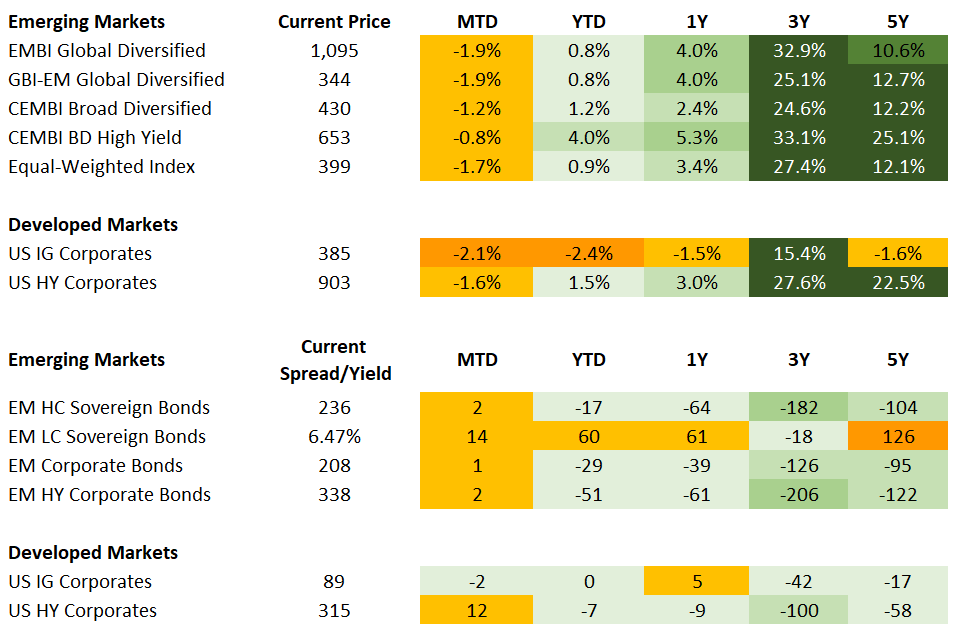
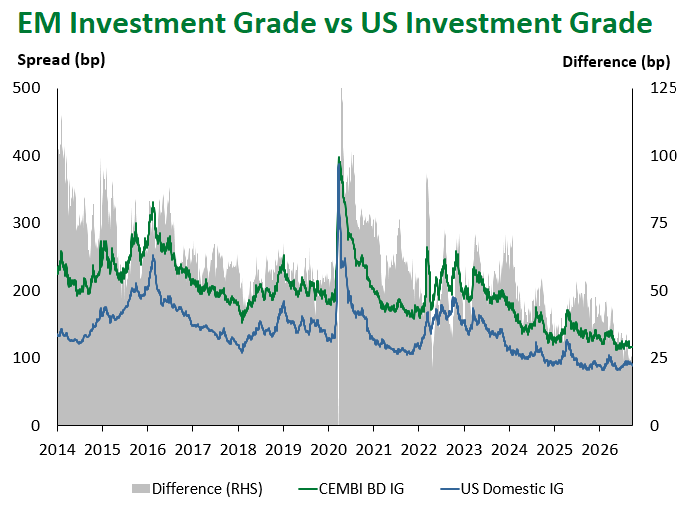
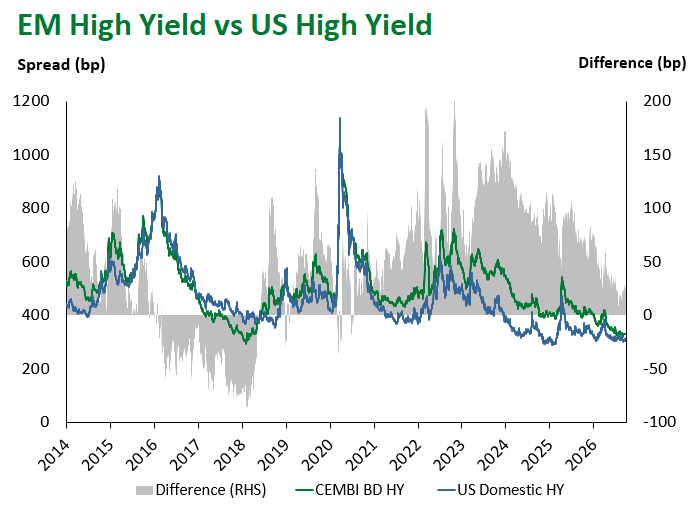
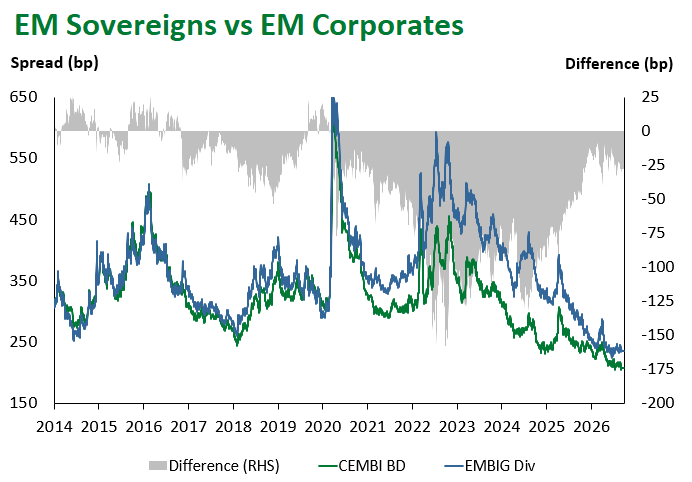
Emerging markets fixed income fell for a fourth consecutive week across all three sub-asset classes, and the selloff broadened. Hard currency sovereigns returned -0.94%, local currency sovereign debt -0.94% and EM corporates -0.48%, against -0.10%, -0.88% and -0.11% the prior week. The benign read of the Federal Reserve’s September 16 hike did not survive the week: 10+ year maturities, the only positive duration bucket in both hard currency indices a week earlier, became the weakest, as 10-year Treasury yields held near 5% and the dollar extended its post-meeting advance. At the same time the weakness in lower-rated credit that emerged last week deepened rather than faded. High yield underperformed investment grade in sovereigns for a second consecutive week. Corporates were again the most insulated of the three, though no country index finished higher.
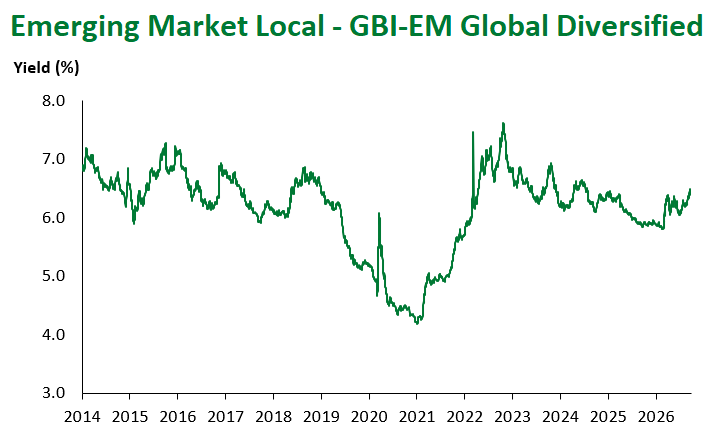
Local currency sovereign debt returned -0.94%, a marginally larger loss than the prior week’s -0.88% and again almost entirely currency-driven, though the distribution changed. Where last week’s dollar strength was near universal, this week FX losses were concentrated in a handful of markets. Colombia (-5.31%) was the outlier by a wide margin, its decline accelerating from -1.92% a week earlier. The peso lost close to 5%, sliding from around 3,120 to roughly 3,290 per dollar, as the global dollar bid combined with a decline in Brent to below $100 to hit the region’s most oil-sensitive currency, after a summer rally that we have flagged as running ahead of fundamentals. Mexico (-2.73%) saw the peso’s slide deepen to -2.53% from -1.23% the prior week, with the price gain that had cushioned the earlier move turning negative. Central and Eastern Europe was hit on both legs. Romania (-2.61%), Hungary (-2.37%), Poland (-2.28%) and the Czech Republic (-1.70%) all saw their currencies fall between 1.2% and 1.8% against the dollar while local bonds sold off as well, most sharply in Romania (price -1.57%). Brazil (-0.22%) steadied after its -1.39% reversal, a positive price return (+0.20%) offsetting most of a softer real (-0.49%). Malaysia (+1.04%) led this week’s gainers, with Egypt (+0.63%, split between the pound and carry), China (+0.18%) and Türkiye (+0.15%, carry of +0.55% outweighing lira weakness) also positive.
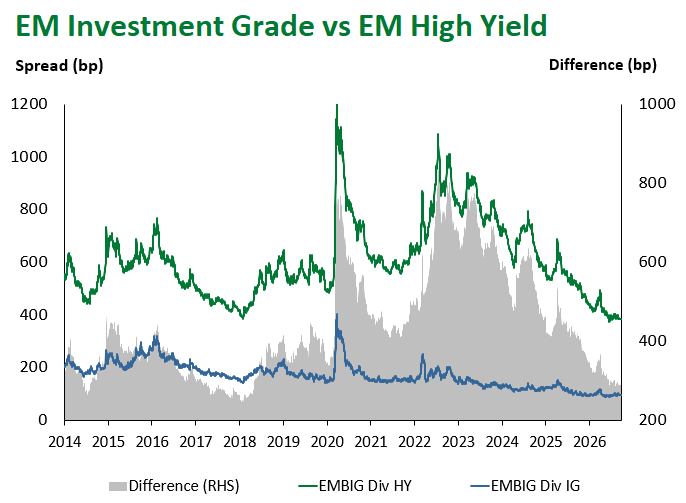
Hard currency sovereign bonds returned -0.94%, a sharp deterioration from -0.10% the prior week, with high yield (-0.99%) underperforming investment grade (-0.89%) for a second consecutive week. After last week’s Fed decision, the long end had been the one bright spot, with 10+ year maturities returning +0.14% while the belly lagged; this week’s returns deteriorated steadily out the curve and the short end offered less protection than in earlier weeks. Regionally, Latin America (-1.30%), broadly flat a week earlier, became the weakest region by a clear margin, while the Middle East (-0.55%) held up best. Only five markets finished higher, Sri Lanka (+0.41%), Lebanon (+0.34%), Bolivia (+0.31%), Jordan (+0.04%) and Georgia (+0.03%), and the distressed and frontier tail did the damage. Venezuela (-4.81%) was the weakest constituent, resuming the reversal of the early-September oil-deal rally as the debt sustainability analysis promised for June remains outstanding and a reported claims perimeter near $240 billion, which would make it the largest sovereign restructuring on record, has yet to be formally disclosed. Senegal (-2.97%) gave back the rebound of two weeks ago and more, the relief from the honored September 13 coupon fading as attention returned to burden-sharing and an ad hoc bondholder group has organized. Argentina (-2.86%) weakened as its country risk premium widened to a five-month high, with reserves slipping and the reform trade cooling, even as Vista Energy and the Province of San Juan tapped the market. Ukraine (-2.22%) fell for a fourth consecutive week and remained the weakest of the larger index constituents after the Kremlin said there were no prerequisites for peace talks and Russia mounted daylight jet-drone attacks on Kyiv during the UN General Assembly, hours after President Zelenskyy met President Trump; a U.S. request that Kyiv curb strikes on Russian refineries added to the sense that diplomacy has stalled while Washington’s attention remains on Iran.
EM corporates returned -0.48%, down from -0.11% the prior week, and the quality skew that had characterized last week’s move inverted: investment grade (-0.55%) underperformed high yield (-0.38%), reverting to the duration-led pattern of early September as the long end sold off. Regional dispersion was narrow but uniformly negative: Asia (-0.46%), the only positive region a week earlier, fell in line with Africa and Europe (both -0.46%), the Middle East (-0.38%) and CEEMEA (-0.42%) held up marginally better, and Latin America (-0.59%) lagged. No country index finished higher; Iraq (-0.02%), Georgia (-0.05%), Nigeria (-0.05%), Trinidad & Tobago (-0.12%) and Oman (-0.12%) were closest to flat. Ukraine (-1.93%) returned to the bottom of the table by a clear margin, tracking the sovereign, followed by Morocco (-0.99%), Poland (-0.94%), Taiwan (-0.82%), Paraguay (-0.79%) and Mexico (-0.79%). Türkiye (-0.29%), the weakest market a week earlier on local fund liquidations, stabilized.
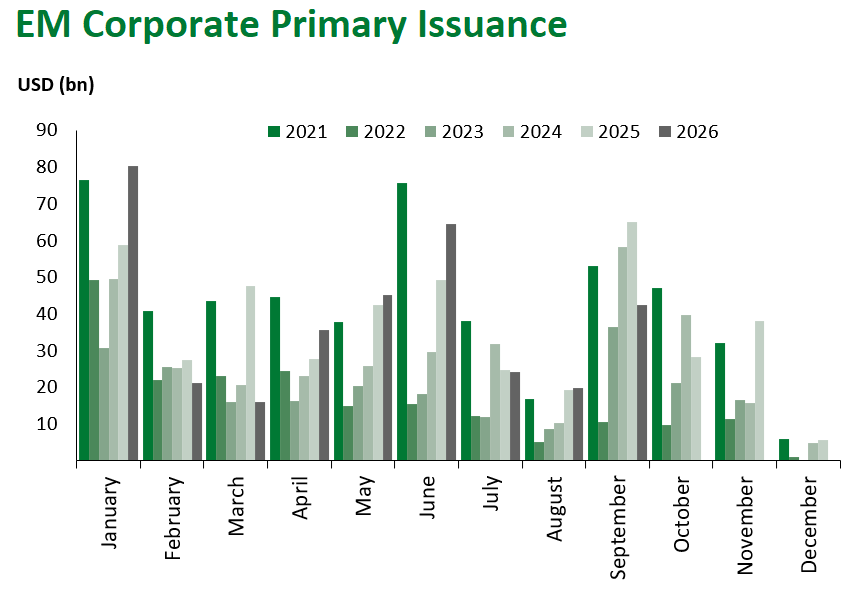
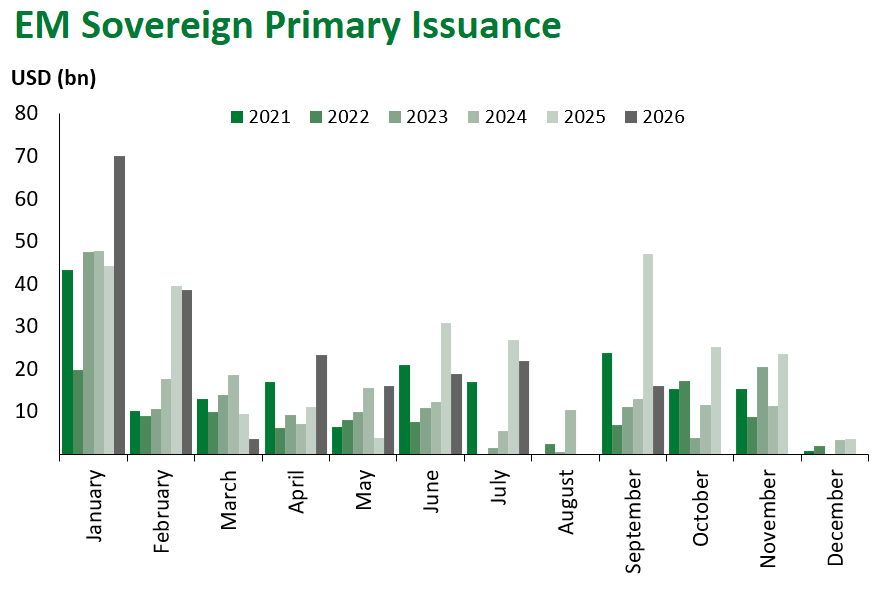
Primary market activity rebounded sharply from the prior week’s lull, with 20 issuers pricing approximately $18.0 billion of hard currency supply across 24 tranches, up from about $3.6 billion, and with both high yield and sovereign supply returning after a week in which every deal was investment grade and no sovereign came to market. The composition shifted decisively toward sovereigns, which accounted for close to half of volume at roughly $8.9 billion. Qatar was the largest borrower, raising $3 billion across a $1 billion five-year at T+55 and a $2 billion ten-year at T+65, while the Slovak Republic priced EUR 2.5 billion (about $2.8 billion) at MS+77. In the high yield sovereign space, the Dominican Republic placed $1.6 billion of 2039 bonds at 6.85% and Türkiye brought a $1.5 billion sustainability bond due 2037 at a 7.65% yield, notable given the prior week’s pressure on Turkish assets. Sub-sovereign and quasi-sovereign supply included India’s National Bank for Financing Infrastructure and Development ($750 million at T+105) and Argentina’s Province of San Juan ($600 million at a 9.875% yield), the week’s highest-yielding print. Bank supply featured a return of capital instruments, Banca Transilvania (EUR 500 million Tier 2 at 6.216%), mBank (EUR 250 million AT1 at 6.625%) and Nan Shan Life ($333 million Tier 2 at 6.85%), alongside senior paper from OTP Bank (EUR 750 million at MS+105), Sharjah Islamic Bank ($500 million at T+105) and Bank of Communications ($670 million in two floating-rate tranches). CEEMEA accounted for about 55% of volume, Asia 24% and Latin America 21%, and investment grade made up close to two thirds.
Fixed Income
Equities
Commodities

Source for data tables: Bloomberg, JPMorgan, Gramercy. EM Fixed Income is represented by the following JPMorgan Indicies: EMBI Global, GBI-EM Global Diversified, CEMBI Broad Diversified and CEMBI Broad High Yield. DM Fixed Income is represented by the JPMorgan JULI Total Return Index and Domestic High Yield Index. Fixed Income, Equity and Commodity data is as of September 25, 2026 (mid-day).
Emerging Markets Flows
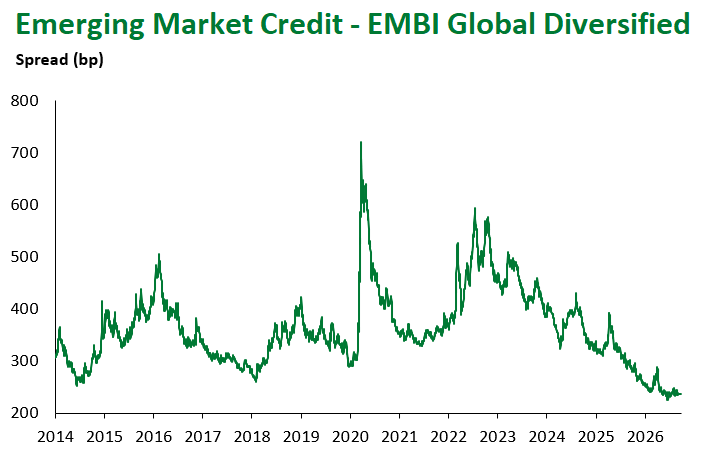
Source for graphs: Bloomberg, JPMorgan, Gramercy. As of September 25, 2026.
For questions, please contact:
Kathryn Exum, CFA ESG, Director, Co-Head of Sovereign Research, [email protected]
Petar Atanasov, Director, Co-Head of Sovereign Research, [email protected]
This document is for informational purposes only. The information presented is not intended to be relied upon as a forecast, research or investment advice, and is not a recommendation, offer or solicitation to buy or sell any securities or to adopt any investment strategy. Gramercy may have current investment positions in the securities or sovereigns mentioned above. The information and opinions contained in this paper are as of the date of initial publication, derived from proprietary and nonproprietary sources deemed by Gramercy to be reliable, are not necessarily all-inclusive and are not guaranteed as to accuracy. This paper may contain “forward-looking” information that is not purely historical in nature. Such information may include, among other things, projections and forecasts. There is no guarantee that any forecasts made will come to pass. Reliance upon information in this paper is at the sole discretion of the reader. You should not rely on this presentation as the basis upon which to make an investment decision. Investment involves risk. There can be no assurance that investment objectives will be achieved. Investors must be prepared to bear the risk of a total loss of their investment. These risks are often heightened for investments in emerging/developing markets or smaller capital markets. International investing involves risks, including risks related to foreign currency, limited liquidity, less government regulation, and the possibility of substantial volatility due to adverse political, economic or other developments. References to any indices are for informational and general comparative purposes only. The performance data of various indices mentioned in this update are updated and released on a periodic basis before finalization. The performance data of various indices presented herein was current as of the date of the presentation. Please refer to data returns of the separate indices if you desire additional or updated information. Indices are unmanaged, and their performance results do not reflect the impact of fees, expenses, or taxes that may be incurred through an investment with Gramercy. Returns for indices assume dividend reinvestment. An investment cannot be made directly in an index. Accordingly, comparing results shown to those of such indices may be of limited use. The information provided herein is neither tax nor legal advice. Investors should speak to their tax professional for specific information regarding their tax situation.