

Executive Summary
The Warsh Fed’s unanimous first hike was taken as a credibility move; EM’s long end rewarded it while the dollar punished local markets. With the 10Y around 5% for the first time since 2007 and the DXY posting its best week since March, 10+ year maturities were the only positive duration bucket in both hard currency indices as the curve flattened on the belly; but local currency debt fell −0.88% almost entirely on FX, with currencies detracting in 18 of 20 markets.
The G10 tightening turn broadened and the first meaningful crack appeared in lower-rated EM credit after a strong year. As the BoJ hiked to a 31-year high and the BoE’s 6-3 hold left it the reluctant laggard, EM credit quality-skewed sharply: IG outperformed HY in both sovereigns and corporates, with returns falling steadily down the rating stack to CCC and C, a second straight week of distressed weakness, with Türkiye the laggard across both indices as local fund liquidations revived macro-fragility concerns.
Brazil cut into the Fed’s hike as oil round-tripped on the Saudi pipeline. Copom’s fifth straight cut to 13.75% hours after the FOMC hike highlighted the good relative position of EM credits with high real rates such as Brazil; however, the market is signaling that every DM tightening step narrows the cushion, making Brazil’s October 4 first round presidential vote the decisive near-term swing factor.
Market Overview
Macro Update
The Warsh Fed delivered its first rate hike this week. The FOMC raised the funds rate 25bps to 3.754.00% in a 12–0 vote, the first increase since July 2023, with the statement noting that economic activity is “expanding at a solid pace,” domestic spending “has been resilient,” and “inflation remains elevated.” The projections were hawkish. 16 of 18 participants see at least one further hike this year and four see two. Warsh framed the Fed’s task as ensuring relative price shocks from oil and food “don’t broaden out,” and markets moved to price around 80% probability of another hike by December. For investors, the unanimous vote alleviates a credibility concern after months of split decisions and ends the debate over Warsh’s willingness to tighten; but with only eight dots pointing to further hikes in 2027, this reads as a short, sharp insurance cycle rather than the start of a prolonged campaign.
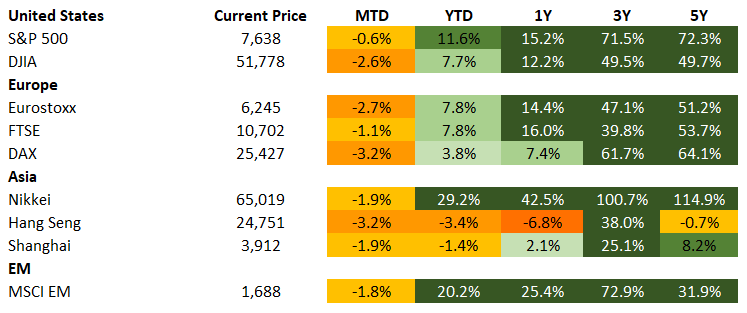
Against this backdrop, markets struggled for direction. The 10-year Treasury yield closed above 5% for the first time since 2007 on Tuesday and pushed to 5.02% on decision day, the dollar index jumped 0.7% to above 100, and equities fell as the first hike in three years met the highest long-end yields in two decades. Following a brief pause in the Treasury selloff on Thursday, 10-year yields climbed back to around 5% on speculation that elevated energy costs could fuel inflation, prompting further Federal Reserve rate hikes. Those worries kept a lid on equities; chipmakers, however, gained. Bitcoin topped $80,000.
The Bank of Japan completed the week’s tightening sequence on Friday, raising its policy rate 25bps to 1.25%, the highest since 1995 and, at three months since the last move, the fastest pace of hikes since 1990. The market’s reaction inverted expectations: the yen weakened to around 157 per dollar and 10-year JGB yields fell 5bps as the split vote and Governor Ueda’s less-hawkish press conference cast doubt on the pace of further tightening. For investors, the feared FOMC-BoJ double-tightening arrived and the yen fell anyway, deferring the carry-unwind risk that had hung over EM Asia and global liquidity.
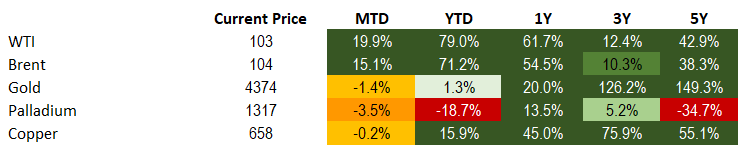
Crude prices were also volatile. A drone attack from Iraq on Saudi Arabia’s East-West pipeline, the roughly 5 million barrel-per-day Hormuz bypass to Yanbu, halted Red Sea loadings and drove Brent close to $110 per barrel mid-week, its highest since May, before easing to around $105 at the close. For investors, the Gulf supply system is proving more adaptive than the bear case assumed, but crude is now trading pipeline-repair headlines against a still-contested Strait and analysts warn the risk remains skewed to a larger disruption if the outage extends past September.
The G10 tightening turn broadened, with the UK the reluctant laggard. The Bank of England held Bank Rate at 3.75% in a 6-3 vote, with three members backing a hike to 4%, even as UK CPI rose to a five-month high of 3.1% in August and the MPC acknowledged inflation is “likely to rise further over coming quarters.” On the continent, economists now see the ECB waiting until December before its next hike following last week’s move to 2.50%. For investors, the BoE stands alone among major central banks in holding while inflation accelerates – a divergence that leaves gilts and sterling carrying catch-up risk into the November 5 meeting, where a hike now looks more likely than not.
In EM, Brazil moved against the global grain. Hours after the Fed hiked, Copom cut the Selic 25bps to 13.75% on Wednesday evening (its fifth consecutive reduction) following August’s deflationary IPCA print, with the BRL steady near 5.15 and an inflation-adjusted policy rate around 9.6% that remains among the highest in the world. The divergence was orderly: the Ibovespa is up more than 20% over the past year and first-round polling ahead of the October 4 presidential election, now two weeks away, has continued to trend in a market-friendly direction. For EM investors, every tightening step by DM central banks narrows the carry cushion that has anchored Latin American currencies all year. Brazil’s cushion is still large enough to absorb the squeeze, but the Fed-Copom divergence caps the BRL’s fundamentals-driven upside and makes the October presidential vote the decisive swing factor.
China’s August activity data deepened the two-speed picture. Industrial production accelerated to 5.2% YoY, comfortably beating forecasts, while retail sales slowed to just 0.4%, fixed-asset investment contracted 7.2% year-to-date, the surveyed urban unemployment rate rose to 5.3%, and home prices kept falling, prompting an unusual official warning of an “acute supply-demand imbalance.” President Xi travels to Washington on September 24 with the largest delegation of Chinese business executives to accompany him since 2015, a signal of willingness to invest and trade, though expectations remain modest with the two sides still divided over which products qualify as non-sensitive under existing arrangements and the secondary-sanctions question unresolved.
The Week Ahead
With the three big central bank decisions behind, the market’s question shifts from “will they” to “how much further.” Fed speakers emerge from the blackout period to shape the December debate, one more hike versus two, and the Treasury’s 2-, 5-, and 7-year auctions testing demand with the 10-year anchored near 5.0%. President Xi’s state visit to Washington on Thursday is the geopolitical centerpiece. The composition of any trade agreement, the fate of secondary sanctions on Chinese entities handling Iranian oil, and the reception of the CEO delegation will set the tone for EM trade sentiment into the fourth quarter, while the UN General Assembly’s high-level week offers a venue for Iran diplomacy. In energy, the pace of the East-West pipeline restoration and the durability of the Hormuz shuttle flows determine whether crude consolidates below $105 or rebuilds its premium. Brazil enters the final fortnight before its October 4 first round. For investors, this week resets the framework: a unanimous Fed, a hiking BoJ, and a retreating oil price have removed three sources of binary risk at once, but with the 10-year at 5% and the Gulf still contested, the reprieve is conditional. EM carry and differentiation remain the trade, with the Xi summit and the pipeline timeline in the spotlight.
Highlights
Brazil’s Supreme Court corruption scandal overshadows the pre-election campaigns
Event: Amid a corruption scandal that has plunged Brazil’s Federal Supreme Court into historic turmoil, a session was held this week to vote on the opening of an inquiry into Justice Alexandre de Moraes for reportedly using his position to protect a former bank owner accused of widespread corruption activity. The session was cut short by a procedural disagreement, suspending proceedings for up to 90 days, with the first round of presidential elections now just two weeks away. Meanwhile, a poll conducted September 1013 gave Senator Flávio Bolsonaro, President Lula’s right-wing challenger, his first runoff lead since April, at 42% to Lula’s 40%, from 41%–41% the week prior, while Lula’s first-round lead narrowed to 5pps from 7pps (36% vs. 31%).
Investment Implications: The Supreme Court corruption scandal has captured the country’s attention and distracted from the pre-election campaigns, which appears to have helped Flávio Bolsonaro on the margin as Lula’s comfortable lead in the polls has evaporated. With no resolution likely before the election, corruption, which is already the top voter issue, will continue to dominate headlines, crowding out both campaigns’ policy messaging and reinforcing the voter pessimism that punishes the incumbent, i.e., Lula. Furthermore, the opposition has successfully tied Lula to Moraes despite Flávio Bolsonaro’s own exposure to the corruption investigation, which speaks to who is winning the narrative. From a market perspective, the focus remains the expected fiscal trajectory under the next administration and the perceived odds of a credible medium-term fiscal anchor. A potential Bolsonaro victory would be seen as a considerable improvement relative to the status quo, driving a constructive market reaction. On the other hand, a more risk-off tone is likely to prevail if President Lula were to be re-elected to serve a fourth term, with implications across credit markets, rates, and the currency. However, once the post-election dust settles, even in the downside scenario, we think that if some modest fiscal consolidation materializes, the central bank (BCB) has substantial room to lower real interest rates, which at around 10%, are among the highest in the EM universe. As such, if disinflation continues and investors’ medium-term fiscal concerns moderate, holders of Brazil local debt stand to benefit from both high carry and price appreciation, alongside potential BRL appreciation, giving local currency bonds significant upside asymmetry.
Indonesia changes finance minister for second time in two years
Event: President Prabowo appointed Deputy Finance Minister Suahasil Nazara as finance minister on September 14, replacing Purbaya Yudhi Sadewa after roughly one year in the role. Nazara is a career technocrat who has served as deputy finance minister since 2019 and previously led the Fiscal Policy Agency. His appointment puts a familiar hand back at the center of fiscal policy following recent changes at Bank Indonesia. Nazara has emphasized continuity, pledging to maintain a healthy and credible budget, keep the fiscal deficit within the 3% of GDP legal ceiling, and support growth while preserving fiscal stability. The appointment has therefore been interpreted as a move toward greater policy predictability rather than a substantive change in direction.
Investment Implications: The appointment provides some near-term reassurance on fiscal management, but the key question is whether Nazara can balance Prabowo’s growth and spending agenda with Indonesia’s fiscal anchor. The 2027 budget will be the first substantive test. Indonesian assets should see some relief in the institutional risk premium following the reshuffle, but the upside is likely to remain constrained near term. The rupiah and local rates remain vulnerable to spending surprises, higher fuel subsidies if crude prices stay elevated, and renewed friction between fiscal and monetary policy. Hard-currency spreads should remain supported by Indonesia’s solid external position and reserve buffers, although current spreads versus BBB peers appear broadly fair to tight rather than compelling. Rating agencies are likely to remain patient for now, with Indonesia retaining investment-grade ratings. However, Fitch and Moody’s remain on negative outlook, making further deterioration in fiscal discipline or policy effectiveness an increasingly relevant risk. Upcoming signposts to watch are the details of the 2027 budget, BI-rate decision on September 23, and broader indications of the direction of policy credibility.
Market Data
EM Credit Update
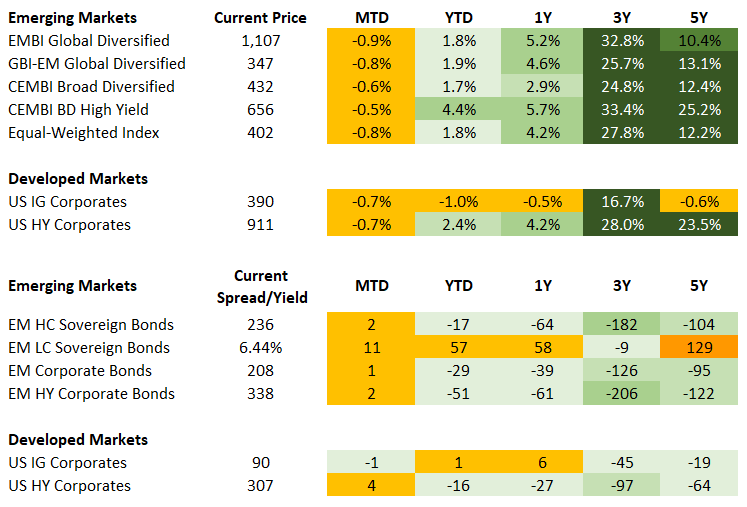
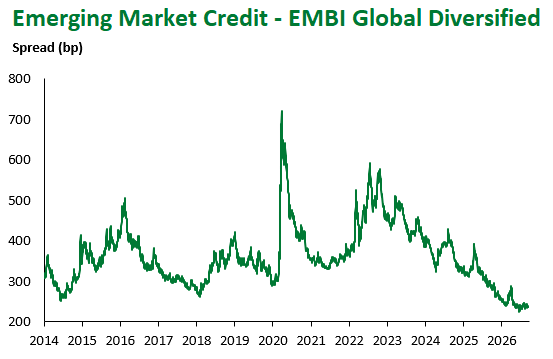
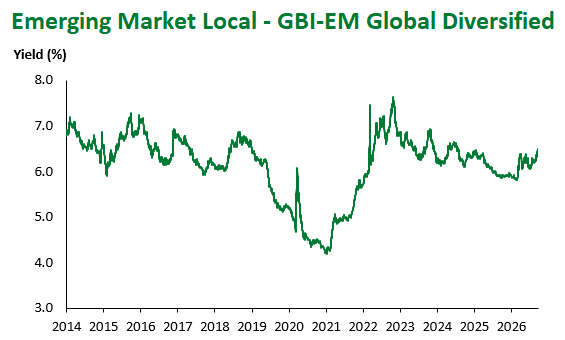
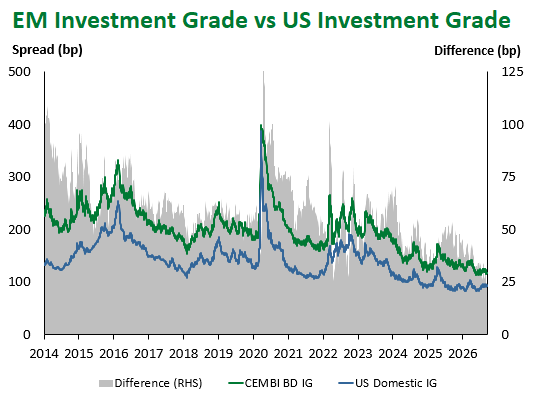
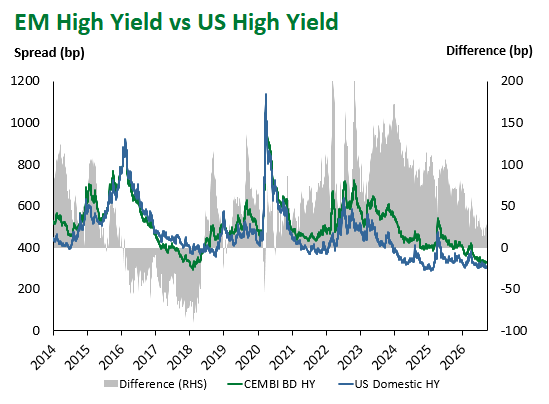
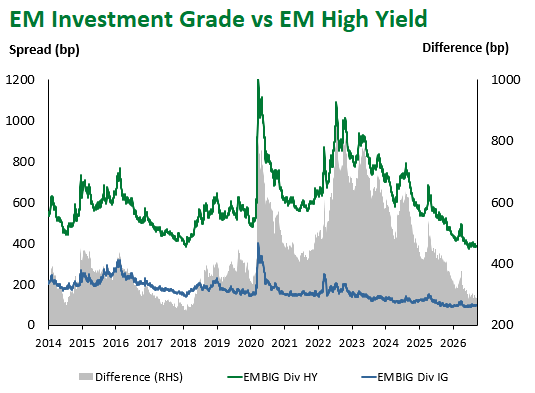
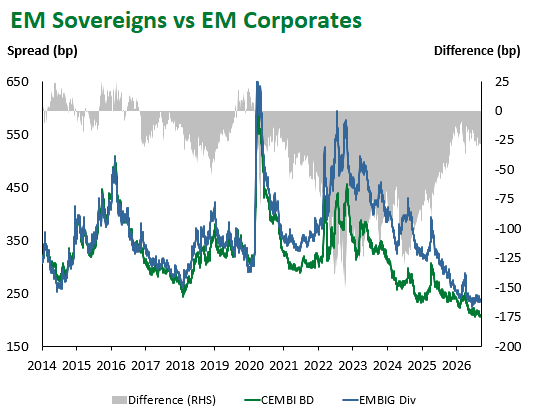
Emerging markets fixed income was lower across all three sub-asset classes this week, with local currency the main underperformer. Local currency sovereign debt returned -0.88%, while hard currency sovereigns (-0.10%) and EM corporates (-0.11%) were only marginally negative. The Federal Reserve hiked on Wednesday, an outcome more than 90% priced going into the meeting, and markets took it as a credibility move. The long end responded well, with 10+ year maturities the only positive duration bucket in both hard currency indices and the belly lagging. The losses came instead from the lower quality end of the credit spectrum, where investment grade outperformed high yield and returns fell steadily down the rating stack. This is the first meaningful weakness in lower rated EM credit after strong performance year to date. In local markets, a firmer dollar accounted for nearly all of the move.
Local currency sovereign debt returned -0.88%, with the weakness almost entirely currency-driven and near universal across the index. FX detracted in 18 of 20 markets, led by the Chilean peso (-2.00%) and Polish zloty (-1.95%). Chile (-2.59%) was the weakest market overall, followed by the Czech Republic (-1.99%), Colombia (-1.92%) and Poland (-1.73%). Brazil (-1.39%) gave back the prior week’s gain as the BRL reversed. Only South Africa (+0.21%) and Uruguay (+0.28%) finished higher, with South African local bonds rallying enough on price (+0.66%) to more than offset a weaker rand. Mexico showed a similar split, with a solid price return (+0.45%) more than offset by peso depreciation (-1.23%).
Hard currency sovereign bonds returned -0.10%, with investment grade (+0.07%) outperforming high yield (-0.26%). By rating, BBB (+0.08%) and single-A (+0.07%) credits were positive while returns fell progressively through the high yield stack, with BB at -0.23%, single-B at -0.27% and CCC at -0.38%. Regionally, Asia was flat and Africa (-0.03%), Latin America (-0.07%) and the Middle East (-0.07%) were broadly unchanged, while Europe (-0.33%) lagged. At the country level, Ukraine (-1.83%) and Türkiye (-0.67%) were the weakest performers, with Mexico (+0.58%) the notable outperformer. Across the curve, the belly underperformed, with the 5-7 year (-0.30%) and 7-10 year (-0.32%) buckets weakest against +0.14% for 10+ year maturities.
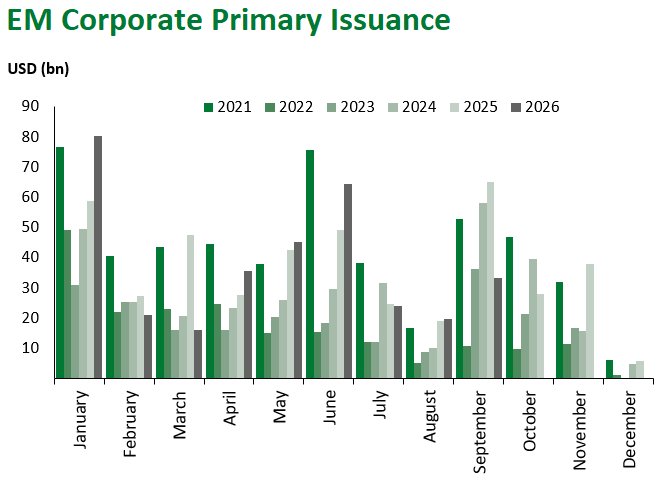
EM corporates returned -0.11%, with the same quality skew. Investment grade (-0.03%) held up while high yield (-0.23%) lagged, and returns declined consistently from AA (+0.07%) and AAA (+0.06%) through single-B (-0.28%) to C (-0.91%), the second consecutive week of sharp weakness in distressed names. Regionally, Asia (+0.01%) was the only region in positive territory, while Africa (-0.09%) and Latin America (-0.09%) were broadly flat and Europe (-0.46%), CEEMEA (-0.24%) and the Middle East (-0.23%) lagged. Türkiye (-0.83%) was the weakest market at the country level, lagging in corporates and sovereigns alike. Local fund liquidations pushed the equity market sharply lower and revived questions about underlying macro fragilities, with the deterioration in sentiment carrying into credit. More broadly, duration followed the same pattern as in sovereigns, with the 3-5 year bucket weakest (-0.22%) and 10+ year maturities marginally positive (+0.03%).
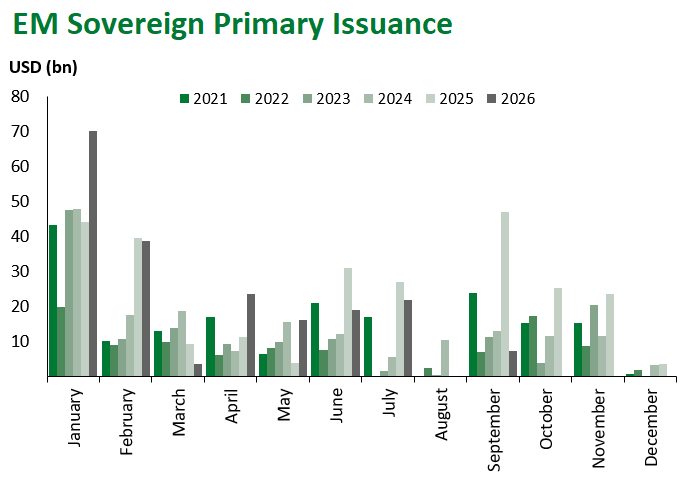
Primary market activity was thin, with five issuers pricing approximately $3.6 billion of hard currency supply across six tranches. Every deal was investment grade and there was no sovereign issuance. Korea accounted for roughly $2.5 billion of the total, with Hyundai Capital pricing $1.5 billion across two tranches, Kookmin Bank placing a EUR 650 million covered bond and Korea Credit Guarantee Fund printing a $300 million floating rate note. Outside Korea, MOL Group of Hungary raised EUR 500 million and Bank of Maharashtra of India priced $500 million. Euro-denominated supply accounted for a little over a third of the week’s volume.
Fixed Income
Equities
Commodities
Source for data tables: Bloomberg, JPMorgan, Gramercy. EM Fixed Income is represented by the following JPMorgan Indicies: EMBI Global, GBI-EM Global Diversified, CEMBI Broad Diversified and CEMBI Broad High Yield. DM Fixed Income is represented by the JPMorgan JULI Total Return Index and Domestic High Yield Index. Fixed Income, Equity and Commodity data is as of September 18, 2026 (mid-day).
Emerging Markets Flows
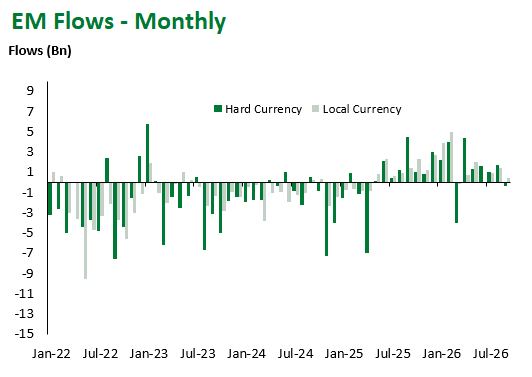
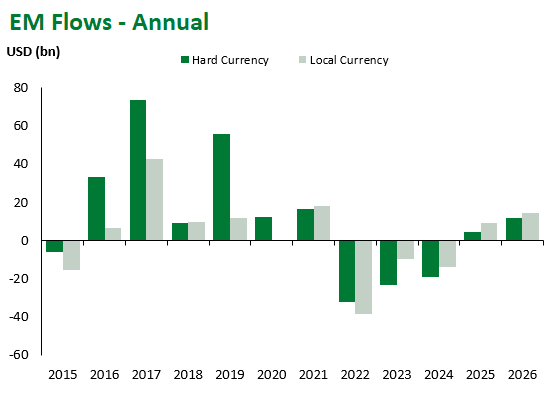
Source for graphs: Bloomberg, JPMorgan, Gramercy. As of September 18, 2026.
For questions, please contact:
Kathryn Exum, CFA ESG, Director, Co-Head of Sovereign Research, [email protected]
Petar Atanasov, Director, Co-Head of Sovereign Research, [email protected]
This document is for informational purposes only. The information presented is not intended to be relied upon as a forecast, research or investment advice, and is not a recommendation, offer or solicitation to buy or sell any securities or to adopt any investment strategy. Gramercy may have current investment positions in the securities or sovereigns mentioned above. The information and opinions contained in this paper are as of the date of initial publication, derived from proprietary and nonproprietary sources deemed by Gramercy to be reliable, are not necessarily all-inclusive and are not guaranteed as to accuracy. This paper may contain “forward-looking” information that is not purely historical in nature. Such information may include, among other things, projections and forecasts. There is no guarantee that any forecasts made will come to pass. Reliance upon information in this paper is at the sole discretion of the reader. You should not rely on this presentation as the basis upon which to make an investment decision. Investment involves risk. There can be no assurance that investment objectives will be achieved. Investors must be prepared to bear the risk of a total loss of their investment. These risks are often heightened for investments in emerging/developing markets or smaller capital markets. International investing involves risks, including risks related to foreign currency, limited liquidity, less government regulation, and the possibility of substantial volatility due to adverse political, economic or other developments. References to any indices are for informational and general comparative purposes only. The performance data of various indices mentioned in this update are updated and released on a periodic basis before finalization. The performance data of various indices presented herein was current as of the date of the presentation. Please refer to data returns of the separate indices if you desire additional or updated information. Indices are unmanaged, and their performance results do not reflect the impact of fees, expenses, or taxes that may be incurred through an investment with Gramercy. Returns for indices assume dividend reinvestment. An investment cannot be made directly in an index. Accordingly, comparing results shown to those of such indices may be of limited use. The information provided herein is neither tax nor legal advice. Investors should speak to their tax professional for specific information regarding their tax situation.