


Contents
Market Overview
Macro Update
The fragile U.S.–Iran détente held through the week, but the road from interim understanding to durable settlement proved anything but smooth. The ceremonial signing scheduled for last Friday in Switzerland was abruptly postponed and Vice President Vance pulled from the trip, underscoring how much remains unresolved beneath the headline agreement. The substance, however, broadly held. The U.S. naval blockade was lifted and Gulf tanker traffic rose sharply as vessels began to move again.
However, friction points appeared to multiply. A dispute over whether ships would be charged to transit Hormuz simmered. Oman and the U.S. insisted the Strait remain toll-free while Iran kept open the option of levying fees once the 60-day negotiation window closes, even as Tehran and Muscat moved to stand up a joint mechanism to govern navigation. Meanwhile another deadly Israeli strike in southern Lebanon was a reminder that the parallel Israel-Hezbollah track remains the most combustible piece of the puzzle. Analysts cautioned that fully clearing mines and restoring pre-war maritime traffic could still take months.
With the supply disruption increasingly seen to be over, oil extended its slide. Brent crude, the global benchmark, fell below $75 per barrel, its lowest in nearly four months and closing in on pre-war levels, as markets began to price a best-case reopening scenario. The move came despite OPEC’s secretary general publicly rejecting the IEA’s warning of a looming supply glut, a divide that frames the 2H26 debate over where crude settles once Hormuz flows get closer to being fully restored.
The week’s marquee emerging market event was Colombia’s presidential runoff. Far-right outsider Abelardo de la Espriella, a Trump-endorsed lawyer campaigning on security, restarting oil exploration and economic liberalization, narrowly defeated leftist Senator Iván Cepeda, taking roughly 49.7% to 48.7% of the vote in the country’s tightest race in recent memory. Cepeda formally conceded upon publication of the official count, easing market concerns about potential social turmoil.
On the data front, the May personal income and outlays report, which is headlined by the PCE price index, the Fed’s preferred inflation gauge, confirmed that price pressures remain elevated. Headline PCE rose to 4.1% YoY from 3.8% in the prior month, it’s highest since 2023, with core at 3.4% YoY as energy costs continued to filter through. The final estimate of 1Q GDP was revised up meaningfully higher to 2.1% annualized (from 1.6%) on softer imports, and initial jobless claims fell to 215,000, slightly below consensus expectations. University of Michigan sentiment improved from a low base with households more optimistic about the economic outlook while inflation expectations eased to 4.6% from 4.8% last month. In Europe, ECB 1Y expectations fell more than expected to 3.5% from 4.0% in May, even before a deal was reached in the Middle East.
In the U.S., futures continued to price around a quarter point Fed rate hike by 4Q26, but the odds fell at the margin, while the dollar touched a fresh one-year high of 101.6 on the DXY before retracing moderately by the end of the week. Treasury yields drifted lower, with the 10Y benchmark falling below 4.40%, while gold extended its retreat under a firmer dollar.
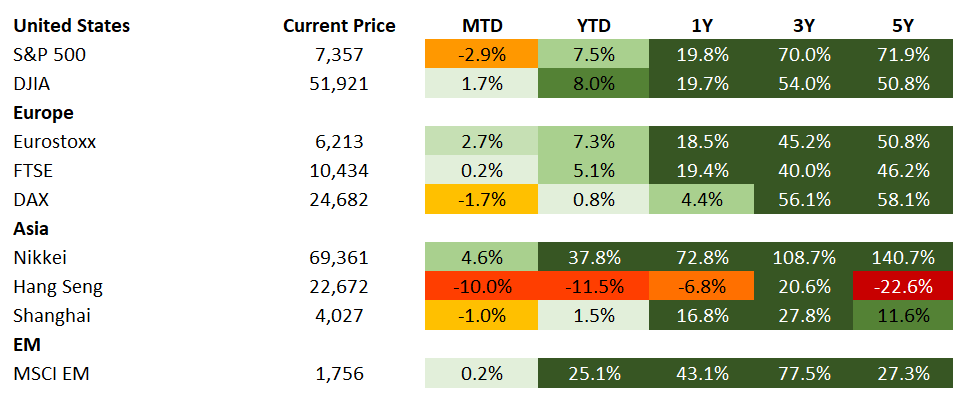
Equities were choppy. An early week rotation out of crowded AI and semiconductor positioning dragged the major indices lower midweek. SpaceX gave back a large share of its post-IPO gains and chipmakers slid, before a rebound as oil and yields eased. This week’s economic data reinforced the view that U.S. consumers and the broader economy remain on solid footing, helping ease fears of a stagflationary scenario.
For emerging markets, the crosscurrents persisted. The retreat in energy prices and Colombia’s market-friendly outcome are supportive, but a dollar at one-year highs and a developed-market policy backdrop tilted toward further tightening keep external financial conditions tight. Mexico and Thailand central banks left their policy rates unchanged at 6.50% and 1.00%, respectively, while their Hungary counterpart delivered a 25bps cut to 6.00% as the strong HUF rally significantly improved the inflation outlook. Attention now turns to whether the disinflationary impulse from lower oil prices can outpace the inflation already in the pipeline as the second half of the year begins.
EM Credit Update
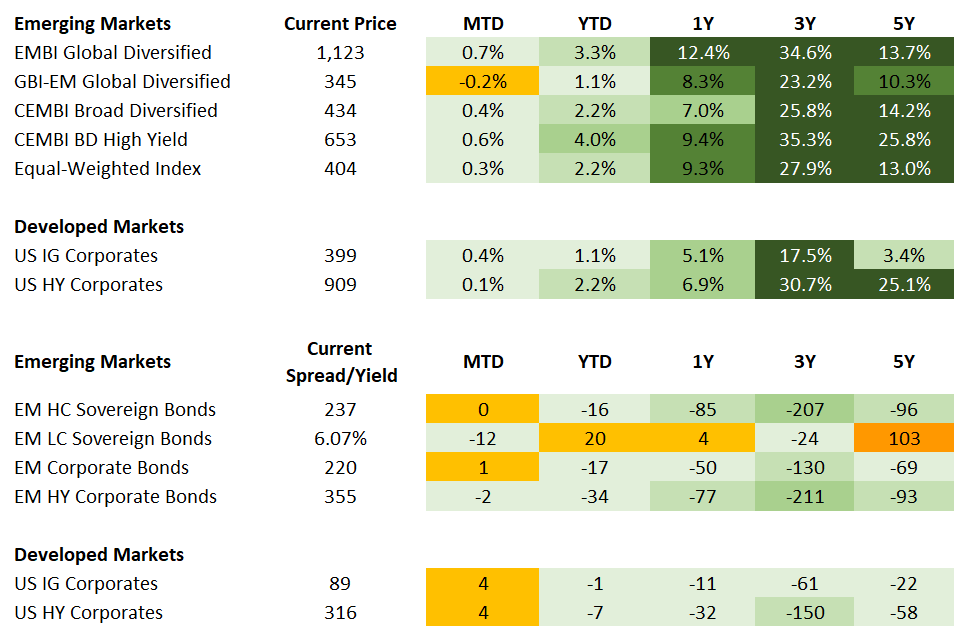
Emerging markets fixed income delivered differentiated performance this week, as a roughly 10% decline in oil prices on a U.S.-Iran deal drove sharp dispersion between net oil importers and oil-exporting and frontier credits. The move came against a softer global risk backdrop, with U.S. equities lower as the tech trade took a breather and high yield lagged across credit. Index-level returns were modest, but the dispersion beneath the surface was wide.
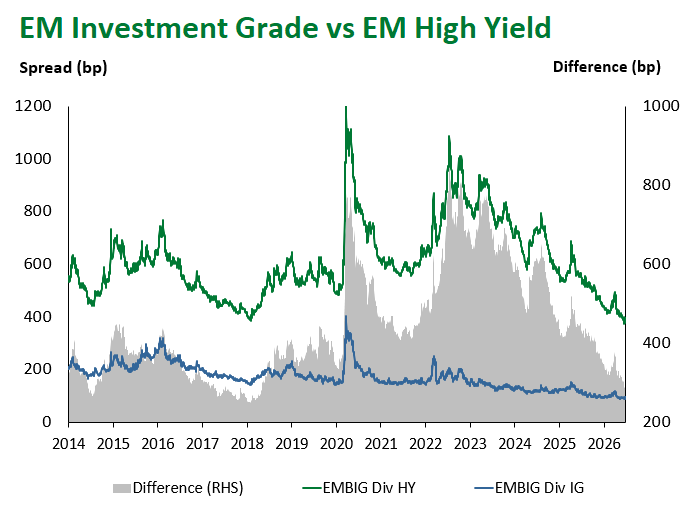
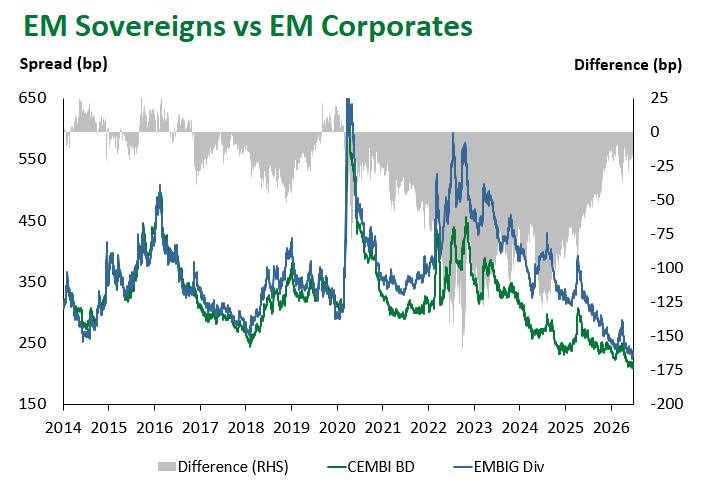
Hard currency sovereign bonds were essentially flat at the index level (-0.07%), with investment grade (+0.17%) outperforming high yield (-0.29%). Exporters were among the weakest names, including Gabon (-1.99%), Angola (-0.80%), Ecuador (-0.54%), and Nigeria (-0.52%). Venezuela (-3.39%) was the single steepest decliner on its own dynamics, as reports suggested the debt stock may be larger than the market had assumed and earthquake damage weighed on GDP projections. Ukraine (-1.95%) was lower on war-related dynamics. Asia (+0.36%) was the sole positive region, helped by its net-importer composition, while Africa (-0.33%), Middle East (-0.16%), Latin America (-0.12%), and Europe (-0.05%) all declined. Net oil importers led the gains, including Sri Lanka (+0.92%), India (+0.51%), and Pakistan (+0.48%), alongside Senegal (+1.17%). By rating, the same pattern held, with BBB (+0.19%) and A (+0.14%) outperforming CCC (-0.65%) and B (-0.39%).
Local currency sovereign debt was the weakest sub-asset class, down -0.31% in USD terms, and notably did not track the oil dynamic. Several net oil importers lagged, with Chile (-2.29%) the standout decliner, followed by Thailand (-1.63%), Indonesia (-1.23%), and the Philippines (-1.18%). Gains were led by Colombia (+1.01%), Turkey (+0.82%), Brazil (+0.47%), and Egypt (+0.28%).
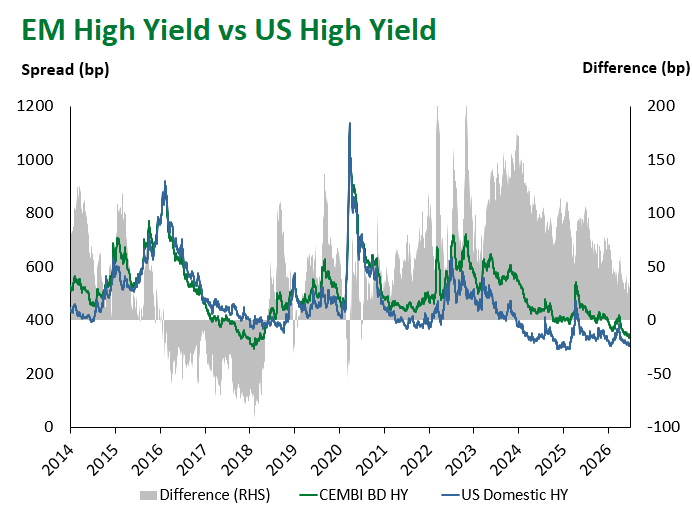
EM corporates were the only sub-asset class in positive territory, up +0.06%, with high grade (+0.13%) outperforming high yield (-0.03%), consistent with the softer high-yield tone. Asia (+0.22%) again led, mirroring sovereigns, while Latin America (-0.08%) and Africa (-0.07%) lagged. The Philippines (+0.95%) was the strongest country. Ghana (-2.15%) was a sharp outlier to the downside, consistent with pressure on its oil-linked credits. By rating, dispersion was wider than in sovereigns, with the C bucket down -0.84%.
Hard currency primary market activity was heavy, with roughly 23 issuers pricing approximately $30 billion. Supply skewed toward investment grade and was dominated by sovereigns: Mexico priced a $6.3 billion dual-tranche deal (2037 and 2056), China placed a EUR5 billion triple-tranche transaction that drew exceptional demand (books above EUR10 billion on the front tranche alone), and Türkiye raised $2.75 billion via sukuk on a $6.7 billion book. High yield supply was meaningful, led by Vedanta Resources of India ($1.75 billion across three tranches), Avianca of Colombia ($650 million at 10.25%), and Pluspetrol of Argentina ($450 million amortizing). Financials were active throughout, including DBS Bank ($2 billion), Emirates NBD ($1.5 billion), and AT1 issuance from Axis Bank and Dukhan Bank.
The Week Ahead
The June U.S. employment report headlines a holiday-shortened week, brought forward to Thursday, July 2, ahead of the U.S. Independence Day market closure on Friday, accompanied by the ISM manufacturing survey, JOLTS job openings, the ADP private payrolls report, and initial jobless claims. Globally, final June manufacturing PMIs are due across the major developed and emerging economies, alongside the Eurozone’s flash June HICP inflation print, German and Swiss CPI, China’s official and Caixin manufacturing PMIs, and the final 1Q UK GDP estimate. On the policy front, the ECB’s annual Forum on Central Banking convenes in Sintra (June 29–July 1). The trade and geopolitical calendar is equally full: the United States, Canada, and Mexico face a July 1 review to extend the USMCA or shift to annual reviews; the U.S.-Iran 60-day negotiating window grinds on following the postponed ceremonial signing, with the durability of the Hormuz reopening and the unresolved toll dispute in focus.
Fixed Income
Equities
Commodities
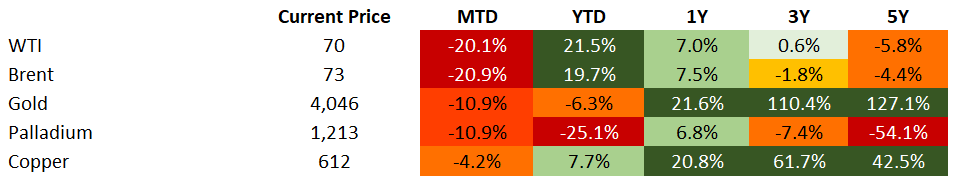
Source for data tables: Bloomberg, JPMorgan, Gramercy. EM Fixed Income is represented by the following JPMorgan Indicies: EMBI Global, GBI-EM Global Diversified, CEMBI Broad Diversified and CEMBI Broad High Yield. DM Fixed Income is represented by the JPMorgan JULI Total Return Index and Domestic High Yield Index. Fixed Income, Equity and Commodity data is as of June 26, 2026 (mid-day).
Highlights
Right-wing De la Espriella elected president of Colombia in a narrow win
Event: Right-wing lawyer and political newcomer Abelardo de la Espriella (ADE) was officially declared president-elect and will take office as Colombia’s 43rd president on August 7. The second round runoff last Sunday saw the tightest presidential race in recent memory, with ADE taking 49.7% of the vote versus left-wing Iván Cepeda’s 48.7%.
Gramercy Commentary: Colombia’s economic and political environment is posed to swing to the right as ADE is likely to align his administration’s policies with pro-market Latin American peers such as Argentina, Ecuador, and El Salvador. The outcome is credit-positive and confirmed the market’s strong base case ahead of the runoff, but the razor-thin margin of victory (1 percentage point) raises some concerns about governability by the new administration. Defeated candidate Cepeda is likely to emerge as the most forceful opposition figure in Congress. The key open question is whether ADE can build alliances with the relevant established patronage-dependent parties in Congress: Liberals, Conservatives, and the U party. We deem ADE’s odds of building a working coalition to be good, but his narrow victory could complicate the road ahead, including tough fiscal adjustment, noisy opposition, and possible street protests to name a few key challenges on the horizon. Despite a testing environment, we expect markets to give the benefit of the doubt to the new right-wing Colombian government, which is also likely to receive vocal support from the Trump administration. Going forward, market focus is likely to shift to the key cabinet appointments, signals from Congress when seated on July 20, as well as the scale and quality of ADE’s fiscal adjustment proposals.
Market awaits Venezuela debt assessment
Event: Press reports this week, originating with the Financial Times, indicate Venezuela’s forthcoming debt assessment will disclose total liabilities near $240 billion, materially above the $150-200 billion range most analysts had assumed and implying a debt-to-GDP ratio above 200% given the parallel macroeconomic framework expected to put nominal GDP near $100 billion. The Centerview Partners viability plan, originally targeted for the end of June, is now expected in early July, a modest delay but still a fast turnaround for a restructuring of this scale. Venezuelan bonds have moderately pulled back from recent highs near 55 cents on the dollar on speculation that the larger figure reflects a tough opening posture from Caracas. Separately, the magnitude 7.2/7.5 earthquakes on June 24, the largest seismic event in Venezuela in over 125 years, has added near-term social and infrastructure rebuild costs.
Gramercy Commentary: We view the $240 billion figure as an opening negotiating position by the sovereign, consistent with how complex restructurings typically begin and not a meaningful signal on ultimate creditor recoveries. The relevant variables for medium-term recovery values remain the breadth of the economic recovery, the trajectory of nominal GDP in dollar terms, and structural repayment capacity through PDVSA oil revenues, which appear largely unaffected by the earthquake based on initial reporting. While the human and infrastructure toll of the June 24 doublet is significant, reconstruction spending and external aid flows should support nominal GDP over the medium-term, consistent with historical precedent across major natural disasters in emerging economies. The early July publication of the macroeconomic framework and Centerview viability plan is the next material catalyst, where the credibility of the GDP, oil revenue assumptions, and underlying debt composition should matter more for market pricing than the headline perimeter figure.
Emerging Markets Technicals
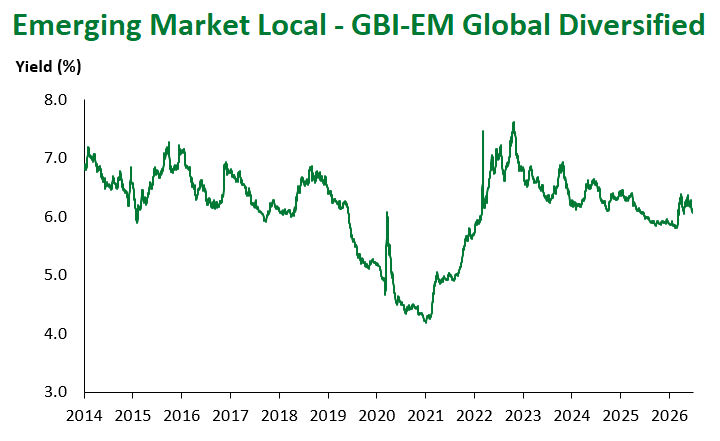
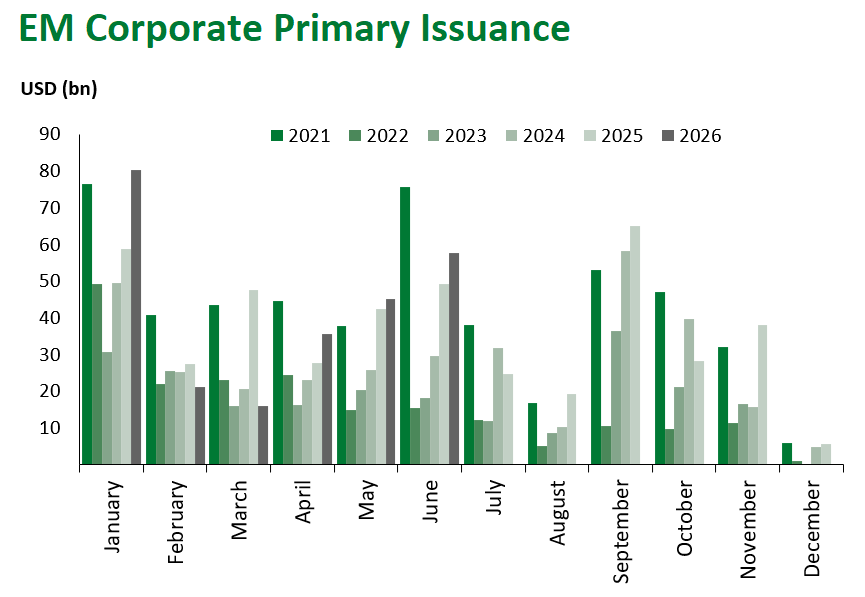
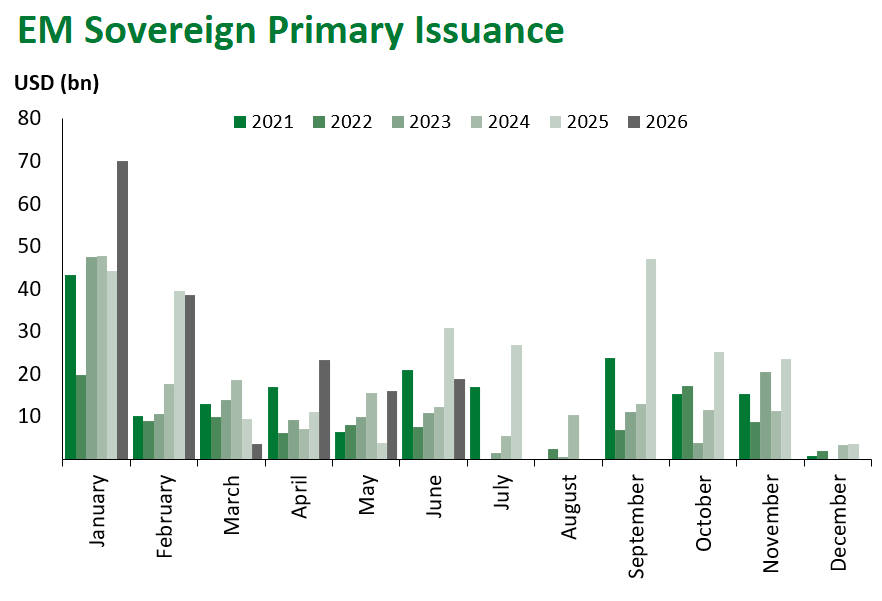
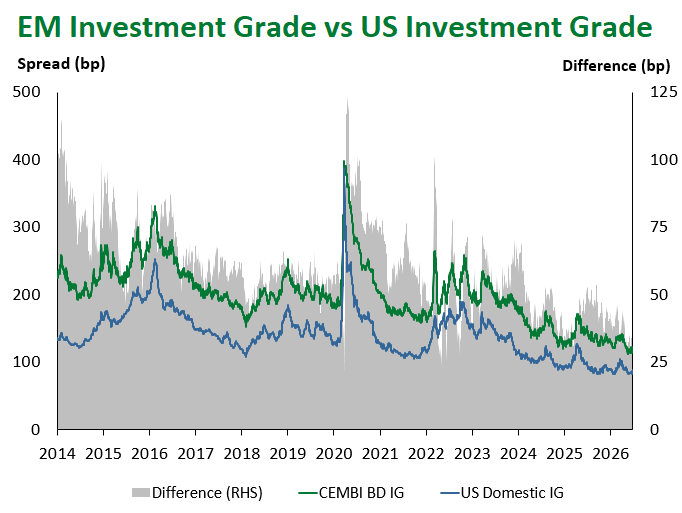
Emerging Markets Flows
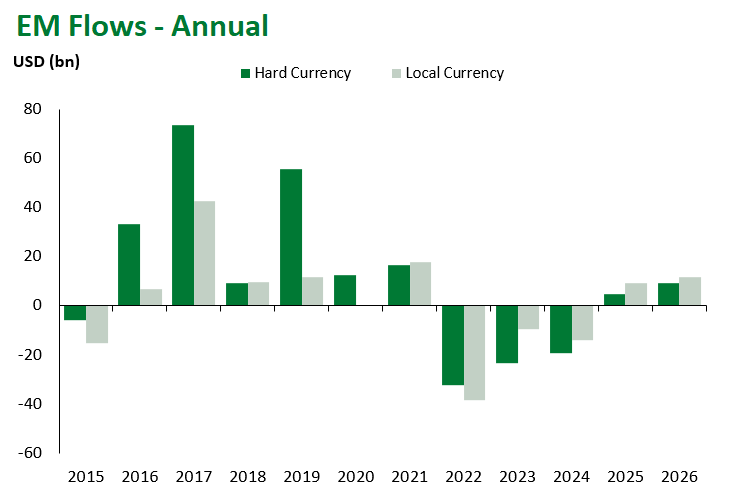
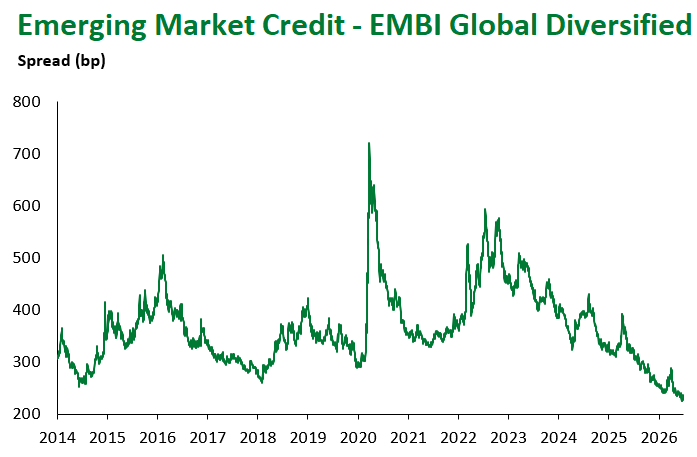
Source for graphs: Bloomberg, JPMorgan, Gramercy. As of June 26, 2026.
For questions, please contact:
Kathryn Exum, CFA ESG, Director, Co-Head of Sovereign Research, [email protected]
Petar Atanasov, Director, Co-Head of Sovereign Research, [email protected]
This document is for informational purposes only. The information presented is not intended to be relied upon as a forecast, research or investment advice, and is not a recommendation, offer or solicitation to buy or sell any securities or to adopt any investment strategy. Gramercy may have current investment positions in the securities or sovereigns mentioned above. The information and opinions contained in this paper are as of the date of initial publication, derived from proprietary and nonproprietary sources deemed by Gramercy to be reliable, are not necessarily all-inclusive and are not guaranteed as to accuracy. This paper may contain “forward-looking” information that is not purely historical in nature. Such information may include, among other things, projections and forecasts. There is no guarantee that any forecasts made will come to pass. Reliance upon information in this paper is at the sole discretion of the reader. You should not rely on this presentation as the basis upon which to make an investment decision. Investment involves risk. There can be no assurance that investment objectives will be achieved. Investors must be prepared to bear the risk of a total loss of their investment. These risks are often heightened for investments in emerging/developing markets or smaller capital markets. International investing involves risks, including risks related to foreign currency, limited liquidity, less government regulation, and the possibility of substantial volatility due to adverse political, economic or other developments. References to any indices are for informational and general comparative purposes only. The performance data of various indices mentioned in this update are updated and released on a periodic basis before finalization. The performance data of various indices presented herein was current as of the date of the presentation. Please refer to data returns of the separate indices if you desire additional or updated information. Indices are unmanaged, and their performance results do not reflect the impact of fees, expenses, or taxes that may be incurred through an investment with Gramercy. Returns for indices assume dividend reinvestment. An investment cannot be made directly in an index. Accordingly, comparing results shown to those of such indices may be of limited use. The information provided herein is neither tax nor legal advice. Investors should speak to their tax professional for specific information regarding their tax situation.