

Contents
Market Overview
Macro Update
As the 2026 FIFA World Cup kicked off in Mexico City and the world’s premier sporting event captured global attention, markets remained hostage to a relentless geopolitical headline ping-pong. Just as it seemed that the fragile U.S.-Iran ceasefire was about to collapse completely amid Israel and Iran exchanging their heaviest strikes in months, President Trump called off planned U.S. military action and signaled that a peace deal between Washington and Tehran could be imminent, claiming negotiations had been elevated to the highest levels of Iranian leadership.
The optimism came with heavy caveats: Iranian officials cautioned that no framework or final text had yet been agreed, U.S. forces shot down two Iranian drones threatening shipping in the Strait of Hormuz overnight, and Washington’s naval blockade of Iranian ports, which Trump has tied to a signed deal, remained in force. Reported terms of an interim memorandum of understanding (MoU) potentially to be signed early next week, possibly at a weekend ceremony in Europe with Vice President Vance attending, would extend the ceasefire, reopen the Strait and open the door to nuclear talks. Even so, the two sides clashed publicly on Friday morning, with Trump branding Tehran dishonorable for misrepresenting the written terms and Iran’s foreign ministry accusing Washington of fresh demands.
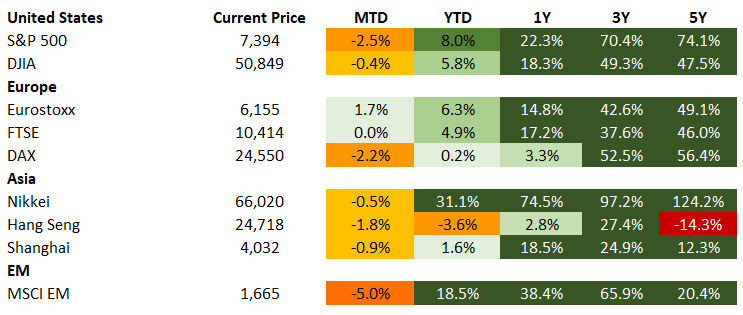
Despite the lack of clarity around a potential MoU between Tehran and Washington, markets rejoiced on the prospect of an interim peace deal: Brent crude, the global benchmark, slid toward $87 per barrel – its lowest in nearly two months – having pushed toward the high-$90s earlier in the week amid the re-escalation of tensions. Equities reversed a two-day slide, with the Nasdaq clawing back ground after shedding more than 7% from its June 1 record. Attention turned to SpaceX’s Nasdaq debut. Priced at $135 per share for a roughly $75 billion raise and a $1.77 trillion valuation, the listing ranks as the largest IPO on record, and shares opened at a sharp premium to the offer price on Friday – an early signal that appetite for AI- and space-related risk remains robust.
The U.S. Treasury curve bull-flattened, with the benchmark 10Y yield back below 4.50%, around last week’s level. The USD held its gains, trading around the 100 mark on the DXY, despite seeming progress towards de-escalation in the Middle East, supported by the repriced policy path as futures now price one full 25bps Fed rate hike by year-end.
Meanwhile, global inflation concerns have intensified further. U.S. May CPI accelerated to 4.2% YoY – its fastest pace in more than three years – broadly in line with expectations, though a contained 0.2% MoM core reading offered some reassurance that the energy shock has yet to bleed decisively into underlying prices. With the higher-for-longer rates narrative entrenched, gold extended its retreat, initially slipping below $4,100 per ounce to its weakest level since November 2025 as elevated real-rate expectations and a firm dollar overwhelmed the metal’s traditional geopolitical bid, but recovered some ground to finish the week around $4,200 per ounce.
The data leave new Fed Chairman Kevin Warsh navigating a narrow path, with headline inflation running well above target even as growth momentum cools. Some of this week’s releases reinforced the dilemma: producer prices (PPI) surged 1.1% on the month and 6.5% over the year – the steepest annual gain since November 2022 – while initial jobless claims rose to a three-month high of 229,000, underscoring the awkward mix of sticky inflation and softening labor demand. Attention now turns to the June 17 FOMC meeting, at which the Committee is widely expected to abandon its residual easing bias and, at a minimum, strike a more hawkish tone.
The hawkish repricing was also validated across the Atlantic where the European Central Bank raised its key rate by 25bps to 2.25%, its first policy change in a year, explicitly framing the move as a defense against war-driven inflation. The ECB lifted its inflation projections and trimmed its growth outlook and President Lagarde, while declining to pre-commit to a path, flagged intensifying upside risks to prices against downside risks to activity.
In other developments, President Trump signaled he was not looking to renew USMCA, the trade deal he struck with Canada and Mexico in his first term. The three North American neighbors, jointly hosting the World Cup, must extend the agreement by July 1 or face annual reviews.
Elsewhere, China’s producer price index (PPI) jumped by 3.9% YoY in May, up from 2.8% the previous month, marking the biggest increase in nearly four years, boosted by higher energy costs caused by the war in Iran. Consumer prices, however, only increased by 1.2% YoY (below consensus expectations), reflecting stubbornly weak domestic demand. Meanwhile, Indonesia’s central bank unexpectedly raised interest rates by 25bps to 5.50%, a week before its next scheduled meeting as the currency hit a record low against the USD amid investor concerns about the economic effects of the Iran war.
EM Credit Update
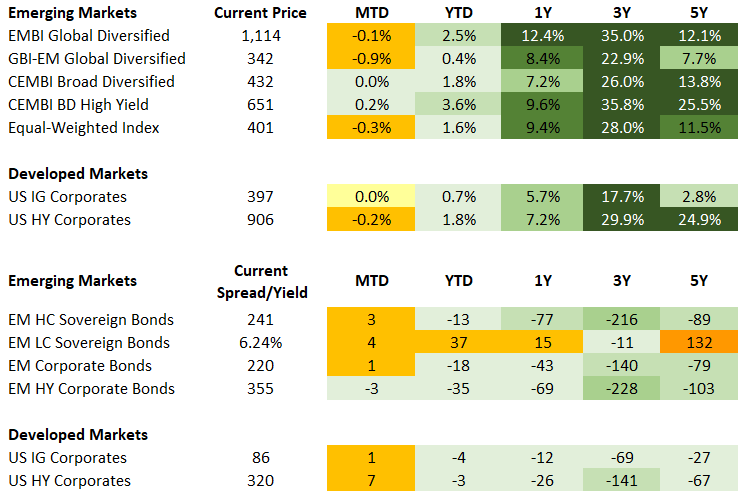
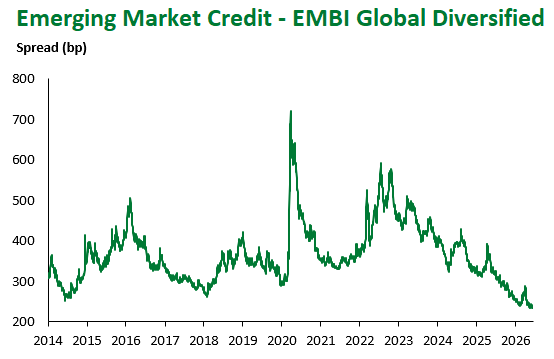
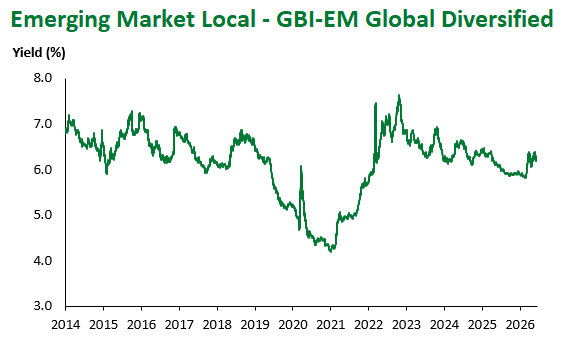
Emerging Markets (EM) fixed income posted modest gains this week as conflicting newsflow on Iran kept investors cautious and trading subdued, with markets awaiting more concrete developments before committing to a directional view. Dispersion across the three sub-asset classes was low: hard currency sovereigns and corporates both finished marginally positive, while local currency debt was the lone laggard as the U.S. dollar firmed.
Local currency sovereign debt declined -0.13% at the index level, with currency weakness the primary drag across most markets. Colombia (+2.50%) and Peru (+1.66%) were the standout performers, both supported by FX appreciation. At the other end, South Africa (-1.67%), Indonesia (-2.51%, driven by price rather than FX), Malaysia (-1.35%), and Chile (-1.32%) lagged, with broad-based forint, zloty, and rand softness weighing on the CEEMEA complex.
Hard currency sovereign bonds rose +0.18% at the index level, with investment grade (+0.17%) and high yield (+0.18%) advancing roughly in line. Regionally, Latin America (+0.49%) led, while the Middle East (-0.23%) and Africa (-0.10%) lagged. At the country level, Argentina (+2.82%) was the clear outperformer, followed by Ukraine (+0.84%). Lebanon (-4.36%) was by far the weakest performer, a sharp reversal of its recent multi-week rally. By rating, the CCC segment outperformed (+0.81%).
EM corporates gained +0.09% at the index level, with investment grade (+0.10%) edging out high yield (+0.06%). Regionally, Asia (+0.14%) and Latin America (+0.13%) led, while Africa, Europe, CEEMEA, and the Middle East were all roughly flat. By rating, AAA-rated bonds outperformed (+0.36%), while the CCC segment (-0.23%) lagged, the inverse of the sovereign pattern.
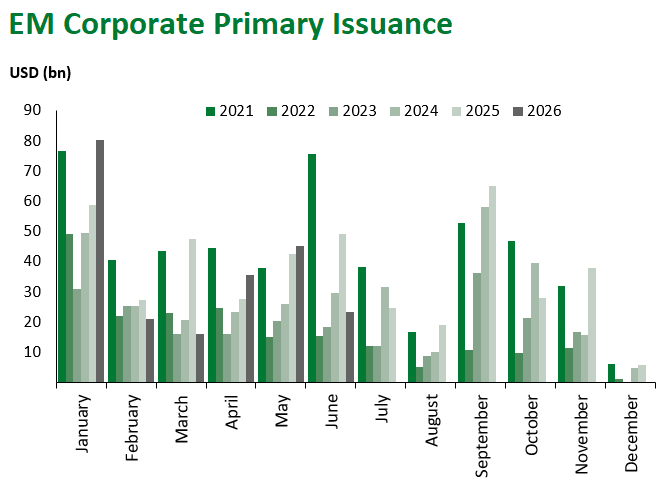
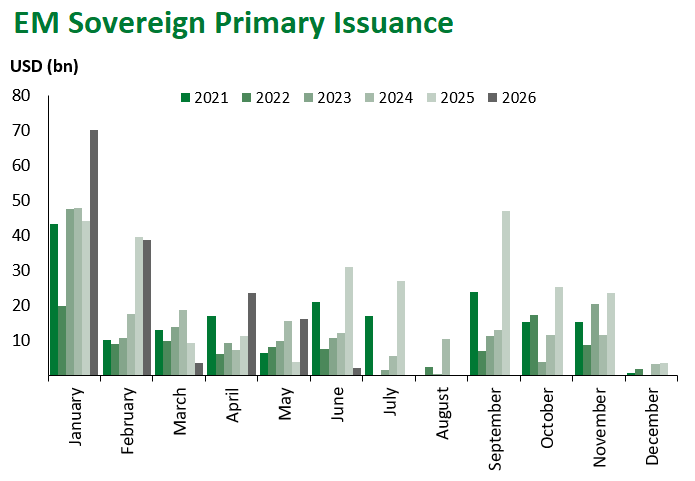
Primary market activity was moderate, with twelve issuers pricing approximately $9 billion in hard currency supply across fifteen tranches, predominantly investment grade (figures reflect hard currency issuance only and exclude any concurrent local currency raises). Asia dominated the calendar. Tencent priced $2.45 billion across two USD tranches (10s and 20s), Indonesia’s sovereign wealth fund Danantara raised $1.5 billion in two tranches, and China Construction Bank and ICBC brought floating-rate bank paper. Notable financials issuance included Dubai Islamic Bank’s $1 billion AT1 perpetual sukuk and Shinhan Card. Elsewhere, ICL Group of Israel placed an $800 million 10-year, Korea Hydro & Nuclear Power priced a ~$500 million 5-year, and San Miguel Global Power of the Philippines issued a perpetual hybrid. The only high yield deal of the week was MSU Green Energy of Argentina, which raised $400 million via an amortizing structure with a 9-year weighted average life.
The Week Ahead
A heavy central bank calendar dominates the week, headlined by the Federal Reserve’s FOMC decision on Wednesday, where rates are widely expected to be held steady and Kevin Warsh chairs his first post-meeting press conference as Fed chair. The Bank of Japan is expected to raise rates 25bps on Tuesday with Deputy Governor Shinichi Uchida fronting the press conference as Governor Kazuo Ueda is hospitalized. The Bank of England is widely seen holding on Thursday despite persistent inflation pressures. A dense slate of additional rate decisions follows, spanning Brazil, Australia, Chile, Sweden, Switzerland, Norway, the Czech Republic, Indonesia, the Philippines, Taiwan, Pakistan, Ukraine, and Russia. On the data front, inflation prints feature the UK, Eurozone, Japan, South Africa, Poland, Saudi Arabia, and Nigeria CPI, China activity data (retail sales, industrial production) and U.S. retail and industrial production. Geopolitics remains front and center: the G7 leaders’ summit convenes in Evian-les-Bains (June 15-17), where leaders are expected to press President Trump to back a European-led mission to clear mines from the Strait of Hormuz, while the European Council summit later in the week focuses on the fallout from the U.S.-Iran conflict and President Putin hosts the Russia-ASEAN summit in Kazan.
Fixed Income
Equities
Commodities
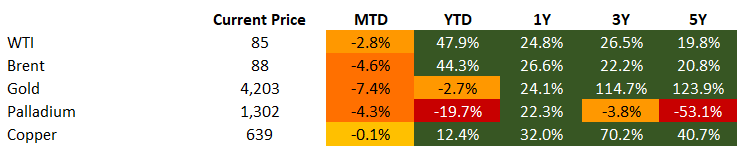
Source for data tables: Bloomberg, JPMorgan, Gramercy. EM Fixed Income is represented by the following JPMorgan Indicies: EMBI Global, GBI-EM Global Diversified, CEMBI Broad Diversified and CEMBI Broad High Yield. DM Fixed Income is represented by the JPMorgan JULI Total Return Index and Domestic High Yield Index. Fixed Income, Equity and Commodity data is as of June 12, 2026 (mid-day).
Highlights
Peru runoff hangs on hundreds of votes, but markets show resilience
Event: Peru’s June 7 presidential runoff between Keiko Fujimori (right-wing Fuerza Popular) and Roberto Sánchez (left-wing Juntos por el Perú) remains unresolved several days after voting, with the count flipping multiple times and the candidates separated by only a few hundred votes out of roughly 18 million cast. Final adjudication awaits remaining overseas ballots, observed actas, and JNE resolution. Peruvian assets have traded with a moderately constructive tone through the count, with the sovereign curve modestly tighter and the sol holding ground.
Gramercy Commentary: Market pricing reflects two reinforcing assumptions: 1) Fujimori is likely to consolidate her lead as remaining ballots and observed actas are adjudicated, and 2) Even a Sánchez victory would be constrained by the new Congress (where Fujimori’s party retains the largest bloc) and by independent technocratic institutions including the BCRP. The current tone is consistent with the view that the binary policy gap between the two candidates is narrower than the original campaign rhetoric implied, with the July BCRP transition, the fiscal rule, and mining regime continuity serving as likely durable anchors regardless of executive ideology. That said, current spread levels appear to discount a smooth proclamation more fully than the historically thin margin and repeated lead reversals would warrant, leaving residual risk of contested legitimacy or street mobilization reminiscent of the 2021 episode. Beyond the proclamation itself, the early signals from the incoming administration on BCRP succession, the fiscal anchor, and the tax and mining regimes will be the relevant catalysts for sustained credit performance.
S&P lifts Argentina to B-, joining Fitch and broadening the buyer base
Event: On June 10, S&P Global Ratings raised its long-term sovereign credit rating on Argentina to ‘B-‘ from ‘CCC+’ with a stable outlook, following Fitch’s earlier upgrade to the same level, citing continued fiscal surpluses, lower inflation, improving external liquidity, and ongoing reserve accumulation. S&P projected the economy growing about 2.7%this year and roughly 3%annually after that, with average inflation easing toward 32%in 2026 from around 42%last year, and highlighted Vaca Muerta as a structural anchor expected to deliver an energy trade surplus near $10 billion in 2026.
Gramercy Commentary: The upgrade ratifies the constructive medium-term thesis and is meaningful primarily because it brings the second major agency to B-, moving Argentina out of the CCC bucket at S&P following Fitch’s earlier action. With two agencies now aligned, the marginal buyer base for Argentine sovereigns should broaden, and a further rally from here could push yields to levels that make a market-based liability management exercise economically attractive for the Treasury. For now, the authorities have clearly opted to rely on alternative financing channels rather than tap voluntary capital markets, with the funding mix already secured for July external debt payments through bank-arranged operations and multilateral guarantees. The credit remains exposed to FX policy execution, the pace of reserve accumulation, and the political environment heading into the 2027 cycle, all of which will shape whether the next leg of spread compression materializes.
Petro threatens to reject results if De la Espriella wins Colombia’s presidency on June 21
Event: Gustavo Petro, Colombia’s incumbent left-wing president, vowed to reject the result of the June 21 runoff and “take to the streets” if opposition frontrunner Abelardo de la Espriella wins.
Gramercy Commentary: The tone of Colombia’s ongoing presidential election campaigns has been unusually acrimonious and divisive. In that context, Petro’s openly floating the idea of “rejecting the results” and “taking to the streets” come as no surprise to us and highlights certain risks associated with the post-election transition period that could inject volatility in Colombian assets. Notably, markets would be monitoring for any signs of 2021-style social unrest organized by Petro’s supporters in the event of a de la Espriella victory such as roadblocks paralyzing commerce and transport and clashes with security forces. This being said, we are of the view that if Abelardo de la Espriella prevails in the second round by a convincing margin as suggested by the latest polls, it will be challenging for Petro to make a compelling argument to his supporters to defy the electoral outcome and the orderly transition of power. We also expect markets to give a de la Espriella administration the benefit of the doubt, despite significant fiscal and economic issues that will need to be addressed by an incoming right-wing government in due course, which should create a supportive backdrop for Colombian assets in the near-term.
Emerging Markets Technicals
Emerging Markets Flows
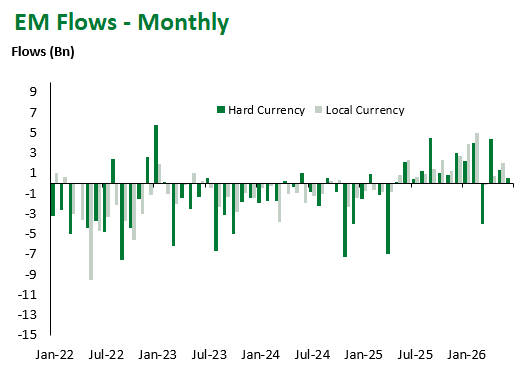
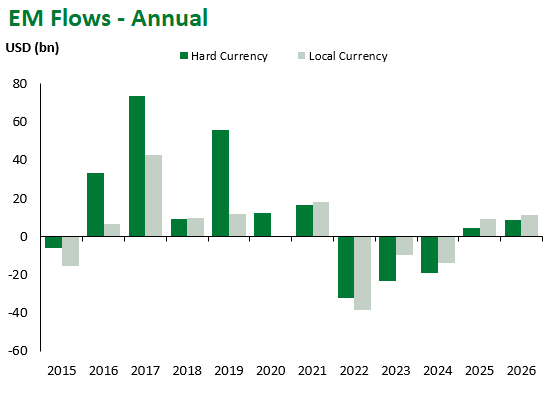
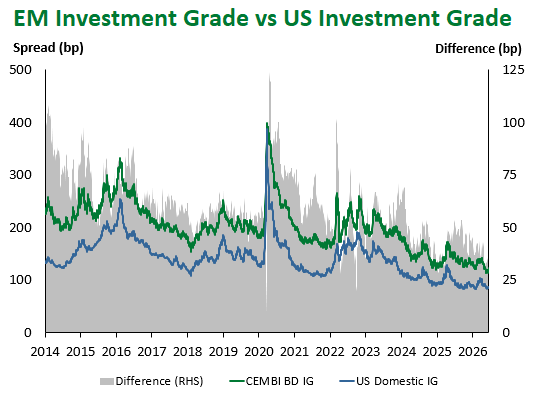
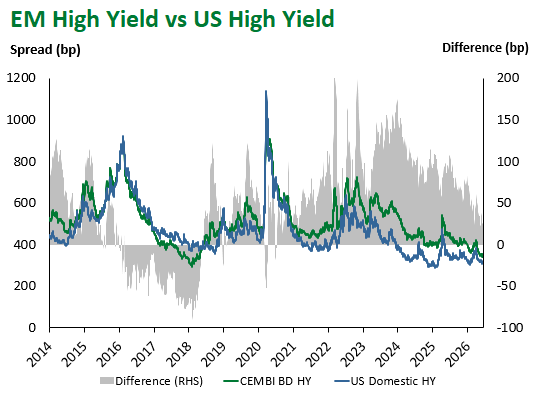
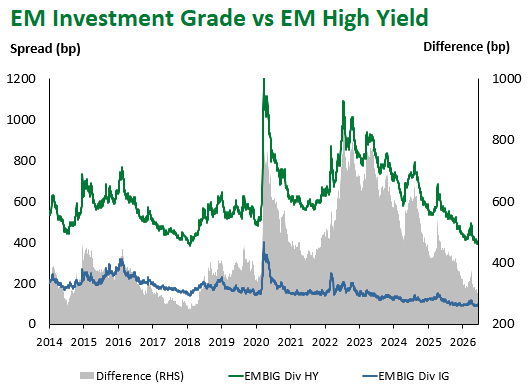
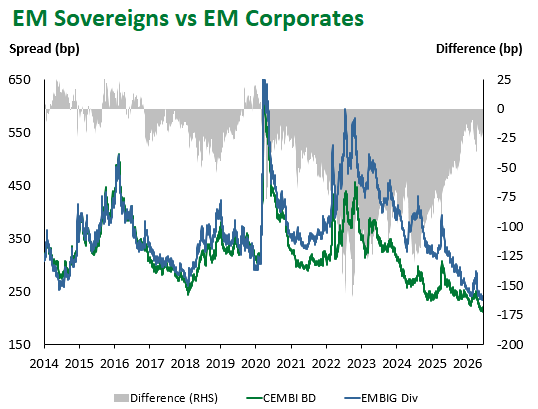
Source for graphs: Bloomberg, JPMorgan, Gramercy. As of June 12, 2026.
For questions, please contact:
Kathryn Exum, CFA ESG, Director, Co-Head of Sovereign Research, [email protected]
Petar Atanasov, Director, Co-Head of Sovereign Research, [email protected]
This document is for informational purposes only. The information presented is not intended to be relied upon as a forecast, research or investment advice, and is not a recommendation, offer or solicitation to buy or sell any securities or to adopt any investment strategy. Gramercy may have current investment positions in the securities or sovereigns mentioned above. The information and opinions contained in this paper are as of the date of initial publication, derived from proprietary and nonproprietary sources deemed by Gramercy to be reliable, are not necessarily all-inclusive and are not guaranteed as to accuracy. This paper may contain “forward-looking” information that is not purely historical in nature. Such information may include, among other things, projections and forecasts. There is no guarantee that any forecasts made will come to pass. Reliance upon information in this paper is at the sole discretion of the reader. You should not rely on this presentation as the basis upon which to make an investment decision. Investment involves risk. There can be no assurance that investment objectives will be achieved. Investors must be prepared to bear the risk of a total loss of their investment. These risks are often heightened for investments in emerging/developing markets or smaller capital markets. International investing involves risks, including risks related to foreign currency, limited liquidity, less government regulation, and the possibility of substantial volatility due to adverse political, economic or other developments. References to any indices are for informational and general comparative purposes only. The performance data of various indices mentioned in this update are updated and released on a periodic basis before finalization. The performance data of various indices presented herein was current as of the date of the presentation. Please refer to data returns of the separate indices if you desire additional or updated information. Indices are unmanaged, and their performance results do not reflect the impact of fees, expenses, or taxes that may be incurred through an investment with Gramercy. Returns for indices assume dividend reinvestment. An investment cannot be made directly in an index. Accordingly, comparing results shown to those of such indices may be of limited use. The information provided herein is neither tax nor legal advice. Investors should speak to their tax professional for specific information regarding their tax situation.