

Executive Summary
The AI funding scare sparked a Treasury rally and a flight to quality. Amid Thursday’s tech selloff, the 10-year Treasury yield fell about 17bps to below 5%, its largest one-day drop since August 2025. Within EM, there was clear credit quality differentiation: IG outperformed HY as investment grade finished marginally positive (sovereigns +0.13%, corporates +0.05%), high yield fell (-0.41% and -0.45%), and B and CCC were the only negative rating buckets in sovereigns.
The Gulf escalation drove a risk-off tone across EM credit, despite the UST rally. Attacks reaching Saudi export routes pushed Brent above $116, reviving global growth concerns, and EM fixed income fell in all three sub-asset classes this week: local currency -0.32%, hard currency sovereigns -0.16%, corporates -0.15%. Higher oil didn’t help oil-linked currencies: the Mexican and Colombian pesos weakened, and Egypt was the weakest local market (-3.09%). Gulf borrowers still raised about $6.5 billion of the week’s $10 billion in new issuance, led by Kuwait’s $3.25 billion sovereign deal. A softer dollar didn’t help local markets, where currency weakness drove most of the -0.32% loss.
Indonesia’s MSCI proposal was the week’s sharpest country-specific development in EM. MSCI’s proposal to move Indonesia to standalone status, skipping the frontier tier, set off the country’s worst equity slump in nearly three decades and pushed the rupiah close to a record low. Bank Indonesia held its policy rate but raised its deposit rate and cut reserve requirements. The selloff spread to fixed income: Indonesia lost 1.29% in local currency on both bond prices and the rupiah and 1.20% in corporates, the largest country decline in that index.
Market Overview
Macro Update
The Gulf conflict moved deeper into Saudi Arabia’s energy system this week, pushing Brent to its highest level since the early days of the Middle East crisis. Brent topped $116 per barrel into the close, on course for a third weekly gain. With Saudi Arabia’s bypass route now a target alongside Hormuz, the market is pricing risk to the Gulf’s remaining export capacity, which leaves the oil premium more sensitive to escalation than to diplomacy.
Washington’s stance hardened in parallel. The New York Times reported that U.S. and Israeli militaries have drawn up plans for a short, intensive campaign against Iran after the midterms, potentially targeting nuclear sites, missile and drone capabilities and energy infrastructure, although President Trump has yet to approve it. Trump said the U.S. is no longer negotiating with Tehran and that “most people think it will happen after the elections,” two weeks after citing “productive discussions,” while a third carrier group is heading to the region. Iran has warned it could respond by targeting Gulf data centers and subsea internet cables. For markets, the period after November 3 now carries an explicit escalation risk that reaches beyond oil to Gulf infrastructure and digital connectivity.
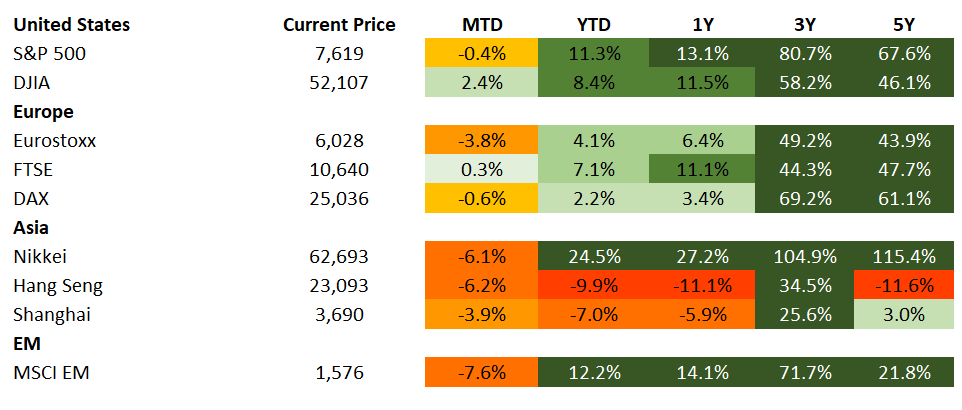
Thursday brought the sharpest cross-asset move of the week, as concerns over how the AI buildout will be financed returned. Meta’s results and its plan to issue new non-voting shares to fund AI expansion, together with a supply-chain warning from chip-equipment maker Lam Research, drove a 2.6% fall in the Nasdaq and a drop of about 1.2% in the S&P 500, after a 3.5% slide in Korea’s Kospi earlier in the day. Treasuries rallied as investors sought safety: the 10-year yield fell about 17bps to around 4.96% and traded around 4.99% into the close, its first below 5% since September 23 and its largest one-day drop since August 2025. In the long end, the 30-year finished the week around 5.30%, 11bps lower compared to last week.
The dollar index slipped to around 101.7, its weakest since October 1, the JPY led the majors after a Bank of Japan deputy governor signaled readiness to raise rates, and gold fell below $4,000 alongside risk assets. Futures put the odds of a Fed hike next week below 10%, with a hike in December priced at about 75%. A growth and funding scare that pulls Treasury yields lower while oil rises is a mixed backdrop for EM: it eases dollar and duration pressure on local markets, but it introduces downside risks on growth in tech-heavy EM stories.
In Europe, French debt broke through a symbolic threshold. The 10-year OAT yield rose above 5% on Wednesday for the first time since 2002, after a weekend of violent protests over spending cuts, and briefly traded above the equivalent U.S. Treasury yield for the first time since 2013. The spread over Bunds widened to around 160–170bps, its widest since late 2011, and tested 175bps on Friday ahead of Moody’s review of France’s Aa3 rating, which most economists expect to end in a downgrade (decision due after Friday’s close).
Elsewhere in Europe, UK inflation rose to 3.5% in September, above forecasts, with core at 2.8%, ahead of next week’s budget, and the euro area’s flash composite PMI fell to 51.9 as cost pressures re-accelerated. With France trading closer to the periphery than the core, Paris has become the main source of risk for European duration and for CEE assets priced off Bunds.
In EM, Indonesia faced the week’s sharpest stress. MSCI’s proposal to move the country from emerging market to standalone status, bypassing the frontier tier, triggered the worst stock-market slump in nearly three decades, with losses spreading to bonds and the rupiah, which hovered near a record low around 18,000 per dollar. Bank Indonesia held its policy rate at 5.75% for a fourth meeting, against expectations of a hike from half of economists surveyed, but raised its deposit facility rate by 25bps to 5.00% and announced a two-percentage-point cut to reserve requirements by December, a mix aimed at supporting the currency while freeing more than $10 billion for lending. Türkiye’s central bank cut its policy rate by 100bps to 36%, its first cut since January, as annual inflation fell below 30% for the first time since November 2021, while signaling it would tighten again if the energy shock feeds through.
Brazil’s presidential election runoff on Sunday is set to be a nailbiter. Datafolha’s poll released Thursday has Senator Flávio Bolsonaro and President Lula tied at 50% of valid votes, down from 51-49% a week earlier, and Quaest has the senator ahead by 50.6% to 49.4%, while Lula’s approval has edged above disapproval for the first time since July. Prediction markets still favor Bolsonaro at around 76-79%, but Brazilian assets have given back part of the post-first-round rally, with the Ibovespa down 1.15% on Thursday to about 2.4% below its October 9 record and the BRL weaker at around R$5.04 per dollar. With the polls tied and prediction markets still leaning toward Bolsonaro, Monday’s open carries large two-way risk for the BRL and local rates.
China’s third-quarter GDP rose 4.5% year-on-year, beating the 4.4% consensus and recovering from 4.3% in the second quarter, with September exports up 36.3% in dollar terms and industrial output up 5.5%. Domestic demand remains the weak link: retail sales grew 1.1% in September and fixed-asset investment fell 7.2% over the first nine months, while the trade surplus reached $938 billion through September and could top $1 trillion once October data are released. Growth at the bottom of the 4.5-5% target range reduces the pressure on Beijing for aggressive stimulus, so exports, and the trade frictions they invite, will keep carrying the recovery into the final quarter.
The rift between Washington and Kyiv deepened early in the week before showing signs of a thaw. President Trump said it was “time for somebody else to negotiate on behalf of Ukraine” after Kyiv launched one of its largest drone attacks of the year on Russia, hitting a key oil terminal in defiance of U.S. demands that it stop striking refineries, while Washington’s diesel deal with Moscow and its waiver of some Russia sanctions drew criticism even from Republicans. After talks in Oslo on Tuesday, Zelenskyy said U.S. intelligence sharing had resumed, and after envoy Steve Witkoff met President Putin, Russia signaled support for trilateral talks by early November, although no dates are set. The partial thaw eases the immediate risk of a transatlantic break, but Ukrainian strikes on Russian refining capacity, and Washington’s opposition to them, remain a direct input into global diesel prices.
The Week Ahead
Brazil’s runoff result lands into Monday’s open. A dense central bank week follows: the Bank of Canada and the Fed decide on Wednesday, with the FOMC expected to hold and markets focused on Chair Warsh’s guidance for December; the ECB meets on Thursday, where most economists expect a hold; and the Bank of Japan decides on Friday, where a hold is also expected but a deputy governor’s signal of readiness to hike has put December in play. Thursday also brings the advance estimate of U.S. third-quarter GDP and September PCE inflation, and mega-cap earnings continue with Microsoft and Alphabet on Wednesday and Amazon on Thursday, a key test for AI-spending sentiment after this week’s selloff. The UK presents its budget on Wednesday, and the U.S. Treasury sells $213 billion of 2-, 5- and 7-year notes and floating-rate notes. In Europe, markets will digest Moody’s decision on France alongside flash third-quarter GDP and October inflation readings, and China’s official PMIs are due on Saturday. Geopolitically, the watch-points are the pace of Houthi attacks on Saudi export infrastructure, tanker attacks in Hormuz, and preparations for possible U.S. and Israeli strikes after the November 3 midterms.
Highlights
Putin signals readiness for trilateral talks in November, but substance remains thin ahead of a likely winter escalation
Event: Following more than three hours of talks with U.S. envoy Steve Witkoff in St. Petersburg on October 21, the Kremlin said Russia is ready to resume trilateral negotiations with the U.S. and Ukraine in the first half of November, possibly in Abu Dhabi, focused on a postwar security framework for both countries. Witkoff arrived from Oslo, where he met President Zelenskyy alongside the Norwegian and Finnish leaders the previous day and presented new proposals from Kyiv and the Europeans. The talks follow a week-long public feud between Trump and Zelenskyy over a U.S.-Russia arrangement allowing some Russian diesel into global markets ahead of the November 3 U.S. midterms, during which Trump suggested Zelenskyy should step aside, while Ukrainian troops continue to face curbs on Starlink access.
Investment Implications: It was a busy week for global shuttle diplomacy on the Ukraine-Russia war. As with previous similar episodes, we see limited substance behind the headlines in terms of Russia’s willingness to compromise on its core demands. The Kremlin’s outreach was unusually detailed and appeared tailored to Trump’s priorities, including mediation in Iran, economic incentives, a goodwill prisoner release, and a leaders’ summit. This combined with Russia’s quick dismissal of the Oslo proposals suggests Moscow is managing the relationship with Washington rather than moving on territory or security guarantees, while there is still no sign Putin is prepared to meet Zelenskyy directly. Our read is that while both sides are signaling willingness to negotiate, each is looking to begin earnest negotiations only from a position of strength, after a potential re-escalation of hostilities this winter. For Moscow, sustaining dialogue buys time ahead of a planned intensification of strikes on Ukrainian cities and may help complicate arms supplies and other assistance to Kyiv at a moment when U.S.-Ukraine relations are under visible strain. For Trump, an active channel with Russia is useful ahead of the midterms. Zelenskyy’s openness to a freeze along the current frontline is a notable signal of flexibility, but it does not bridge the gap with Russia’s demands. For Ukraine sovereign bonds, we would treat this week’s small rally after a significant sell-off as headline-driven and would be reluctant to chase it: the optionality we highlighted last month on a negotiated de-escalation remains intact, but we believe the more probable path over the coming months is a harder winter rather than a breakthrough.
Bangkok IMF meetings: resilience is the consensus; fundamentals drive differentiation
Event: The IMF-World Bank Annual Meetings in Bangkok reflected a market characterized by tight spreads, low conviction, and still light investor positioning. Resilience remains the consensus, supported by AI-related investment but increasingly tested by the Middle East energy shock. The key question is how long that resilience can endure as fiscal and energy buffers erode and inflation remains sticky. Iran and Strait of Hormuz risks are increasingly viewed as structural rather than transitory, sustaining a higher geopolitical premium in oil. The shock has been less disruptive than feared, but the pressure is migrating into public finances, with fuel pricing a common fault line across importers and exporters. Fiscal sustainability, rather than inflation alone, is emerging as the more persistent risk to long-end yields, amid heavy global investment needs and constrained savings. On the IMF front, political constraints continue to impede progress, while restructuring frameworks evolve. Fund engagement remains a necessary but insufficient condition for a program, as Cameroon, Kenya, Mozambique and CEMAC illustrate.
Investment Implications: The meetings reinforced a selective sovereign credit environment: broad asset-class exposure offers less conviction than country-level differentiation, with performance likely to favor issuers delivering tangible fiscal and external adjustment and demonstrating policy credibility. Oil exporters and reform-oriented importers appear better positioned to absorb the shock. Nigeria benefits from domestic refining capacity that reduces exposure to imported fuel costs, while Angola remains a net beneficiary of higher oil prices, notwithstanding subsidy overruns. Egypt’s sustained reform momentum, resilient external position amid renewed inflows and use of the currency as a shock absorber, gave authorities confidence to signal a path away from continuous Fund dependence. Sri Lanka continues to outperform IMF program assumptions. Venezuela was the most constructive restructuring story, with rising oil production, early investment inflows and collaborative IMF engagement pointing to progress. But optimism should not be confused with near-term resolution. An Article IV requires additional data and clarity on fiscal policy, debt sustainability analysis is taking longer than signaled, and restructuring is likely to proceed in stages. Senegal and Lebanon face more binding constraints. Senegal’s 1Q27 restructuring target looks optimistic, with debt-servicing capacity potentially becoming binding by March, while Lebanon’s progress hinges on passage of the gap law before the political window narrows ahead of the May 2028 elections. Elsewhere, oil importers and economies lagging the AI investment cycle, including India, face greater adjustment through currencies and fiscal subsidies. Ukraine’s roughly $30 billion financing gap for 2027, as U.S. support recedes, raises the stakes of European funding and the debate over frozen Russian assets. The bottom line: resilience is sustaining the asset class but not lifting all sovereigns equally. Genuine fiscal and external improvement, credible policy execution and financing visibility will determine the next phase of sovereign performance.
Market Data
EM Credit Update
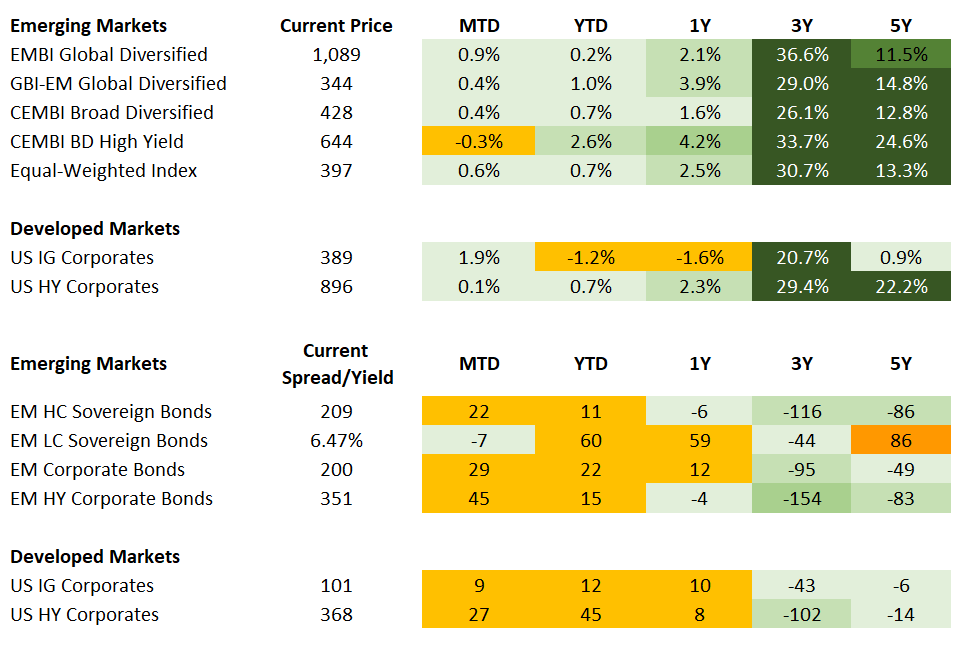
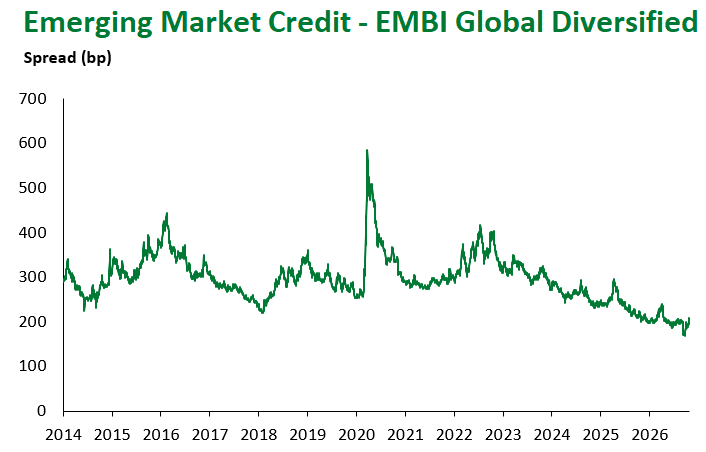
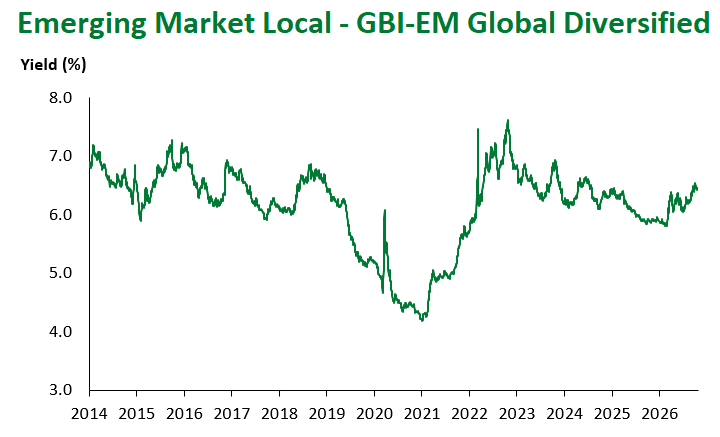
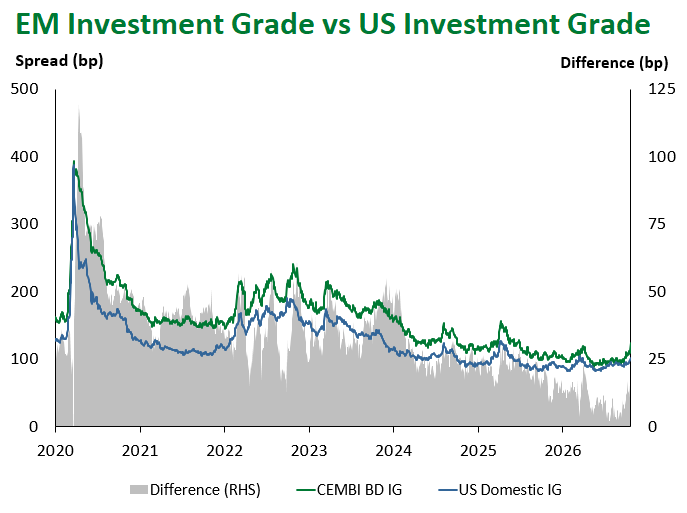
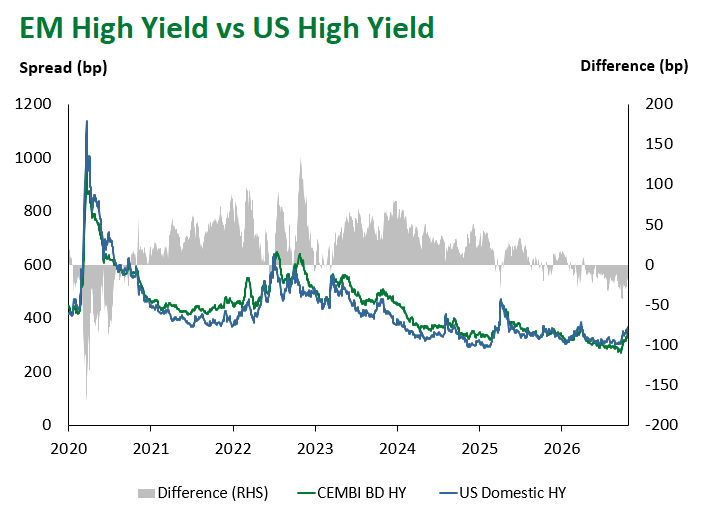
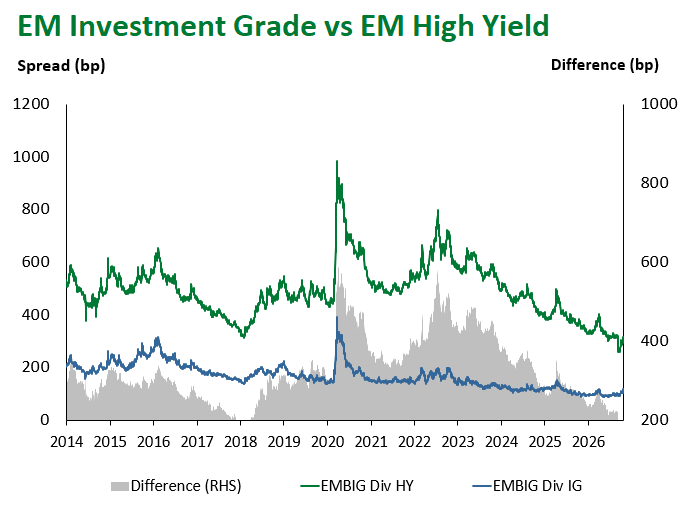
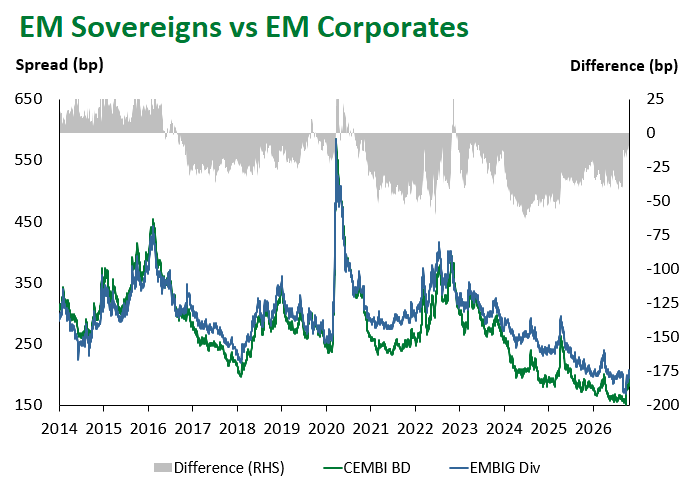
Emerging markets fixed income declined across all three sub-asset classes this week as higher oil prices revived global growth concerns and the AI trade stumbled. Local currency sovereigns were the weakest at -0.32% (GBI-EM Global Diversified), while hard currency sovereigns (-0.16%) and corporates (-0.15%) posted smaller losses. The rally in U.S. Treasuries cushioned dollar-denominated debt, leaving the long end of both curves roughly flat, so the losses came mainly from wider spreads. Investors moved up in quality, with investment grade finishing positive in both sovereigns (+0.13%) and corporates (+0.05%), while high yield fell -0.41% and -0.45%, respectively.
Local currency sovereign debt returned -0.32%, with currency weakness accounting for most of the decline. Egypt (-3.09%) was the weakest market, almost entirely on the back of weaker FX, while Mexico, Hungary, Peru and Colombia also lagged. The Mexican and Colombian pesos weakened despite higher oil prices, suggesting broader risk aversion rather than terms of trade drove currency moves this week. Indonesia (-1.29%) sold off in both price and currency after MSCI proposed reclassifying the country’s stock market from emerging to standalone status, effectively a double downgrade that would remove it from both its emerging and frontier indices. South Africa outperformed on a rally in local bonds, and Brazil held onto last week’s election-driven gains ahead of Sunday’s presidential runoff.
Hard currency sovereign bonds fell -0.16%, with investment grade (+0.13%) outperforming high yield (-0.41%). Africa (-0.87%) was the weakest region, with losses across most of the continent, followed by the Middle East, while Latin America and Europe finished slightly positive. Senegal (-4.13%) was the worst performer, and Venezuela, Lebanon, Ecuador and Gabon also sold off sharply. Ukraine led gains, while higher-quality Latin American credits such as Peru, Brazil and Uruguay also did well. By rating, unrated (-2.07%), B (-0.97%) and CCC (-0.68%) bonds were the only segments in negative territory, while BB and BBB both returned +0.17%.
EM corporates fell -0.15%, with investment grade (+0.05%) again ahead of high yield (-0.45%). All regions finished lower, with the Middle East, Europe and CEEMEA underperforming and Latin America and Asia holding up best. Indonesia (-1.20%) saw the largest decline at the country level, as contagion from the MSCI reclassification proposal spread to corporate credit, while Israel also lagged. By rating, the C bucket fell -3.51% and B -0.62%, while AAA and AA posted small gains.
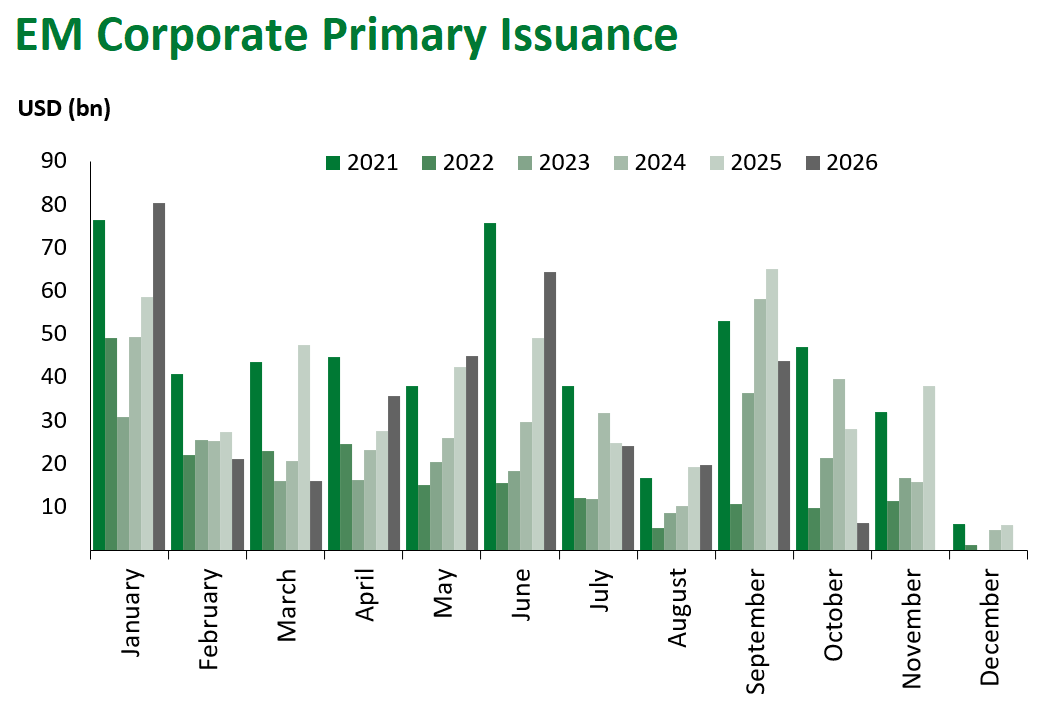
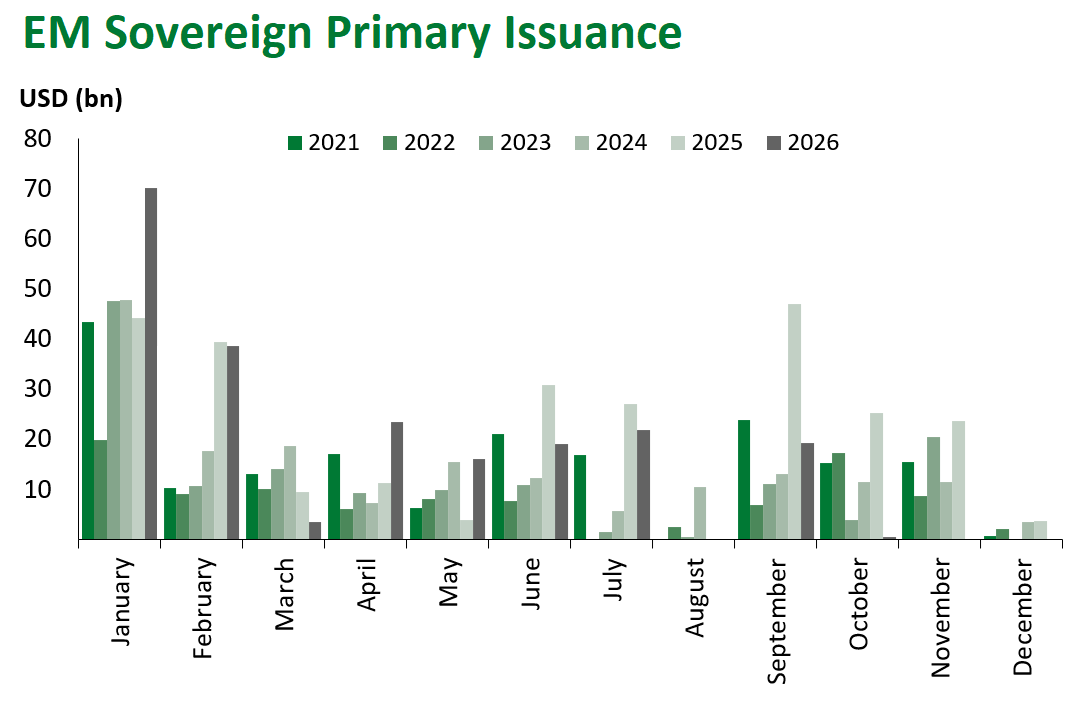
Primary market activity picked up despite the weaker backdrop, with 11 issuers pricing approximately $10.0 billion in hard currency supply, with roughly two-thirds of it being investment grade. Gulf borrowers accounted for about $6.5 billion, led by Kuwait’s $3.25 billion sovereign deal and TAQA’s $1.75 billion transaction. The Bahamas also issued $1.1 billion, and Banamex priced a $900 million AT1.
Fixed Income
Equities
Commodities
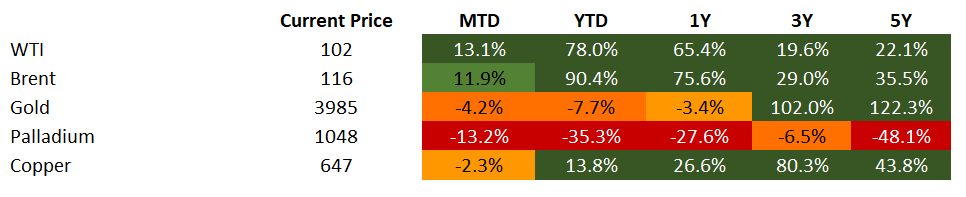
Source for data tables: Bloomberg, JPMorgan, Gramercy. EM Fixed Income is represented by the following JPMorgan Indicies: EMBI Global, GBI-EM Global Diversified, CEMBI Broad Diversified and CEMBI Broad High Yield. DM Fixed Income is represented by the JPMorgan JULI Total Return Index and Domestic High Yield Index. Fixed Income, Equity and Commodity data is as of October 23, 2026 (mid-day).
Emerging Markets Flows
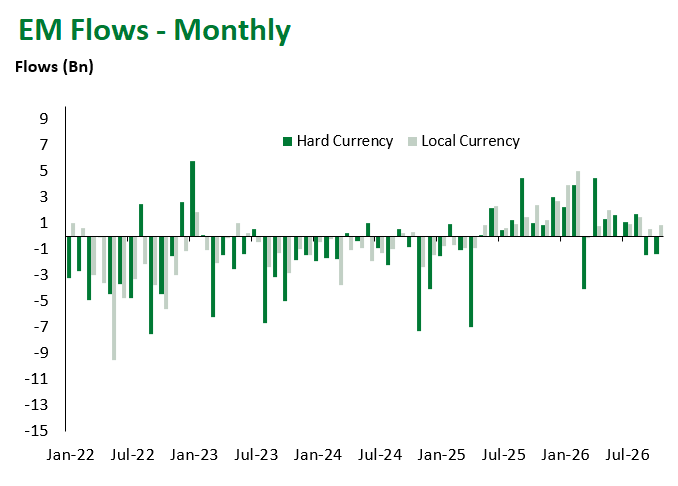
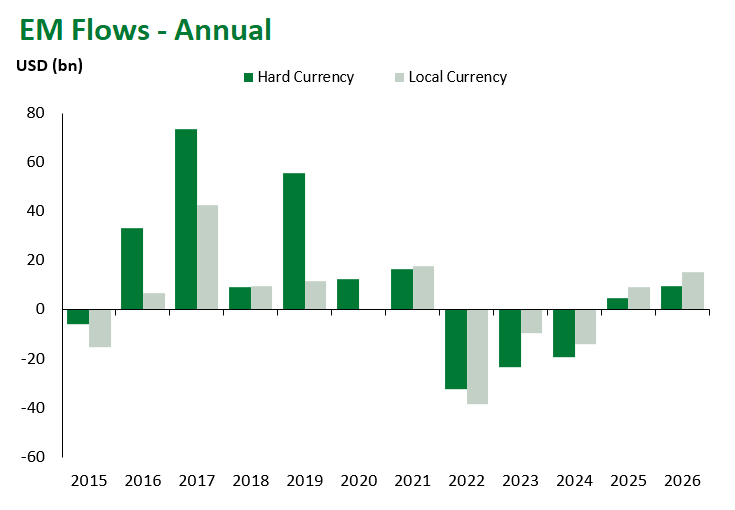
Source for graphs: Bloomberg, JPMorgan, Gramercy. As of October 23, 2026.
For questions, please contact:
Kathryn Exum, CFA ESG, Director, Co-Head of Sovereign Research, [email protected]
Petar Atanasov, Director, Co-Head of Sovereign Research, [email protected]
This document is for informational purposes only. The information presented is not intended to be relied upon as a forecast, research or investment advice, and is not a recommendation, offer or solicitation to buy or sell any securities or to adopt any investment strategy. Gramercy may have current investment positions in the securities or sovereigns mentioned above. The information and opinions contained in this paper are as of the date of initial publication, derived from proprietary and nonproprietary sources deemed by Gramercy to be reliable, are not necessarily all-inclusive and are not guaranteed as to accuracy. This paper may contain “forward-looking” information that is not purely historical in nature. Such information may include, among other things, projections and forecasts. There is no guarantee that any forecasts made will come to pass. Reliance upon information in this paper is at the sole discretion of the reader. You should not rely on this presentation as the basis upon which to make an investment decision. Investment involves risk. There can be no assurance that investment objectives will be achieved. Investors must be prepared to bear the risk of a total loss of their investment. These risks are often heightened for investments in emerging/developing markets or smaller capital markets. International investing involves risks, including risks related to foreign currency, limited liquidity, less government regulation, and the possibility of substantial volatility due to adverse political, economic or other developments. References to any indices are for informational and general comparative purposes only. The performance data of various indices mentioned in this update are updated and released on a periodic basis before finalization. The performance data of various indices presented herein was current as of the date of the presentation. Please refer to data returns of the separate indices if you desire additional or updated information. Indices are unmanaged, and their performance results do not reflect the impact of fees, expenses, or taxes that may be incurred through an investment with Gramercy. Returns for indices assume dividend reinvestment. An investment cannot be made directly in an index. Accordingly, comparing results shown to those of such indices may be of limited use. The information provided herein is neither tax nor legal advice. Investors should speak to their tax professional for specific information regarding their tax situation.