


Executive Summary
U.S. rates volatility and stronger USD drive pressure on EM this week. The 30-year crossed 5.60% for the first time since 2002 and the DXY reached an 18-month high of around 102. In this context, all three EM sub-asset classes were lower this week, led by hard currency sovereigns.
Softer U.S. employment data and more dovish Fed speak offer a potential relief valve for EM assets. September payrolls rose just 29k against around 90k expected, signaling a cooling in the U.S. labor market, pushing October rate hike odds below 20% and Treasury yields 4-6bps lower, although a December hike is still about 70% priced.
Energy stress has shifted to refined products but U.S. diesel export ban likely off the table now. Hormuz talks stalled and Brent swung between the mid-$90s and $105 before finishing just below $100 per barrel. Meanwhile, China’s fuel-export halt and the threatened U.S. diesel export ban carry risks for fuel-importing EM economies, but Friday’s G7 diesel stocks release agreement should alleviate market concerns.
Market Overview
Macro Update
September payrolls, released Friday morning, rose just 29k against a consensus of around 90k, while August’s strong gain was revised down to 133k from 162k. Additionally, private payrolls added only 46k, the unemployment rate ticked up to 4.2% from 4.1%, and average hourly earnings rose 0.1% on the month, slowing to 3.0% YoY.
In response, Treasury yields fell 4-6bps across the curve, with the benchmark 10-year yield dropping below 5.20%; equities also climbed as traders scaled back bets on an October Fed hike to below 20%, from below 30% ahead of the data, on expectations that the sharp slowdown in U.S. hiring would give the FOMC sufficient arguments to stay on hold. The September CPI report due on October 14 now looks like the key datapoint ahead of the December Fed meeting that still carries a 70% implied probability of a 25bps rate hike.
Earlier in the week, August core PCE printed 3.0% YoY against a 3.3% consensus, with headline at 3.4% versus 3.7% expected and prior months revised lower. New York Fed President Williams also said there was no urgency for another hike. Together these cut October hike odds to below 30% from roughly 70% a week earlier, so the payrolls miss landed on a market that had already turned steadily less hawkish.
Some of the week’s data pointed the other way. 2Q GDP was revised up to 2.2% from 1.5%, ADP private payrolls beat at 90k, jobless claims fell to their lowest since July, and the ISM manufacturing prices-paid index jumped nearly 7 points to 77.9 as energy costs fed through supply chains. Slower hiring combined with rising input prices is the stagflation mix the Fed has tried to avoid, and with December now the next live meeting, the inflation data are likely to decide it.
Meanwhile, long-dated Treasury yields remain elevated as the 30-year crossed 5.60% for the first time since 2002, and the 10-year touched 5.30%, it’s highest since 2007, before they eased to around 5.58% and 5.20%, respectively, on the jobs report. While the front end could price a less hawkish Fed on the latest data, pressure on the long end points to term premium. Heavy Treasury supply and uncertainty over energy-driven inflation are both pushing it higher, and the selloff in government bonds is global. Softer U.S. data has less impact on the long-term rates that matter most for valuations, so duration risk stays relevant even if a Fed tightening cycle is delayed.
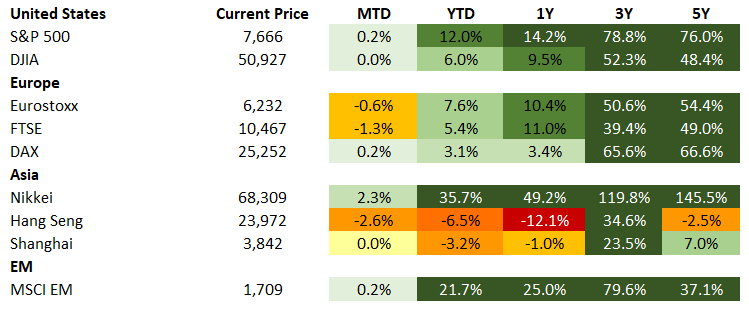
The dollar index rose to an 18-month high above 102 on its yield advantage, before retreating slightly into the close on the repriced Fed expectations. Gold was stable and the USDJPY hovered near 158. U.S. equities ended the third quarter near record highs, led by technology, and Micron’s stronger-than-expected results gave the AI hardware trade another lift. Breadth has deteriorated sharply, though fewer than half of S&P 500 constituents now trade above their 200-day moving averages, compared with roughly three-quarters in mid-August.
Talks to reopen the Strait of Hormuz stalled after President Trump on Saturday publicly rejected Iran’s seven-day roadmap. Under the plan, Tehran would have reopened the Strait in exchange for an end to the U.S. naval blockade, waivers on oil sanctions, and the release of roughly $12 billion in frozen assets. The Wall Street Journal reported that Trump expects bombing to resume after the November midterms. A third U.S. aircraft carrier is also reportedly heading to the region. The talks are still alive, but the real decision now looks likely to come after the midterms, leaving a November escalation risk for energy and rates markets.
Brent was volatile again, opening the week above $105 after Trump rejected the truce, then sliding to around $96-97 by Wednesday, to finish the week just below $100 per barrel. Goldman Sachs estimated that Gulf crude exports, including “dark” shipments, had recovered to 23.3 million barrels per day, in line with the 2025 average, and JPMorgan put Hormuz flows as high as 98% of pre-war levels.
However, refined products pulled prices back up. Chinese refiners suspended fuel exports outside Hong Kong and Macau for October, on top of Russia’s diesel export ban through month-end, and the Trump administration reportedly pressed Germany and France to draw down emergency diesel stocks or face a possible U.S. diesel export ban. As such, the pressure point in the energy shock has moved from crude to refined products, and that bottleneck is harder to clear. Goldman notes that a U.S. diesel export ban would hit Latin America hardest, a direct risk for fuel-importing EM economies. In a constructive development, on Friday, French President Macron announced that the G7 had agreed to release 100 million barrels of diesel and crude in response to the threatened U.S. ban on exports.
In Europe, the final Eurozone manufacturing PMI rose to 52.9 in September, its highest since May 2022 and another upside surprise, on investment-goods demand tied to AI and defense. The ECB looks to be settling into a sustained tightening path after treating its first moves as a response to the energy shock. That keeps pressure on European duration and should limit how far the euro can fall against a dollar supported by U.S. yields.
Ahead of Golden Week, China’s official manufacturing PMI returned to expansion at 50.1 for the first time since June. The non-manufacturing gauge beat expectations at 50.2, and the composite rose to 50.7 from 49.5. Beijing also moved to protect domestic energy supply by halting refined fuel exports, with domestic diesel and gasoline inventories well below the threshold it has set for permitting exports. Steadier Chinese activity is a modest positive for EM Asia exporters and industrial metals. The fuel-export halt cuts the other way: Beijing is putting energy security ahead of trade openness, which adds to inflation pressure for fuel-importing economies across Asia.
Brazil votes in the first round on Sunday with the race at its tightest. Datafolha’s final in-person survey shows President Lula leading 40-36% in the first round but only 47-45% in a runoff, and other final polls range from a 42-42 tie (Quaest) to a narrow Flávio Bolsonaro lead (Vox Brasil). In Argentina, the IMF technical mission concluded on September 29, without a staff-level agreement on the third program review. Talks will continue over the coming weeks, with roughly $865 million in disbursements pending. Latin America enters the fourth quarter with its two largest credit stories riding on binary outcomes: a likely Brazilian runoff on October 25 and an Argentine staff-level agreement still weeks away.
The Week Ahead
Brazil’s first-round result will be known by Mondays open. A runoff on October 25 is the base case, and the margin between the two front-runners, along with the makeup of Congress, will matter most for the BRL and local rates. In the U.S., the question after payrolls is whether a December hike is still on. Wednesday’s minutes from the September FOMC and a busy Fed speak calendar should show how the Committee is weighing a cooling labor market against hot input prices, and ISM services are also due before September CPI on October 14. The monthly 3-, 10-, and 30-year Treasury auctions will test demand with the long end at multi-decade highs. China returns from Golden Week on October 8 and refined-product markets will watch whether Beijing reissues fuel export permits. On Iran, the main question is whether Qatari mediation can bridge the gap between Tehran’s demand that the blockade end first and Washington’s insistence on nuclear concessions. Maritime incidents in the Strait of Hormuz and the U.S. military buildup in the region remain on the watch list. In energy, the EU’s response to U.S. pressure over emergency diesel stocks and any formal move toward a U.S. diesel export ban are the main tail risks.
Highlights
Ecuador’s MinFin Moya’s abrupt exit mid-IMF review compounds a core rates-driven selloff, but IMF program unlikely to veer off track
Event: President Daniel Noboa unexpectedly replaced Finance and Economy Minister Sariha Moya and the government has not explained the circumstances of the reshuffle. The change came while Ecuador’s economic team was in Washington for the IMF’s sixth review of the country’s $5.0 billion Extended Fund Facility (EFF) program. Moya, a young technocrat with relatively limited public sector experience prior to joining the Noboa administration, held the post since April 2025, led the IMF negotiations, and oversaw rating upgrades from all three major agencies. Her replacement, Bernardo Cordovez, has a similar profile and, just like Moya, appears to be a Noboa loyalist, which signals likely broad policy continuity despite the change.
Investment Implications: Ecuador’s sovereign bond complex was under pressure even before Moya’s abrupt departure, which introduced additional uncertainty to a market already nervous about HY EM credit against a backdrop of tightening global financing conditions. This development unfolded against a backdrop of 10-year U.S. Treasury yields climbing to around 5.25%, their highest level since 2007, following the Fed’s mid-September rate hike and growing market unease with the DM inflation outlook amid lingering high energy prices. In the context of higher for longer global energy prices, Ecuador, an oil producer and exporter, has seen a significant improvement in its crude oil export bill while FX reserves stand at comfortably high levels for its dollarized economy. However, despite genuine credit improvements, the recent sharp increase in global diesel prices and disruptions in Ecuador’s domestic refining capacity this year have reintroduced market concerns about a return of previously eliminated diesel price subsidies as well as the general outlook for fiscal consolidation. In addition, investors in Ecuador’s sovereign bonds need to consider risks related to unpredictable El Niño weather patterns into 2027 and regional and local elections in November, where the sidelined Correista opposition will be looking for a political comeback. In this context, completion of the sixth IMF review without delay and an early signal from new MinFin Cordovez of commitment to the recalibrated targets would likely be necessary conditions for sovereign spreads to begin retracing the recent idiosyncratic widening. Meanwhile, the beta component will likely remain dominant and continue to track the path of U.S. rates regardless of what happens in Ecuador=. We see Ecuador’s sovereign credit valuations as one of the more attractive opportunities within the HY EM universe and are inclined to fade Ecuador-specific weakness.
Moody’s lifts Angola outlook to positive on macro resilience through the oil cycle
Event: On September 27, Moody’s revised Angola’s sovereign outlook to Positive from Stable while affirming its B3 long-term issuer and foreign-currency senior unsecured ratings. The move reflects a stronger track record of macroeconomic stability across the oil cycle, improving debt dynamics, and lower near-term financing risk. Moody’s projects public debt at ~46% of GDP and interest costs at ~23% of revenue by the end of 2026, while highlighting the authorities’ active liability management, including three Eurobond transactions since October 2025 that raised roughly $5.75 billion alongside substantial buybacks. Further positive rating action would depend on sustained fiscal consolidation and improved monetary and FX policy effectiveness, while oil dependence, limited fiscal buffers and kwanza vulnerability remain key constraints. Angolan assets have outperformed year-to-date, but sovereign spreads remain wide to B- peers, particularly at the long end, with the 2048-49s trading roughly 75-80bps wide of Kenya’s 2048s and 180-200bps wide of Nigeria’s 2047-49s.
Investment Implications: The outlook change reinforces the broader improvement in Angola’s sovereign credit trajectory, with the key shift being greater evidence that macro adjustment and debt management can hold across different points in the oil cycle. The debt ratio has declined to around 48% from 70% in 2021 while liability management has reduced near-term refinancing and rollover pressure. The remaining question is how durable this improvement proves as oil prices normalize and the policy cycle becomes more constrained ahead of the 2027 election. The near-term credit backdrop remains supported by favorable oil pricing and proactive liability management, but Angola’s structural sensitivity to crude prices and limited fiscal buffers leave the sovereign exposed to deterioration in the external environment. At current spread levels, the valuation gap versus B- peers leaves room for further compression if the improving credit trajectory is validated by additional rating action. Key catalysts to watch are potential follow-through from S&P and Fitch, both currently at B- Stable; the pace of fiscal and subsidy reform ahead of and beyond the 2027 election; and continued liability management.
Romania’s political uncertainty persists, keeping loss of investment grade risk in focus
Event: Romania’s political stalemate dragged on after Parliament rejected Prime Minister-designate Siegfried Mureșan’s proposed government, with 182 votes in favor versus the 233 required. The vote marks the third failed attempt to form a government since the Bolojan cabinet collapsed in May. President Nicușor Dan has indicated that snap elections are not the preferred path and is expected to nominate a fourth candidate following further consultations. The prolonged stalemate is increasingly relevant for sovereign credit given Romania’s need to sustain fiscal consolidation, with the deficit targeted to decline from 9.4% of GDP in 2024 to 6.5% in 2026 and 5.5% in 2027. S&P’s October 2 review is the most immediate rating catalyst, with S&P, Fitch and Moody’s all maintaining Romania at one notch above investment grade but with negative outlooks. Romanian spreads have widened modestly but remain within recent trading ranges.
Investment Implications: The key credit issue is whether the lack of an empowered government begins to weaken fiscal execution and complicate preparation of the 2027 budget. S&P’s upcoming decision provides the most imminent test, while the persistence of political uncertainty will weigh on subsequent reviews by Fitch and Moody’s. Our base case is that Romania retains investment grade from at least two of three agencies through the remainder of this year, supported by fiscal consolidation measures already in place and continued ECOFIN engagement, though a cross-agency downgrade becomes materially more likely if political uncertainty persists into 2027 and begins to erode 2027 budget execution. The timing is also important for EU funding. The Recovery and Resilience Facility (RRF)’s end-August reform and end-September payment-request deadlines have passed, with Romania’s sixth payment request now expected in October. The ability to secure EU funds will provide an important read-through on policy execution and Romania’s engagement with Brussels. Romanian spreads already trade wide of BB+ peers, suggesting a downgrade is largely priced in, though losing investment-grade status could still trigger technical selling from IG-only investors.
Market Data
EM Credit Update
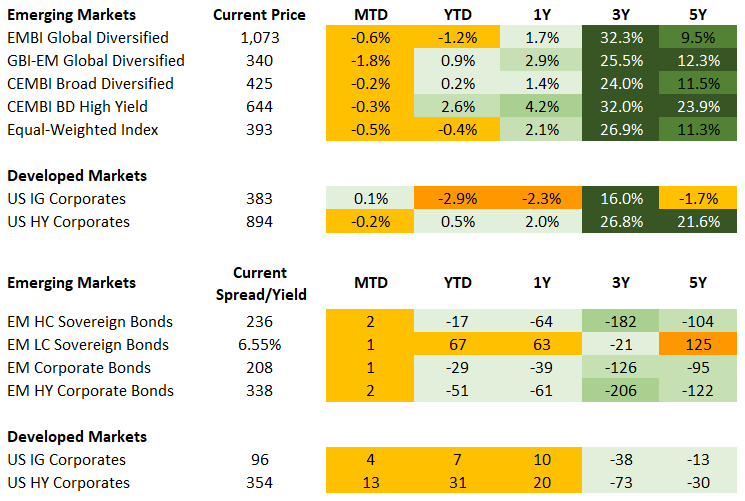
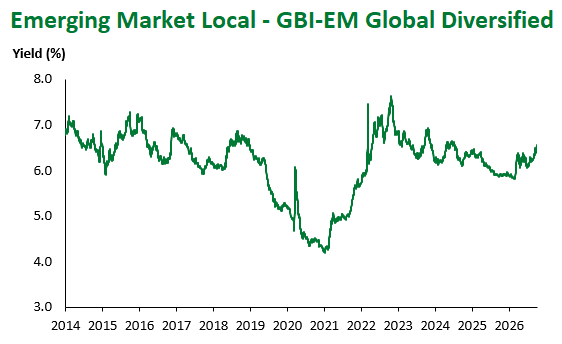
Emerging markets fixed income sold off across all three sub-asset classes this week as a sharp move higher in U.S. rates increased volatility across all markets and pushed the dollar stronger. Hard currency sovereigns were the weakest performer (-1.59%), followed by local currency debt (-1.11%) and corporates (-0.83%). Duration was the common thread in hard currency, with longer maturities underperforming in both sovereigns and corporates. In local markets, the currency channel did most of the damage.
Local currency sovereign debt declined -1.11% at the index level, with FX accounting for the bulk of losses as the dollar strengthened. Mexico (-3.64%) was the clear underperformer, almost entirely on peso weakness (-3.55% FX contribution). South Africa (-2.41%), Chile (-2.38%), and Romania (-2.17%) also lagged. Chile and Romania were overwhelmingly FX-driven. South Africa was the exception among the laggards, where bond prices fell almost as much as the currency there. Local duration otherwise held up well despite the U.S. move, with positive price returns in Hungary, Brazil, and Poland. Türkiye (+0.32%), supported by high carry, and China (+0.06%) were the only markets in positive territory.
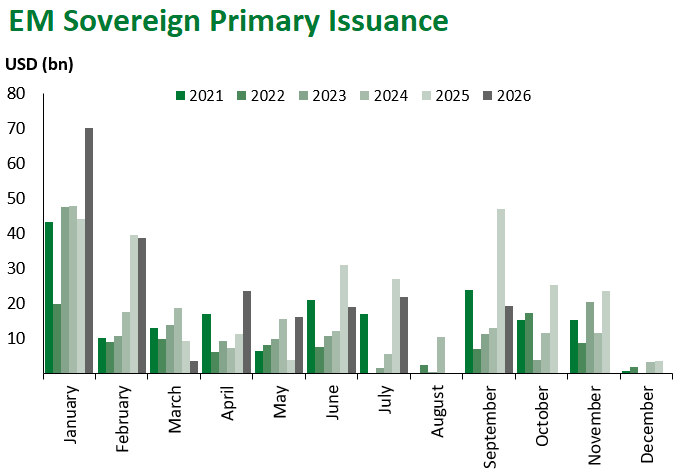
Hard currency sovereign bonds fell -1.59%. High yield (-1.86%) underperformed investment grade (-1.29%), with spreads widening alongside the rates move. Regionally, Africa (-2.27%) and Europe (-1.72%) lagged, while Asia (-0.98%) held up best. Along the curve, the 10+ year bucket (-2.66%) trailed the 1–3 year segment (-0.45%) by more than two percentage points. At the country level, Gabon (-5.33%), Ukraine (-5.26%), and Ethiopia (-4.04%) were the weakest performers, while Lebanon (+1.15%) and Senegal (+0.81%) bucked the trend.
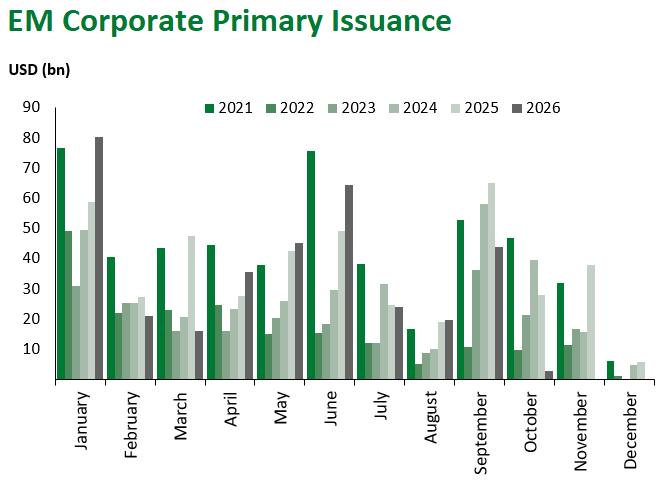
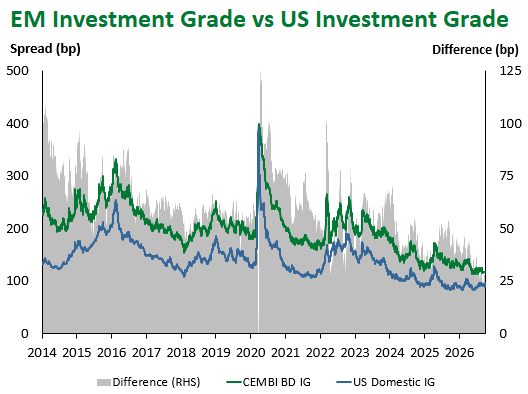
EM corporates outperformed sovereigns, declining -0.83%, with high yield (-1.15%) again lagging investment grade (-0.63%). Regionally, Latin America (-1.48%) and Africa (-1.36%) underperformed, while Asia (-0.28%) and the Middle East (-0.64%) were more resilient. The curve pattern mirrored sovereigns, with the 10+ year bucket (-1.61%) trailing the 1-3 year segment (-0.25%). By rating, AAA-rated bonds were flat (+0.01%), while the C bucket was the main underperformer (-3.44%).
Primary market activity was moderate, with six issuers pricing approximately $7.1 billion in hard currency supply across nine tranches, roughly three-quarters of it investment grade. Bulgaria led with a €2.25 billion triple-tranche sovereign deal. Mexico was the most active country. Grupo Aeroportuario del Sureste raised $1.8 billion across two tranches, and BBVA Mexico priced a $1 billion Tier 2. Hong Kong (€450 million green), Korea Housing Finance ($500 million), and Polish parcel locker operator InPost (€700 million, high yield) rounded out the week.
Fixed Income
Equities
Commodities
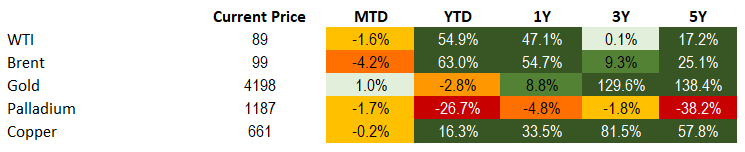
Source for data tables: Bloomberg, JPMorgan, Gramercy. EM Fixed Income is represented by the following JPMorgan Indicies: EMBI Global, GBI-EM Global Diversified, CEMBI Broad Diversified and CEMBI Broad High Yield. DM Fixed Income is represented by the JPMorgan JULI Total Return Index and Domestic High Yield Index. Fixed Income, Equity and Commodity data is as of October 2, 2026 (mid-day).
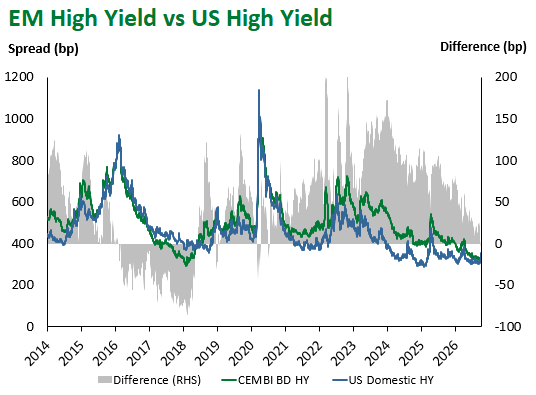
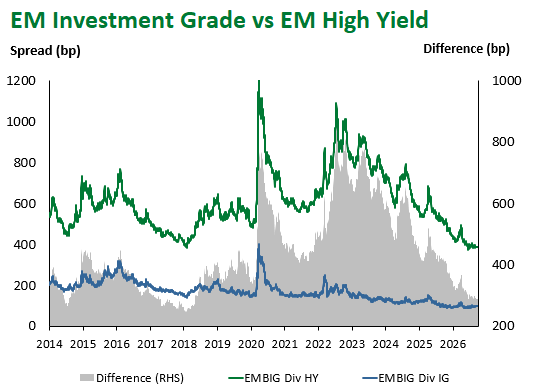
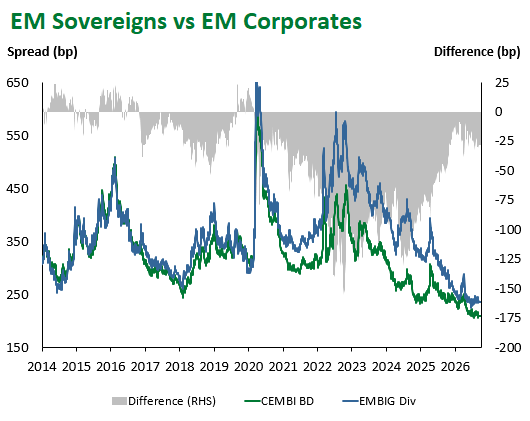
Emerging Markets Flows
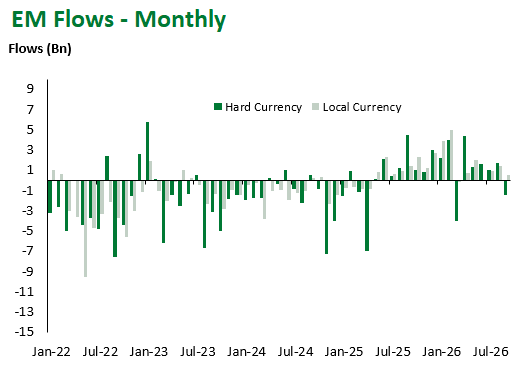
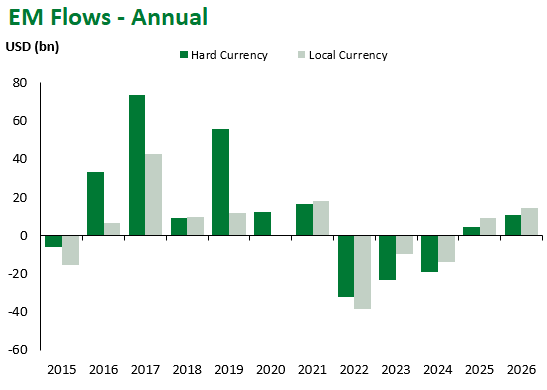
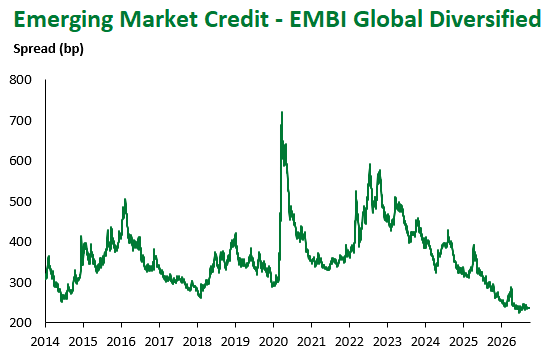
Source for graphs: Bloomberg, JPMorgan, Gramercy. As of October 2, 2026.
For questions, please contact:
Kathryn Exum, CFA ESG, Director, Co-Head of Sovereign Research, [email protected]
Petar Atanasov, Director, Co-Head of Sovereign Research, [email protected]
This document is for informational purposes only. The information presented is not intended to be relied upon as a forecast, research or investment advice, and is not a recommendation, offer or solicitation to buy or sell any securities or to adopt any investment strategy. Gramercy may have current investment positions in the securities or sovereigns mentioned above. The information and opinions contained in this paper are as of the date of initial publication, derived from proprietary and nonproprietary sources deemed by Gramercy to be reliable, are not necessarily all-inclusive and are not guaranteed as to accuracy. This paper may contain “forward-looking” information that is not purely historical in nature. Such information may include, among other things, projections and forecasts. There is no guarantee that any forecasts made will come to pass. Reliance upon information in this paper is at the sole discretion of the reader. You should not rely on this presentation as the basis upon which to make an investment decision. Investment involves risk. There can be no assurance that investment objectives will be achieved. Investors must be prepared to bear the risk of a total loss of their investment. These risks are often heightened for investments in emerging/developing markets or smaller capital markets. International investing involves risks, including risks related to foreign currency, limited liquidity, less government regulation, and the possibility of substantial volatility due to adverse political, economic or other developments. References to any indices are for informational and general comparative purposes only. The performance data of various indices mentioned in this update are updated and released on a periodic basis before finalization. The performance data of various indices presented herein was current as of the date of the presentation. Please refer to data returns of the separate indices if you desire additional or updated information. Indices are unmanaged, and their performance results do not reflect the impact of fees, expenses, or taxes that may be incurred through an investment with Gramercy. Returns for indices assume dividend reinvestment. An investment cannot be made directly in an index. Accordingly, comparing results shown to those of such indices may be of limited use. The information provided herein is neither tax nor legal advice. Investors should speak to their tax professional for specific information regarding their tax situation.