

Contents
Market Overview
Macro Update
The Middle East re-escalation that resurfaced late in the prior week hardened this week. The U.S. and Iran intensified their attacks beyond military targets as the U.S. naval blockade was reinstated and Tehran fired on U.S. bases in Kuwait, Jordan, Bahrain and Oman. The sanctions waiver on Iranian crude remained revoked and traffic through the strait stayed heavily curtailed. Yet, the channel to diplomacy seemed to remain open with both sides continuing to signal a preference for a negotiated outcome.
Despite the significant re-escalation, the market continued to price the episode as a contained, negotiable flare-up rather than a slide back to open war. However, renewed concerns about Hormuz traffic drove a rebuild of some geopolitical risk premium that had been priced out since June. Analysts cautioned that there was little evidence of any near-term improvement in vessel traffic through the strait, and that even a formal reopening would likely be partial given the infrastructure damage and the lingering security overhang.
Against this backdrop, Brent crude, the global benchmark, pushed to a one-month high, with the front contract trading in the mid-$80s intraday midweek—its firmest since mid-June and up roughly $10 on the week, leaving it close to 20% above its pre-war level. The revocation of the Iranian waiver and the renewed Hormuz supply risk layered onto the existing OPEC–IEA debate over a prospective 2H26 glut, while refined products, diesel in particular, stayed under acute pressure given the combination of lost Middle East refining capacity and the Ukraine drone-driven disruption to Russian output.
In the U.S., the week’s centerpiece was the June inflation data. Headline CPI fell 0.4% on the month—the largest monthly decline since April 2020—pulling the annual rate down to 3.5% from 4.2% in May, below the ~3.8% consensus and the first deceleration in four months. Core CPI was flat on the month, easing the annual rate to 2.6%, with shelter and core services notably softer. June PPI reinforced the picture, falling 0.3%. The relief traced overwhelmingly to the roughly 10% June drop in gasoline that the earlier ceasefire had allowed. Markets read the two cool prints as giving breathing room to the Fed, with Fed Fund Futures pricing just one instead of two rate hikes by year-end after this week’s CPI release, even as the renewed escalation and price of oil threaten to reverse the energy relief that produced the prints.
The data landed alongside Chair Kevin Warsh’s first semiannual monetary policy testimony, delivered to the House on Tuesday and the Senate on Wednesday. Warsh reaffirmed a resolute commitment to restoring price stability and “no tolerance for persistently elevated inflation,” pledging to consign five years of high inflation to the past, but, consistent with his aversion to forward guidance, offered little insight on the upcoming July 28–29 decision. Meanwhile, the 2Q earnings season opened on a strong note, with all five of the largest U.S. banks beating estimates—JPMorgan posting a record quarterly profit and Goldman Sachs its best quarter on record—helped by a trading and investment-banking surge that the outsized June SpaceX listing had amplified.
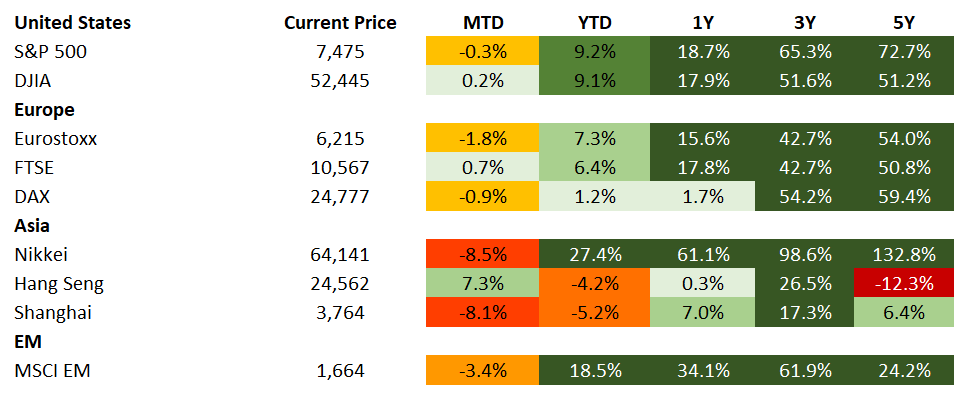
Across assets, a selloff in chipmaker stocks gathered pace as the week ended on renewed worries that the artificial intelligence spending spree is becoming harder to justify and a breakthrough from Chinese AI startup Moonshot. The slide rippled through global markets, spurring a rush for safety, with U.S. Treasuries rising and haven currencies including the Japanese Yen and Swiss Franc outperforming.
The 2Y Treasury yield eased 7bps to around 4.14% and the 10Y 3bps to around 4.53%; the DXY dollar index slipped below 101 but remains near its one-year high. Gold held broadly steady near $4,000 per ounce. USD/JPY closed around a 162 handle as a safe-haven bid from the geopolitical flare-up pulled against the terms-of-trade drag of costlier crude on an energy importer, while 10Y JGB yields sat near a three-decade high (~2.7%) as the oil shock, the Bank of Japan’s tightening bias, and the Takaichi government’s fiscal-expansion plans compounded.
In Asia, China’s 2Q GDP slowed to 4.3% year on year, below the ~4.5% consensus and down from 5.0% in 1Q—the weakest quarterly pace since late 2022, reviving the domestic stimulus debate. A deepening slide in fixed-asset investment (−5.7% year-to-date) offset firmer June activity, with retail sales (+1.0%) and industrial production (+5.3%) both beating expectations.
EM Credit Update
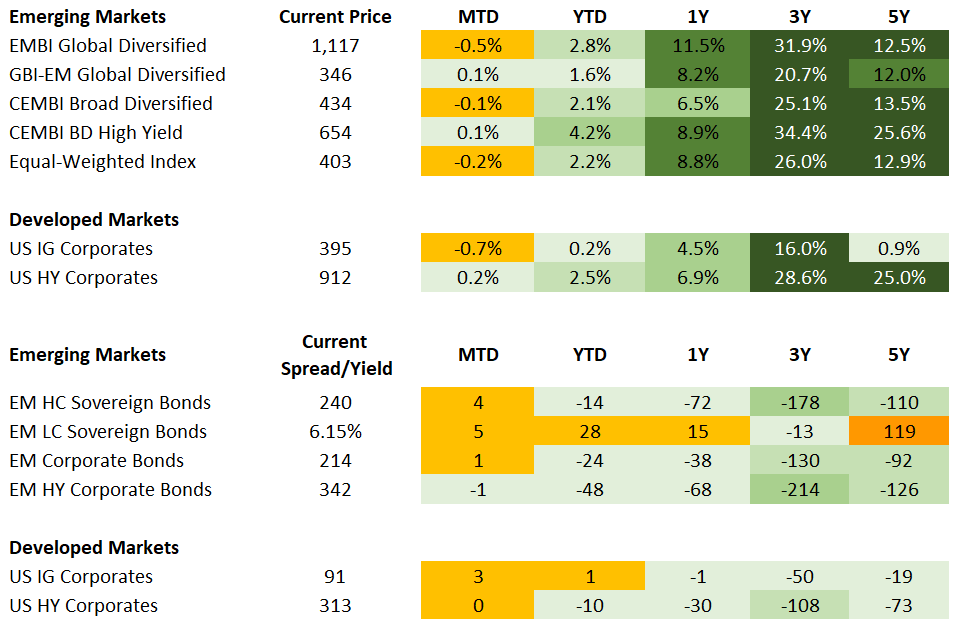
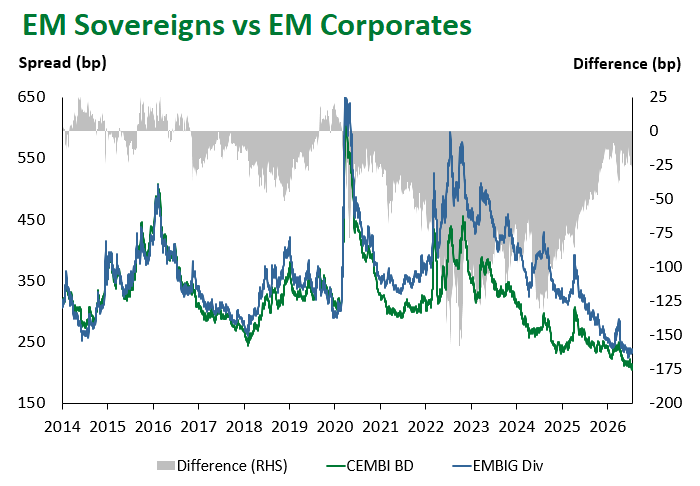
Emerging Markets (EM) fixed income was modestly lower and highly differentiated this week, caught between a flare-up in U.S.-Iran tensions that lifted oil and a softer-than-expected run of inflation data. U.S. rates were generally lower but the curve steepened, and that steepening was the dominant signal for credit: longer-dated paper lagged the front end across all three sub-asset classes. The dollar was volatile rather than directional, offering no clean tailwind. Hard currency corporates held up best, essentially flat at -0.03%, while hard currency sovereigns returned -0.22% and local currency sovereigns -0.27% at the index level.
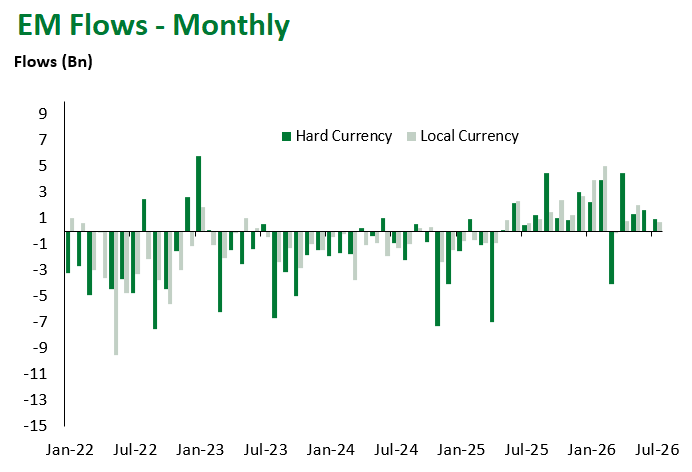
Local currency sovereigns returned -0.27% at the index level, with softness broad-based across the majority of markets and gains concentrated in a few Latam names. The weakness was led by energy importers Hungary (-2.41%), India (-0.9%), and South Africa (-0.9%). Against that, a firmer peso and constructive local dynamics drove a standout move in Colombia (+3.56%), with further gains in Mexico (+1.65%) and Peru (+1.64%).
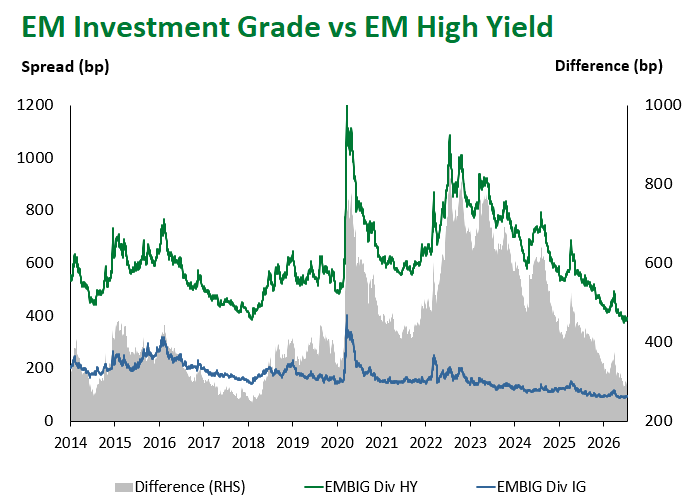
Hard currency sovereign bonds returned -0.22%, with high yield (-0.17%) outperforming investment grade (-0.27%). The Iran flare-up was clearest in the cross-section: oil-exporting credits led, with Venezuela (+1.94%), Gabon (+1.03%), Iraq (+0.58%), and Angola (+0.44%) at the top, while oil-importing frontier names lagged, including Kenya (-0.99%), Egypt (-0.79%), and Sri Lanka (-0.69%). Regionally, Latin America (-0.07%) outperformed and the Middle East (-0.45%) was weakest on proximity to the conflict, with Bahrain (-0.87%) the standout laggard. The steepening drove a clear duration split, the 1-3 year bucket returning +0.15% against -0.56% for 10+ year paper, and by rating the CCC segment (+0.29%) was the only cohort in positive territory.
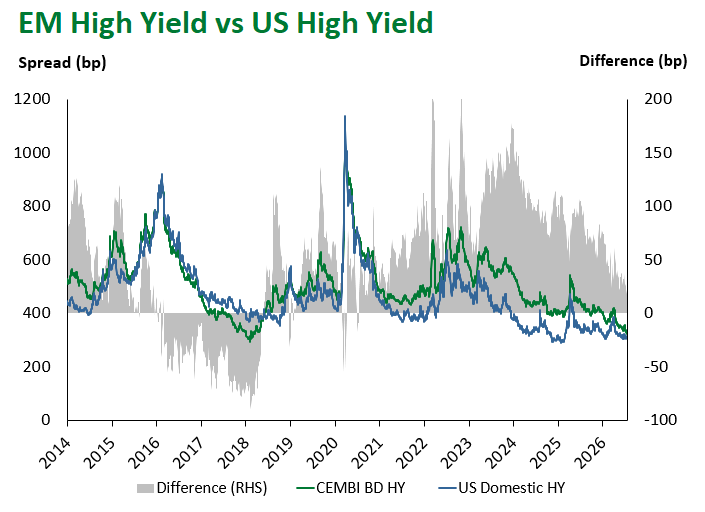
EM corporates (CEMBI BD) were essentially unchanged at -0.03%, with high yield (-0.00%) marginally ahead of investment grade (-0.06%). Asia (+0.04%) was the only region in positive territory, while the Middle East (-0.19%) and CEEMEA (-0.13%) lagged. In contrast to the sovereign pattern, the corporate rating stack favored the top of the credit spectrum, with AAA (+0.12%) leading and the CCC/C bucket (-0.31%) trailing, and longer-dated paper again underperformed (10+ year -0.23%). At the country level, Ghana (+1.02%) and Trinidad & Tobago (+0.50%) led, while Paraguay (-0.97%) and Bahrain (-0.83%) were the weakest.
Primary market activity in hard currency totaled approximately $8.9 billion across 15 tranches from 11 issuers, predominantly investment grade and heavily skewed to Asia, Korea in particular. Korea Export-Import Bank ($2.0 billion across two tranches) and the New Development Bank ($1.75 billion) anchored supply, alongside repeat issuance from KEPCO and Nonghyup. Outside the investment grade core, CITIC Bank priced a $400 million perpetual non-call 5 AT1 at 5.00%, Türkiye Is Bankasi issued a $500 million 12NC7 Tier 2 at 8.40%, the city of Barranquilla brought a $350 million crossover municipal deal at 7.35%, and African Export-Import Bank placed a $1.5 billion dual-tranche supranational.
The Week Ahead
The near-term focus shifts to positioning ahead of the July 28–29 FOMC, the Warsh Fed’s second meeting, with the market debating whether the June disinflation reprieve will survive the renewed energy shock. U.S. releases include the July flash S&P Global PMIs, alongside a broadening 2Q earnings season led by the mega-cap technology names. Central-bank decisions feature prominently, starting with the PBoC on Sunday, followed by Hungary, Nigeria, Indonesia, the ECB, Türkiye, South Africa, Kazakhstan, and Russia. Geopolitically, the overriding question remains whether the Middle East re-escalation is contained or hardens further, with Strait of Hormuz throughput, the status of the U.S.–Iran memorandum, and the crude and diesel complex the key barometers.
Fixed Income
Equities
Commodities

Source for data tables: Bloomberg, JPMorgan, Gramercy. EM Fixed Income is represented by the following JPMorgan Indicies: EMBI Global, GBI-EM Global Diversified, CEMBI Broad Diversified and CEMBI Broad High Yield. DM Fixed Income is represented by the JPMorgan JULI Total Return Index and Domestic High Yield Index. Fixed Income, Equity and Commodity data is as of July 17, 2026 (mid-day).
Highlights
Trump administration sets 25% tariff on Brazil with a broader exemption list
Event: The Trump administration will impose a 25% tariff on Brazilian exports to the U.S. effective July 22, but with a wider exception list. The updated exemption list includes more than 800 items, including oil, cattle, coffee, poultry, rare earths, and aircraft, versus roughly 700 exempted in the first round of additional tariffs introduced back in August 2025. The U.S. trade representative’s (USTR) office criticized Brazil’s lack of engagement, while the Lula administration framed the dispute as a matter of national sovereignty.
Gramercy Commentary: Given the broader exemption list and Brazil’s large and relatively closed (i.e., mostly domestically driven) economy, the macroeconomic impact of U.S. tariffs is likely to remain limited. However, a more significant market-relevant implication from this development could be impact on the highly consequential presidential elections in October. In the context of domestic political dynamics, the U.S. tariffs announcement could further boost Lula’s momentum in the polls, given his sovereignty stance and overall foreign policy positions that have been critical of the Trump administration. Lula’s main rival, Senator Flávio Bolsonaro, son of jailed right-wing former president Jair Bolsonaro, is in the opposite camp, having recently met and praised Trump. Lula’s team has aimed to capitalize on the association between the Bolsonaro family and U.S. tariff pressure, having coined a “TariFlávio” campaign slogan that is gaining popularity on social media locally. For Brazilian assets, we would treat the tariff headlines as largely priced-in, but would pay close attention to the potential domestic political spillover in coming weeks. The outcome of the presidential race in October carries material implications for markets, especially in terms of BRL and local rates dynamics, with the outlooks for fiscal and monetary policy being the key drivers.
Emerging Markets Technicals
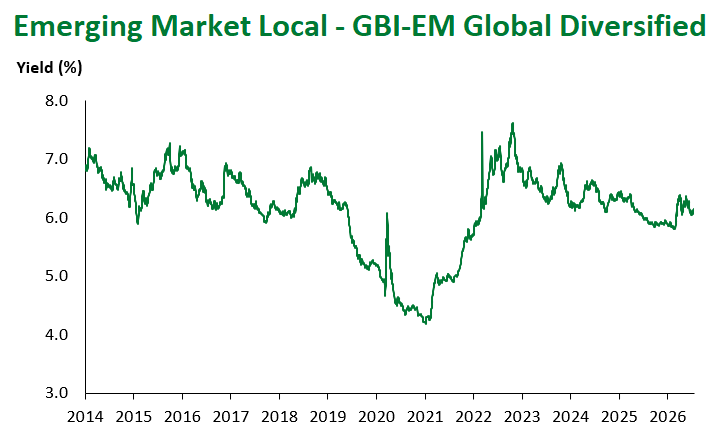
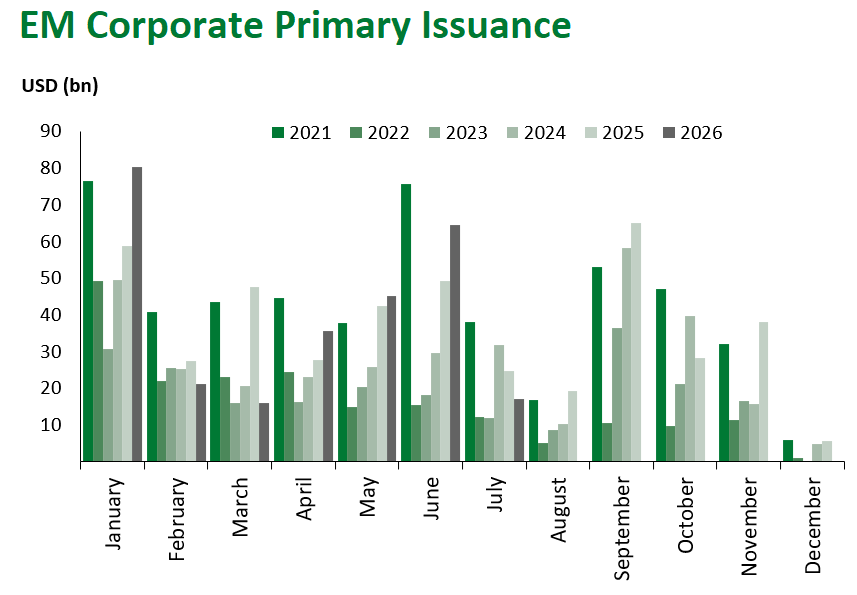
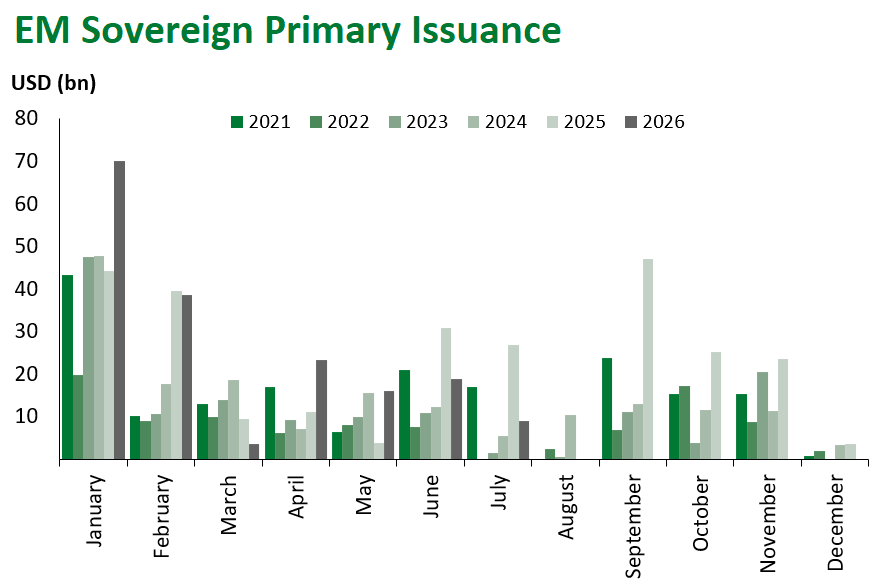
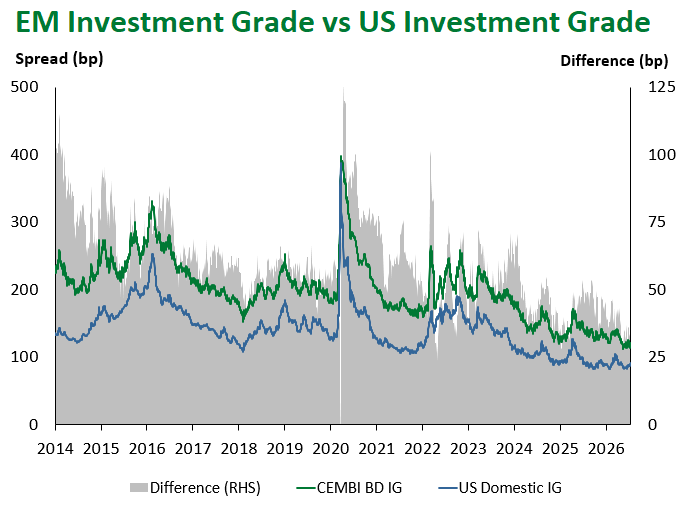
Emerging Markets Flows
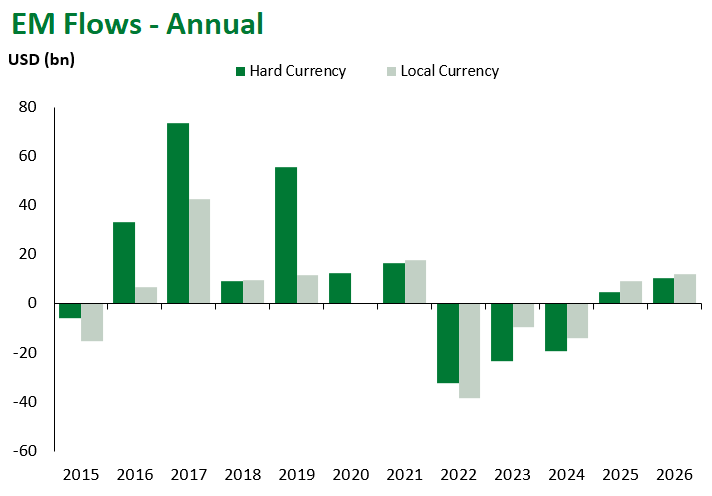
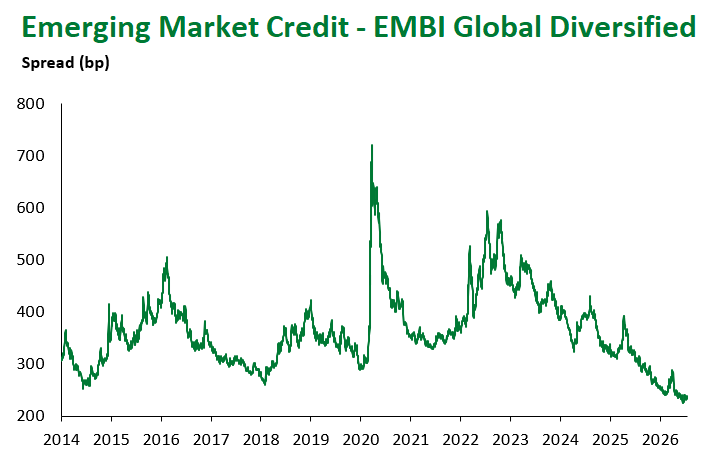
Source for graphs: Bloomberg, JPMorgan, Gramercy. As of July 17, 2026.
For questions, please contact:
Kathryn Exum, CFA ESG, Director, Co-Head of Sovereign Research, [email protected]
Petar Atanasov, Director, Co-Head of Sovereign Research, [email protected]
This document is for informational purposes only. The information presented is not intended to be relied upon as a forecast, research or investment advice, and is not a recommendation, offer or solicitation to buy or sell any securities or to adopt any investment strategy. Gramercy may have current investment positions in the securities or sovereigns mentioned above. The information and opinions contained in this paper are as of the date of initial publication, derived from proprietary and nonproprietary sources deemed by Gramercy to be reliable, are not necessarily all-inclusive and are not guaranteed as to accuracy. This paper may contain “forward-looking” information that is not purely historical in nature. Such information may include, among other things, projections and forecasts. There is no guarantee that any forecasts made will come to pass. Reliance upon information in this paper is at the sole discretion of the reader. You should not rely on this presentation as the basis upon which to make an investment decision. Investment involves risk. There can be no assurance that investment objectives will be achieved. Investors must be prepared to bear the risk of a total loss of their investment. These risks are often heightened for investments in emerging/developing markets or smaller capital markets. International investing involves risks, including risks related to foreign currency, limited liquidity, less government regulation, and the possibility of substantial volatility due to adverse political, economic or other developments. References to any indices are for informational and general comparative purposes only. The performance data of various indices mentioned in this update are updated and released on a periodic basis before finalization. The performance data of various indices presented herein was current as of the date of the presentation. Please refer to data returns of the separate indices if you desire additional or updated information. Indices are unmanaged, and their performance results do not reflect the impact of fees, expenses, or taxes that may be incurred through an investment with Gramercy. Returns for indices assume dividend reinvestment. An investment cannot be made directly in an index. Accordingly, comparing results shown to those of such indices may be of limited use. The information provided herein is neither tax nor legal advice. Investors should speak to their tax professional for specific information regarding their tax situation.