

Contents
Market Overview
Macro Update
The Middle East narrative that had anchored markets for the better part of a month was under pressure this week. A fresh cluster of Iranian Revolutionary Guard attacks on tankers in the Strait of Hormuz, including a projectile strike on a Qatari LNG carrier off Oman, drew retaliatory U.S. strikes, prompted Washington to revoke the sanctions waiver on Iranian crude, and led President Trump to declare at the NATO summit that the ceasefire was “over” and further negotiation a waste of time. Tehran, for its part, threatened a large-scale response and signaled strikes on U.S. bases in Bahrain and Kuwait.
Despite all of this, as technical talks between the two sides appeared to continue and U.S. officials reiterated a commitment to a negotiated solution, the market stopped well short of pricing a return to open war. The prevailing read was to take the administration’s rhetoric seriously but not literally: the base case among investors remained that a deal ultimately holds, even as the episode restored some geopolitical risk premium that had all but drained out of prices over the prior three weeks.
Against this backdrop, Brent crude, the global benchmark, spiked toward $80 per barrel midweek before settling near $76 into Friday, up more than $4 on the week, though still close to its pre-war level of ~$70. The revocation of the Iranian oil waiver and the renewed choking of Hormuz throughput layered fresh supply risk onto the existing OPEC–IEA debate over a prospective 2H26 glut, while refined products, diesel in particular, faced acute pressure given the combination of lost Middle East refining capacity and the Ukraine drone attacks-driven disruption to Russian output.
On trade, the post-review USMCA backdrop stayed in frame. With Washington having declined to renew the pact in its current form at the July 1 deadline, shifting it onto a schedule of annual reviews through the 2036 expiry, the focus remained on the responses from Ottawa and Mexico City, though the issue was largely overshadowed this week by the return of Middle East risk.
In the U.S., the week’s centerpiece was Wednesday’s release of the minutes from Chair Kevin Warsh’s first FOMC meeting. They revealed a committee split almost evenly, nine of the eighteen participants submitting projections favored at least one rate hike this year, eight saw no change, and one a cut, in what Warsh characterized as a “family fight,” with the Chair himself declining to submit a dot. The FOMC held the funds rate at 3.50–3.75% at the June meeting and saw the risks to inflation still tilted to the upside, citing the lingering effects of tariffs and the supply disruption from the Hormuz closure. Consistent with Warsh’s aversion to forward guidance, the minutes offered little insight on the July 28–29 decision and the market reaction was muted.
Rates and the dollar moved with the oil tape. The 10Y Treasury yield backed up toward 4.55% (~7bps higher vs last week) as higher crude lifted break-evens and the minutes underscored the upside inflation risk, while the dollar held firm near its one-year high on the DXY (~101). Gold, which had firmed ahead of the minutes, gave back some ground, but finished broadly unchanged this week at around $4,100 per ounce. The yen was the sharpest crosscurrent: a safe-haven bid from the geopolitical flare-up pulled against the terms-of-trade drag of costlier crude on an energy-importing economy, leaving USD/JPY with a 161 handle and keeping Tokyo’s intervention calculus and the Bank of Japan’s lagging stance in focus.
In the emerging-market policy sphere, the week’s rate decisions skewed cautious. The National Bank of Poland held at 3.75% for a fourth straight meeting, with June headline inflation easing to 2.5%, back to its target midpoint, even as it nudged its inflation projections higher on the energy backdrop; Bank Negara Malaysia likewise held at 2.75%, explicitly flagging the Middle East conflict as the principal risk to commodity prices and financial conditions. Peru’s BCRP also kept the policy rate unchanged at 4.25%. Across the complex, June inflation prints were mixed, with the renewed rise in energy risks reintroducing an upside tail to headline readings just as several economies had begun to see disinflation take hold.
EM Credit Update
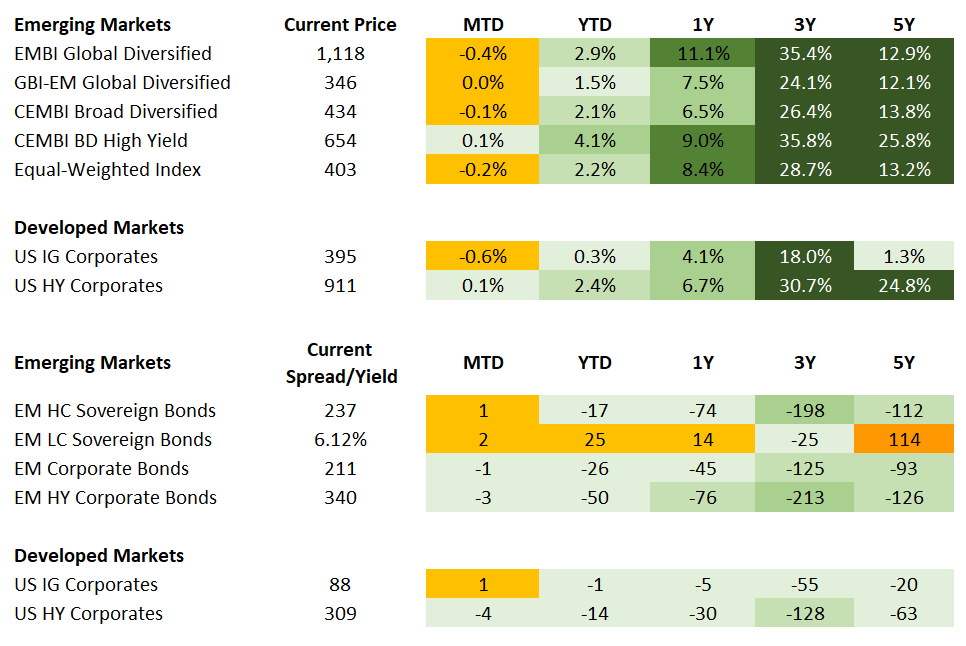
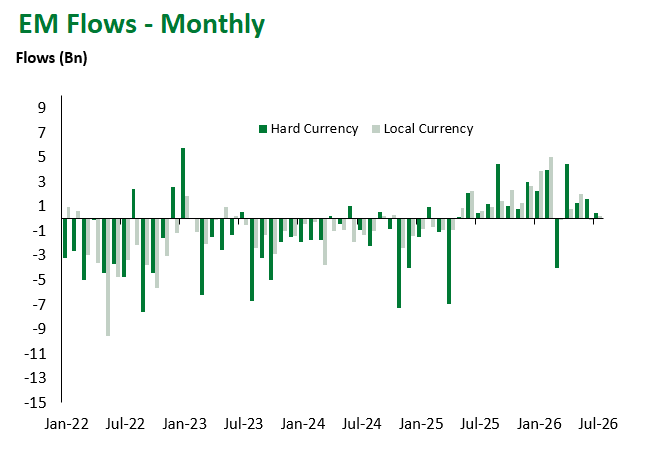
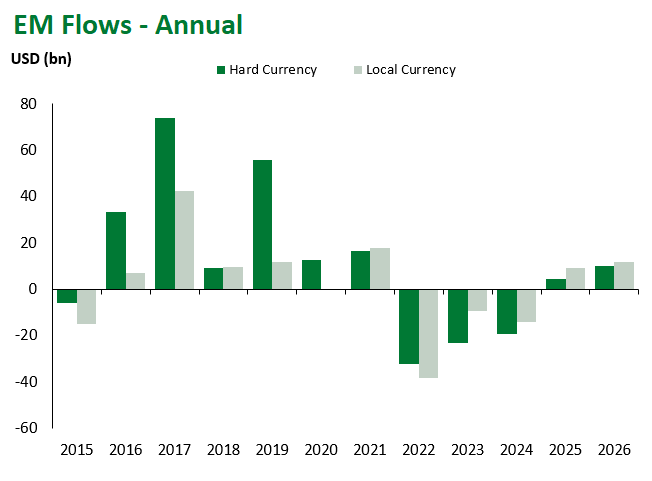
Emerging Markets (EM) fixed income was modestly lower across all three sub-asset classes this week, pressured by a back-up in core rates rather than a broad risk repricing. The rates move traced to a flare-up in the Iran-U.S. conflict that pushed oil prices higher and revived inflation concerns. Local currency sovereigns lagged (-0.44%), followed by hard currency sovereigns (-0.22%), while hard currency corporates were the most resilient (-0.06%). Across the hard currency complex, investment grade underperformed high yield, longer-duration bonds bore the brunt, and lower-rated, higher-carry paper held up best, consistent with the pressure coming from rates rather than spreads.
Hard currency sovereign bonds returned -0.22% at the index level, with investment grade (-0.36%) underperforming high yield (-0.10%). The move was concentrated at the long end, where 10+ year bonds fell -0.56% against a roughly flat 1-3 year segment, and the higher-rated buckets (A -0.39%, BBB -0.34%) lagged B (+0.05%) and CCC (+0.06%). Regionally, Africa (+0.21%) was the only area in positive territory, while the Middle East (-0.42%) and Latin America (-0.38%) were the weakest. At the country level, frontier and high-beta African credits led, including Mozambique (+1.20%), Senegal (+1.01%), Ghana (+0.94%), Angola (+0.78%), and Ukraine (+0.70%), with oil exporters Angola and Nigeria (+0.44%) supported by firmer crude. Lebanon (-1.01%) was the weakest performer, followed by Paraguay (-0.80%) and Bahrain (-0.65%).
EM corporates were the most resilient, down just -0.06%, with high yield (+0.03%) edging out investment grade (-0.12%). By rating, B-rated credits led (+0.14%) while CCC lagged (-0.30%), a different internal picture from sovereigns, where the lowest-rated buckets held up. Regionally, Latin America (-0.02%) and Europe (-0.03%) were most resilient and the Middle East (-0.14%) lagged. Ghana was again the standout at the country level (+1.87%).
Local currency sovereigns were the weakest sub-asset class at -0.44%, with highly dispersed performance split between FX and price effects. The Dominican Republic (+2.13%) led, its gain divided between currency (+1.16%) and price (+0.80%), and Brazil (+1.71%) followed on a largely FX-driven move (+1.42%). Colombia (+0.51%) and Peru (+0.23%) also posted gains. At the other end, Türkiye (-1.80%) was the worst, driven almost entirely by a price decline (-2.10%) that carry only partly offset, while Hungary (-1.54%) and Poland (-1.23%) saw losses led by currency depreciation (FX -0.99% and -1.08%, respectively). South Africa (-1.03%) and Chile (-1.05%) rounded out the laggards. The headline figure reconciles with the constituent table this week, with the larger index weights (Poland, Hungary, South Africa, Türkiye, Mexico, Indonesia) mostly lower.
Primary market activity was solid, with 11 issuers pricing roughly $13.9 billion equivalent across 16 tranches of hard currency supply, predominantly investment grade and heavily skewed toward euro-denominated paper (nearly two-thirds of volume). Sovereign supply featured prominently: Hungary priced a EUR3 billion dual-tranche (2032 and 2037), Bulgaria a EUR2.5 billion triple-tranche (2032, 2038, 2045), Korea a EUR1.7 billion dual-tranche, and Trinidad & Tobago $800 million 2038 bond. Gulf issuers brought sukuk, including Saudi Real Estate Refinance Company’s $2.75 billion dual-tranche and a $300 million AT1 perpetual sukuk from Ajman Bank. Bank capital was also in focus, with Tier 2 deals from Bank Pekao (Poland) and Fubon Bank (Hong Kong). The two high yield prints were Philippine Airlines ($300 million) and MBH Bank of Hungary (EUR500 million).
The Week Ahead
The calendar centers on U.S. June CPI, the first inflation read since the payrolls miss and the most consequential data point for the Warsh Fed’s July deliberations, with Chair Warsh due to testify before Congress soon after the release. June PPI and retail sales follow, alongside the opening of the 2Q U.S. earnings season led by the large banks. Internationally, China releases 2Q GDP and June activity data, and the PBOC decision on 1- and 5-year loan prime rates is due. Geopolitically, the overriding question is whether this week’s Middle East re-escalation is contained or hardens into a more meaningful breakdown of the truce, with Strait of Hormuz throughput, the status of U.S.–Iran talks, and the crude and diesel complex the key barometers. The post-USMCA-review trade backdrop and the Bank of Japan’s response to yen volatility remain secondary watch-items.
Fixed Income
Equities
Commodities
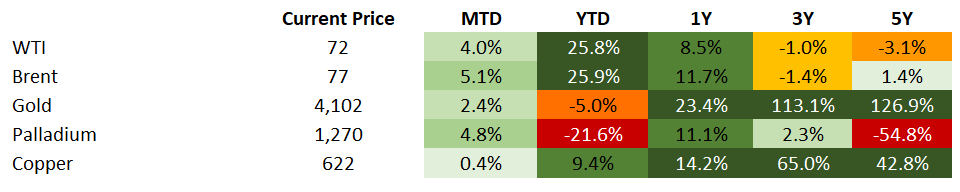
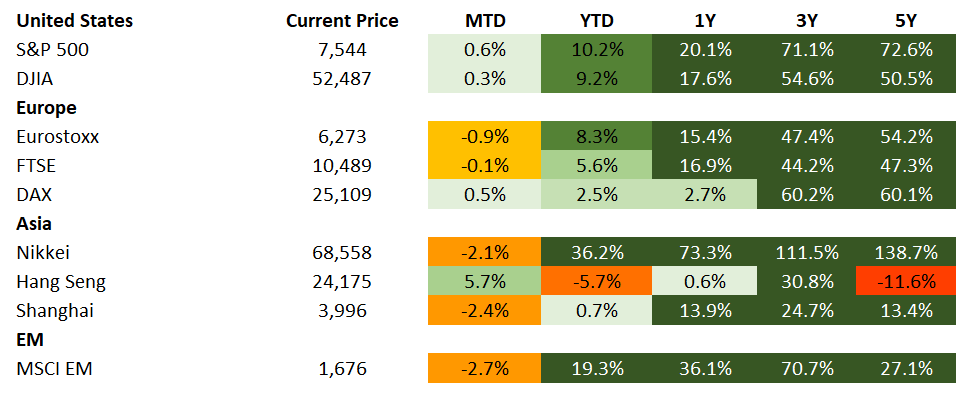
Source for data tables: Bloomberg, JPMorgan, Gramercy. EM Fixed Income is represented by the following JPMorgan Indicies: EMBI Global, GBI-EM Global Diversified, CEMBI Broad Diversified and CEMBI Broad High Yield. DM Fixed Income is represented by the JPMorgan JULI Total Return Index and Domestic High Yield Index. Fixed Income, Equity and Commodity data is as of July 10, 2026 (mid-day).
Highlights
Türkiye and Ukraine emerge as geopolitical winners from Ankara NATO summit
Event: During this week’s two-day NATO summit in Ankara, U.S. President Donald Trump signaled unequivocally his support for his Turkish counterpart Erdogan, suggesting he would move ahead with the sale of F-35 fighter jets to Türkiye blocked by Washington in 2020 after Ankara purchased Russia’s S-400 air-defense system. Trump also pledged to roll back the CAATSA sanctions imposed the same year on Türkiye’s defense procurement agency. On Ukraine, the U.S. president said his administration would grant the right to manufacture Patriot missile interceptors, a notable turnaround in Trump’s posture toward President Zelensky and a broader signal on his shifting approach toward the Ukraine-Russia war.
Gramercy Commentary: Türkiye and Ukraine are the two countries that emerged as winners from the Ankara summit, in our view. For Türkiye, President Erdogan secured an outcome that highlights yet again Ankara’s heavyweight NATO and regional status while also cementing Erdogan’s domestic image as skillful diplomat capable of defending Türkiye’s interest on the global stage; in that context, the global leaders’ focus while in Ankara remained firmly away from arguably eroding democratic norms in the country. This week’s signals on both the long-blocked F-35 sale and a CAATSA rollback formalize a meaningful normalization of the U.S.-Türkiye defense relationship that has weighed on sentiment since 2020 and should be constructive for Turkish assets at the margin. For Ukraine, President Zelensky walked away with a potential opportunity to manufacture Patriot interceptors, the only weapon systems capable of countering Russian ballistic and hypersonic missiles, and, as such, desperately needed for Ukraine’s air defense capabilities. More importantly, Zelensky appeared to have successfully repaired his relationship with President Trump, who had previously told him he held “no cards” in the conflict with Russia. We would caution, however, that for now Trump’s promises made in Ankara this week remain verbal statements rather than iron-clad policy commitments. Nevertheless, the signaling is important and will likely inform how markets perceive Türkiye and Ukraine’s medium-term geopolitical outlooks.
Argentina Financing Strategy Ends 2026 with Modest Buffer
Event: The government released its 2026–27 financing strategy, reiterating its objective of refinancing principal maturities at the lowest possible cost while funding interest payments through the primary fiscal surplus. The strategy projects $3.7 billion of excess financing in 2026, providing an initial buffer against approximately $25 billion of financing needs in 2027. With access to lower-cost funding backed by partial multilateral guarantees, a return to international capital markets remains opportunistic rather than a financing necessity.
Gramercy Commentary: The presentation of the financing strategy reinforces confidence in the authorities’ financing framework and reduces uncertainty around near-term funding needs, although the strategy offers limited new information. The combination of continued primary fiscal surpluses, gradually improving FX reserve dynamics, and anchored inflation expectations supports the sovereign’s improving credit profile. That said, financing conditions remain subject to election-year uncertainty posing non-linear risks that should continue to support a risk premium in Argentine sovereign bonds absent an acceleration in buffer accumulation.
USMCA Shifts to Annual Reviews While Bilateral Negotiations Continue
Event: The U.S. declined to renew the USMCA at the July 1 joint review, with Greer saying it “did not agree to renew the USMCA in its current form,” while Mexico and Canada both backed a 16-year extension. The pact stays fully in force through 2036 but now shifts to annual reviews until the parties either agree to extend or it expires. The U.S. next meets Mexico bilaterally the week of July 20, focused on tighter auto rules of origin alongside steel and aluminum, agriculture, energy, labor enforcement, and China-content disciplines.
Gramercy Commentary: The shift to annual reviews is largely consistent with market expectations, as the likelihood of this outcome has increased steadily over the past year. The muted market response reflects both the anticipated nature of the decision and the view that Mexico is likely to preserve a relatively favorable effective tariff position throughout the review process. While the annual review mechanism introduces additional policy uncertainty, it does not alter the agreement’s legal force or materially change near-term trade conditions. More broadly, Mexico’s structural competitiveness remains intact, with exports to the U.S. continuing to outpace both China and Canada, supported by robust technology-related shipments that have more than offset recent softness in automotive exports. Importantly, the annual review process should be viewed as a negotiating framework rather than a countdown to termination, as the parties retain the ability to extend the agreement at any point before its 2036 expiration.
Emerging Markets Technicals
Emerging Markets Flows
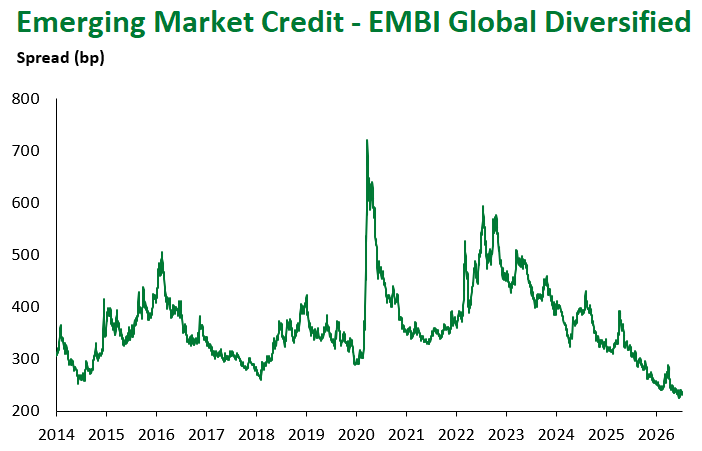
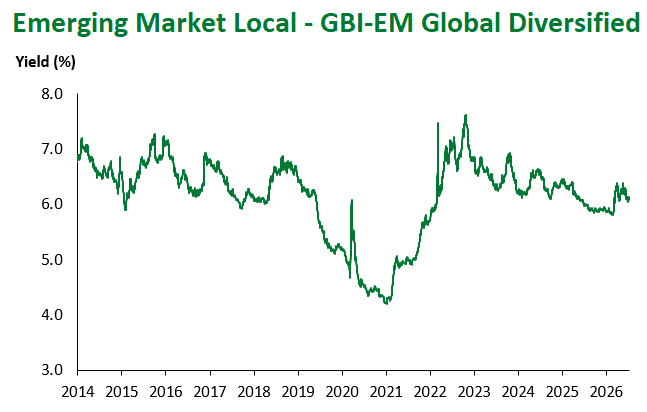
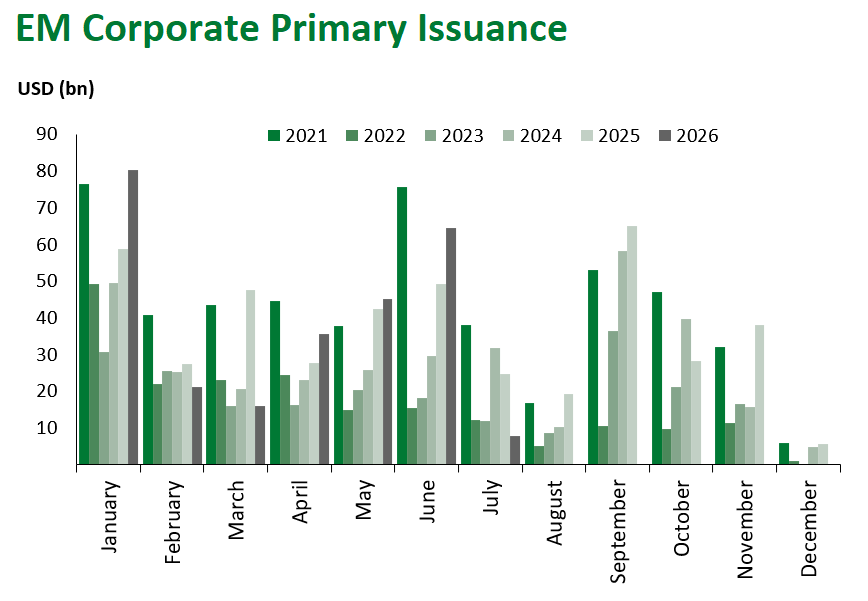
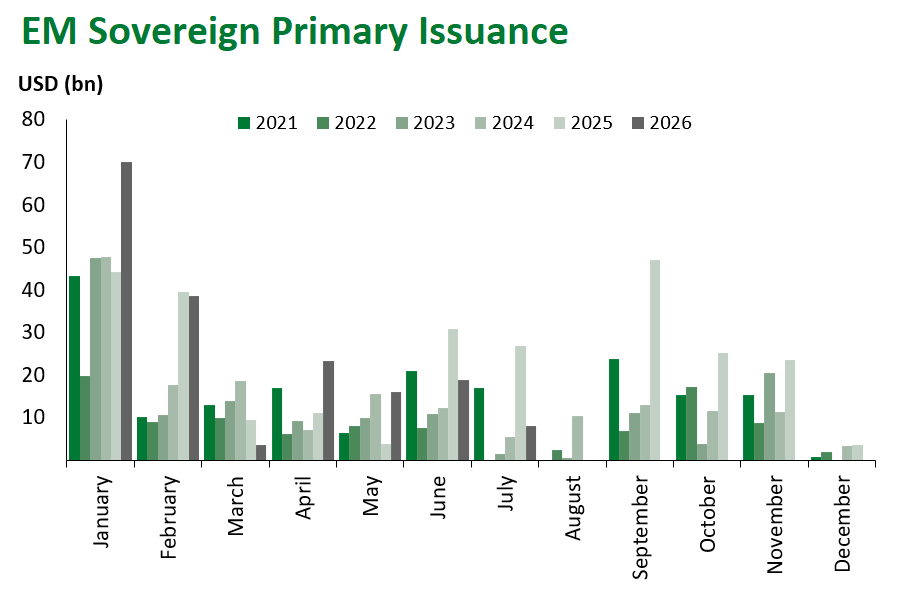
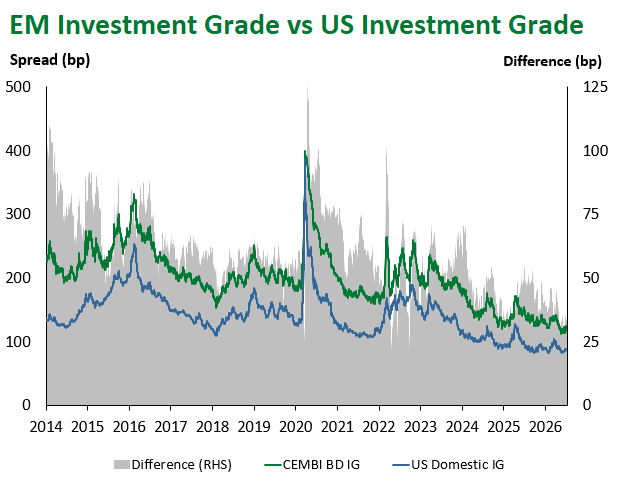
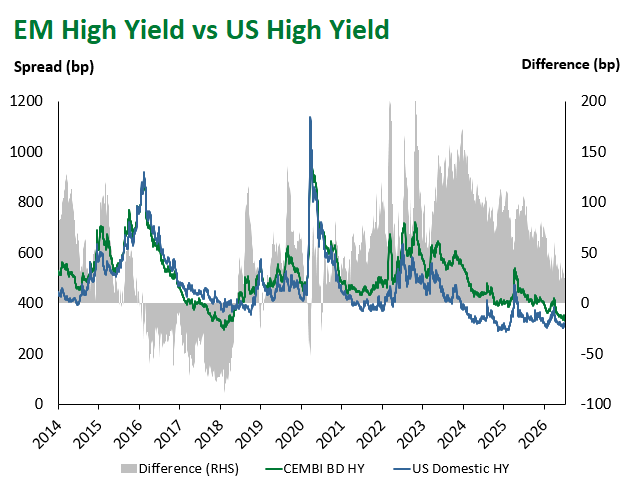
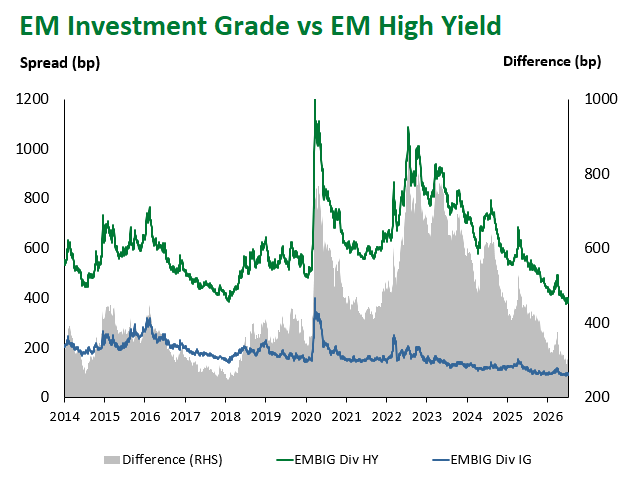
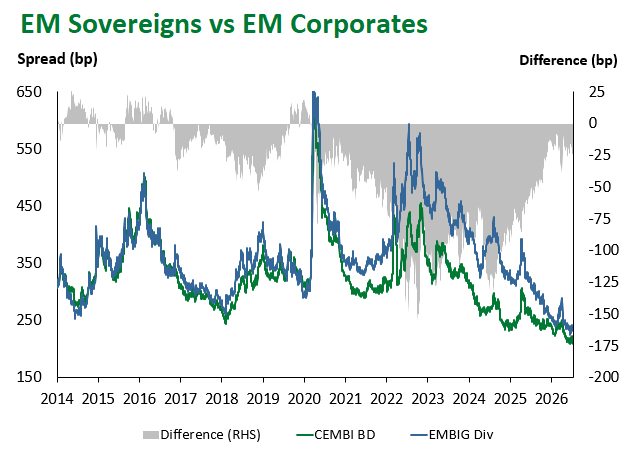
Source for graphs: Bloomberg, JPMorgan, Gramercy. As of July 10, 2026.
For questions, please contact:
Kathryn Exum, CFA ESG, Director, Co-Head of Sovereign Research, [email protected]
Petar Atanasov, Director, Co-Head of Sovereign Research, [email protected]
This document is for informational purposes only. The information presented is not intended to be relied upon as a forecast, research or investment advice, and is not a recommendation, offer or solicitation to buy or sell any securities or to adopt any investment strategy. Gramercy may have current investment positions in the securities or sovereigns mentioned above. The information and opinions contained in this paper are as of the date of initial publication, derived from proprietary and nonproprietary sources deemed by Gramercy to be reliable, are not necessarily all-inclusive and are not guaranteed as to accuracy. This paper may contain “forward-looking” information that is not purely historical in nature. Such information may include, among other things, projections and forecasts. There is no guarantee that any forecasts made will come to pass. Reliance upon information in this paper is at the sole discretion of the reader. You should not rely on this presentation as the basis upon which to make an investment decision. Investment involves risk. There can be no assurance that investment objectives will be achieved. Investors must be prepared to bear the risk of a total loss of their investment. These risks are often heightened for investments in emerging/developing markets or smaller capital markets. International investing involves risks, including risks related to foreign currency, limited liquidity, less government regulation, and the possibility of substantial volatility due to adverse political, economic or other developments. References to any indices are for informational and general comparative purposes only. The performance data of various indices mentioned in this update are updated and released on a periodic basis before finalization. The performance data of various indices presented herein was current as of the date of the presentation. Please refer to data returns of the separate indices if you desire additional or updated information. Indices are unmanaged, and their performance results do not reflect the impact of fees, expenses, or taxes that may be incurred through an investment with Gramercy. Returns for indices assume dividend reinvestment. An investment cannot be made directly in an index. Accordingly, comparing results shown to those of such indices may be of limited use. The information provided herein is neither tax nor legal advice. Investors should speak to their tax professional for specific information regarding their tax situation.