

Contents
Market Overview
Macro Update
The practical dividend of de-escalation in the Middle East kept accruing this week: Gulf tanker traffic normalized further and mine-clearing operations off the Iranian coast progressed, though officials on all sides reiterated that a full restoration of pre-war maritime flows would be measured in months rather than weeks. It was the durability of the arrangement, rather than its existence, that remained the market’s central preoccupation as the 60-day negotiating window runs down.
Frictions beneath the headlines persisted. The dispute over transit fees through the Strait of Hormuz continued, with Oman and the U.S. continuing to press for a toll-free Strait while Tehran preserved the option to levy charges once the window expires; the Iran-Oman joint navigation mechanism advanced in parallel. The Israel-Hezbollah track remained the most combustible element of the regional picture, a standing reminder that tail risks to the détente have not been resolved.
With the supply shock now firmly behind it, crude drifted toward pre-war levels. Brent, the global benchmark, traded in the low-$70s per barrel, its lowest since before the conflict, as markets priced a best-case reopening. The OPEC-IEA divide over a prospective 2H26 supply glut continued to frame the debate over where prices will ultimately settle once Hormuz throughput is close to being fully restored, with WTI tracking the move lower.
On trade, the July 1 USMCA review reached its deadline. As telegraphed by the Trump administration, the U.S. declined to renew the agreement with Canada and Mexico in its current form, effectively shifting the process to a schedule of annual reviews until the deal expires in 2036, unless one of the parties decides to withdraw.
The week’s marquee data event was the U.S. June employment report, brought forward to Thursday, July 2 ahead of the Independence Day market closure. Nonfarm payrolls rose by just 57k versus consensus expectation of 113k and the prior two months were revised downward, with the unemployment rate falling to 4.2% as labor force participation plunged.
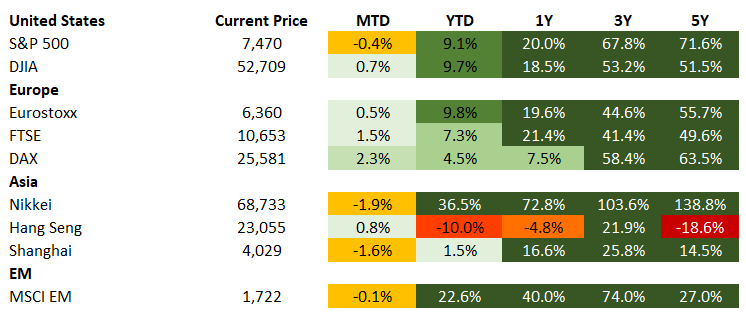
The slower-than-anticipated increase in U.S. jobs drove stocks higher, while short-dated U.S. treasury yields fell on bets that the Federal Reserve will not be forced to raise interest rates any time soon, prompting a repricing of market assigned Fed rate hike probabilities lower. The U.S. dollar held near its one-year high on the DXY (~100) and the Treasury curve was broadly stable, with the 10Y benchmark around 4.48%. Gold re-gained some ground against the backdrop of a stable dollar. The Japanese yen started the week on the back foot but strengthened sharply mid-week from record-low levels against the USD amid rising speculation that authorities in Tokyo may intervene to prop up the currency.
Globally, the policy set-piece was the ECB’s annual Forum on Central Banking in Sintra, Portugal, where policymakers struck a broadly cautious tone, emphasizing that a disinflation last mile complicated by the recent energy price shock argues for patience before any easing. In the Eurozone, German and French flash June CPI prints had a disinflation tone, coming in below expectations. China’s manufacturing PMIs held above the 50 expansion line, while the final 1Q UK GDP estimate was revised down to 0.9% YoY, from 1.1% originally estimated.
For emerging markets, the familiar crosscurrents endured. Cheaper energy and the clearing of Colombia’s electoral risk, where president-elect de la Espriella’s transition proceeded with early cabinet and policy signaling following rival Cepeda’s concession, remain supportive at the margin, but a dollar near cycle highs and a developed-market policy backdrop still tilted toward tightening, keeping external financial conditions on the restrictive side.
EM Credit Update
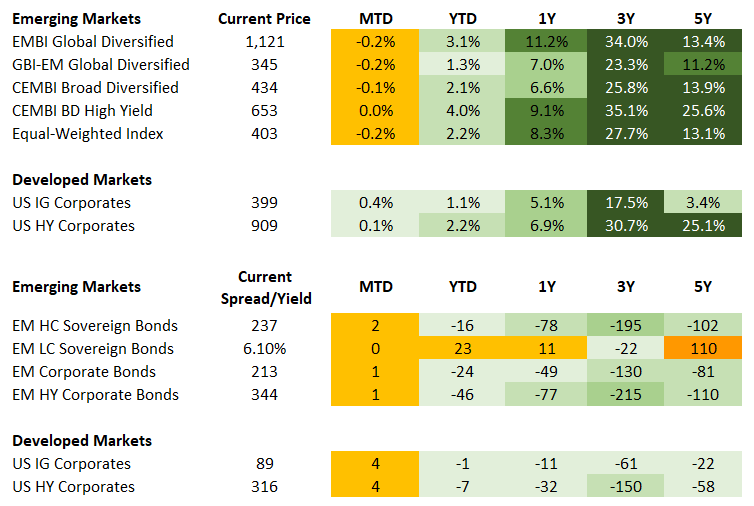
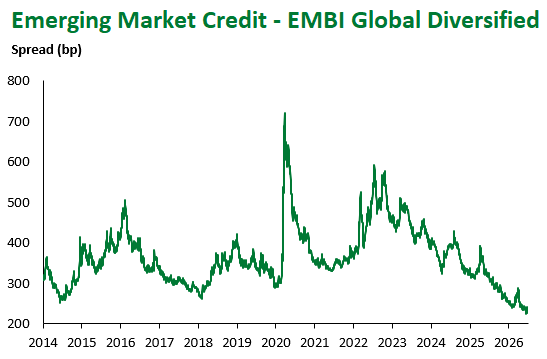
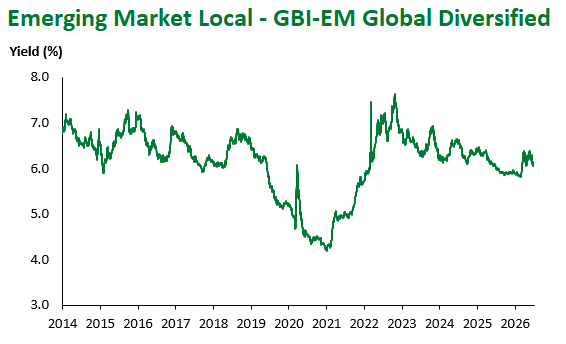
Hard currency emerging markets fixed income was marginally lower this holiday-shortened week, with returns clustered close to flat (data measured through July 2 morning, ahead of the July 3 U.S. market closure), while local currency sovereign debt outperformed, boosted by USD softening post the weaker-than-expected U.S. jobs report on Thursday. Beneath the muted index-level moves, dispersion stayed wide, with distressed and frontier credits continuing to outperform while higher-quality, rate-sensitive segments lagged.
Local currency sovereign debt returned 0.68% at the index level through Thursday, July 2; Colombia led the positive returns (+1.87%), boosted by the post-election rally, followed by South Africa (+1.72%), Hungary (+1.46%), Egypt (+1.38%), and Malaysia (+1.29%). Colombia’s gain was almost entirely price-driven, while South Africa, Hungary, Egypt, and Malaysia were carried primarily by currency appreciation. The Dominican Republic (-1.81%) and Chile (-0.40%) were the notable laggards, both weighed down by local currency depreciation.
Hard currency sovereign bonds slipped marginally -0.12% at the index level, with high yield (+0.14%) again outperforming investment grade (-0.40%) as duration and rate sensitivity pressured higher-quality paper. By rating, the distressed and CCC segments led (+1.97% and +0.96%, respectively), while BBB and AAA lagged (-0.40% and -0.43%). Regionally, Africa (+0.07%) was the only region in positive territory, while the Middle East (-0.24%), Europe (-0.21%), and Asia (-0.20%) trailed. At the country level, the distressed complex drove returns: Ethiopia (+3.08%), Venezuela (+3.02%), and Ukraine (+1.79%) led, while Senegal (-1.73%) and Romania (-0.94%) were the weakest performers.
EM corporates were down -0.10% at the index level, with high yield (-0.04%) modestly outperforming investment grade (-0.14%). Regionally, the Middle East (-0.02%) was most resilient, while Europe (-0.40%) lagged. By rating, BB-rated credits were essentially flat (+0.05%) and outperformed, while the B (-0.26%) and AA (-0.20%) segments lagged. At the country level, Ukraine (+0.49%) led, while Paraguay (-1.24%) and Trinidad & Tobago (-0.66%) were the weakest.
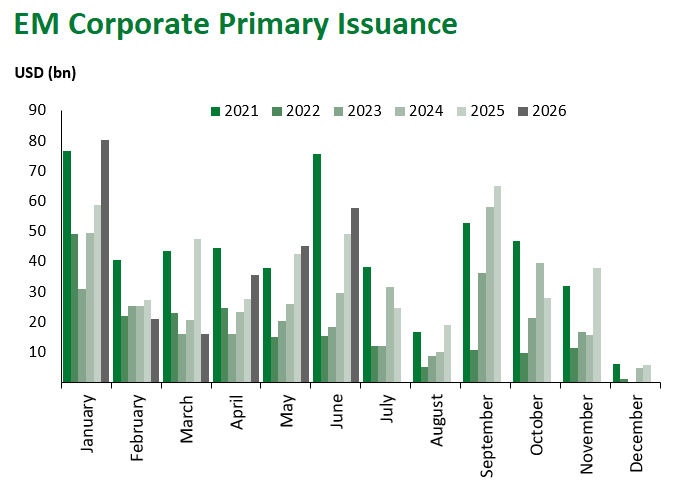
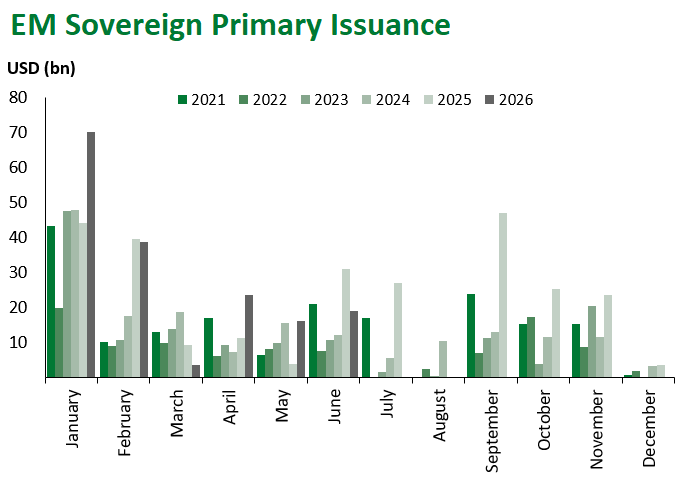
Primary market activity was moderate given the shortened week, with 13 issuers pricing approximately $7.7 billion in hard currency supply, skewed toward CEEMEA and financials. Notable transactions included a $2 billion dual-tranche deal from the State Oil Company of Azerbaijan (SOCAR), a $750 million print from Dangote Refinery in Nigeria at 7.50%, Türkiye Sınai Kalkınma Bankası ($300 million at 7.25%), and a $500 million AT1 perpetual from Mashreqbank of the UAE. China Development Bank tapped both the GBP and EUR markets.
The Week Ahead
Attention turns to the July FOMC meeting minutes and the ISM services index. Globally, June CPI/PPI prints across many emerging economies are due. On the monetary policy front, central bank rate decisions are scheduled in Poland, Malaysia and Peru. The U.S.-Iran 60-day negotiating window continues, with the durability of the Hormuz reopening and the unresolved transit-fee question in focus, while the post-USMCA review trade backdrop is monitored for follow-through.
Fixed Income
Equities
Commodities
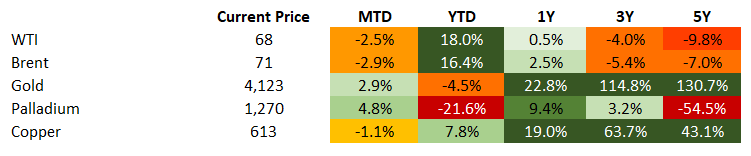
Source for data tables: Bloomberg, JPMorgan, Gramercy. EM Fixed Income is represented by the following JPMorgan Indicies: EMBI Global, GBI-EM Global Diversified, CEMBI Broad Diversified and CEMBI Broad High Yield. DM Fixed Income is represented by the JPMorgan JULI Total Return Index and Domestic High Yield Index. Fixed Income, Equity and Commodity data is as of July 2, 2026 (mid-day).
Highlights
Colombia’s central bank resumes tightening with hawkish 75bps move, president-elect De la Espriella nominates a market-friendly finance minister
Event: BanRep, Colombia’s central bank, delivered a 75bps policy rate hike, surprising market consensus (+50bps) to the upside. Meanwhile, president-elect Abelardo de la Espriella (ADE) nominated Miguel Gomez, former conservative congressman, head of Colombia’s exporters association, and ambassador to France, as finance minister.
Gramercy Commentary: BanRep’s hawkish move reflects sticky above target inflation, but also fading political pressure for lower interest rates following the outcome of recent presidential election in which outgoing President Petro’s candidate Ivan Cepeda was defeated by ADE who is set to take over as Colombia’s next president on August 7. This is a credit-positive development from an institutional independence perspective and likely to support the improvement of investor sentiment vis-a-vis Colombian assets. The appointment as finance minister of a credible figure from a well-known conservative political family is also a step in that direction. However, the fiscal adjustment facing the new administration is significant and will require strong political will and ability to implement socially challenging adjustment measures. ADE’s governability in the early days of his new administration will likely depend on his ability to build alliances with the relevant established patronage-dependent parties in Congress: Liberals, Conservatives, and U. In addition, potential negative economic implications due to a “super El Nino” event in the second half of the year could complicate the task of the incoming economic team further. Despite the significant challenges on the horizon, our expectation is that markets will be willing to give the benefit of the doubt to the new right-wing Colombian government, which is also likely to receive vocal support by the Trump administration as well as by like-minded regional leaders such as Presidents Noboa of Ecuador and Milei of Argentina, among others.
Emerging Markets Technicals
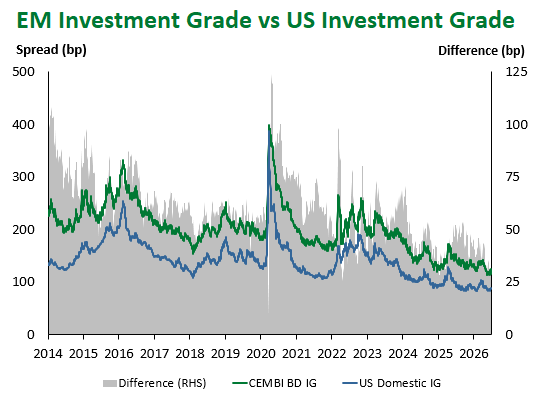
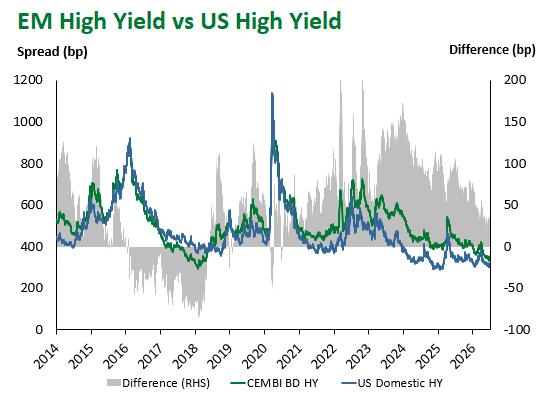
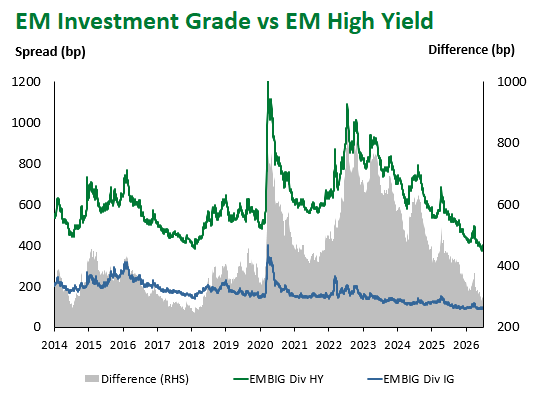
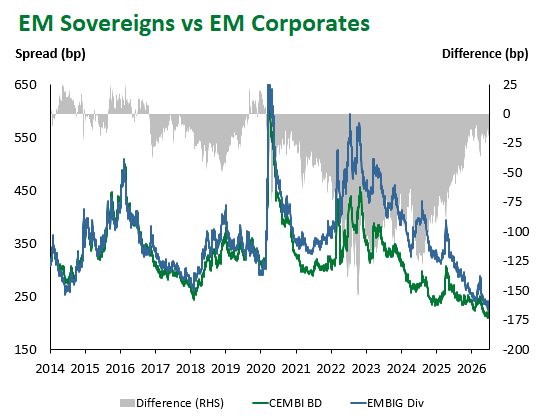
Emerging Markets Flows
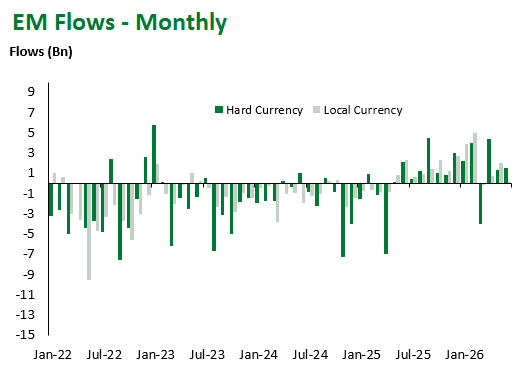
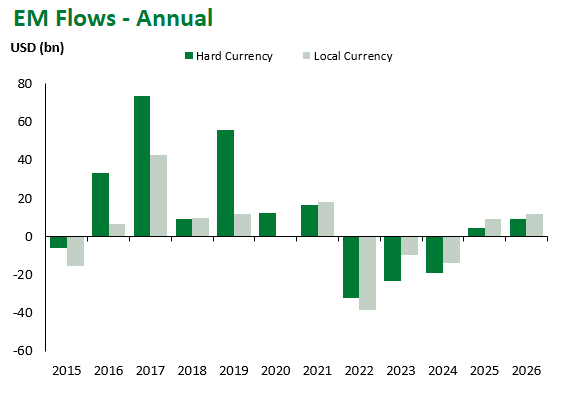
Source for graphs: Bloomberg, JPMorgan, Gramercy. As of July 2, 2026.
For questions, please contact:
Kathryn Exum, CFA ESG, Director, Co-Head of Sovereign Research, [email protected]
Petar Atanasov, Director, Co-Head of Sovereign Research, [email protected]
This document is for informational purposes only. The information presented is not intended to be relied upon as a forecast, research or investment advice, and is not a recommendation, offer or solicitation to buy or sell any securities or to adopt any investment strategy. Gramercy may have current investment positions in the securities or sovereigns mentioned above. The information and opinions contained in this paper are as of the date of initial publication, derived from proprietary and nonproprietary sources deemed by Gramercy to be reliable, are not necessarily all-inclusive and are not guaranteed as to accuracy. This paper may contain “forward-looking” information that is not purely historical in nature. Such information may include, among other things, projections and forecasts. There is no guarantee that any forecasts made will come to pass. Reliance upon information in this paper is at the sole discretion of the reader. You should not rely on this presentation as the basis upon which to make an investment decision. Investment involves risk. There can be no assurance that investment objectives will be achieved. Investors must be prepared to bear the risk of a total loss of their investment. These risks are often heightened for investments in emerging/developing markets or smaller capital markets. International investing involves risks, including risks related to foreign currency, limited liquidity, less government regulation, and the possibility of substantial volatility due to adverse political, economic or other developments. References to any indices are for informational and general comparative purposes only. The performance data of various indices mentioned in this update are updated and released on a periodic basis before finalization. The performance data of various indices presented herein was current as of the date of the presentation. Please refer to data returns of the separate indices if you desire additional or updated information. Indices are unmanaged, and their performance results do not reflect the impact of fees, expenses, or taxes that may be incurred through an investment with Gramercy. Returns for indices assume dividend reinvestment. An investment cannot be made directly in an index. Accordingly, comparing results shown to those of such indices may be of limited use. The information provided herein is neither tax nor legal advice. Investors should speak to their tax professional for specific information regarding their tax situation.