


Contents
Market Overview
Macro Update
Diplomatic momentum continued to build this week as Iran-U.S. discussions remained broadly constructive and markets increasingly priced a ceasefire extension as the most likely near-term outcome. Adding to the positive tone, Lebanon and Israel agreed to a formal 10-day ceasefire, with the two sides set to hold their first direct talks in Washington in 34 years next Tuesday, facilitated by Secretary of State Marco Rubio. On Friday, reports emerged that the U.S. is considering a $20 billion cash-for-uranium deal with Iran as part of a broader diplomatic package – a potential breakthrough that, if confirmed, would represent the most concrete signal yet of a path toward a durable resolution. Direct U.S.-Iran talks are expected to follow in Islamabad as early as Sunday while Iran announced that the Strait of Hormuz is fully open for the remainder of the ceasefire. The cumulative message from the week’s diplomatic news flow is that the regional de-escalation narrative has real momentum, even as a comprehensive resolution to the broader Iran conflict remains a work in progress.
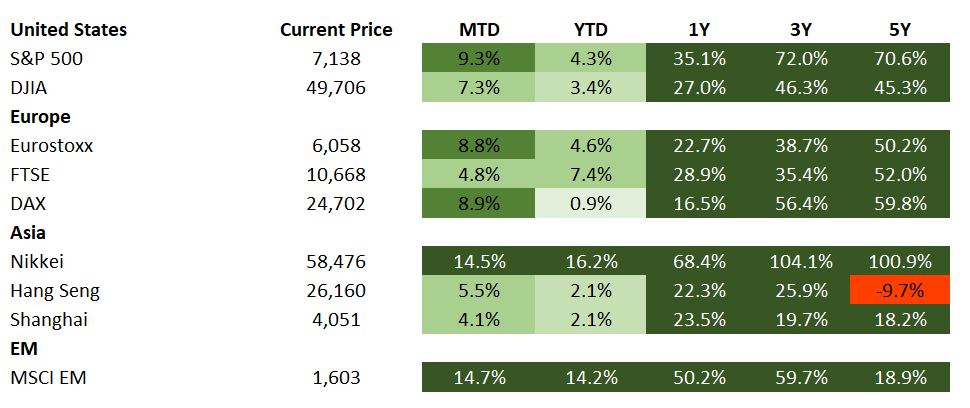
The path to that conclusion was not a smooth one. The U.S. announcement of a naval counter-blockade of the Strait of Hormuz at the start of the week raised immediate fears about whether the ceasefire would hold under those conditions, sending Brent crude and WTI sharply higher to $103 and $105 per barrel, respectively. As the week progressed and the ceasefire proved more resilient than feared, Brent and crude moderated to the low to high 80s, respectively – meaningful intra-week swings that underscore how sensitive markets remain to headline risk. The S&P 500 advanced more than 3%, extending the recovery that began the prior week. The U.S. dollar softened modestly, with the DXY settling below 98 from 99 a week ago. The U.S. Treasury market rallied with the 2-year yield falling 9bps to ~3.71%, the 10-year tightening 10bps to ~4.24%, and the 30-year declining 8bps to 4.87%. Gold moved up more than 2.0% to around $4,840 per ounce.
On the domestic data front, March PPI came in well below expectations at +0.5% month-over-month versus consensus of +1.1%, with core PPI a notably soft +0.1% – energy drove goods prices sharply higher but services were flat, suggesting pass-through beyond energy remains contained for now. Weekly jobless claims for the week ending April 11 fell to 207K, below expectations of 213K, with the 4-week moving average at ~210K – a continued signal of a healthy labor market. Large U.S. bank earnings this week collectively reinforced the picture: U.S. consumers are weathering the energy shock well, though management tone across the board reflected a mild softening in the forward macro outlook.
The week’s most consequential macro development came from the IMF’s Spring World Economic Outlook. The Fund cut its 2026 global growth forecast to 3.1% from 3.4% prior to the conflict – with a partial recovery to 3.2% projected for 2027 – and delivered a sharper downgrade for Emerging Markets to 3.9% from 4.2% in January, citing the Middle East conflict, higher energy prices, and tighter financial conditions as the primary culprits. Crucially, the IMF flagged that downside risks have risen materially should disruptions persist – a signal that the Fund’s base case is itself already embedding significant uncertainty. Emerging Asia drew a specific warning: oil-importing economies face increasingly difficult policy trade-offs between supporting growth and containing inflation, with limited fiscal buffers to fall back on.
European macro data presented a mixed though cautionary picture. Euro area March CPI surprised to the upside, driven by energy, complicating what had been an increasingly clear easing path for the ECB despite tentative signs of activity stabilization across the bloc. In the UK, growth beat expectations but sterling weakened as higher energy-driven inflation expectations and volatile gilt yields pushed out the prospect of Bank of England rate cuts. The message from Europe is consistent: the easing cycles that appeared well underway at the start of 2026 have been materially interrupted by the energy shock, and the path back to cutting is likely to be slower and more contested than markets had priced only a few months ago.
In China, the March trade balance deteriorated on soft export growth and strong import growth, signaling possible headwinds to the country’s robust external growth engine. First quarter GDP growth and March industrial production beat estimates while retail sales were softer than expected, underscoring a still lackluster domestic demand picture.
Hungary’s parliamentary election delivered a decisive pro-EU opposition victory, ending Prime Minister Viktor Orbán’s 16-year grip on power and triggering sharp appreciation in the forint and improved investor confidence in Hungarian policy credibility. The implications extend well beyond Budapest: an opposition-led Hungary would fundamentally alter EU internal dynamics, including its posture toward Russia and Ukraine, representing perhaps the most significant shift in Central European politics in over a decade.
In Latin America, the IMF announced that it will resume dealings with Venezuela while the U.S. lifted sanctions against the country’s central bank. Argentina reached a staff level agreement with the IMF on its latest program review and obtained a $550 million guarantee from the IDB to broaden its multilateral financing envelope.
EM Credit Update
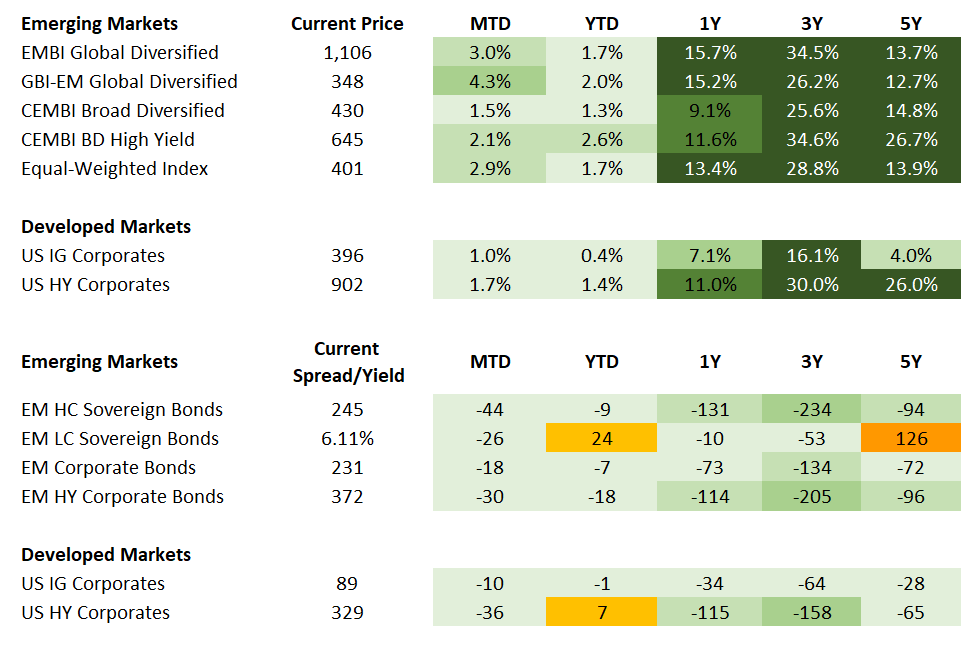
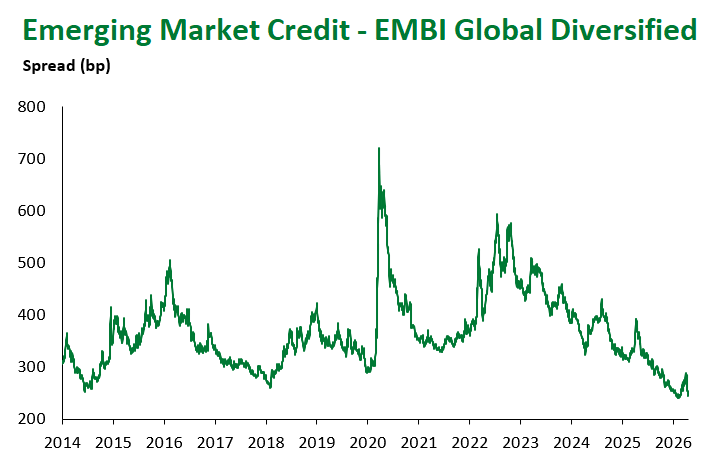
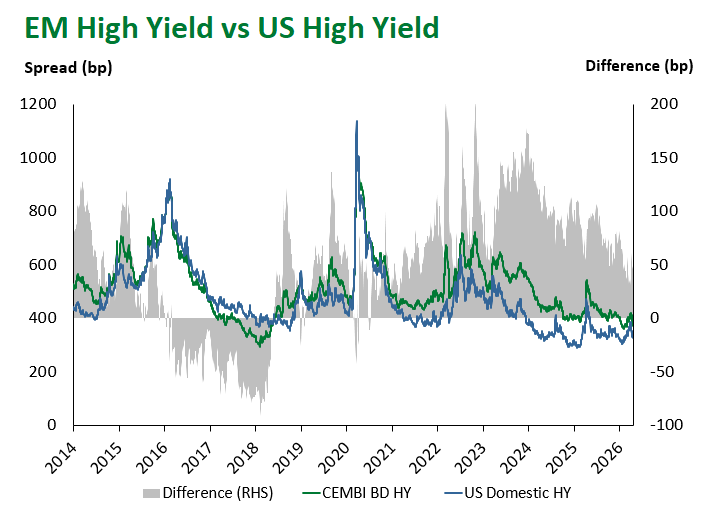
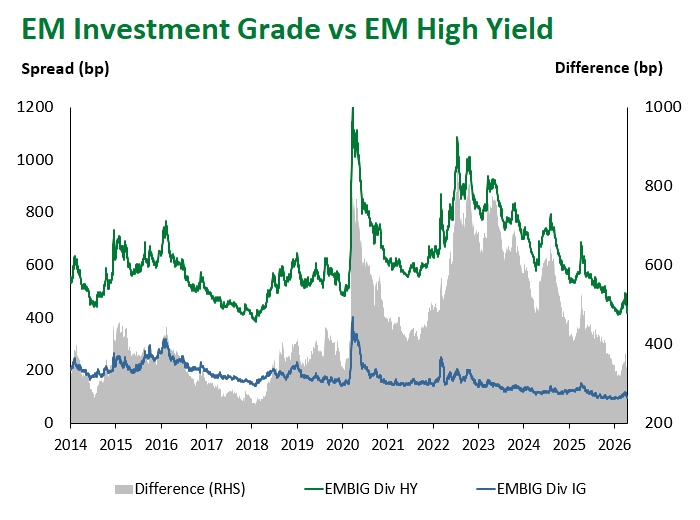
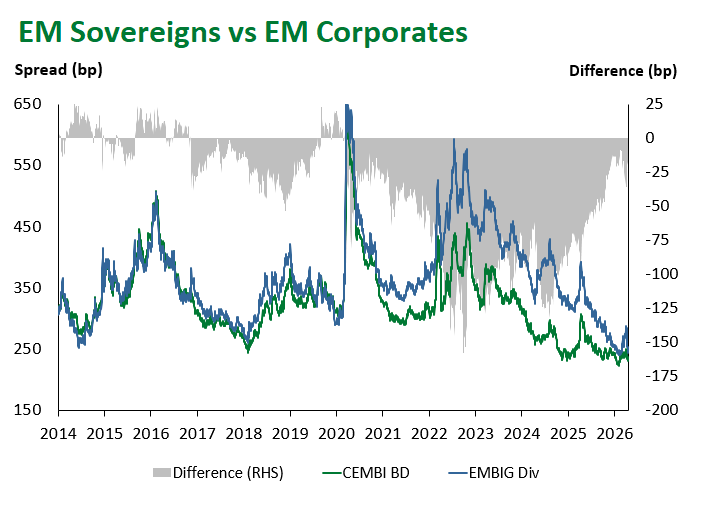
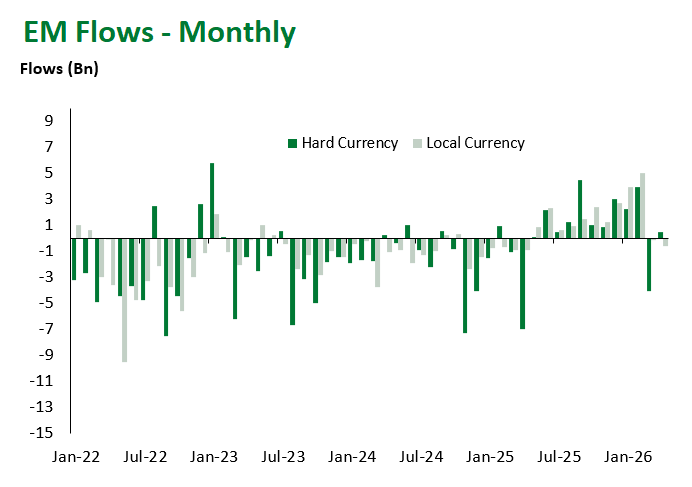
Emerging Markets fixed income advanced across all three sub-asset classes, with ceasefire optimism driving broad-based spread compression. Hard currency sovereigns rose +0.69% (IG +0.46%, HY +0.90%), with Latin America (+1.11%) leading regionally. Colombia (+2.02%), Panama (+1.47%), and Argentina (+1.89%) were among top performers; Venezuela (+7.73%) continued its remarkable run. Africa (+0.61%) also outperformed, led by Mozambique (+3.55%), Ghana (+1.73%), and Cote d’Ivoire (+1.10%). Asia (+0.48%) lagged, consistent with the region’s heightened sensitivity to the energy cost shock.
Local currency sovereign debt rose +0.37%, with Hungary (+6.66%) the unambiguous standout on election-driven forint appreciation. Brazil (+1.68%) and Colombia (+1.69%) also posted solid gains, while Peru (-1.05%) and the Philippines (-0.97%) lagged.
EM corporates advanced +0.47% (IG +0.34%, HY +0.66%), with Latin America (+0.67%) again leading regionally, followed by Europe (+0.64%) and the Middle East (+0.58%). Asia (+0.27%) lagged.
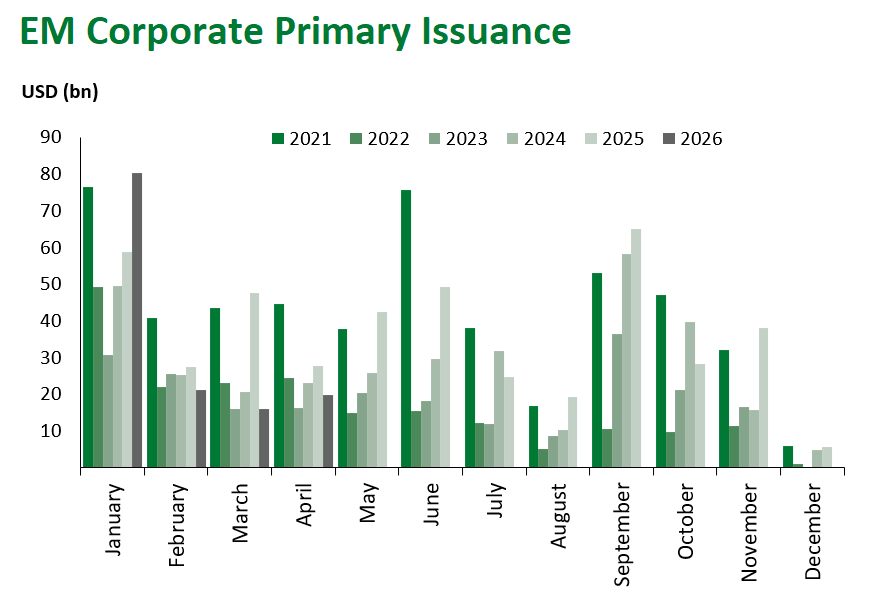
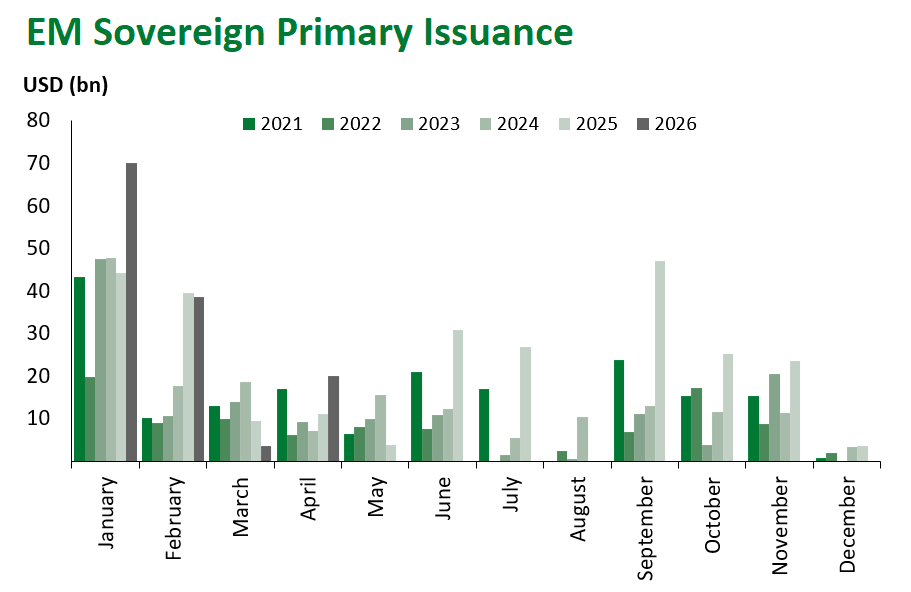
Primary market activity rebounded sharply, with 19 issuers pricing approximately $16.9 billion in hard currency supply – a marked pickup signaling returning market confidence. Brazil’s triple-tranche EUR5 billion sovereign deal attracted books exceeding EUR12 billion. Türkiye priced $2 billion at 6.375%, and OCP of Morocco placed a $1.5 billion dual-tranche perpetual. On the corporate side, Naver Corporation of Korea priced a USD/EUR dual-currency transaction, Aluminium Corp of China raised $800 million, and Bank Negara Indonesia and Grupo Nutresa priced AT1 and hybrid perpetuals, respectively.
The Week Ahead
The most immediate focus for markets over the weekend will be the U.S.-Iran talks expected in Islamabad on Sunday—the highest-stakes direct diplomatic engagement since the conflict began. Investors will be watching closely for any signal on the contours of a broader deal, including whether the reported $20 billion cash-for-uranium framework under consideration by the U.S. administration could serve as a credible foundation for negotiations. A constructive outcome from Islamabad would materially reinforce the ceasefire and likely drive a further leg of risk-on across EM assets at the open of next week. All eyes will also be on Tuesday’s Lebanon-Israel talks in Washington as well – the first direct engagement between the two sides in 34 years – where the durability of the ceasefire and the parameters of a more permanent arrangement will be tested. Any progress toward reopening the Strait of Hormuz remains the single most impactful potential catalyst for global risk assets. On the political calendar, Bulgaria will hold a snap parliamentary election, following the collapse of the government earlier this year. Key macro releases include U.S. retail sales, jobless claims and University of Michigan sentiment survey plus Eurozone and UK PMIs as well as UK CPI. Central banks in Indonesia, the Philippines, and Türkiye will announce rate decisions.
Fixed Income
Equities
Commodities
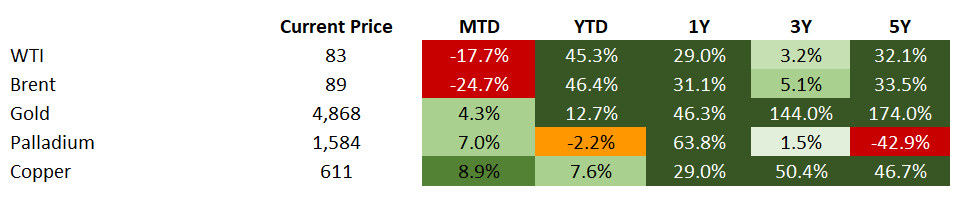
Source for data tables: Bloomberg, JPMorgan, Gramercy. EM Fixed Income is represented by the following JPMorgan Indicies: EMBI Global, GBI-EM Global Diversified, CEMBI Broad Diversified and CEMBI Broad High Yield. DM Fixed Income is represented by the JPMorgan JULI Total Return Index and Domestic High Yield Index. Fixed Income, Equity and Commodity data is as of Apr. 17, 2026 (mid-day).
Highlights
Hungary Votes: Orbán Era Ends
Event: Hungary held parliamentary elections on Sunday, April 12, resulting in a decisive victory for the opposition Tisza party led by Péter Magyar. With turnout near post Communist records, Tisza secured roughly 53-54% of the vote and a two thirds supermajority in parliament, unseating Prime Minister Viktor Orbán and ending Fidesz’s 16 year rule. Viktor Orbán conceded defeat on election night, acknowledging a clear transfer of governing authority.
Gramercy Comment: The outcome removes a longstanding political overhang and is viewed positively by markets, particularly given Tisza’s supermajority, which materially reduces execution risk during the transition. A strong parliamentary mandate increases the likelihood of meaningful institutional and governance reforms, as well as faster normalization of relations with Brussels and progress toward unlocking previously frozen EU funds. Near term volatility cannot be ruled out as the new government moves to assert control over entrenched institutions, but Hungarian assets should benefit from reduced fiscal slippage risk and an improved medium term credit trajectory.
Peru Heads to a Fragmented Runoff
Event: Peru’s April 12 first round presidential election produced no outright winner. Keiko Fujimori finished first with just over 17% of the vote, while the contest for second place remains unresolved. As of Thursday, with roughly 93% of polling stations counted, Roberto Sánchez holds a slim lead of around 10,000 votes over Rafael López Aliaga, a margin that has narrowed meaningfully over recent updates. A sizeable share of overseas ballots remains outstanding, where López Aliaga continues to run well, keeping the runoff composition unsettled ahead of the June 7 second round.
Gramercy Comment: The evolving vote count suggests that uncertainty around the runoff pairing will persist in the near term. While Sánchez retains a narrow numerical advantage, the compression in the margin highlights a realistic possibility of a late shift should outstanding ballots follow recent patterns. As a result, the balance of risks continues to straddle two distinct scenarios: a Keiko – Sánchez runoff, or a Keiko – López Aliaga matchup that would likely be viewed more constructively by investors. More broadly, institutional constraints remain an important stabilizing factor. Sánchez has adopted a more pragmatic tone than the Castillo administration, public tolerance for renewed political experimentation appears limited, and the next Congress is expected to lean right of center, reducing the scope for abrupt policy changes regardless of the runoff outcome.
OCP Breaks New Ground with Africa’s First Corporate Hybrid
Event: OCP S.A. (Baa3/BBB-/BB+), the Moroccan state-controlled phosphate and fertiliser group, priced a debut $1.5 billion dual-tranche perpetual hybrid. The $1.0 billion PNC5.25 priced at 6.75% and the $500 million PNC10.25 at 7.375%, both tightening 62.5bps from IPTs, on a book covered ~3.5 times. The notes carry a standard two-notch subordination differential (Ba2/BB) to OCP’s senior curve.
Gramercy Comment: This is a landmark transaction – the first hybrid bond from an African non-financial corporate, signalling the continent’s growing maturity as an EM credit market and setting a replicable template for other investment-grade African issuers. The 3.5x oversubscription and 62.5bps tightening across both tranches reflect robust investor appetite for EM hybrid paper, notwithstanding ongoing Middle East geopolitical uncertainty. OCP’s strong credit fundamentals – 94% state ownership, ~68% share of global phosphate rock reserves, and a 38% EBITDA margin that leads global peers – underpin the demand. While input cost pressures from the Gulf conflict (sulphur and ammonia) pose a near-term earnings headwind, OCP’s product mix flexibility, secured inventory buffers and meaningful capex reductions provide adequate resilience.
Emerging Markets Technicals
Emerging Markets Flows
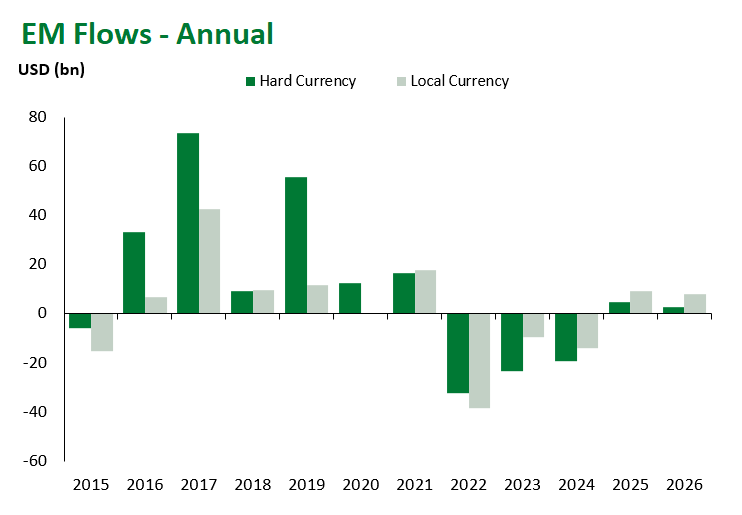
Source for graphs: Bloomberg, JPMorgan, Gramercy. As of Apr. 17, 2026.
For questions, please contact:
Kathryn Exum, CFA ESG, Director, Co-Head of Sovereign Research, [email protected]
Petar Atanasov, Director, Co-Head of Sovereign Research, [email protected]
This document is for informational purposes only. The information presented is not intended to be relied upon as a forecast, research or investment advice, and is not a recommendation, offer or solicitation to buy or sell any securities or to adopt any investment strategy. Gramercy may have current investment positions in the securities or sovereigns mentioned above. The information and opinions contained in this paper are as of the date of initial publication, derived from proprietary and nonproprietary sources deemed by Gramercy to be reliable, are not necessarily all-inclusive and are not guaranteed as to accuracy. This paper may contain “forward-looking” information that is not purely historical in nature. Such information may include, among other things, projections and forecasts. There is no guarantee that any forecasts made will come to pass. Reliance upon information in this paper is at the sole discretion of the reader. You should not rely on this presentation as the basis upon which to make an investment decision. Investment involves risk. There can be no assurance that investment objectives will be achieved. Investors must be prepared to bear the risk of a total loss of their investment. These risks are often heightened for investments in emerging/developing markets or smaller capital markets. International investing involves risks, including risks related to foreign currency, limited liquidity, less government regulation, and the possibility of substantial volatility due to adverse political, economic or other developments. References to any indices are for informational and general comparative purposes only. The performance data of various indices mentioned in this update are updated and released on a periodic basis before finalization. The performance data of various indices presented herein was current as of the date of the presentation. Please refer to data returns of the separate indices if you desire additional or updated information. Indices are unmanaged, and their performance results do not reflect the impact of fees, expenses, or taxes that may be incurred through an investment with Gramercy. Returns for indices assume dividend reinvestment. An investment cannot be made directly in an index. Accordingly, comparing results shown to those of such indices may be of limited use. The information provided herein is neither tax nor legal advice. Investors should speak to their tax professional for specific information regarding their tax situation.