


Contents
Market Overview
Macro Update
Global markets were driven this week by the Middle East conflict and its impact on energy prices, supply chains and the global inflation and monetary policy outlooks. President Trump announced that he will extend his “deadline” for Iran to reach a deal and avoid U.S. strikes against its energy infrastructure until April 6, while ordering the deployment of additional military assets to the region. This development provided no relief to markets concerned that the conflict spilling into April will keep oil prices elevated, fueling an increase in global inflation and a slowdown in growth.
Meanwhile, regardless of how the military conflict evolves from here, economists have started to formally reflect the impact of the conflict and the energy price shock on economic activity into their projections. This week, the OECD released its interim economic outlook, titled “Testing Resilience”, in which it projects 2026 global GDP growth of 2.9% YoY (down from 3.3% in 2025) and increased its base case inflation forecast for the G20 economies this year to 4.0% YoY, (up from 2.8% projected in December 2025). The OECD highlights that at the start of 2026, global growth was on track for an upgrade – supported by AI-related investment and lower effective U.S. tariffs – but this positive trajectory was completely reversed by the Middle East conflict and ensuing energy shock. The report also notes global inflation pressures are likely to persist longer as the disruption to oil, gas and fertilizer markets erase earlier disinflation trends.
Earlier in the week, reports emerged that Iran has delivered a response to the 15-point ceasefire framework allegedly put forward by the Trump administration, suggesting that both sides might be willing to engage in backdoor diplomacy, despite public denials. However, the content of the U.S. and Iran’s proposals appear to remain far apart, especially on the status of the critical shipping lanes through the Strait of Hormuz, keeping the probability of near-term de-escalation low. Meanwhile, Israel, the third main participant in the conflict, threatened to “escalate and expand” its attacks against Iran and signaled further escalation against Iran-aligned forces in Lebanon and a potential major ground invasion beyond Southern Lebanon, keeping regional uncertainty highly elevated.
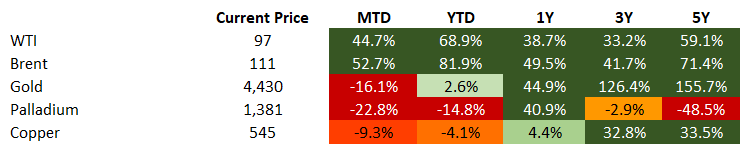
Against the backdrop of “ping pong geopolitics” and conflicting signals by all sides, global assets remained unanchored and prone to fluctuations on any seemingly substantial headline. The Brent spot price attempted to retreat below the $100 per barrel on reports of backchannel diplomacy between the warring parties but resumed its march higher to finish the week around $110 per barrel. The U.S. dollar followed a very similar pattern, initially weakening on de-escalation hopes and then regaining momentum toward 100 on the DXY as hopes for near-term diplomatic progress faded.
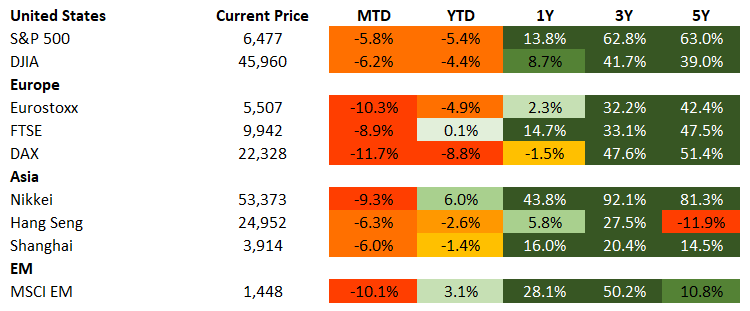
U.S. Treasuries bear-flattened led by the Fed policy-sensitive short end that widened 5-9bps vs last week. The 10Y benchmark was 7bps wider at around 4.45% while the long end outperformed with the 30Y yield 4bps wider to a touch below 5.00%. Following four consecutive weeks of losses, U.S. stock indices continued to decline, with the S&P 500 on course for its longest streak of weekly losses since 2022 and NASDAQ falling into correction territory. After last week’s heavy sell-off, gold and silver spot prices found an anchor, around $4500 and $70 per ounce, respectively.
Looking beyond the crisis in the Middle East, President Trump announced that the postponed summit in Beijing with Chinese counterpart Xi Jinping has been rescheduled to May and signaled that he plans to host President Xi in Washington later this year. The relationship between the leaders of the two largest global economies could be further tested by developments in the Middle East, in addition to disagreements over Taiwan, trade, technology and global security, among many others.
In notable macro developments, preliminary March consumer confidence deteriorated more than expected in the Eurozone and the UK, with households citing renewed inflation concerns tied to the Middle East conflict. UK’s pre-conflict inflation for February came in line with consensus and unchanged from the prior month (3.0% YoY). Its March preliminary composite PMI declined relative to the prior month and missed expectations (51.0 vs 52.8), which mirrored the dynamic in the U.S. (51.4 vs 51.9) and the Eurozone (50.5 vs 51.0). U.S. initial jobless claims were little changed vs last week (210K vs 205K). The final University of Michigan consumer sentiment index for March was revised lower from the initial estimate and indicated that consumer sentiment slid to a three-month low, while year-ahead inflation expectations jumped as the war in the Middle East drives up gasoline prices.
Across emerging markets, the central banks of Chile (4.50%), Hungary (6.25%), Sri Lanka (7.75%), and South Africa (6.75%) all held their policy rates unchanged amid heightened uncertainty and deteriorating growth and inflation outlooks. Mexico’s central bank was the one exception, surprising markets with a 25bps cut to 6.75% to its benchmark rate and signaled potential additional easing “when conditions permit”.
EM Credit Update
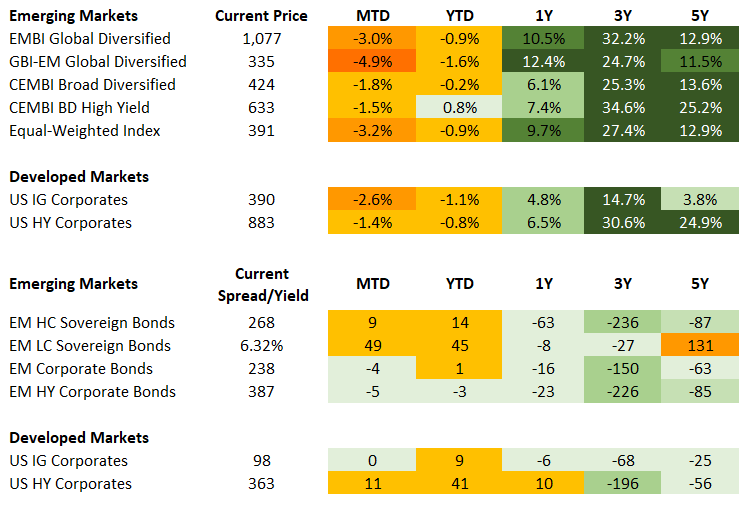
Emerging Markets (EM) fixed income delivered a more differentiated performance this week, with early gains in local and hard currency sovereigns giving way to renewed weakness by Friday. Through Thursday, sentiment was supported by optimism that the Trump administration could broker a swift resolution to the Middle East conflict. That optimism faded at the end of the week, however, as negotiations were extended by another 10 days, pushing out the timeline for any potential resolution and weighing on risk assets.
Hard currency sovereign bonds were up +0.20% through Thursday, led by high yield (+0.30%) outperforming investment grade (+0.11%). By midday Friday, those gains had fully reversed, with the index down -0.70%, as high yield (-0.98%) underperformed alongside investment grade (-0.98%). Regionally, Friday’s sell-off was most pronounced in Africa (-1.38%) and Europe (-0.83%), while Asia proved more resilient (-0.29%). At the country level, Russia (-5.68%), Ukraine (-1.73%), and Mozambique (-1.22%) were the weakest performers on the day.
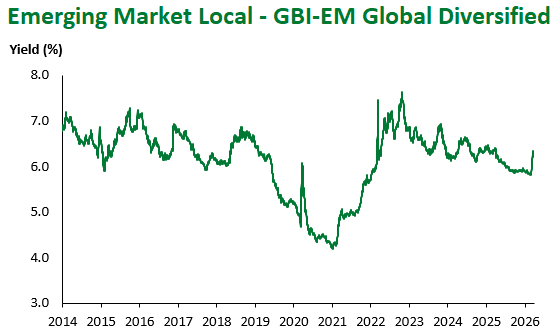
Local currency debt was the standout performer earlier in the week, rising +0.23% through Thursday as U.S. dollar strength eased. However, those gains were also erased on Friday, leaving the asset class down -0.28% for the week by midday. At the country level, Colombia (+1.50%) and Hungary (+1.29%) outperformed through Thursday, supported by constructive political dynamics ahead of upcoming presidential elections. In contrast, Malaysia (-1.50%), Türkiye (-1.41%), and Chile (-1.24%) lagged, as higher global energy prices continued to pressure net energy importers.
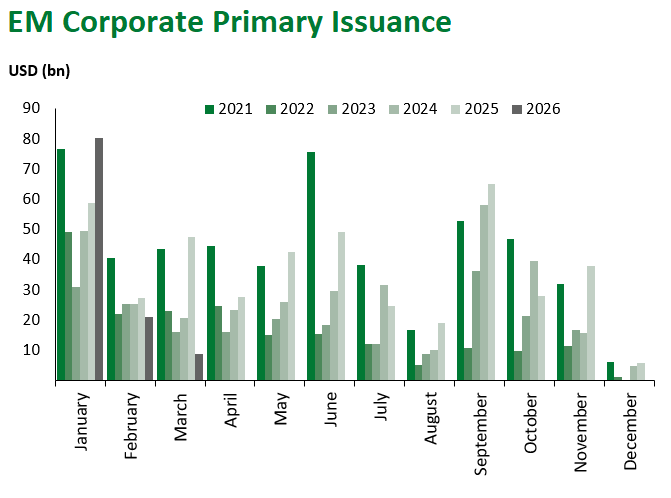
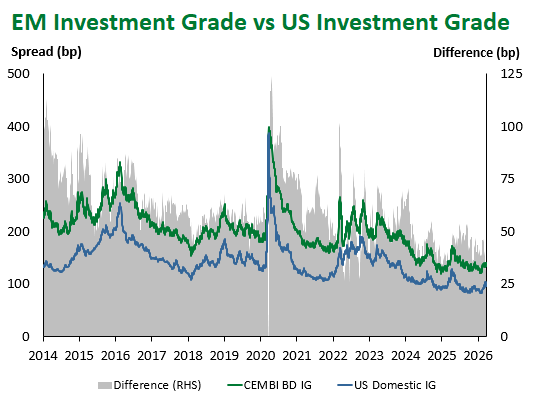
EM corporates did not participate in the early week rebound, with the index down -0.16% overall. Investment grade (-0.19%) lagged high yield (-0.10%). Regionally, the Middle East (+0.02%) outperformed, supported by renewed local demand and deal-related flows in Saudi Arabia and Oman, while Asia (-0.25%) underperformed amid broader market weakness.
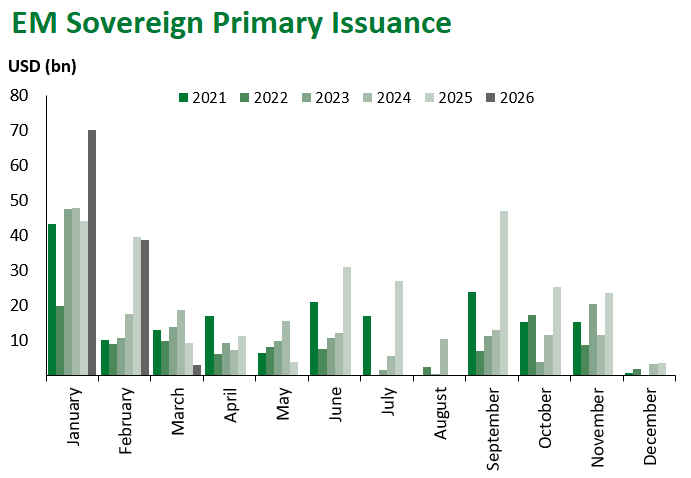
Primary market activity picked up modestly, with five hard currency deals totaling approximately $6 billion, including three investment grade and two high yield issuances. The high yield transactions included Angola and Helios Towers in Africa.
The Week Ahead
Next week will be a short one as European, North American and some Asian markets are closed for Good Friday. Undoubtedly, focus will remain on developments in the Middle East and if any diplomatic progress can be made within President Trump’s extended “deadline” to Iran. French President Emmanuel Macron will visit Asia where he is slated to hold talks with Japanese Prime Minister Sanae Takaichi and attend a summit in Seoul with South Korean President Lee Jae Myung. In terms of notable macro data, the March U.S. jobs report will be a key gauge of whether recent signs of labor market softening are deepening. Other U.S. data releases include JOLTS job openings, retail sales, ISM Manufacturing, and initial jobless claims. Preliminary inflation data for March will be released across Europe as well as in Japan, Sri Lanka, Pakistan, South Korea, and Türkiye, while a slew of final March composite, manufacturing, and services PMIs are to be reported globally, including in the U.S., China, the Eurozone, UK, India and Japan. Eurozone economic and consumer confidence and final 4Q UK GDP are also on the agenda.
Fixed Income
Equities
Commodities
Source for data tables: Bloomberg, JPMorgan, Gramercy. EM Fixed Income is represented by the following JPMorgan Indicies: EMBI Global, GBI-EM Global Diversified, CEMBI Broad Diversified and CEMBI Broad High Yield. DM Fixed Income is represented by the JPMorgan JULI Total Return Index and Domestic High Yield Index. Fixed Income, Equity and Commodity data is as of Mar. 27, 2026 (mid-day).
Highlights
A widening Israeli offensive might challenge Lebanon’s political stability
Event: Ever since the large scale military conflict in the Middle East erupted, Israel has carried out intensive air strikes on Lebanon and sent ground troops across the border in the south of the country. This week, the Israeli army said that its campaign against Hezbollah, the Iran-backed Lebanese militia, had “only just begun”, signaling that a potential next step could involve a major ground campaign and occupation of larger parts of Lebanon.
Gramercy Comment: Lebanon’s notoriously complicated political system and badly mismanaged economy have been on a recovery trend for the last couple of years under the most reform-minded administration in decades, but they remain highly vulnerable to external or domestic shocks. The government’s political standing and Lebanon’s fragile social fabric have already been strained by Israel’s air strikes against Hezbollah targets across the country that have killed more than 1000 people and displaced around 1 million over the last month, more than 15% of the country’s estimated population. Meanwhile, Hezbollah appears to remain defiant and committed to fighting. The Lebanese national army is unlikely to succeed disarming the group to Israel’s satisfaction, even if it attempted to do so. As such, Israel’s military strategists could decide that a large-scale ground offensive beyond the “buffer zone” in southern Lebanon may be necessary. Such a scenario would only increase the political pressure on the government in Beirut and is likely to be economically and socially devastating, threatening to plunge Lebanon back into acute crisis. Israel’s invasion in 1982 – and its subsequent nearly two decades long occupation of southern Lebanon – led to the emergence of Hezbollah and continues to elicit painful memories across Lebanon. A new invasion could end up strengthening Hezbollah’s support base that has otherwise been eroding recently, even within the group’s traditional strongholds. In terms of market reaction to these developments, Lebanon’s distressed sovereign bond curve has seen some downside pressure in recent weeks, but valuations remain far from pricing the potential negative political and economic implications that a widening Israeli offensive could trigger, in our view.
Hungarian opposition widens lead in key poll
Event: The opposition Tisza Party, led by Péter Magyar, holds a commanding 23-percentage-point lead over the ruling Fidesz in a recent survey published by the respected pollster Median. Such a margin, if sustained, would point to the possibility of a two-thirds parliamentary majority in the general election scheduled for April 12. That said, the broader polling landscape presents a more measured picture. Aggregated survey data – including results from government-aligned pollsters – suggests a narrower advantage for the opposition.
Gramercy Comment: A decisive victory for the opposition – bringing an end to 16 years of rule by Viktor Orbán and his Fidesz government – would likely be viewed positively by markets, all else equal. Investors would anticipate a reset in relations with the European Union, alongside improvements in governance and the rule of law. However, a narrower margin of victory could lead to a more turbulent transition. Residual institutional influence held by Fidesz may enable it to delay policy implementation, sustain expansionary fiscal measures, and introduce a degree of economic uncertainty, echoing the post-election dynamics observed in 2002. The broader macroeconomic outlook is further complicated by external risks, particularly those tied to the Iran conflict. While Hungary’s external position has improved in recent years, it remains a net energy importer vulnerable to commodity price volatility, especially given existing price subsidies and a negative trajectory in sovereign credit assessments. In this context, the central bank is expected to maintain a cautious, wait-and-see stance, keeping policy settings unchanged for now. Similarly, credit rating agencies are likely to defer any decisions until there is greater clarity on the election outcome and the incoming government’s policy direction.
Emerging Markets Technicals
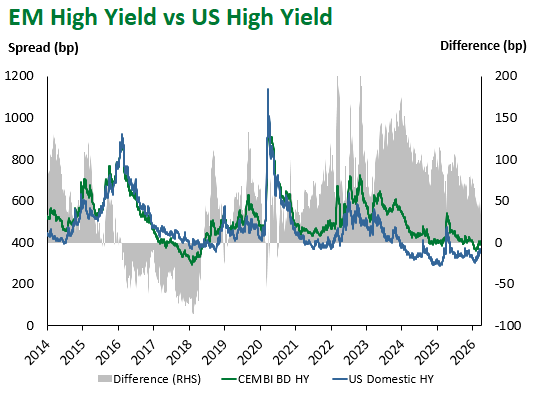
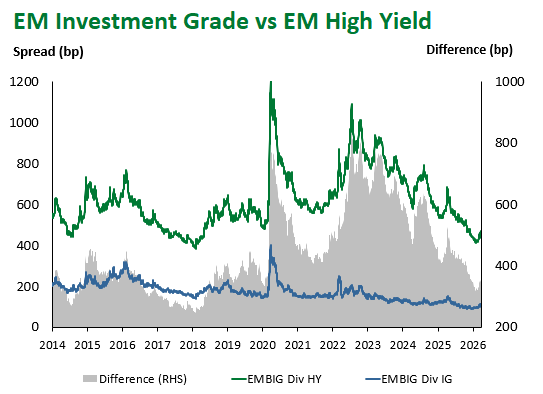
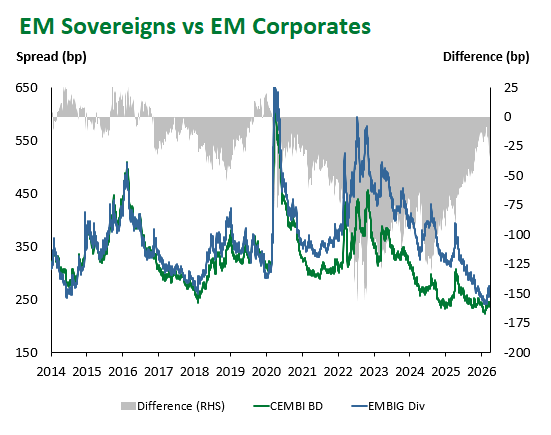
Emerging Markets Flows
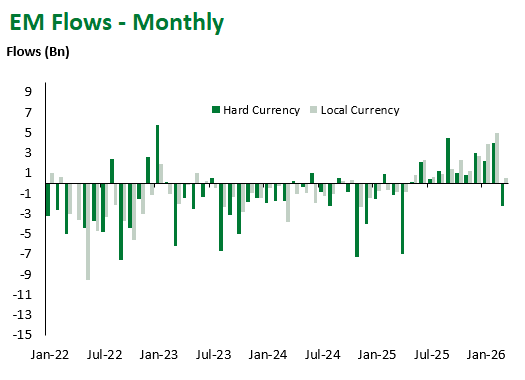
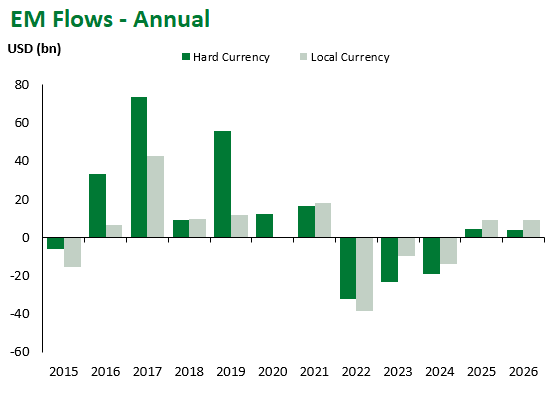
Source for graphs: Bloomberg, JPMorgan, Gramercy. As of Mar. 27, 2026.
For questions, please contact:
Kathryn Exum, CFA ESG, Director, Co-Head of Sovereign Research, [email protected]
Petar Atanasov, Director, Co-Head of Sovereign Research, [email protected]
This document is for informational purposes only. The information presented is not intended to be relied upon as a forecast, research or investment advice, and is not a recommendation, offer or solicitation to buy or sell any securities or to adopt any investment strategy. Gramercy may have current investment positions in the securities or sovereigns mentioned above. The information and opinions contained in this paper are as of the date of initial publication, derived from proprietary and nonproprietary sources deemed by Gramercy to be reliable, are not necessarily all-inclusive and are not guaranteed as to accuracy. This paper may contain “forward-looking” information that is not purely historical in nature. Such information may include, among other things, projections and forecasts. There is no guarantee that any forecasts made will come to pass. Reliance upon information in this paper is at the sole discretion of the reader. You should not rely on this presentation as the basis upon which to make an investment decision. Investment involves risk. There can be no assurance that investment objectives will be achieved. Investors must be prepared to bear the risk of a total loss of their investment. These risks are often heightened for investments in emerging/developing markets or smaller capital markets. International investing involves risks, including risks related to foreign currency, limited liquidity, less government regulation, and the possibility of substantial volatility due to adverse political, economic or other developments. References to any indices are for informational and general comparative purposes only. The performance data of various indices mentioned in this update are updated and released on a periodic basis before finalization. The performance data of various indices presented herein was current as of the date of the presentation. Please refer to data returns of the separate indices if you desire additional or updated information. Indices are unmanaged, and their performance results do not reflect the impact of fees, expenses, or taxes that may be incurred through an investment with Gramercy. Returns for indices assume dividend reinvestment. An investment cannot be made directly in an index. Accordingly, comparing results shown to those of such indices may be of limited use. The information provided herein is neither tax nor legal advice. Investors should speak to their tax professional for specific information regarding their tax situation.