


Contents
Market Overview
Macro Update
As the second week of the U.S./Israeli war against Iran progressed, market attention has been increasingly focused on the scenarios and potential timeframe for reopening the strategic Strait of Hormuz. While geopolitical experts have been shifting their views toward “harder to re-open for longer”, the market does not appear to have embraced that narrative yet amid mixed messaging coming out of the Trump administration on efforts to at least partially reopen traffic through the strait.
Iran’s new supreme leader, Mojtaba Khamenei, who has been “wounded and likely disfigured” according to U.S. Secretary of War Hegseth, signaled that Tehran’s goal is to keep the strait closed for commercial traffic and will look to open new fronts in the war if the U.S./Israeli attacks persist. The Islamic Revolutionary Guard Corps warned countries to “get ready for oil to be $200 a barrel” as it struck energy vessels and infrastructure in the Persian Gulf.
The high uncertainty continued to impede the willingness and ability of shipping to resume transiting the Strait of Hormuz. It remains unclear how plans shared by the Trump administration for the U.S. navy to escort commercial vessels would work in practice and how soon they could be implemented, offering little relief to energy markets that remain highly volatile.
Although off-ramps for de-escalation have not appeared yet two full weeks into the conflict, mixed messages and investors’ desire to believe in a quick resolution amid a “buy the dip mentality” have kept market reactions relatively benign thus far. As such, this week ended in a calmer tone compared to the previous two. Below the surface, however, tensions remain, and parts of the currency market appear to be flashing yellow as the Yen slid to its weakest level since July 2024.
Amid dueling signals on the likely trajectory and duration of the conflict and mounting concerns about material global oil supply disruptions, oil prices were highly volatile, with Brent spot initially touching $120 per barrel before retreating to around $80 mid-week, to close at around $100. Volatility persisted despite the International Energy Agency announcing it would release an unprecedented 400 million barrels of oil from its reserves.
The U.S. dollar, having regained some of its traditional “safe haven” appeal during periods of geopolitical stress, broke back into 100 territory on the DXY index for the first time since November 2025. The next level markets will be watching is 102, last reached in May of last year. The U.S. Treasury curve edged higher relative to last week, led by the short end (2-Year +17bps to around 3.73%, 10-Year +14bps to around 4.28%, and 30-Year +15bps to around 4.91%) as weak U.S. economic data failed to provide relief and to support market bets that the Fed might have space to deliver rate cuts later in the year.
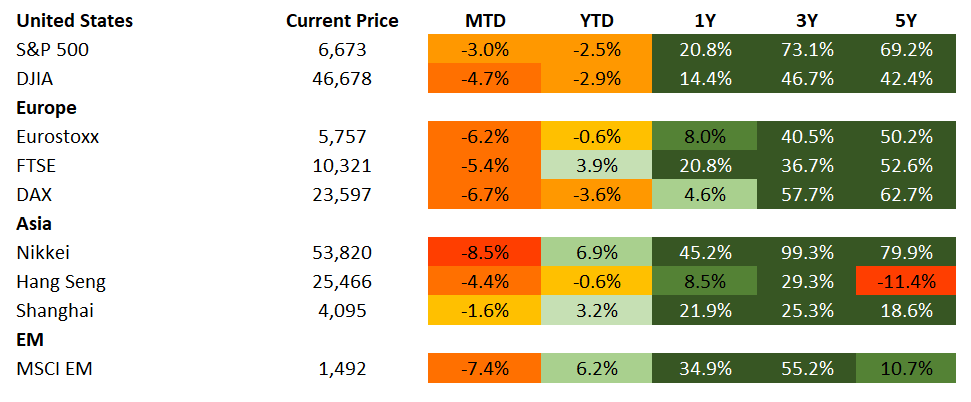
Global stock markets finished weaker despite an attempt at a modest late-week relief rally. Earlier weakness was driven by oil supply and inflation fears that were amplified by other underlying global economic fragilities such as signs of distress in the U.S. private credit market amid what appeared to be increasing redemption requests. Gold and silver spot prices were stable around their recent reference levels ($5000 and $85 per ounce, respectively), while Bitcoin rallied to the low $70,000s.
U.S. macro data was weak or revised weaker across the board: consumer sentiment measured by the preliminary March University of Michigan sentiment survey, fell to a three-month low on concerns about the impact on gasoline prices and inflation from the war in the Middle East. The second reading of 4Q GDP indicated that economic growth at the end of 2025 was significantly slower (0.7% annualized rate vs 1.4%) than initially estimated. The January Core PCE index, the Federal Reserve’s preferred price gauge, was in line with expectations (0.4% month-over-month and 3.1% year-over-year), as was February headline CPI (0.3% month-over-month and 2.4% year-over-year), but the market value of both readings is limited as they reflect pre-Iran conflict dynamics.
In China, February CPI and PPI data surprised to the upside, with headline inflation accelerating to 1.3% year-over-year from 0.2% in January and 0.9% expected by consensus. However, the data coincided with the Lunar New Year, signaling it might be too early to call a rebound in China’s lackluster consumption dynamics. Meanwhile, robust February trade data (export YTD +21.8% year-over-year vs. 7.2% consensus; import YTD +19.8% year-over-year vs. 7.0% consensus) point to a still strong external growth engine for now.
Across emerging markets, the central bank of Türkiye interrupted its rate cutting cycle citing elevated uncertainty on the inflation outlook driven by the ongoing oil price shock and signaled a “wait-and-see” approach going forward, which we expect to be the dominant tone by EM central banks as long as uncertainty driven by the conflict in the Middle East remains unresolved. Colombia’s parliamentary elections and presidential primaries last Sunday produced a better-defined presidential field with a path for a market-friendly candidate to win the likely presidential run-off in June and a fragmented but center-dominated Congress, which we see as constructive developments relative to expectations.
EM Credit Update
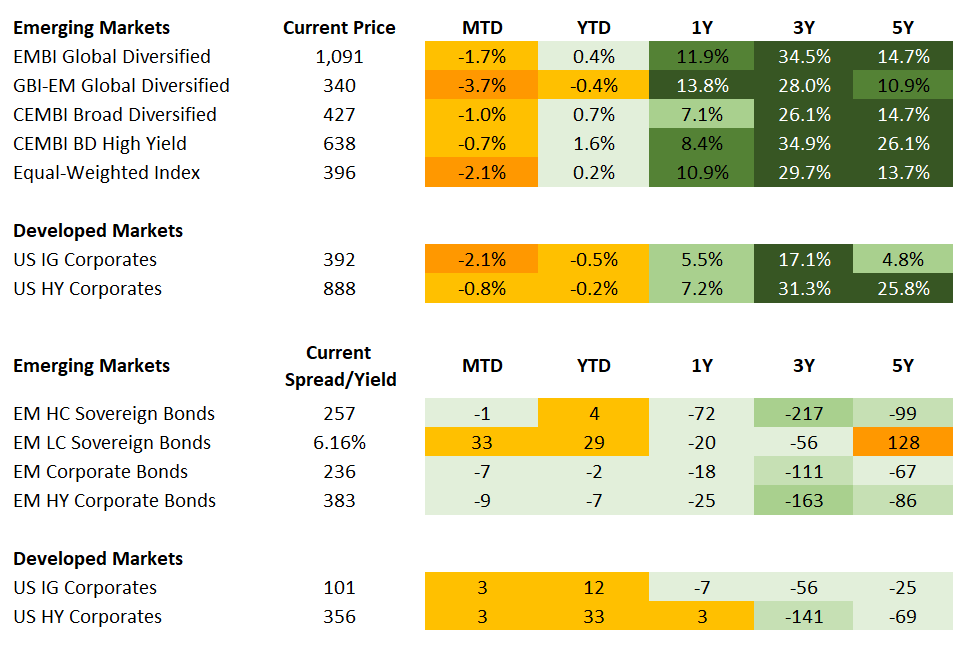
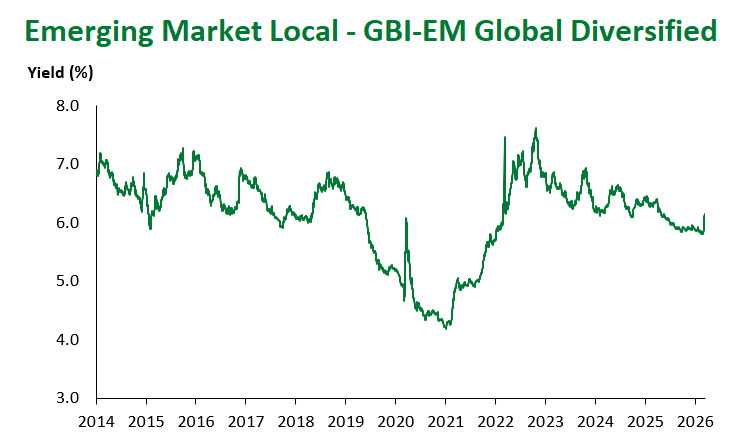
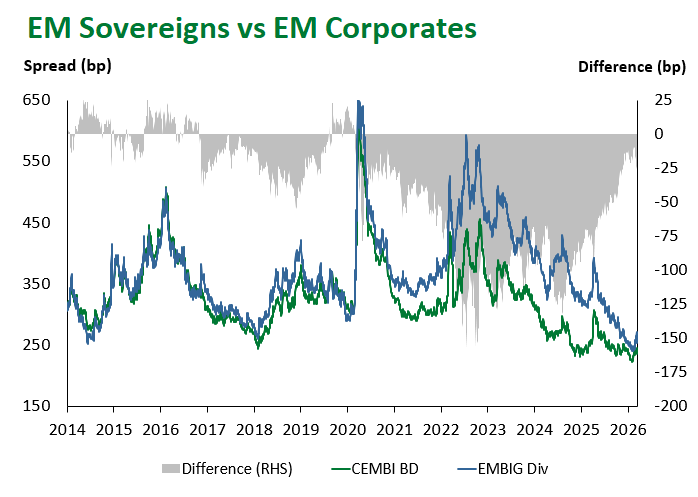
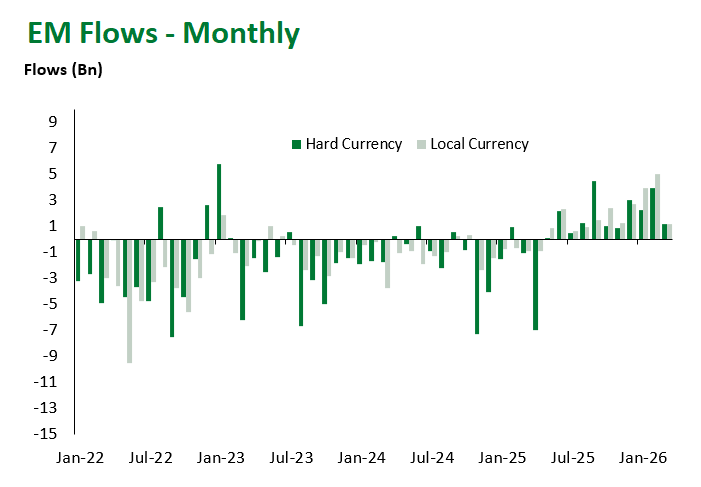
Emerging Markets (EM) fixed income remained under pressure this week amid ongoing geopolitical tensions, but market performance showed more differentiation, with corporates outperforming even as local and sovereign debt lagged. Local currency debt continued to underperform, declining -0.43%, pushing YTD performance into negative territory at -0.39% and making it the weakest EM sub asset class so far this year.
At the country level, energy importing economies faced the largest headwinds, including the Dominican Republic (-4.38%), Turkey (-3.85%), and Egypt (-3.62%), reflecting vulnerability to higher oil prices. In contrast, net energy exporters posted positive returns, led by Colombia (+2.19%) and Malaysia (+0.33%). Colombia’s performance was further supported by the results of the presidential primaries, where Senator Paloma Valencia—a right leaning candidate with centrist appeal—performed strongly.
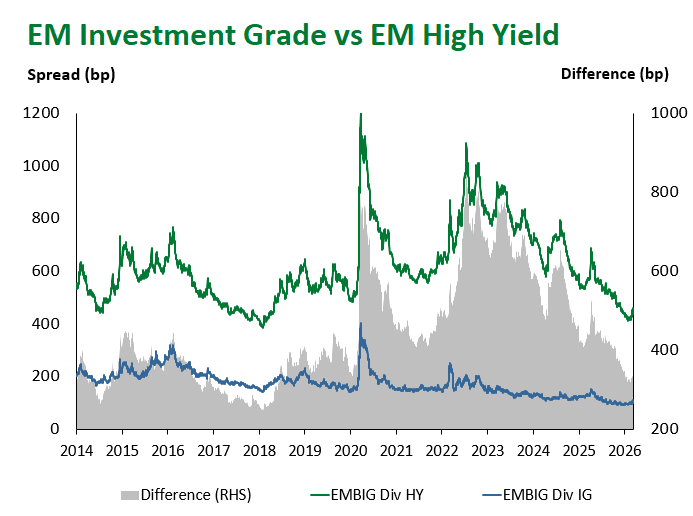
Hard currency sovereign bonds (-0.49%) outperformed local currency debt, with high yield (-0.44%) again outperforming investment grade (-0.54%). Regionally, Asia underperformed (-0.81%), reflecting expected economic pressures on net oil importers and sensitivity to rates, while Africa (-0.26%) and Latin America (-0.27%) were relative outperformers, benefiting from both distance from the conflict and potential gains from higher commodity prices. At the country level, Lebanon (-8.00%) was the weakest performer amid increased military activity, whereas Venezuela outperformed, supported by ongoing progress toward normalization in the energy sector.
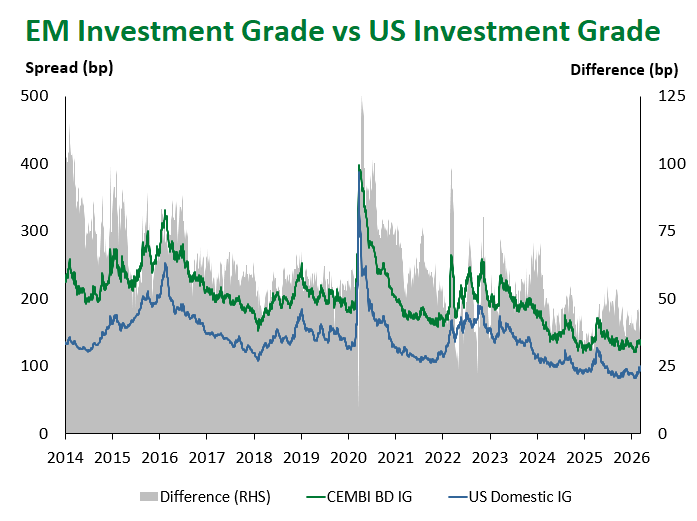
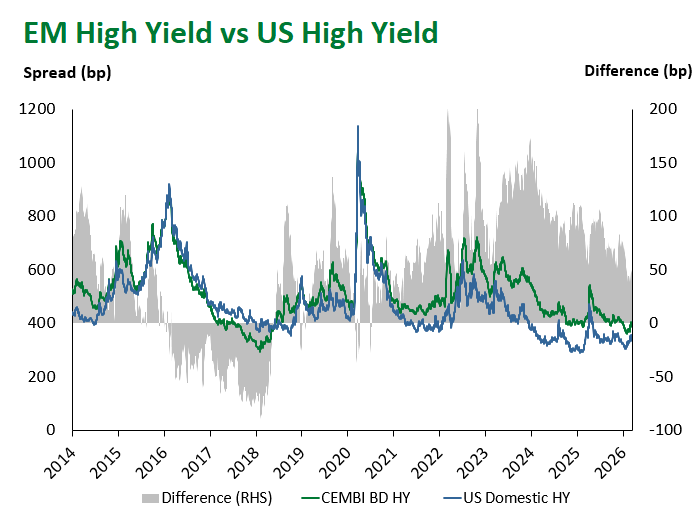
EM corporates delivered robust performance this week (+0.65%), with high yield (+1.57%) significantly outperforming investment grade (+0.03%). Regionally, Asia (-0.49%), Europe (-0.48%), and the Middle East (-0.42%) lagged, while Latin America (-0.19%) and Africa (-0.26%) outperformed. Gains were led by oil and gas credits in Ghana and Argentina. Across the curve, shorter-duration bonds outperformed, with the 1-3-year segment returning -0.18% versus -0.70% for 10+ year maturities. By rating, C rated credits were the only segment to post positive returns (+1.35%), while BBB-rated bonds underperformed (-0.53%), driven by higher rates.
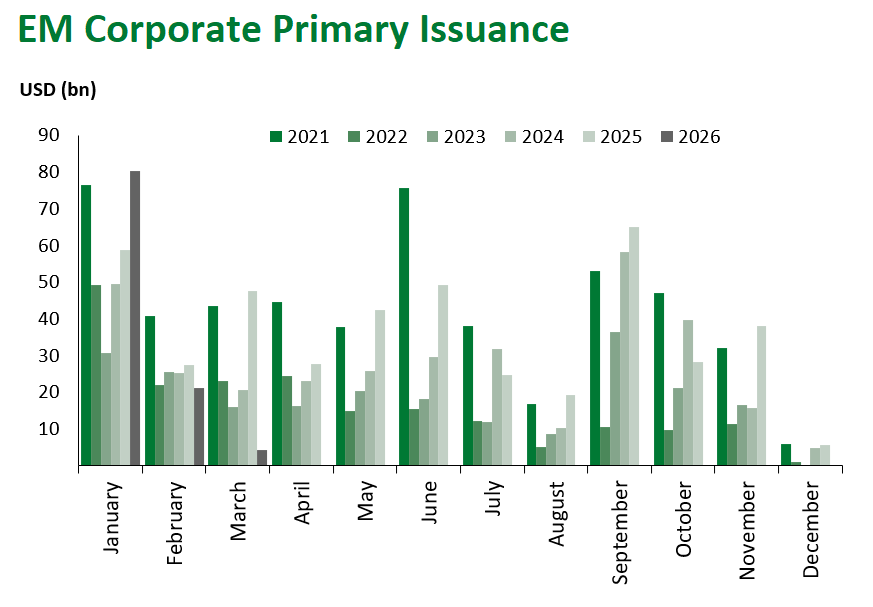
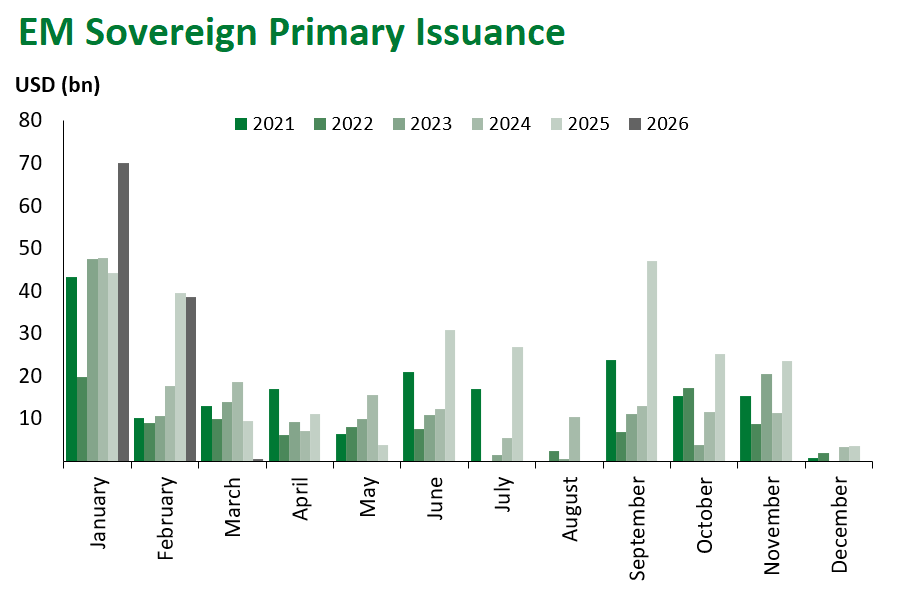
Primary market activity remained subdued, with only one issuer accessing the hard-currency market: ICBC of China, which issued $1 billion in USD and €500 million in euro-denominated bonds.
The Week Ahead
Markets will remain focused on developments in the Middle East, particularly security conditions in the Strait of Hormuz and the Red Sea, as investors continue to assess the duration and scope of disruptions to global energy supply and shipping routes. Absent indication of de-escalation, upward pressure on oil prices will likely persist and could more meaningfully challenge the relatively sanguine market backdrop.
In the United States, attention will center on the upcoming policy meeting of the Federal Reserve, where policymakers are widely expected to leave interest rates unchanged. Market participants will focus on forward guidance, the updated Summary of Economic Projections (SEP), and the revised dot plot, which will provide insight into the expected path of monetary policy.
Other U.S. data releases include Empire manufacturing, industrial production, ADP employment, PPI, new home sales, and building permits. Corporate earnings from Adobe and Oracle as well as the Nvidia GTC conference will provide signals on software spending, AI adoption, and advances to AI infrastructure.
Globally, monetary policy decisions will also remain in focus. The European Central Bank, Bank of Japan, and People’s Bank of China are all expected to maintain current policy settings, though investors will monitor commentary for any shifts in policy bias. Meanwhile, the Central Bank of Brazil may deliver a rate cut while Bank Indonesia is expected to keep policy rates unchanged.
Fixed Income
Equities
Commodities
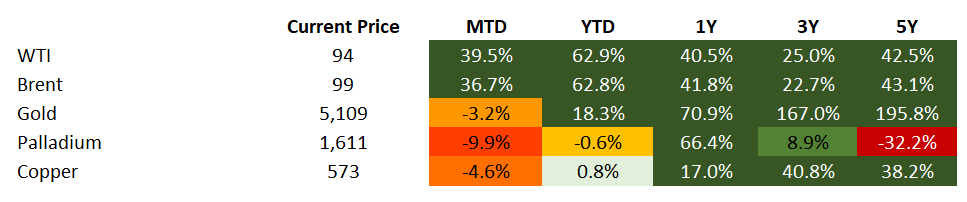
Source for data tables: Bloomberg, JPMorgan, Gramercy. EM Fixed Income is represented by the following JPMorgan Indicies: EMBI Global, GBI-EM Global Diversified, CEMBI Broad Diversified and CEMBI Broad High Yield. DM Fixed Income is represented by the JPMorgan JULI Total Return Index and Domestic High Yield Index. Fixed Income, Equity and Commodity data is as of Mar. 13, 2026 (mid-day).
Highlights
Colombian presidential primaries’ outcome points to a binary pre-election environment for markets
Event: Intra-party presidential primaries in Colombia completed the consolidation of the presidential election race, with Senator Paloma Valencia emerging as the clear winner on the Right and a potential frontrunner in the actual elections in May/June. Congress remained fragmented but appears likely to be dominated by centrist forces that should enjoy significant sway over policymaking by the next administration.
Gramercy Comment: After last weekend’s primaries, the presidential election field has been narrowed to six viable candidates (two each on the Right, Center and Left of the political spectrum), which should improve visibility for markets ahead of the first round of the presidential elections on May 31. Senators Paloma Valencia (right wing with centrist appeal) and Ivan Cepeda (left wing, supported by President Petro) appear to be best positioned to make it to a likely presidential runoff on June 21, signaling a binary market environment in the coming months. Political “outsider” Abelardo de la Espriella, who is ideologically to the right of Ms. Valencia, is another competitive candidate, but his likely limited appeal to centrist voters could prove to be a liability in a runoff against a unified Left behind Mr. Cepeda. Ms. Valencia’s choice of Juan Daniel Oviedo, a respected economist and technocrat, who came in second behind her in the Right’s primary, is likely to be seen as a constructive development by markets as it could help with capturing the critically important center and center-right vote. As for Congress, centrist/traditional parties gathered close to ten million votes and appear set to be the decisive factor on any policy decisions by the next Colombian administration, limiting the potential for radical reform in both directions. On balance, we see last Sunday’s electoral outcomes as moderately credit-positive for Colombian assets. A better-defined presidential field with a path for a right-wing candidate to win the likely run-off in June and a center-dominated Congress paint a supportive picture relative to market expectations. However, the competitiveness of left-wing candidate Cepeda (supported by a still popular President Petro) is likely to keep investors cautious, limiting near-term upside potential.
Emerging Markets Technicals
Emerging Markets Flows
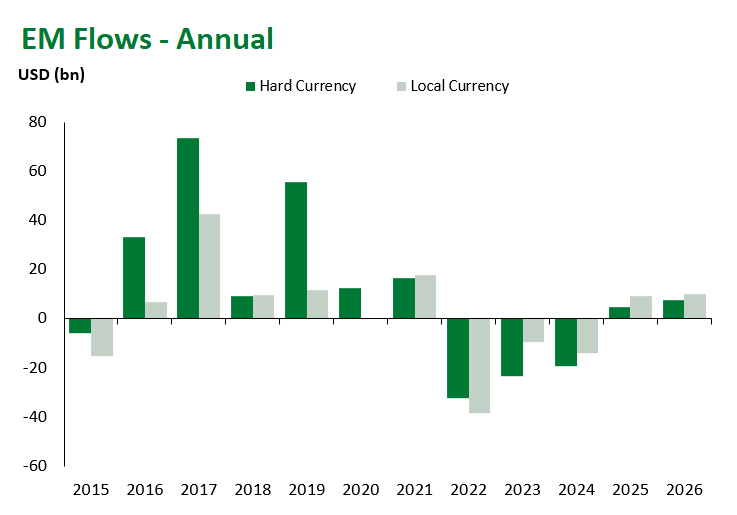
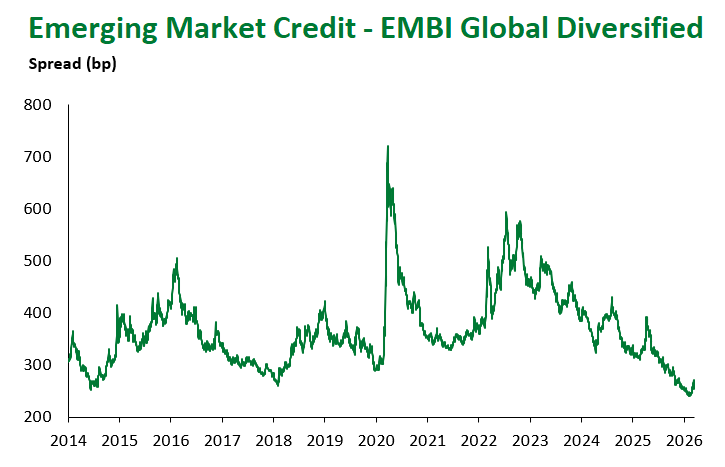
Source for graphs: Bloomberg, JPMorgan, Gramercy. As of Mar. 13, 2026.
For questions, please contact:
Kathryn Exum, CFA ESG, Director, Co-Head of Sovereign Research, [email protected]
Petar Atanasov, Director, Co-Head of Sovereign Research, [email protected]
This document is for informational purposes only. The information presented is not intended to be relied upon as a forecast, research or investment advice, and is not a recommendation, offer or solicitation to buy or sell any securities or to adopt any investment strategy. Gramercy may have current investment positions in the securities or sovereigns mentioned above. The information and opinions contained in this paper are as of the date of initial publication, derived from proprietary and nonproprietary sources deemed by Gramercy to be reliable, are not necessarily all-inclusive and are not guaranteed as to accuracy. This paper may contain “forward-looking” information that is not purely historical in nature. Such information may include, among other things, projections and forecasts. There is no guarantee that any forecasts made will come to pass. Reliance upon information in this paper is at the sole discretion of the reader. You should not rely on this presentation as the basis upon which to make an investment decision. Investment involves risk. There can be no assurance that investment objectives will be achieved. Investors must be prepared to bear the risk of a total loss of their investment. These risks are often heightened for investments in emerging/developing markets or smaller capital markets. International investing involves risks, including risks related to foreign currency, limited liquidity, less government regulation, and the possibility of substantial volatility due to adverse political, economic or other developments. References to any indices are for informational and general comparative purposes only. The performance data of various indices mentioned in this update are updated and released on a periodic basis before finalization. The performance data of various indices presented herein was current as of the date of the presentation. Please refer to data returns of the separate indices if you desire additional or updated information. Indices are unmanaged, and their performance results do not reflect the impact of fees, expenses, or taxes that may be incurred through an investment with Gramercy. Returns for indices assume dividend reinvestment. An investment cannot be made directly in an index. Accordingly, comparing results shown to those of such indices may be of limited use. The information provided herein is neither tax nor legal advice. Investors should speak to their tax professional for specific information regarding their tax situation.