


Contents
Market Overview
Macro Update
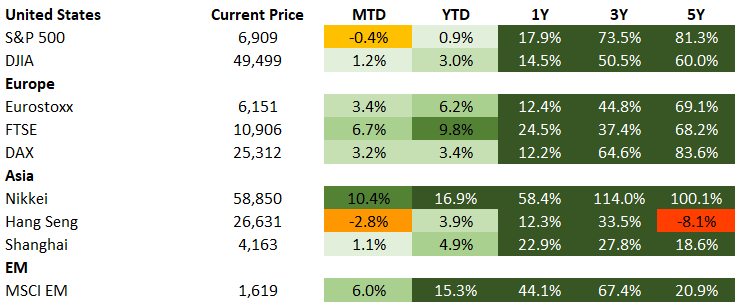
Markets this week continued to deal with a confluence of economics, finance and geopolitics. Investors remained worried about the disruptive potential of AI on the broader economy and concerns about an AI bubble resurfaced as companies such as Block, Inc. announced reducing their workforce by almost half in a bet on AI. Concerns about pockets of private credit loans going bad in developed economies also weighed on market sentiment. Meanwhile, geopolitical developments failed to provide relief as U.S.-Iran negotiations concluded the week without a deal and a fragile ceasefire between Pakistan and Afghanistan collapsed into intense clashes between the two neighbors.
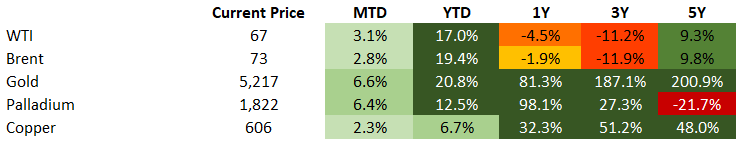
Against this backdrop, equity markets finished the week on a weak foot, while USD held its ground at a 97 handle on the DXY. In the context of rising global risks, the U.S. Treasury yields continued to move lower with the 10-year breaking below 4.0% for the first time since November 2025 and on track for its best monthly performance in a year. Other haven assets such as gold and silver spot prices also moved higher to around $5,250 and $94 per ounce, respectively. Bitcoin remained in its recent mid-$60,000 range.
Oil prices moved higher (low $70s for Brent and mid $60s for WTI) and were largely dictated by the third round of nuclear negotiations between the U.S. and Iran, which were initially described as constructive by Oman’s foreign minister who is mediating the discussions, but reportedly came to a halt on lack of agreement on U.S. demand for zero enrichment. President Trump has set a March 1-6 deadline for Iran to reach an agreement, warning of potential military action in the absence of progress. Further discussions are expected to take place next week, but analyst expectations for eventual U.S. military strikes remain elevated.
In U.S. macro data, inflation dynamics reinforced expectations that the Fed is unlikely to resume cutting rates in 1H26. Data released on Friday showed that prices paid by U.S. producers (measured by the PPI index) rose in January more than expected (0.5% vs 0.3% month-over-month and 2.9% vs 2.6% year-over-year). Stripping the volatile food and energy components, PPI (0.8% vs 0.3% month-over-month and 3.6% vs 3.0% year-over-year) advanced the most since July, pointing to lingering inflationary pressures in the economy. Consumer confidence exceeded expectations, driven primarily by improved forward-looking sentiment, even as assessments of current conditions softened from the prior month. Initial jobless claims were broadly in line with consensus.
Meanwhile, the evolving U.S. tariff landscape had a contained impact on financial markets this week. While the effective tariff rate declined modestly, the U.S. administration signaled its intention to pursue alternative measures to maintain trade pressure.
Russia continued its deadly attacks on Ukraine as President Volodymyr Zelenskyy and President Trump discussed next steps toward potential peace negotiations, ahead of U.S.-Ukraine meetings scheduled for next week. Meanwhile, Pakistan declared “open war” on Afghanistan’s Taliban authorities as a fragile ceasefire agreement from October collapsed.
In the euro area, confidence indicators modestly underperformed expectations, while ECB inflation expectations data came in at 2.6% on both 1- and 3-year horizons vs expectations of 2.7% and 2.5%, respectively.
In Japan, Prime Minister Sanae Takaichi nominated two dovish candidates for governor positions at the Bank of Japan and signaled caution regarding further rate hikes. Later in the week, Bank of Japan board member Hajime Takata reiterated his call for additional tightening, describing inflation as “heated to the core”, which partially reversed the recent rally in Japanese government bonds.
In China, the People’s Bank of China left policy rates unchanged, as expected. President Xi Jinping continued his military anti-corruption campaign, removing nine additional military lawmakers from parliament. The renminbi appreciated against the U.S. dollar, supported in part by tariff relief under the latest iteration of U.S. trade policy.
EM Credit Update
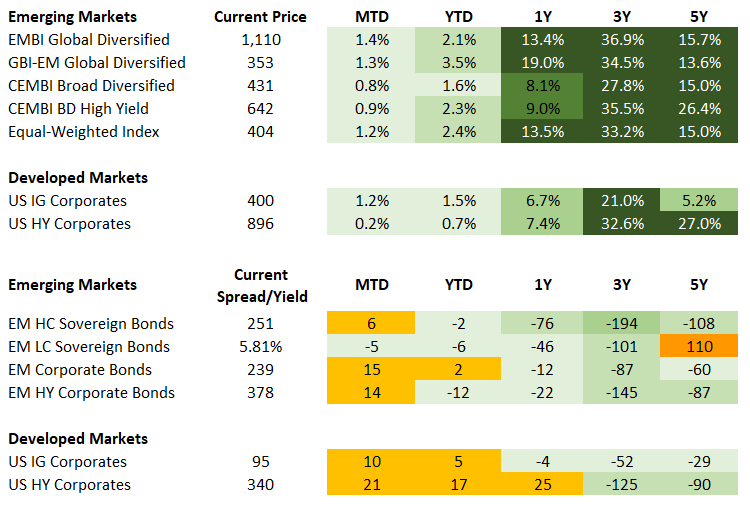
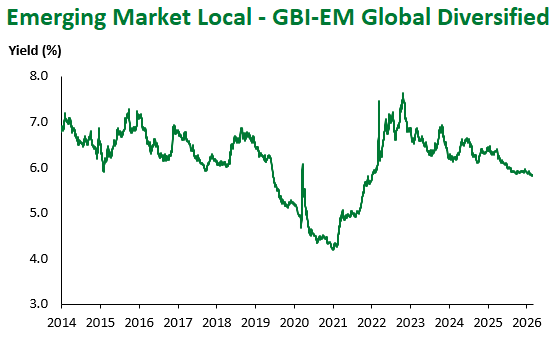
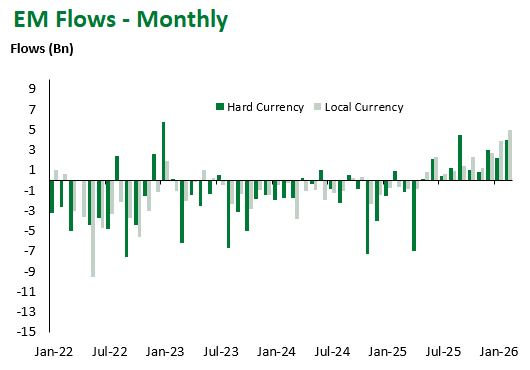
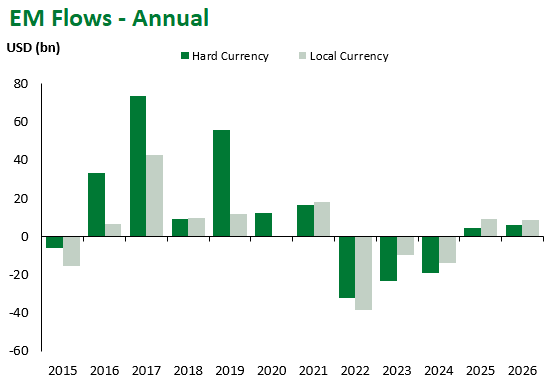
Emerging Markets (EM) fixed income saw differentiated performance this week against a volatile global macro backdrop. Local-currency debt regained leadership, returning +0.56% on the week. The Dominican Republic (+3.22%) and South Africa (+2.56%) were the standout performers. In the Dominican Republic, bonds extended their rally as easing inflation and resilient growth reinforced expectations for policy easing, driving yield compression in a high-carry environment alongside stable FX. South Africa also rallied, with investors pricing in a supportive budget and improving fiscal outlook. In contrast, Colombia (-4.20%) and Egypt (-0.98%) were the only local markets in negative territory. Colombia underperformed amid rising fiscal and election-related uncertainty. Concerns over a sizable minimum-wage hike, unanchored inflation expectations, and a leftist candidate leading in the polls pushed yields higher and weighed on local assets. Egypt lagged as renewed pressure on the Egyptian pound and persistently elevated local yields reflected ongoing FX constraints and cautious investor positioning, despite solid inflows and remittance data.
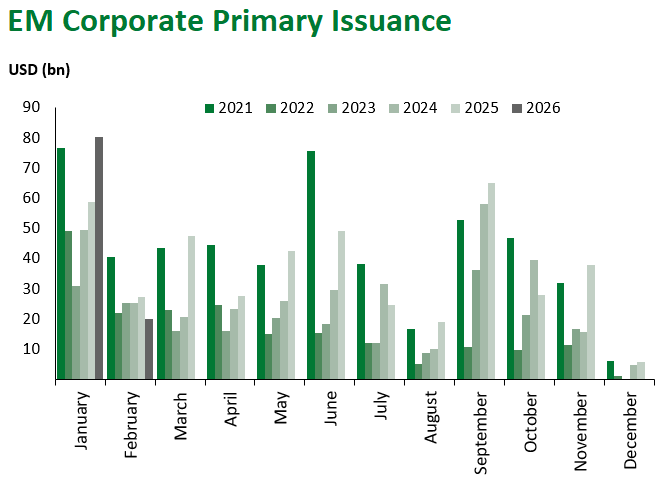
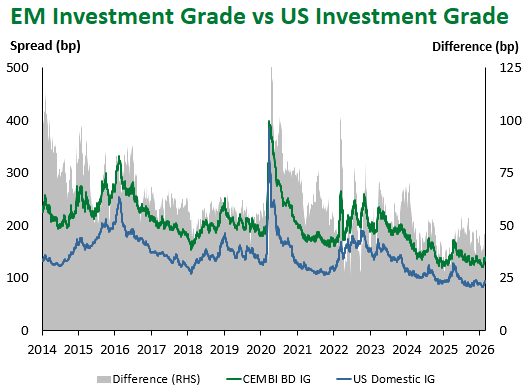
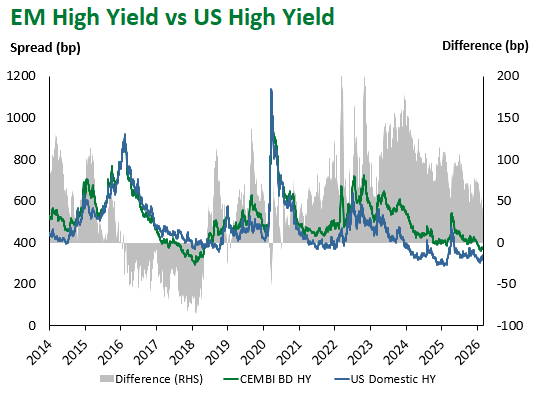
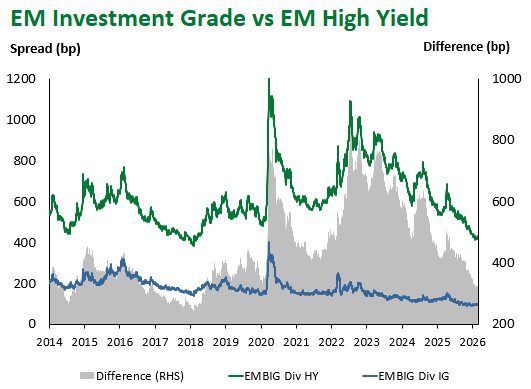
EM corporates also delivered positive returns through Thursday (+0.21%), with broadly similar performance across high yield – supported by carry – and investment grade, which benefited from favorable rates moves. Regionally, Africa (+0.41%) led gains, driven in part by a sharp rally in Ghanaian corporate credit (+6.35%). Notably, Kosmos Energy bonds surged after Ghana’s parliament ratified extensions of the Jubilee and TEN offshore licenses to 2040, enhancing long-term asset visibility, strengthening cash-flow expectations, and reinforcing balance-sheet confidence following recent refinancing activity. Europe (+0.16%) and Latin America (+0.17%) posted more modest, though still healthy, gains. Across the curve, longer-duration bonds outperformed, with the 10+ year segment gaining +0.33% versus +0.13% for the 1-3 year bucket. By rating, CCC-rated bonds led (+0.47%), while BBs lagged (+0.13%). At the index level, corporate spreads widened modestly by 5bps.
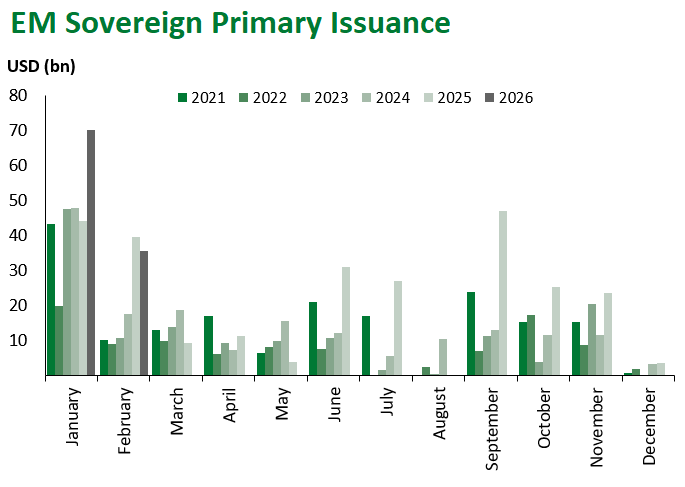
Hard-currency sovereigns were slightly positive through Thursday (+0.10%), with solid investment grade performance (+0.27%) offsetting weakness in high yield (-0.06%). Regionally, Europe (+0.26%) outperformed, while Africa (+0.03%) and the Middle East (+0.02%) lagged. However, sentiment deteriorated into Friday as global risk tone turned more negative. As of mid-morning, hard-currency sovereigns were down -0.23% at the index level on the day, with high yield declining -0.39% and investment grade lower by -0.08%, reflecting broader de-risking across credit markets. In the Middle East, positioning remained cautious amid rising geopolitical tensions between the U.S. and Iran. In Africa, oil-linked sovereigns were pressured by lower crude prices, alongside weaker risk appetite and rotation out of more liquid high yield paper.
Primary market activity picked up modestly, with 15 issuers pricing $20 billion in hard-currency debt. Nearly half of issuance was euro-denominated, with Indonesia and Romania tapping the EUR market. Approximately 87% of deals were investment grade, and 68% came from sovereign or supranational issuers. Paraguay, Hungary, and Abu Dhabi were also among the more notable borrowers.
The Week Ahead
In the United States, focus will center on the February employment report for an updated assessment of labor market conditions. Consensus expects private nonfarm payroll growth to moderate to 75,000, down from 172,000 in January. February ISM indices and January retail sales data will also be released, providing further insight into business activity and consumer demand.
In Europe, key releases will include Eurozone CPI, the unemployment rate, retail sales, and fourth-quarter GDP data, all of which will help shape expectations for regional growth and monetary policy.
In Asia, Japan is scheduled to publish PMI, consumer confidence, and labor market data. In China, annual parliamentary meetings will commence, with authorities widely expected to lower the official growth target to “around-4.5%”.
Monetary policy decisions are due in Poland and Malaysia.
Finally, OPEC will convene this weekend to determine April production policy amid heightened regional geopolitical tensions.
Fixed Income
Equities
Commodities
Source for data tables: Bloomberg, JPMorgan, Gramercy. EM Fixed Income is represented by the following JPMorgan Indicies: EMBI Global, GBI-EM Global Diversified, CEMBI Broad Diversified and CEMBI Broad High Yield. DM Fixed Income is represented by the JPMorgan JULI Total Return Index and Domestic High Yield Index. Fixed Income, Equity and Commodity data is as of Feb. 27, 2026 (mid-day).
Highlights
South Africa annual budget underscores consolidation
Event: Minister of Finance Enoch Godongwana presented the 2026 budget, which reaffirmed the country’s consolidation path with a main budget deficit of 4.5% of GDP for fiscal year 2025/26 and 3.7% of GDP for fiscal year 2026/27, increasing primary surpluses, and a 2026 growth forecast of 1.6%. Debt is set to stabilize this year at 78.9% of GDP and ease to 77.3% of GDP in 2026/27. Weekly local government bond issuance was adjusted downward by 450 million rand. Authorities will announce a principles-based medium-term fiscal anchor later this year, which will require each new administration to outline a medium-term plan and an appropriate fiscal metric to measure compliance. The rand and SAGBs rallied in the aftermath.
Gramercy Comment: We see South Africa’s commitment to fiscal consolidation as well as a comparatively smoother budget process relative to last year’s as positive for the market and the country’s credit ratings. Commodities-related revenue assumptions could turn out to be conservative, leaving room for modest upside risk while implementation of a fiscal anchor and larger fiscal surpluses bode well for the medium-term debt trajectory notwithstanding usual growth and latent spending risks. We expect positive rating action from Fitch and Moody’s following S&P’s upgrade to BB last quarter. Further upgrades from S&P could ensue following a constructive medium-term budget statement in 4Q.
Trade tensions between Colombia and Ecuador escalate but key credit drivers are elsewhere
Event: Ecuador’s government said it plans to increase tariffs on imports from Colombia to 50% from 30% effective March 1, just days after the Petro administration announced 30% reciprocal tariffs in goods from Ecuador in an escalating trade dispute between the two Andean neighbors. Meanwhile, pre-election polls in Colombia showed leftist presidential candidate Ivan Cepeda with a significant lead, while Ecuador’s sovereign credit rating was upgraded by one notch to B- with a stable outlook by Fitch.
Gramercy Comment: The public trade spat between the Petro and Noboa administrations is unsurprisingly generating significant news flow, but its direct market and macro relevance for both credits is likely to be limited. Only around 2.5% of total Ecuadorian exports go to Colombia and around 4.0% of total Colombian exports to Ecuador, according to latest data. As such, the key factors driving investor sentiment in 1H 2026 are elsewhere. In the case of Colombia, the focus is clearly on the upcoming elections in March (legislative) and May/June (presidential). The lead in the polls of left-wing candidate Cepeda has put downside pressure on Colombian assets lately, but we note that the election field is still quite fragmented and fluid; better clarity for markets could emerge after party presidential primaries scheduled for March 8 that could paint a more clear picture around the main candidates on the left, center and right of Colombia’s political specter and their respective chances. As for Ecuador, the latest sovereign rating upgrade by Fitch (Moody’s already upgraded the sovereign by two notches at the end of January) reflects Ecuador’s successful return to the global capital markets earlier this year for the first time since 2019 and after its 2020 sovereign debt restructuring, as well as general macro and fiscal improvement under the country’s IMF program. Supported by the Noboa administration’s reform momentum, we expect good relations with the IMF to continue to drive spread tightening relative to Ecuador’s peers in the single-B sovereign space.
Emerging Markets Technicals

Emerging Markets Flows
Source for graphs: Bloomberg, JPMorgan, Gramercy. As of Feb. 27, 2026.
For questions, please contact:
Kathryn Exum, CFA ESG, Director, Co-Head of Sovereign Research, [email protected]
Petar Atanasov, Director, Co-Head of Sovereign Research, [email protected]
This document is for informational purposes only. The information presented is not intended to be relied upon as a forecast, research or investment advice, and is not a recommendation, offer or solicitation to buy or sell any securities or to adopt any investment strategy. Gramercy may have current investment positions in the securities or sovereigns mentioned above. The information and opinions contained in this paper are as of the date of initial publication, derived from proprietary and nonproprietary sources deemed by Gramercy to be reliable, are not necessarily all-inclusive and are not guaranteed as to accuracy. This paper may contain “forward-looking” information that is not purely historical in nature. Such information may include, among other things, projections and forecasts. There is no guarantee that any forecasts made will come to pass. Reliance upon information in this paper is at the sole discretion of the reader. You should not rely on this presentation as the basis upon which to make an investment decision. Investment involves risk. There can be no assurance that investment objectives will be achieved. Investors must be prepared to bear the risk of a total loss of their investment. These risks are often heightened for investments in emerging/developing markets or smaller capital markets. International investing involves risks, including risks related to foreign currency, limited liquidity, less government regulation, and the possibility of substantial volatility due to adverse political, economic or other developments. References to any indices are for informational and general comparative purposes only. The performance data of various indices mentioned in this update are updated and released on a periodic basis before finalization. The performance data of various indices presented herein was current as of the date of the presentation. Please refer to data returns of the separate indices if you desire additional or updated information. Indices are unmanaged, and their performance results do not reflect the impact of fees, expenses, or taxes that may be incurred through an investment with Gramercy. Returns for indices assume dividend reinvestment. An investment cannot be made directly in an index. Accordingly, comparing results shown to those of such indices may be of limited use. The information provided herein is neither tax nor legal advice. Investors should speak to their tax professional for specific information regarding their tax situation.