


Contents
Market Overview
Macro Update
U.S. President Donald Trump announced Friday that he intends to nominate Kevin Warsh to be the next Fed chair. Mr. Warsh, who sat on the Fed Board of Governors from 2006 to 2011, is seen by investors as a more orthodox figure compared to some of the other candidates and as such is likely to proceed more cautiously with monetary policy easing.
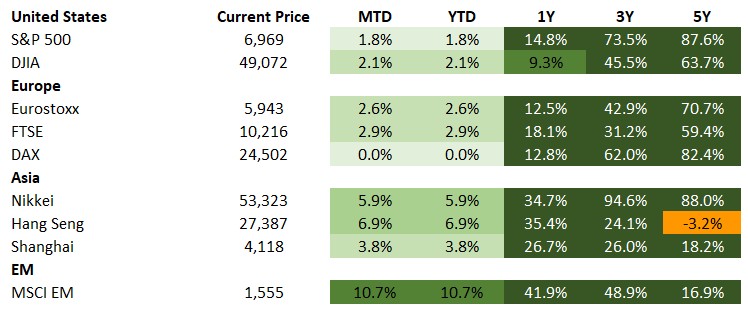
Upon the Warsh announcement, and amid a flurry of corporate earnings that showed no signs of easing up on AI spending, U.S. equity indexes retreated from near-record highs. The treasury curve bear-steepened with the 10-year and 30-year yields ending the week around 4.25% (+5 bps) and 4.90% (+10 bps), respectively.
Metal markets saw wild swings this week as spot gold and silver prices experienced a sharp plunge after their scorching rally took them to all-time highs of around $5400 and $117 per ounce, respectively. Gold finished the week around 7.5% off the mid-week highs, and silver was off around 16%.
Notable dollar weakness reversed slightly on the Warsh news. Earlier in the week, as the dollar fell to a four-year low against other major currencies amid President Trump’s comments that the dollar was “doing great,” speculations that the U.S. and Japan might intervene to support the Japanese Yen, and concerns about another U.S. federal government shutdown.
Oil remained on an upward trajectory amid Trump’s bellicose rhetoric on Iran and as the U.S. naval “armada” reached the Middle East. Iran’s foreign minister suggested that his country is ready for “immediate and powerful response” in case of U.S. aggression. Against this backdrop, spot Brent prices broke into the $70s per barrel for the first time since the summer of 2025, and WTI reached the mid-$60s. Bitcoin broke to its recent low from November 2026, ending the week in the low-$80,000s.
Earlier in the week, the Fed kept its benchmark interest rate unchanged (3.75%) following three consecutive cuts since September; two governors dissented in favor of a 25 bps reduction. President Trump reacted angrily to the no cut decision, calling for “the lowest interest rate of any country in the world.” The Fed noted signs of stabilization in the labor market and described economic activity as expanding at a “solid pace,” but provided no guidance on the timing of future rate cuts. The market is currently pricing two full additional 25 cuts by the end of 2026.
Geopolitics remained in focus as the “massive armada” of the U.S. made its way to waters near Iran, and trilateral talks involving Ukraine, Russia, and the U.S. continued in the UAE.
In a mutual effort to diversify away from security and economic interdependence with the U.S., the EU and India unveiled the “mother of all trade deals,” in which both sides commit to major tariff reductions on almost all their bilateral trade in goods.
Along the same lines, the UK and China announced plans for greater economic partnership and closer ties during the British PM’s trip to Beijing, the first official visit at that level in eight years. President Trump warned the UK and Canada against striking business deals with China, saying it would be “very dangerous.”
In addition to the Fed’s policy rate decision, U.S. macro data flow included the Conference Board Consumer Confidence index for January that plunged to the lowest level since April’s “Liberation Day,” showing a broad-based deterioration in consumer sentiment. Initial jobless claims were little changed for the week ending January 24, remaining anchored around 200,000.
The December Producer Price Index (PPI) rose 0.5% month-over-month vs. 0.2% consensus expectation and over the prior month. This marks the fastest pace in three months, suggesting that companies are increasingly passing on tariff costs to U.S. consumers, keeping inflationary pressures elevated.
The euro area economy grew more than expected at the end of last year (0.3% quarter-over-quarter vs. 0.2% consensus), demonstrating resilience to the global trade turmoil unleashed by the Trump administration policies. The economies of Germany, Italy, and Spain also beat estimates, while France matched the expected pace of 0.2% quarter-over-quarter.
EM Credit Update
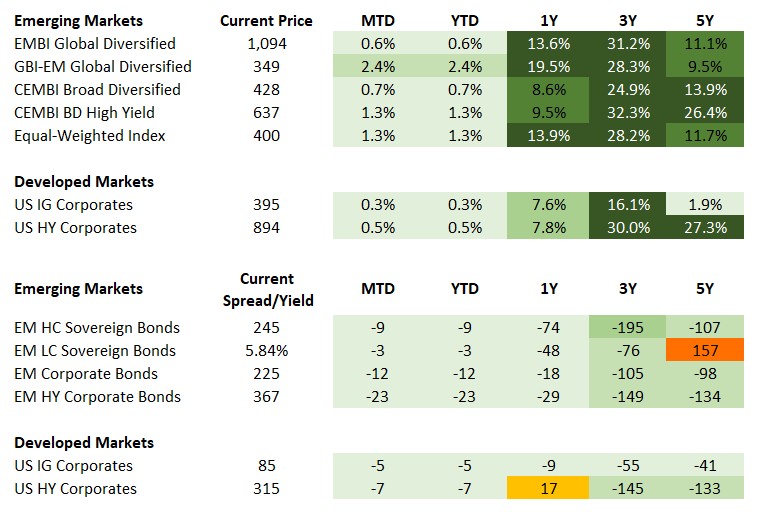
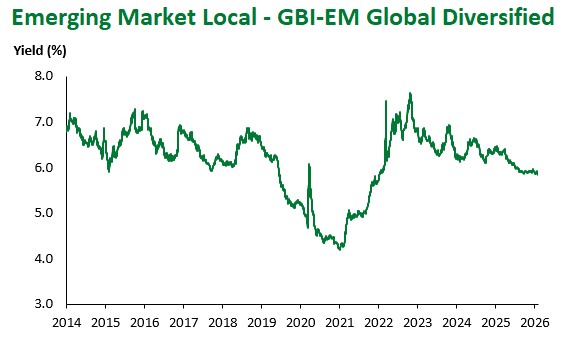
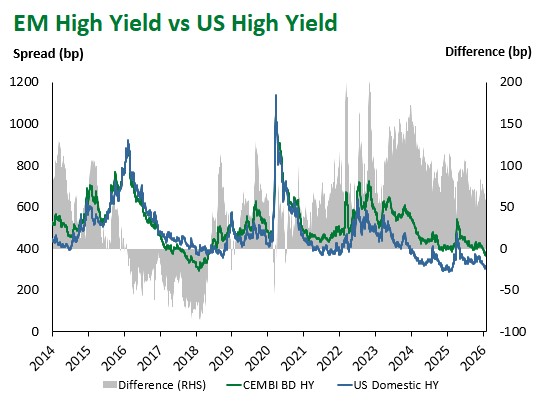
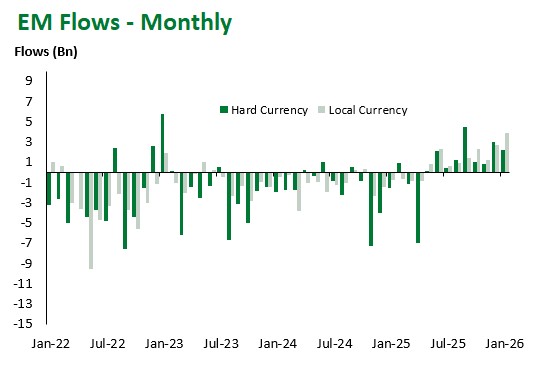
Emerging Markets (EM) fixed income delivered solid results this week, with positive performance across sub-asset classes, underpinned by strength in high yield. Local-currency debt once again led returns, advancing +0.99% as the “sell U.S.” narrative continued to dominate investor sentiment. South Africa (+3.71%), Malaysia (+3.11%), and Brazil (+2.47%) outperformed, supported by favorable local rate dynamics and, in some cases, commodity strength. In contrast, Uruguay (-2.24%) and Colombia (-1.52%) lagged. Spreads were broadly unchanged over the week.
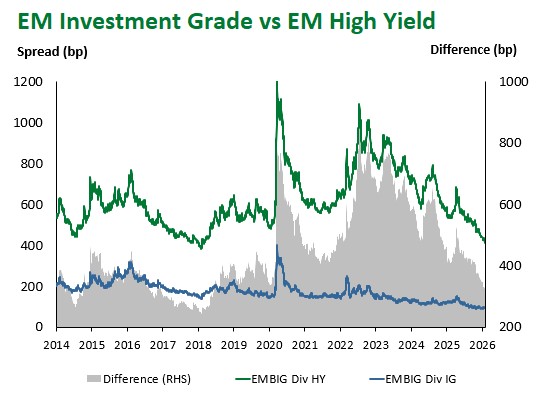
Hard-currency sovereigns posted modest gains, returning +0.09%, driven by high yield (+0.18%), which offset flat performance in investment grade. Performance was regionally dispersed, with Europe (+0.19%) and Latin America (+0.17%) leading, while the Middle East (-0.06%) and Africa (-0.06%) lagged. At the country level, Argentina (+1.94%) and Gabon (+1.67%) were top performers. Gabon extended its recent rally, albeit at a slower pace, while Argentina benefited from improving EM risk sentiment. Senegal (-1.74%) and El Salvador (-0.85%) underperformed. Senegal bonds lagged as the recent rally stalled amid limited progress in IMF discussions, while El Salvador was weighed down by heightened market focus on delays in securing approval for the second review of the IMF’s Extended Fund Facility.
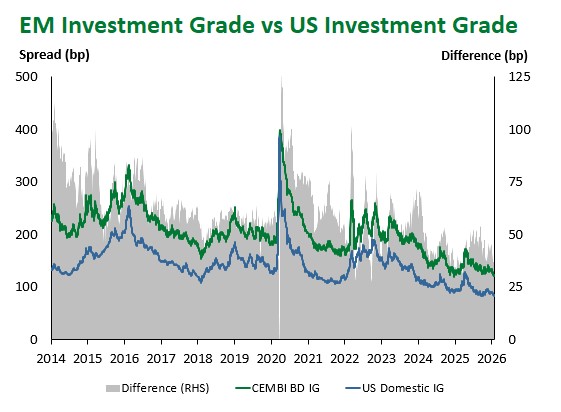
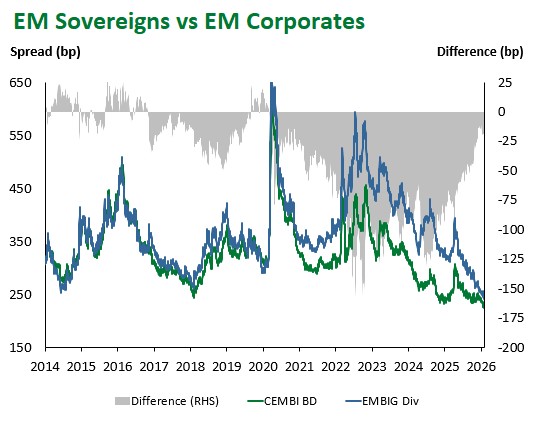
EM corporate bonds outperformed sovereigns this week, returning +0.17%, with high yield (+0.28%) again outperforming investment grade (+0.08%). Europe (+0.22%) led regional performance, supported by continued strength in Ukrainian corporates (+2.23%) amid rising hopes of conflict resolution. The Middle East (+0.06%) lagged, pressured by heavy primary market supply. Along the curve, the 3-year to 5-year maturity bucket outperformed (+0.19%), while the 10+-year segment lagged (+0.11%). By rating, the ‘C’ bucket led performance (+1.03%), while BBBs (+0.06%) trailed. Corporate spreads tightened modestly by 1 bp at the index level.
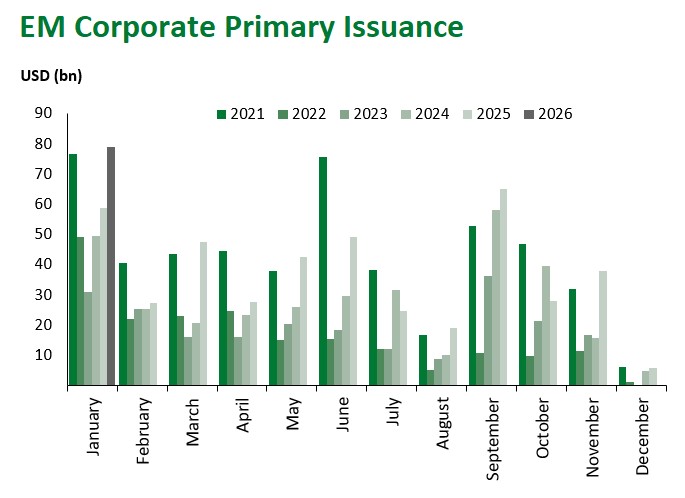
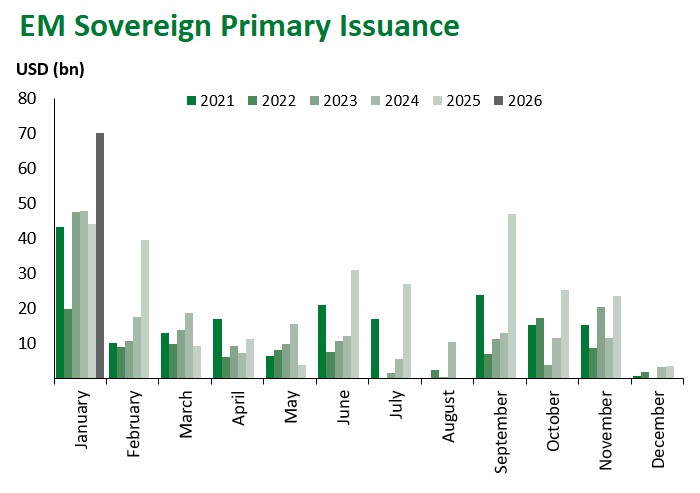
Primary market activity picked up again, with approximately $22.5 billion of hard-currency issuance from 34 issuers across 26 tranches. Sovereigns accounted for 37% of total supply. Issuance was more balanced this week, with investment grade representing only 43% of total volume. Notably, Ecuador returned to the bond market for the first time since its 2020 external debt restructuring, successfully raising U.S. $4 billion across two tranches and using proceeds to tender shorter-dated bonds. This helped alleviate concerns around market access.
The Week Ahead
The week ahead includes rate decisions by the European Central Bank and the Bank of England. Both institutions are expected to leave their key rates unchanged at 2.0% and 3.75%, respectively. Rate decisions by the central banks in Poland, Czechia, Mexico, and India are also on the agenda. January manufacturing PMIs will be released in the U.S., China, the eurozone, France, Germany, India, and the UK. Other notable releases include the January jobs report, JOLTS job openings, initial jobless claims, the preliminary February University of Michigan consumer sentiment in the U.S. and German industrial production for December. Beyond macro data, markets will see another round of trilateral talks in the UAE between officials from Ukraine, Russia, and the U.S., while the UK’s prime minister continues his Asia tour with a visit to Japan to meet with his counterpart, Sanae Takaichi. OPEC+ ministers meet to review oil market conditions and production policy, and the Indian finance minister is set to present next year’s budget, with a focus on fiscal discipline. Costa Rica holds legislative elections and the first round of presidential elections. The heavy slate of corporate earnings continues with companies such as Alphabet and Amazon reporting.
Fixed Income
Equities
Commodities
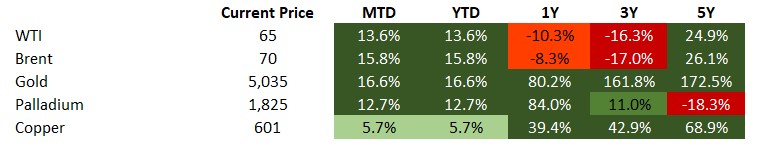
Source for data tables: Bloomberg, JPMorgan, Gramercy. EM Fixed Income is represented by the following JPMorgan Indicies: EMBI Global, GBI-EM Global Diversified, CEMBI Broad Diversified and CEMBI Broad High Yield. DM Fixed Income is represented by the JPMorgan JULI Total Return Index and Domestic High Yield Index. Fixed Income, Equity and Commodity data is as of Jan. 30, 2026 (mid-day).
Highlights
Ecuador Returns to Global Capital Markets, Gets Ratings Upgrade
Event: The government of Ecuador tapped international financial markets for the first time since its sovereign debt default and restructuring in 2020, issuing $4 billion of 7-year and 12-year securities with coupons of 8.75% and 9.25%, respectively. Concurrently, the authorities repurchased $3 billion of the restructured 2030 and 2035 bonds, which improves the sovereign’s medium-term maturity profile and reduces market debt service by around $1.5 billion over the next five years.
Gramercy Comment: Ecuador becomes the second sovereign, after Suriname, emerging from pandemic-era defaults to regain market access. The government’s return to capital markets is a breakthrough for the administration of President Daniel Noboa, as well as an important milestone under the country’s IMF program. Now that market access has been re-established after more than six years – the last unsecured market issuance was in September 2019 – investors should feel further reassured by the government’s funding access. Amid an improving credit trajectory since President Noboa took office in May 2025, Ecuador was also rewarded by a two notch rating upgrade by Moody’s (to Caa1). The upgrade was driven by broadening financing availability from official lenders and international capital markets, in addition to stronger fiscal performance, permanent revenue measures (VAT and diesel subsidy reforms), and anchored investor sentiment under the IMF program. Supported by recent economic reforms, Ecuador’s sovereign spreads at the index level have compressed by a remarkable ~1500 bps since Mr. Noboa’s election. However, they remain wide relative to key peers of similar credit quality. In that context, we expect regained market access and continuing reform momentum to drive further spread tightening this year.
China Military Purge Reflects Power Consolidation Under Xi
Event: Chinese President Xi Jinping removed top military leaders, Zhang Youxia and Liu Zhenli, in the latest and most significant move in a purge of the armed forces that has been going on since 2023. On the economic front, several provinces lowered their 2026 growth targets by around 50 bps, increasing speculation for a reduction in the national target to 4.5%-5.0%. At the same time, local news sources reported a potential relaxation in the “Three Red Lines” disclosure requirements aimed to curb leverage of property developers. Chinese property stocks jumped on the headlines.
Gramercy Comment: We interpret the recent military changes as an effort by President Xi to further consolidate power, preempt potential challenges to his rule, and enhance the People’s Liberation Army’s capabilities over time. In the near term, these adjustments may lower the risk of an imminent Taiwan invasion but could increase risks over the medium term. Some analysts suggest that key vacancies may remain unfilled until the 21st Party Congress in 2027. In the interim, China is likely to continue opportunistic military exercises around Taiwan and in the South China Sea. Recent U.S.– Philippines joint drills at Scarborough Shoal – where China has expanded its presence – heighten the probability of retaliatory Chinese exercises in the coming weeks.
On the economic front, market consensus already places China’s 2026 growth at 4.5%, roughly 50 bps below the official 5% target maintained over the past three years. As a result, announcing a national growth target near this level in March is unlikely to be disruptive. We expect policymakers to continue incremental policy fine-tuning while avoiding broad-based easing. Easing requirements for property developers on its own would be a signal of authorities’ priorities for the sector, rather than a catalyst for a recovery, as many restrictions have already been eased or not enforced. We expect authorities will eventually introduce new policy frameworks to address the sector’s structural challenges and arrears, but the timing remains uncertain.
Emerging Markets Technicals
Emerging Markets Flows
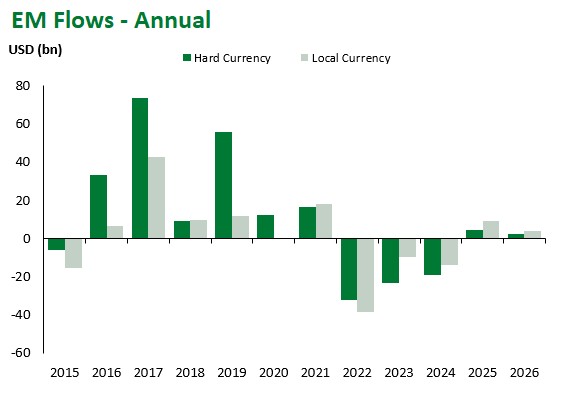
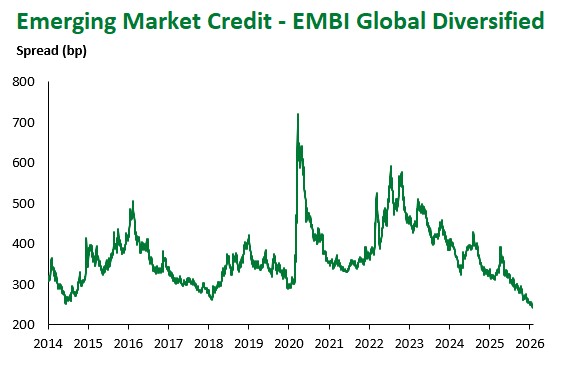
Source for graphs: Bloomberg, JPMorgan, Gramercy. As of Jan. 30, 2026.
For questions, please contact:
Kathryn Exum, CFA ESG, Director, Co-Head of Sovereign Research, [email protected]
Petar Atanasov, Director, Co-Head of Sovereign Research, [email protected]
This document is for informational purposes only. The information presented is not intended to be relied upon as a forecast, research or investment advice, and is not a recommendation, offer or solicitation to buy or sell any securities or to adopt any investment strategy. Gramercy may have current investment positions in the securities or sovereigns mentioned above. The information and opinions contained in this paper are as of the date of initial publication, derived from proprietary and nonproprietary sources deemed by Gramercy to be reliable, are not necessarily all-inclusive and are not guaranteed as to accuracy. This paper may contain “forward-looking” information that is not purely historical in nature. Such information may include, among other things, projections and forecasts. There is no guarantee that any forecasts made will come to pass. Reliance upon information in this paper is at the sole discretion of the reader. You should not rely on this presentation as the basis upon which to make an investment decision. Investment involves risk. There can be no assurance that investment objectives will be achieved. Investors must be prepared to bear the risk of a total loss of their investment. These risks are often heightened for investments in emerging/developing markets or smaller capital markets. International investing involves risks, including risks related to foreign currency, limited liquidity, less government regulation, and the possibility of substantial volatility due to adverse political, economic or other developments. References to any indices are for informational and general comparative purposes only. The performance data of various indices mentioned in this update are updated and released on a periodic basis before finalization. The performance data of various indices presented herein was current as of the date of the presentation. Please refer to data returns of the separate indices if you desire additional or updated information. Indices are unmanaged, and their performance results do not reflect the impact of fees, expenses, or taxes that may be incurred through an investment with Gramercy. Returns for indices assume dividend reinvestment. An investment cannot be made directly in an index. Accordingly, comparing results shown to those of such indices may be of limited use. The information provided herein is neither tax nor legal advice. Investors should speak to their tax professional for specific information regarding their tax situation.