


Contents
Market Overview
Macro Update
This week, global markets remained in the grip of geopolitics. The spotlight was on Iran, where the regime’s crackdown on nationwide protests intensified, with some reports suggesting that as many as 10,000 protesters have been killed. President Trump appeared to consider U.S. military intervention in support of the protests, posting on social media that “help is on its way” and urging Iranians to “take over institutions”, but subsequently appeared to back off as he claimed that “killing has stopped”. Earlier, Trump threatened that countries “doing business” with Iran would face immediate new tariffs of 25%.
Greenland remained a hot topic amid potential developments that could trigger a huge internal crisis for NATO. Denmark’s Foreign Minister met U.S. Vice President J.D. Vance and Secretary of State Marco Rubio in Washington for “constructive” talks but cautioned that “fundamental disagreement” remained. Prior to the meeting, Greenland’s Prime Minister said that the territory “cannot under any circumstances accept” U.S. control, while President Trump insisted that “anything other than U.S. control” would be unacceptable.
On Venezuela, Trump spoke on the phone with interim President Delcy Rodriguez and characterized her as a “terrific person”. A day later he met at the White House with exiled opposition leader and Nobel Prize laureate Maria Corina Machado; Mr. Trump said Ms. Machado’s decision to gift her Nobel peace prize medal to him was “a great honor” but did not commit to any timeframe for a potential internationally recognized election in Venezuela. Regarding Cuba, Mr. Trump said that the country will no longer receive a subsidy in the form of free Venezuelan oil, a key lifeline for its struggling economy, and demanded a deal with his administration “before it is too late”.
In U.S. domestic affairs, market concerns about Fed independence and policymaking credibility came back to the forefront as the Trump administration opened a criminal investigation into the Federal Reserve and personally against Chair Jerome Powell related to his testimony to Congress about a renovation of the Fed’s headquarters. Mr. Powell said the “unprecedented action” was an attack on the Central Bank’s independence and his colleagues from around the world issued a joint statement in his support. Meanwhile, President Trump appeared to voice reluctance over nominating his close associate Kevin Hassett for Fed chair, triggering a sharp increase in the markets’ probability assigned to Kevin Warsh’s nomination.
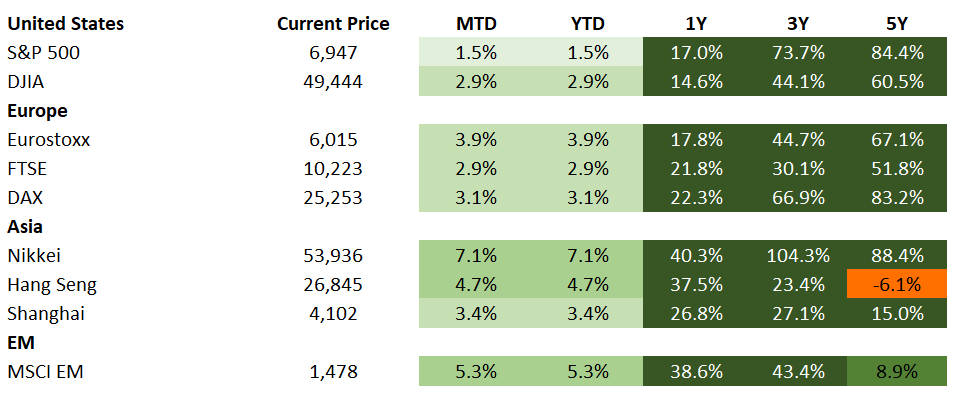
Amid intense geopolitical and political noise and uncertainty across the globe, stock markets were mixed, supported by an upbeat outlook by chipmaker Taiwan Semiconductor Manufacturing (TSM), Asia’s most valuable company, that revived hopes about the longevity of the bull-market driver. Bond yields globally were little changed, with the U.S. Treasuries curve bull-flattening as the 10-year remained stable at ~ 4.20%, while the longer end tightened by ~5bps to ~4.80%.
The dollar extended its YTD momentum, closing above 99 on the DXY index for the first time since early December. Bitcoin rallied, climbing to around $95,000. Oil prices gave up earlier gains on apparent de-escalation in Iran-U.S. tensions, finishing the week back in the low/mid $60s and high 50s per barrel for Brent and WTI, respectively. Spot gold silver had another record-breaking week, reaching all-time highs of $4,640 and $93/oz, respectively, but closed off the highs.
In the world of macro data, the December U.S. CPI report came in line with median market expectations, showing that headline inflation remained stable (2.7% year-over-year and 0.3% month-over-month); the core measure (net of food and energy prices) rose by less than expected (0.2% month-over-month and 2.6% year-over-year), signaling that the tariff-driven price momentum might have peaked. Initial jobless claims fell to below 200K, significantly below expectations, suggesting that layoffs in the economy have not picked up substantially in the post-holiday period.
In Europe, the German economy expanded in 2025 in annual terms for the first time since 2022, but only marginally (0.2% year-over-year), supported by the Merz administration’s fiscal spending and higher consumer spending. This was offset by a fall in private investment and exports that were pressured by Trump’s tariffs and Chinese competition. The UK economy also expanded, by 0.3% month-over-month in November, outperforming consensus expectations and reversing the prior month’s contraction (-0.1%). Growth was driven by manufacturing/industrial production, while construction output disappointed (-1.3% month-over-month).
Data published by China’s customs authorities revealed that the economy’s 2025 trade surplus reached a record high of $1.2 trillion and that exports increased by 5.5% relative to last year, despite the Trump administration’s aggressive tariff policy as cheap Chinese exports were successfully re-directed to other markets.
EM Credit Update
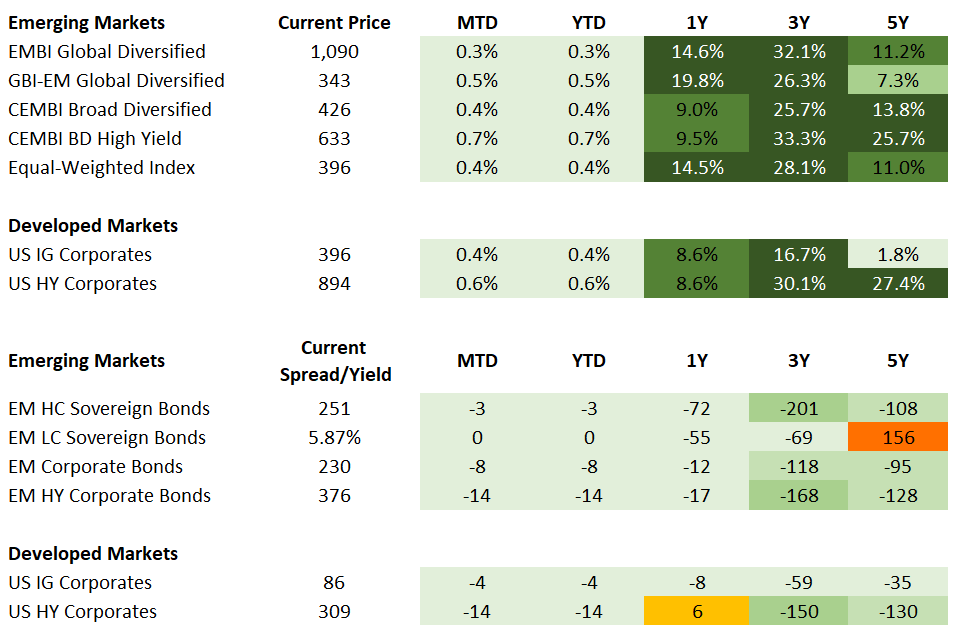
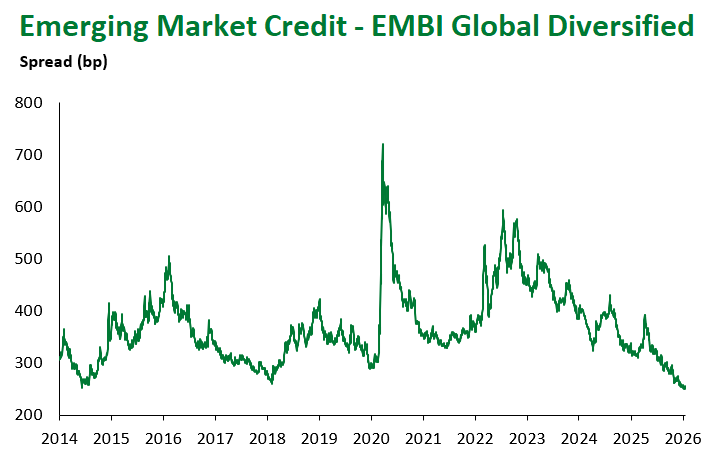
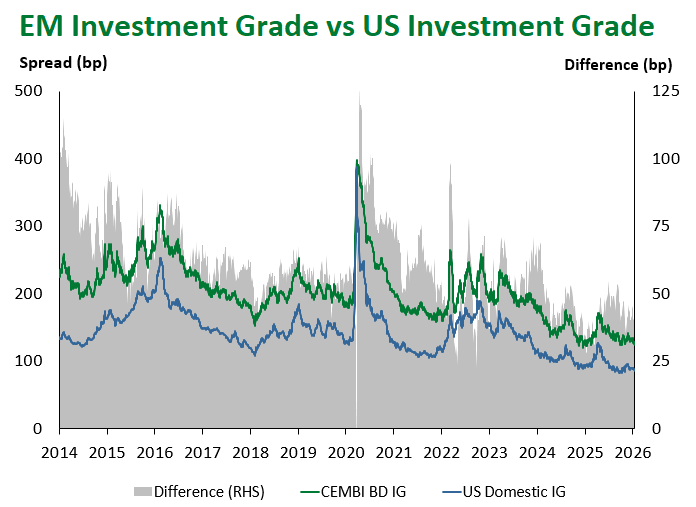
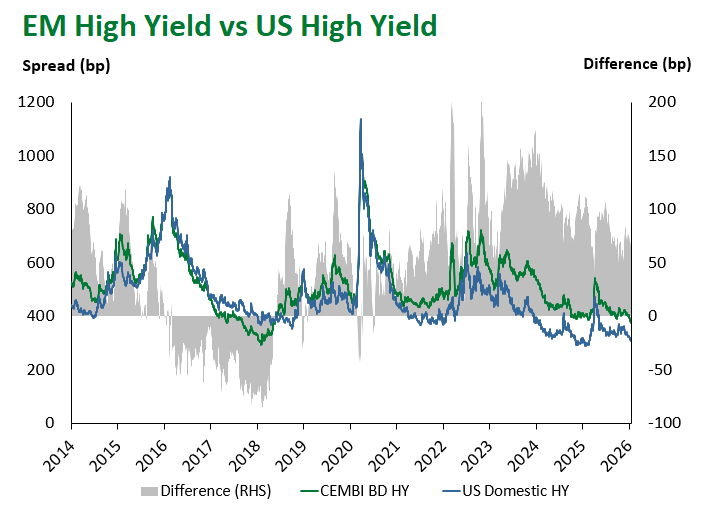
Emerging Markets (EM) fixed income delivered solid results this week. Hard-currency sovereigns edged higher (+0.12%), supported by a rebound in investment-grade bonds, which reversed the prior week’s losses (+0.22%). High yield was largely flat on the week (+0.02%). At the index level, spreads were broadly unchanged (-1bp), with little differentiation between investment grade (-2bps) and high yield (flat).
On a regional basis, the Middle East (+0.29%) and Asia (+0.16%) led performance, while Latin America (+0.03%) and Europe (+0.11%) lagged, though both regions still posted positive returns. At the country level, Lebanon (+3.12%) and Sri Lanka (+1.35%) outperformed. In Lebanon, continued progress on the disarmament of militant groups and regional developments along with speculation around potential regime change in Iran, drove prices higher. In Sri Lanka, fading cyclone-related concerns, a scarcity of high-yield alternatives in Asia, and short dealer positioning in the 2036s accelerated the rally. Venezuela (-5.07%) and Senegal (-4.02%) underperformed. Venezuela paused following very strong recent gains, while Senegal was pressured by elevated credit and liquidity concerns amid stalled IMF negotiations and broader fiscal challenges.
EM corporates also had a strong week (+0.19%), with high yield outperforming investment grade (+0.28% vs. +0.12%). Regionally, Latin America (+0.27%) and Europe (+0.21%) led gains, while the Middle East (+0.10%) and Asia (+0.15%) lagged. Longer-dated maturities (>10 years) outperformed (+0.30%), while the 7- to 10-year bucket underperformed (+0.13%). By rating, the ‘C’ bucket again led performance (+1.29%), while AAA (+0.04%) and AA (+0.09%) lagged. Corporate spreads tightened modestly by 4bps at the index level.
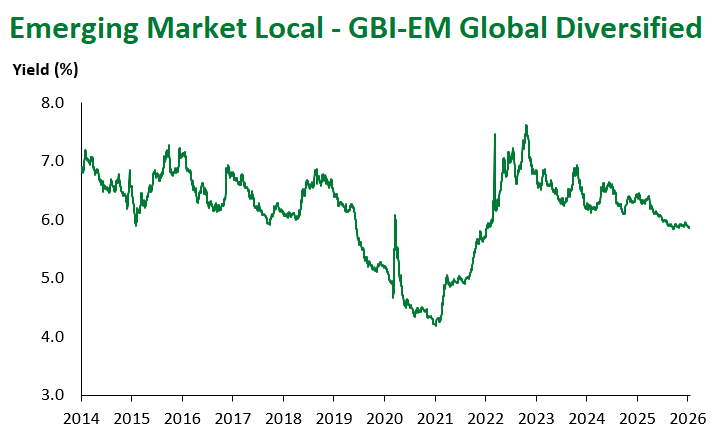
Local-currency debt returned +0.32%, as investor concerns around Federal Reserve independence resurfaced. Colombia (+4.10%) and South Africa (+1.88%) led gains. In Colombia, the peso continued to strengthen amid reduced political noise between Presidents Gustavo Petro and Donald Trump, alongside higher oil prices. In South Africa, the rand benefited from elevated commodity prices. The main underperformers were Indonesia (-0.87%) and the Czech Republic (-0.70%) as investors favored higher yielding local currency stories and, in the case of so called “EUR-adjacent” EM currencies such as the Czech Koruna, the USD gained against the common European currency.
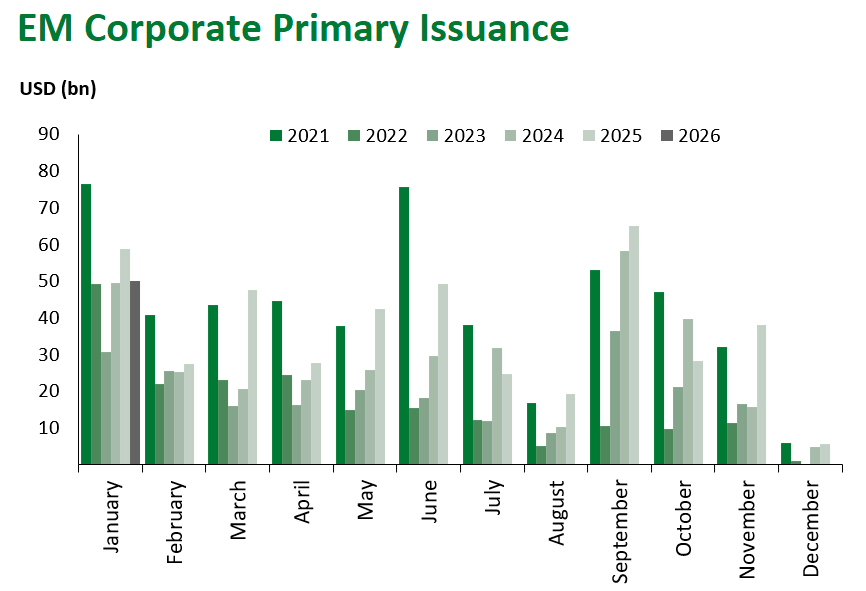
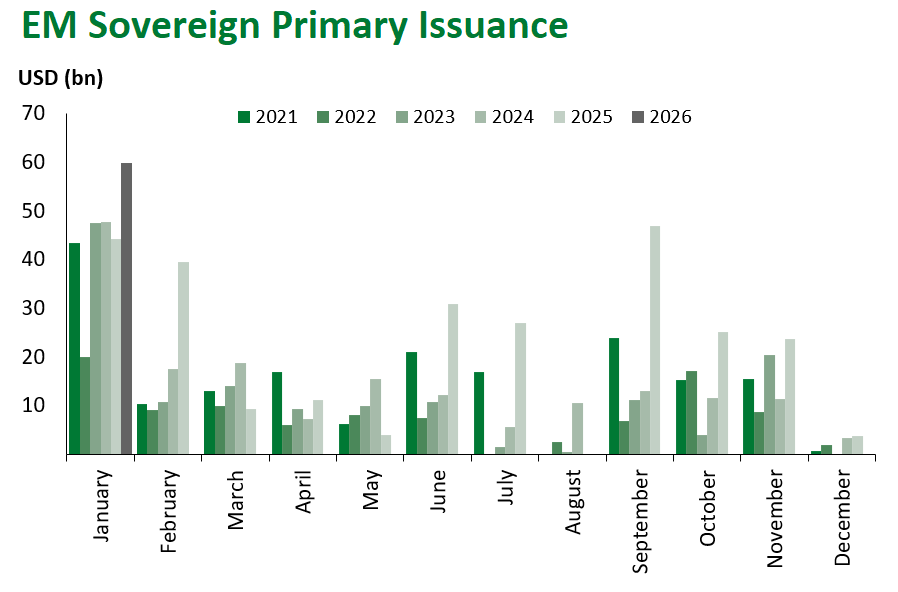
Primary markets were active, with $36 billion in hard-currency issuance across 32 issuers and 46 tranches. Sovereign borrowers accounted for just 30% of total supply, led by sizeable multi-tranche deals from Indonesia and Colombia. Issuance was more balanced this week, with 56% investment grade and the remainder high yield.
The Week Ahead
The annual World Economic Forum kicks off in Davos, Switzerland, with more than 60 heads of state attending. President Donald Trump, leading the biggest U.S. delegation ever, is expected to use the global stage to push his economic and geopolitical agenda, including his declared ambition to acquire Greenland, an issue of “fundamental disagreement” between the U.S. and its European NATO partners. In domestic affairs, the U.S. Supreme Court is set to hear oral arguments in the case of Fed Governor Lisa Cook, whom President Trump has attempted to fire in a perceived attempt to undermine Fed independence. Portugal votes in a presidential election that is likely to go to a second round in February, and a trade agreement between the EU and Mercosur is set to be signed in Paraguay. Key Chinese economic data is set to be released, including 4Q 2025 GDP, December retail sales and industrial production, as well as the 1 and 5-year loan prime rates. In the U.S., the third reading of 3Q 2025 GDP will be published alongside the PCE price index, the Fed’s preferred inflation measure, and the final January University of Michigan consumer sentiment index. In Europe, markets will see final December inflation for the Euro area, Germany’s ZEW survey expectations, and UK jobless claims, CPI and retail sales for December. Japan publishes December CPI and the Bank of Japan (BoJ) is expected to keep its policy rate on (0.75%), with market focus on any forward guidance regarding the timing of the next rate hike. The central banks in Türkiye, Romania, Indonesia, and Malaysia will also be announcing interest rate decisions.
Fixed Income
Equities
Commodities

Source for data tables: Bloomberg, JPMorgan, Gramercy. EM Fixed Income is represented by the following JPMorgan Indicies: EMBI Global, GBI-EM Global Diversified, CEMBI Broad Diversified and CEMBI Broad High Yield. DM Fixed Income is represented by the JPMorgan JULI Total Return Index and Domestic High Yield Index. Fixed Income, Equity and Commodity data is as of Jan. 16, 2026 (mid-day).
Highlights
Political Stability Holds in Venezuela Amid U.S. Talks and Oil Cashflow Management Plans
Event: President Trump spoke with interim President Delcy Rodriguez and met opposition leader Maria Carina Machado, but did not commit to any timeframe for a potential internationally recognized election. This follows Venezuela’s gradual release of political prisoners and U.S. issuance of an Executive Order to enable the transport and sale of Venezuelan oil to global markets as well as a creation of a fund to safeguard cashflows. The accumulated proceeds will be shielded from creditor attachment while the use the of the funds on the behalf of Venezuela will be managed by the U.S. in “compliance with international obligations, performance of government functions, and maintenance of diplomatic and foreign policy objectives”. Additionally, Secretary Bessent announced plans to meet with the IMF and World Bank to discuss reengagement with Venezuela, including access to roughly $5 billion of SDRs.
Gramercy Comment: We see the communication channels between the U.S., the interim government, and opposition as constructive although the timing and intention towards eventual elections or permanency of a Delcy Rodriguez government remains unclear. The oil sector mechanism should enhance U.S. leverage and control with room for evolution over time. Expectations for oil sector recovery and normalization support higher oil revenue and nominal GDP assumptions. However, the restructuring process itself will take time to execute and probably will not occur under a caretaker or transition government. Rather, to complete a restructuring, one typically needs to see a permanent government in place, one that seeks normalization of relations generally, and with bondholders specifically. Should political developments raise the probability of an electoral transition, or should oil output recover more rapidly under Ms. Rodríguez, bond prices could re-rate higher. In the meantime, price volatility may ensue as markets digest the contours and implications of the U.S. control of oil cashflows and bilateral commercial arrangements. More broadly, compressed sovereign spreads and a constructive global risk environment should sustain investor interest in Venezuela, despite persistent and complex political and execution risks.
Egypt Receives EU Disbursement as Geopolitical Risk Spikes
Event: The EU Commission disbursed $1 billion euros to Egypt under its $7.4 billion euro support package struck in 2024, which consists of a mix of concessional loans, grants, and investment projects related to renewable energy and food security. This follows the IMF staff level agreement on the delayed 5th and 6th program reviews in late December. Following IMF board approval, authorities will receive roughly $2.4 billion.
Gramercy Comment: Egypt continues to benefit from balance of payments backstops through a mix of bilateral and multilateral sources, providing a partial buffer against geopolitical shocks. The IMF’s press release from last month emphasized a broad-based economic recovery with robust performance in non-oil manufacturing, transportation, finance, and tourism. The current account has narrowed despite the challenging regional security environment thanks to buoyant remittances and tourism. Non-resident inflows into local currency debt rose to roughly $30 billion, according to the Fund. The Fund commended tight monetary policy with gradual and cautious easing which will likely continue in the context of this week’s softer core-CPI print. Further efforts are needed on tax revenue mobilization and reduction of the state footprint. Investors and rating agencies will watch for tax reform initiatives and progress on privatization.
Emerging Markets Technicals
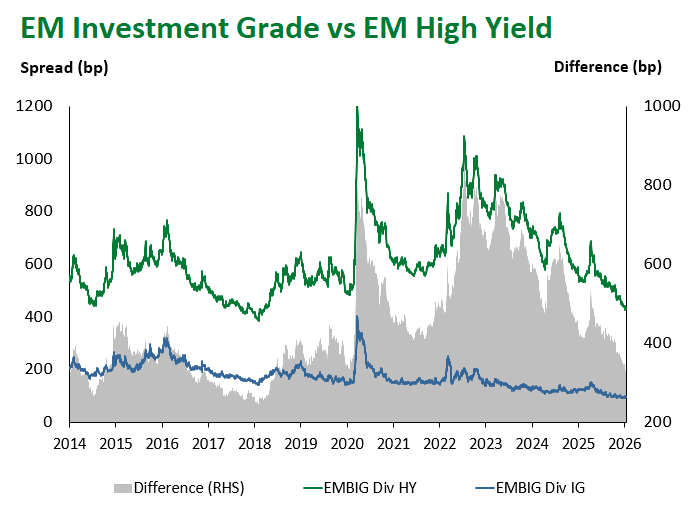

Emerging Markets Flows
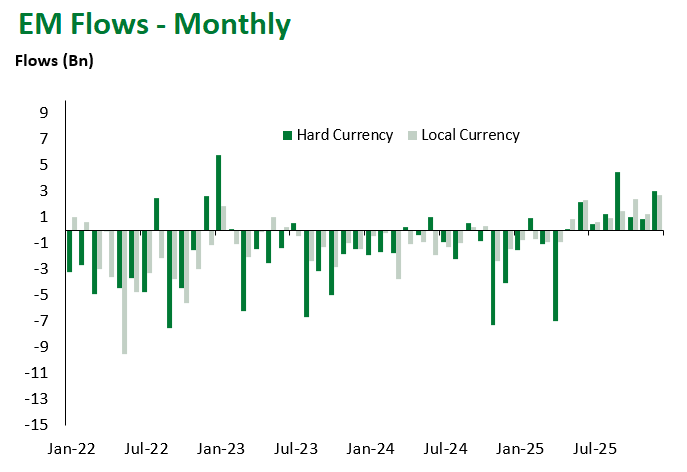
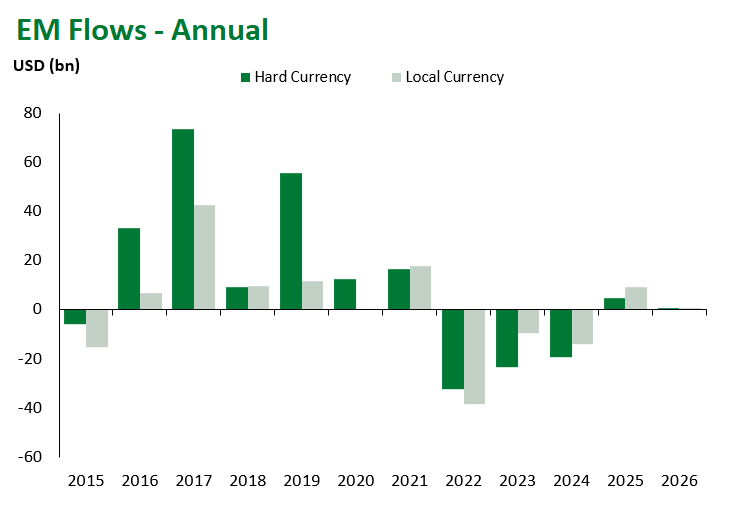
Source for graphs: Bloomberg, JPMorgan, Gramercy. As of Jan. 16, 2026.
For questions, please contact:
Kathryn Exum, CFA ESG, Director, Co-Head of Sovereign Research, [email protected]
Petar Atanasov, Director, Co-Head of Sovereign Research, [email protected]
This document is for informational purposes only. The information presented is not intended to be relied upon as a forecast, research or investment advice, and is not a recommendation, offer or solicitation to buy or sell any securities or to adopt any investment strategy. Gramercy may have current investment positions in the securities or sovereigns mentioned above. The information and opinions contained in this paper are as of the date of initial publication, derived from proprietary and nonproprietary sources deemed by Gramercy to be reliable, are not necessarily all-inclusive and are not guaranteed as to accuracy. This paper may contain “forward-looking” information that is not purely historical in nature. Such information may include, among other things, projections and forecasts. There is no guarantee that any forecasts made will come to pass. Reliance upon information in this paper is at the sole discretion of the reader. You should not rely on this presentation as the basis upon which to make an investment decision. Investment involves risk. There can be no assurance that investment objectives will be achieved. Investors must be prepared to bear the risk of a total loss of their investment. These risks are often heightened for investments in emerging/developing markets or smaller capital markets. International investing involves risks, including risks related to foreign currency, limited liquidity, less government regulation, and the possibility of substantial volatility due to adverse political, economic or other developments. References to any indices are for informational and general comparative purposes only. The performance data of various indices mentioned in this update are updated and released on a periodic basis before finalization. The performance data of various indices presented herein was current as of the date of the presentation. Please refer to data returns of the separate indices if you desire additional or updated information. Indices are unmanaged, and their performance results do not reflect the impact of fees, expenses, or taxes that may be incurred through an investment with Gramercy. Returns for indices assume dividend reinvestment. An investment cannot be made directly in an index. Accordingly, comparing results shown to those of such indices may be of limited use. The information provided herein is neither tax nor legal advice. Investors should speak to their tax professional for specific information regarding their tax situation.