


Contents
Market Overview
Macro Update
The Fed delivered its widely anticipated 25 bps rate cut, bringing the target range to 3.5%–3.75%. The decision, however, underscored a growing policy divergence inside the FOMC: One voter favored a deeper 50 bps cut, two preferred no move, and several non-voting members signaled discomfort with the easing bias. Markets nonetheless continue to price at least one additional cut in 2026. Complicating the outlook, Kevin Hassett remains the leading candidate for Fed Chair – and he is an advocate of even looser policy when internal divisions are already notable.
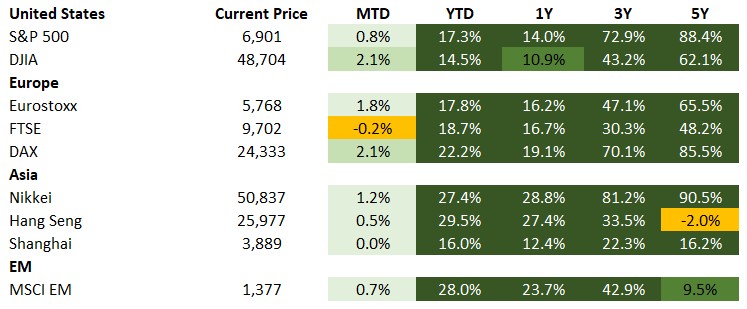
Risk assets initially rallied but struggled to sustain momentum. Concerns around stretched tech valuations and the economic return on heavy AI capital expenditure once again weighed on U.S. equities, with the Nasdaq experiencing its sharpest pullback since November’s AI-driven volatility episode. This dragged other indexes down as well.
Treasury yields were volatile, initially easing post-Fed, but ending the week around where they started, ~4.19% and ~4.86% for 10s and 30s respectively, with the curve steepening. The dollar’s slide accelerated, pushing the DXY to its lowest level since early October. Cryptocurrencies were not spared: Bitcoin again failed to hold $90,000, well below its $126,000 October high. Oil prices retreated to multi-month lows despite the IEA’s reduced oversupply estimates. Precious metals surged, with gold climbing to close to $4,300/oz and silver extending its extraordinary year-to-date surge to $64/oz, but giving up some gains late in the week and closing around $61/oz.
China’s latest data offered mixed signals. CPI rose 0.7% year-over-year – its fastest pace in nearly two years. PPI, however, fell for a 38th consecutive month, reinforcing the persistence of producer-level deflation. China’s annual goods trade surplus surpassed $1 trillion for the first time, as gains in non-U.S. exports offset weakness tied to Trump administration tariffs.
Europe delivered a rare upside surprise: German industrial production significantly outperformed expectations, supporting the view that Europe’s largest economy may be stabilizing after years of stagnation. Japan, by contrast, confirmed a deeper-than-estimated 3Q GDP contraction, though the setback is unlikely to divert the central bank from its path toward a rate hike next week.
In geopolitics, the U.S. pressured Ukrainian President Volodymyr Zelenskiy to consider a “peace framework,” yet territorial concessions appear politically untenable for Kyiv or its European allies. On Venezuela, Washington seized a sanctioned tanker, while opposition leader and Nobel winner María Corina Machado traveled to Oslo after months in hiding.
Mexico introduced sweeping tariffs on Chinese imports, a move likely aimed less at revenue than at aligning with the U.S. ahead of complex bilateral trade discussions. Meanwhile, tensions flared in Southeast Asia, with Thai air strikes near the Cambodian border prompting calls for restraint from both Washington and Beijing. In Benin, the government, supported militarily by neighboring Nigeria, succeeded in thwarting a coup attempt.
EM Credit Update
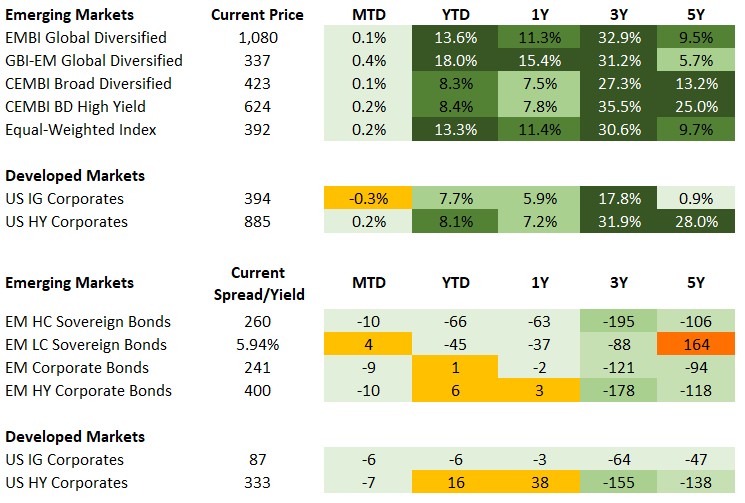
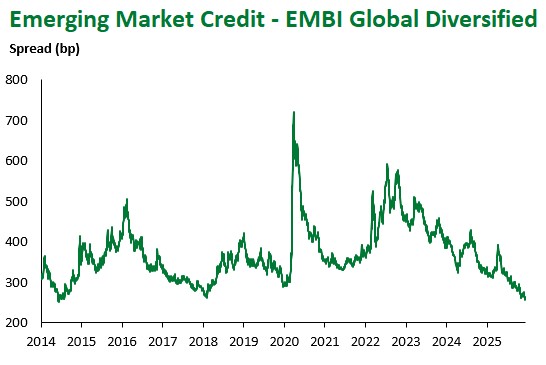
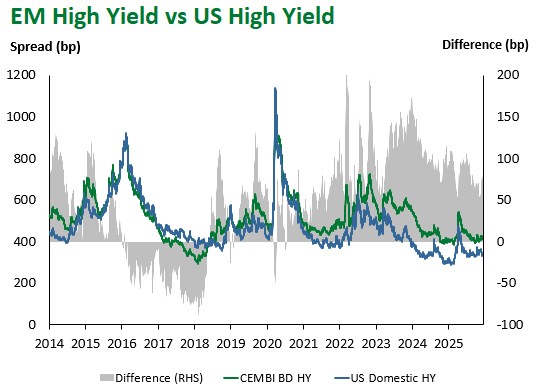
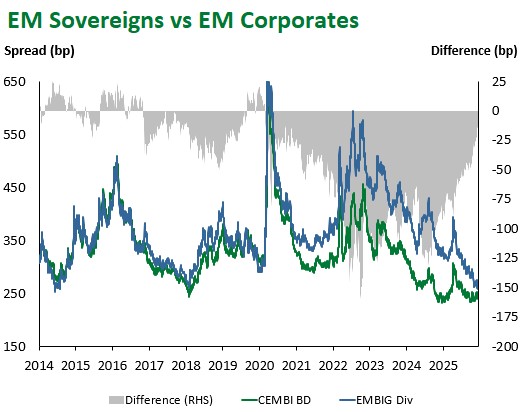
Emerging Markets (EM) fixed income posted mixed results this week. EM hard-currency sovereigns were flat, returning -0.04%, weighed down by investment grade bonds (-0.1%) while high yield edged slightly higher (+0.03%). Spreads moved modestly, with 2 bps widening at the index level, and performance was broadly similar across segments.
Regionally, Africa reversed last week’s gains, underperforming at -0.26%. Senegal was the main driver, as elevated credit risk and liquidity concerns emerged amid structural fiscal challenges and stalled IMF negotiations. Asia, by contrast, outperformed (+0.07%), supported by strong inflows despite slightly wider rates. From a country-specific perspective, Ukraine led performance as sentiment improved on hopes for peace deal progress.
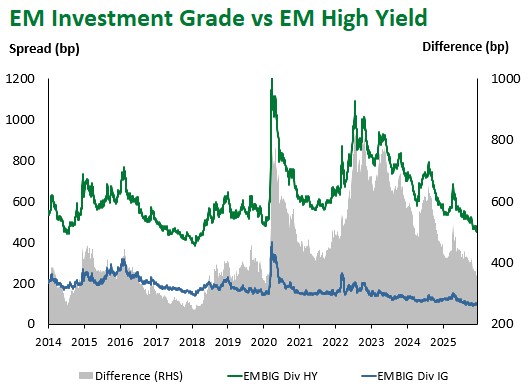
EM corporates were the standout this week, gaining 0.12%, with high yield slightly outperforming investment grade (+0.13% vs. +0.11%). Regionally, Asia (+0.16%) and Africa (+0.14%) outperformed, while Latam lagged (+0.05%). Returns were broad-based across maturities. By rating, the ‘C’ bucket led (+0.25%), whereas the highest-rated AA and AAA segments underperformed (+0.07%). Unlike sovereigns, corporate spreads compressed modestly by 2 bps at the index level.
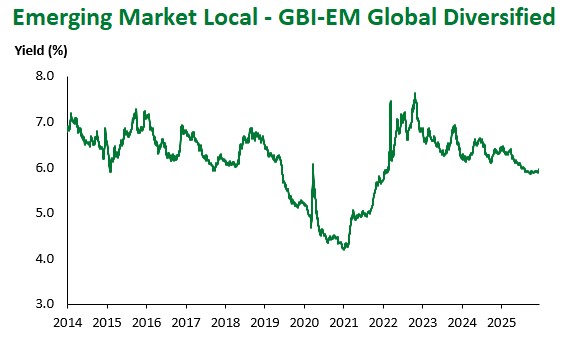
Local-currency debt posted marginal gains (+0.02%), with performance driven by stronger currencies and resilient local rates. South Africa (+2%) benefited from continued portfolio inflows, while Romania (+1.7%) was supported by improving political dynamics. In contrast, Brazil (-1.9%) and the Dominican Republic (-1%) lagged, reflecting rising domestic policy uncertainty, especially in Brazil.
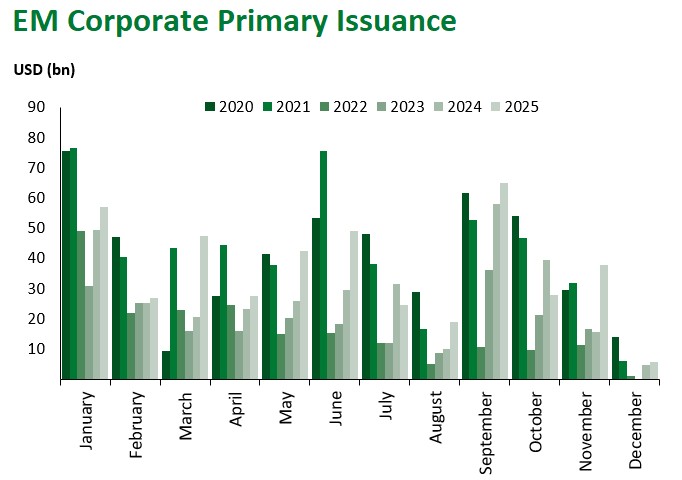
Primary issuance slowed materially this week, with only three hard-currency corporate deals – two in China and one in Europe – and no sovereign issuance.
The Week Ahead
Next week, markets will digest the year’s final flurry of global central bank monetary policy decisions, including those by the European Central Bank (ECB), the Bank of England (BoE) and the Bank of Japan (BoJ). The ECB is set to keep its deposit rate at 2% so the focus will be on updated economic projections. Consensus expects the BoE to cut rates by 25 bps to 3.75%, but like their Fed colleagues, UK’s policymakers could deliver a divided vote as the hawkish wing remains concerned about sticky inflation. The BoJ is expected to go in the opposite direction and raise rates to 0.75% from 0.5%, despite 3Q GDP underperformance.
Next week will also be a data-heavy week globally. The U.S. will release November nonfarm payroll figures, incorporating elements of October as well, in the first major snapshot of employment since the longest ever-government shutdown this fall. Other notable U.S. data releases include November CPI, initial jobless claims, unemployment, retail sales, the S&P Global manufacturing PMI and the December final University of Michigan consumer sentiment survey. The UK will see November CPI, retail sales, the S&P Global manufacturing PMI, jobless claims, and unemployment. The eurozone will report on industrial production, consumer confidence, November CPI, and the Hamburg Commercial Bank (HCOB) manufacturing PMI. China releases November retail sales and industrial production.
Elsewhere, November CPI will be reported by Japan, Nigeria, Poland, Saudi Arabia, and South Africa, and 3Q GDP by Sri Lanka and Argentina. HCOB manufacturing PMIs are due in France, Germany and India, the German ZEW survey expectations will also be released.
Other important developments will include Chile’s presidential election runoff pitting a far-left candidate against one from the far-right, and Russian President Vladimir Putin’s traditional televised event that blends his annual press conference with a nationwide call-in show.
Fixed Income
Equities
Commodities

Source for data tables: Bloomberg, JPMorgan, Gramercy. EM Fixed Income is represented by the following JPMorgan Indicies: EMBI Global, GBI-EM Global Diversified, CEMBI Broad Diversified and CEMBI Broad High Yield. DM Fixed Income is represented by the JPMorgan JULI Total Return Index and Domestic High Yield Index. Fixed Income, Equity and Commodity data is as of Dec. 12, 2025 (mid-day).
Highlights
Zelenskiy’s “Donbas Referendum” is Likely Tactical, Not Intentional
Event: Ukraine President Zelenskiy floated the idea of organizing a referendum on the possibility of ceding Ukraine-controlled territory in the eastern region of Donbas to Russia as part of a plan to end the conflict.
Gramercy Comment: We interpret Mr. Zelenskiy’s proposal as a tactical move to show Ukraine’s extraordinary flexibility, rather than a realistic prospect – especially as it comes amid mounting pressure on Kyiv by the Trump administration to end the conflict. Importantly, Mr. Zelenskiy qualified the “Donbas referendum” notion by adding that such an initiative could take place if the U.S. and Europe can “ensure security,” a construct that sounds: A. highly unrealistic and B. like a non-starter from a Russian perspective. In the unlikely event that a referendum over the status on Donbas does take place as part of a Trump administration-endorsed peace plan, Ukrainian voters are highly likely to reject it, in our view. Ceding Ukraine-controlled Donbas territories to Russia would also be highly problematic for Ukraine’s military after years of staunch defense that has claimed hundreds of thousands of lives.
China Signals Its Economic Backstop Will Continue in 2026
Event: The December Politburo meeting and Central Economic Work Conference pointed to the continuation of moderate stimulus next year with “necessary” fiscal spending, flexible and efficient use of monetary policy, and ongoing efforts to stabilize the real estate market.
Gramercy Comment: Similar to 2025, we expect Chinese authorities to keep the official growth target around 5% in 2026 and deploy opportunistic stimulus to achieve the target. Market consensus growth estimates for 2025 and 2026 are 4.9% and 4.5%, respectively. The authorities’ toolkit will likely remain similar to 2025. It could include front-loading of local government special bond issuance and select consumption-oriented measures such as trade-in programs, childbirth and pre-school subsidies, and increases in elderly pensions. In the property sector, city-specific measures will be utilized to control new supply, reduce inventory, and optimize supply structure. Our base case envisions relatively more stable U.S.-China relations in 2026 and steady global growth, which in part underpins President Xi Jinping’s lack of urgency or need for more extensive support.
Orban Continues Controversial Measures Ahead of Hungary’s Vote
Event: Hungary passed legislation to make it more difficult to remove the president from power, while Prime Minister Viktor Orban is reportedly exploring the expansion of presidential powers and taking the office of president ahead of the parliamentary vote expected in April. On the macro front, inflation surprised to the downside, dropping below the central bank’s upper target. Fitch revised the outlook on Hungary’s BBB rating to negative on fiscal and medium-term growth concerns, while credit jitters emerged and spreads widened moderately. Meanwhile, the Hungarian forint strengthened against the dollar on renewed optimism around Russia-Ukraine peace prospects.
Gramercy Comment: We expect Prime Minister Orban to continue to deploy controversial policy and legislative measures ahead of the election, particularly as the ruling Fidesz party continues to trail the opposition Tisza party. Currently, authorities do not appear overly concerned with near-term rating pressures despite negative outlooks from all three agencies. Eurobond spreads will likely remain subject to volatility next year as markets assess the scope of Hungary’s institutional erosion and fiscal slippage. Despite this week’s downside inflation surprise, previous guidance from the central bank would suggest a further decline in inflation is needed to open the door to rate cuts. However, investors will watch next week’s policy meeting closely for any evolution in the central bank’s stance.
Emerging Markets Technicals


Emerging Markets Flows
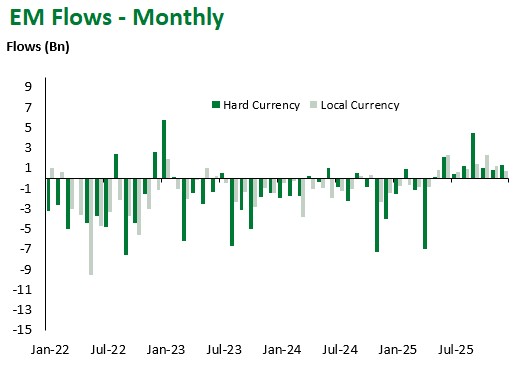
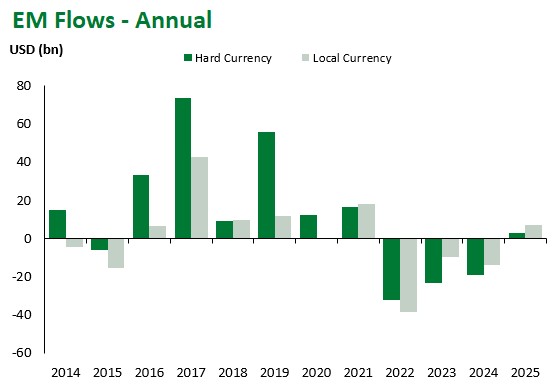
Source for graphs: Bloomberg, JPMorgan, Gramercy. As of Dec. 12, 2025.
For questions, please contact:
Kathryn Exum, CFA ESG, Director, Co-Head of Sovereign Research, [email protected]
Petar Atanasov, Director, Co-Head of Sovereign Research, [email protected]
This document is for informational purposes only. The information presented is not intended to be relied upon as a forecast, research or investment advice, and is not a recommendation, offer or solicitation to buy or sell any securities or to adopt any investment strategy. Gramercy may have current investment positions in the securities or sovereigns mentioned above. The information and opinions contained in this paper are as of the date of initial publication, derived from proprietary and nonproprietary sources deemed by Gramercy to be reliable, are not necessarily all-inclusive and are not guaranteed as to accuracy. This paper may contain “forward-looking” information that is not purely historical in nature. Such information may include, among other things, projections and forecasts. There is no guarantee that any forecasts made will come to pass. Reliance upon information in this paper is at the sole discretion of the reader. You should not rely on this presentation as the basis upon which to make an investment decision. Investment involves risk. There can be no assurance that investment objectives will be achieved. Investors must be prepared to bear the risk of a total loss of their investment. These risks are often heightened for investments in emerging/developing markets or smaller capital markets. International investing involves risks, including risks related to foreign currency, limited liquidity, less government regulation, and the possibility of substantial volatility due to adverse political, economic or other developments. References to any indices are for informational and general comparative purposes only. The performance data of various indices mentioned in this update are updated and released on a periodic basis before finalization. The performance data of various indices presented herein was current as of the date of the presentation. Please refer to data returns of the separate indices if you desire additional or updated information. Indices are unmanaged, and their performance results do not reflect the impact of fees, expenses, or taxes that may be incurred through an investment with Gramercy. Returns for indices assume dividend reinvestment. An investment cannot be made directly in an index. Accordingly, comparing results shown to those of such indices may be of limited use. The information provided herein is neither tax nor legal advice. Investors should speak to their tax professional for specific information regarding their tax situation.