


Contents
Market Overview
Macro Update
This week, markets continued to sift through delayed U.S. macro data releases. The highly anticipated nonfarm payrolls report showed a rise of 119,000 in September, the month before the federal government shutdown. This was more than double the consensus expectation of 51,000. However, the July and August numbers were both revised down, by a total of 33,000, with August’s payroll revised to a decline of 4,000, from the increase of 22,000 reported previously. In addition, the unemployment rate also rose, to 4.4%, emphasizing the crosscurrents in the U.S. labor market.
Fed minutes from the October FOMC meeting indicated that policymakers “expressed strongly differing views” about whether to cut interest rates in December. Given stubborn inflation, a few committee members appeared to favor holding rates steady next month, and the minutes also showed the FOMC had been divided over October’s rate cut. However, following dovish comments by Federal Reserve Bank of New York President John Williams on Friday, the market-assigned probability of a December rate hike jumped sharply, to close to 70%, up from as low as 40% following the release of the jobs data.
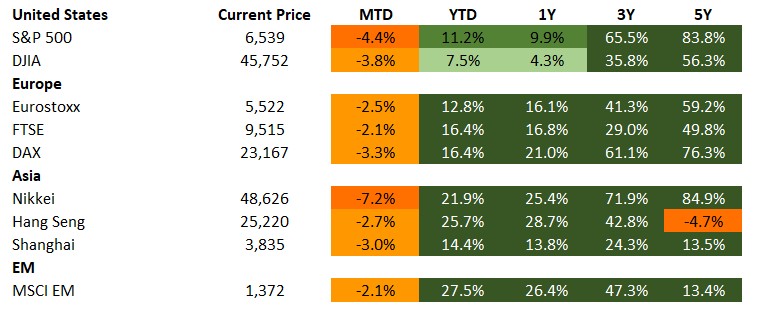
Against this backdrop, stocks were volatile. Global equities surged after the closely watched Nvidia earnings report on Wednesday initially reassured investors on the AI outlook, with the company giving a strong revenue forecast and pushing back on the idea of an AI bubble. However, concerns about the AI trade and the elevated U.S. equity market quickly overshadowed the company’s better-than-expected 3Q performance, driving the S&P 500 and the tech-heavy Nasdaq lower and erasing earlier gains. The price of bitcoin continued to slide to below $85,000, down from an all-time high of roughly $126,000 in October.
U.S. Treasury yields were unchanged for most of the week but rallied sharply on Friday following Mr. Williams’ dovish comments. They ended the week at around 4.05% and 4.70%, for the 10-year and 30-year maturities, respectively. The DXY remained above 100 despite the shift in the market’s rate cut expectations, marking the dollar’s strongest level in six months. Oil prices trended lower but remained in the low $60s and high $50s for Brent and WTI, respectively. Gold closed at around $4,000 per ounce, around 10% below its year-to-date peak.
In other notable data releases, preliminary U.S. PMIs for November indicated that U.S. business activity expanded the most in four months. This was driven by the services sector, as the end of the government shutdown boosted optimism despite inflationary pressures appearing to accelerate. The final November University of Michigan consumer sentiment survey was also better-than-expected: 51.0 vs. a 50.6 median expectation and a preliminary reading of 50.3. However, it declined from 53.6 in the prior month. The current economic conditions component of the survey fell to a record low of 51.1, compared to a 52.3 preliminary reading for November and 58.6 in October.
In China, the benchmark lending rates were kept unchanged at 3.0% (1-year) and 3.5% (5-year), in line with market expectations. In the euro area, final October CPI was confirmed at 2.1% year-over-year, unchanged from the prior month. Also in the euro area, preliminary November PMIs exhibited a dynamic similar to the U.S., with service outperforming and manufacturing lagging. Japanese GDP contracted in Q3 to 1.8% quarter-over-quarter in annualized terms. Despite outperforming median market expectations of a 2.4% contraction, this boosted the new Takaichi administration argument in favor of additional fiscal stimulus and will add pressure on the BoJ to slow policy normalization. Meanwhile, October CPI was in line with the market consensus of 3.0% year-over-year. In the UK, headline inflation for October surprised on the upside (3.6% year-over-year vs. 3.5%) but decelerated from September when it was 3.8% year-over-year; core inflation was in line with expectations at 3.4% year-over-year. Unlike in the U.S. and continental Europe, preliminary November PMIs outperformed on the manufacturing side, while services disappointed, falling to 50.5 from 52.3 in October and compared to the median market expectation of 52.
In the geopolitical arena, Saudi Arabia’s Crown Prince Mohamed bin Salman received a warm reception from President Donald Trump at the White House. During the meeting, President Trump designated Saudi Arabia a “major non-NATO ally” and the prince reciprocated by promising that Saudi investments in the U.S. would increase to $1 trillion, up from the $600 billion announced previously.
Meanwhile, reports emerged about a 28-point peace plan for Ukraine drafted by the U.S. and Russia without Ukrainian and European involvement. The plan appears to incorporate all of Russia’s key demands, including the reduction of Ukraine’s armed forces, the ceding of further territory, and the ban of foreign troops on its soil. These would be in exchange for vague and less than credible “security guarantees” by the U.S. Like previous, similar initiatives by the White House and the Kremlin, the plan is unlikely to be acceptable to Ukraine and Europe.
A very busy geopolitical week for the Trump administration also included continued military buildup near Venezuela, in the apparent aim to increase pressure on the government of President Nicolas Maduro and catalyze internal fracturing of the regime. Mr. Trump said that he would “probably” talk to Mr. Maduro, who has recently been designated by the U.S. as the head of a “foreign terrorist organization.” The Trump administration has deployed the world’s largest aircraft carrier to waters close to Venezuela, but the use of force has thus far been limited to strikes against alleged “narco terrorists” in small civilian boats.
In election developments across emerging markets, Ecuadorians voted in a national referendum, rejecting a new constitution and the re-opening of U.S. military bases in the country. In Chile, conservative parties and candidates had a strong showing in the parliamentary and presidential elections. In the presidential runoff on Dec. 14th, Jeannette Jara from Chile’s Communist Party will face right-wing candidate Jose Antonio Kast.
EM Credit Update
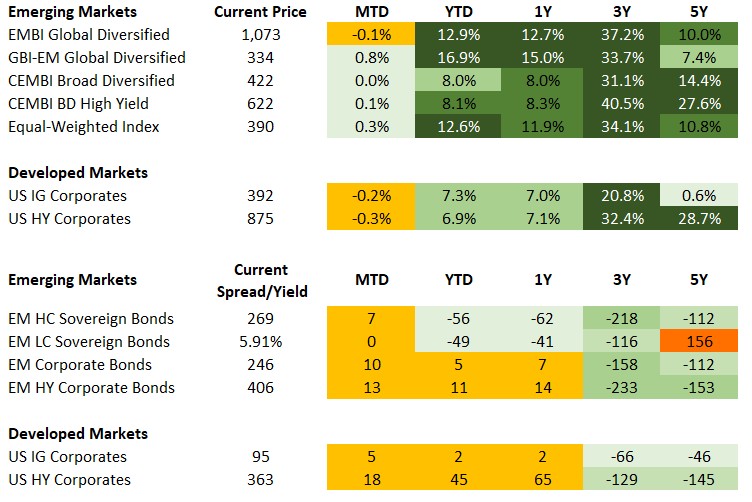
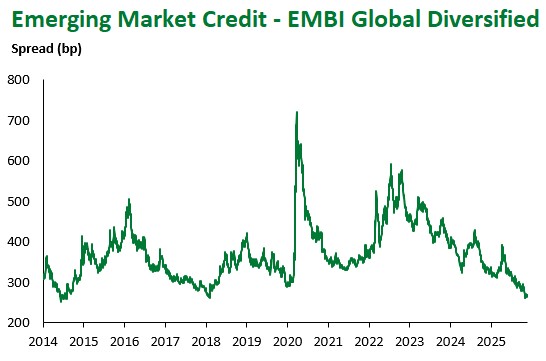
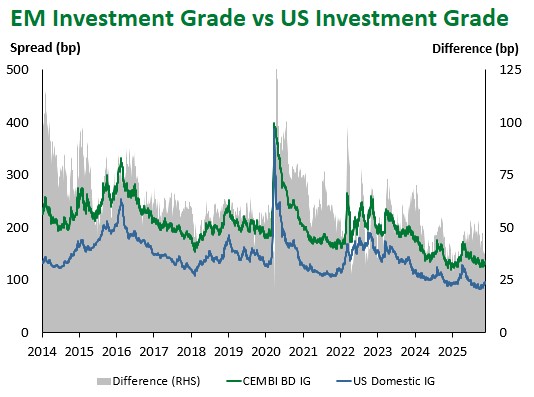
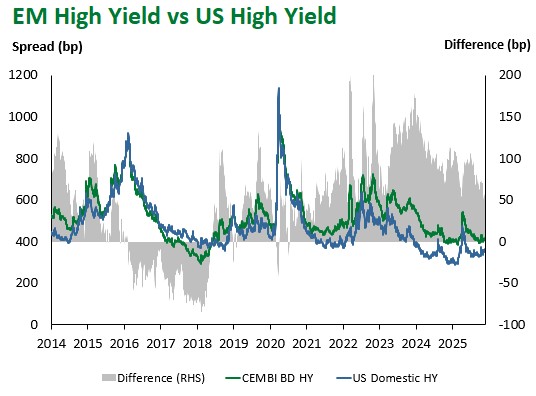
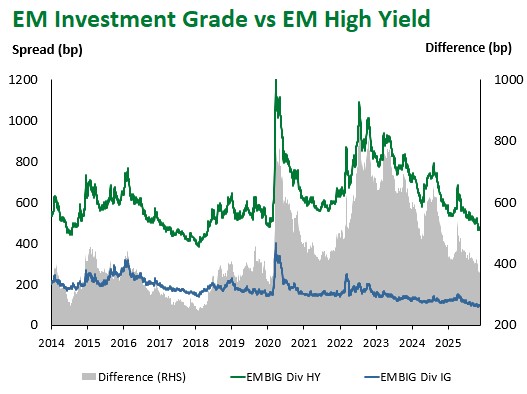
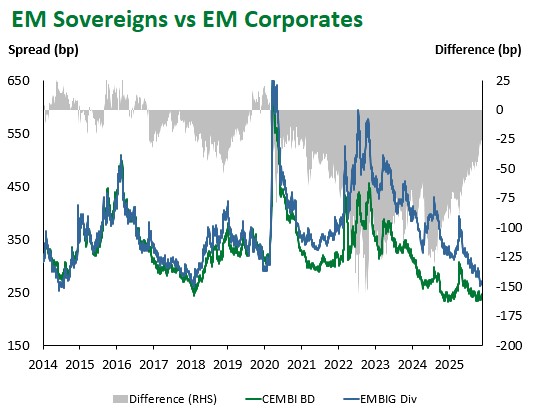
Emerging Markets (EM) fixed income proved relatively resilient despite softer global risk sentiment this week. EM hard-currency sovereign bonds gained 0.15%, led by high yield (+0.26%), while investment grade delivered a more muted +0.05%. At the index level, spreads widened modestly by 4 bps, with similar moves across both high yield and investment grade.
Regionally, Africa and Eastern Europe outperformed, while more rate-sensitive areas such as the Middle East and Asia delivered slightly negative returns. Venezuela was the standout performer amid rising optimism around potential regime change and debt restructuring as U.S. military pressure intensified. Hopes for a possible path towards ending the Russia-Ukraine conflict in the wake of a proposed U.S. peace plan supported Ukraine. By contrast, Ecuador was the weakest performer following President Noboa’s referendum defeat, which heightened political uncertainty. Lebanon and Argentina also gave back some of their recent gains.
EM corporates gained a modest 0.06%, with investment grade (+0.09%) outperforming high yield (+0.01%). In contrast to sovereigns, Asia outperformed (+0.08%), while Africa lagged (-0.04%). C-rated credits reversed last week’s strength, falling 0.69%. From a duration standpoint, the 7-year to10-year segment once again led performance. Index-level spreads widened 7 bps, with minimal differentiation between investment grade and high yield.
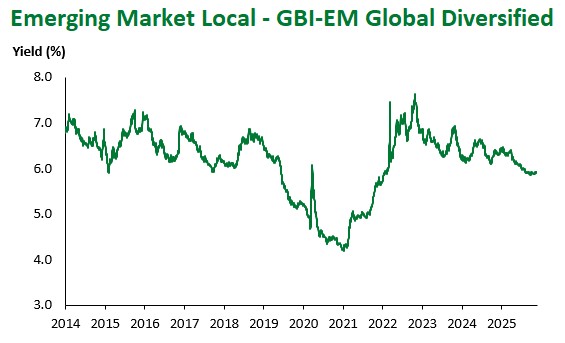
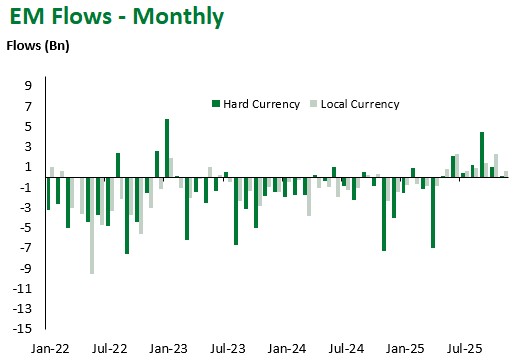
Local-currency debt gave back some of last week’s gains, returning -0.23%. The Dominican Republic (+2.2%) and Türkiye (+1.2%) were the only positive performers, while Colombia (-1.4%), the Czech Republic (-1.3%), and Poland (-1.2%) lagged amid a lack of well-defined idiosyncratic drivers. A relatively firmer dollar impacted EM foreign exchange, especially so called “euro-adjacent” currencies that led gains earlier in the year.
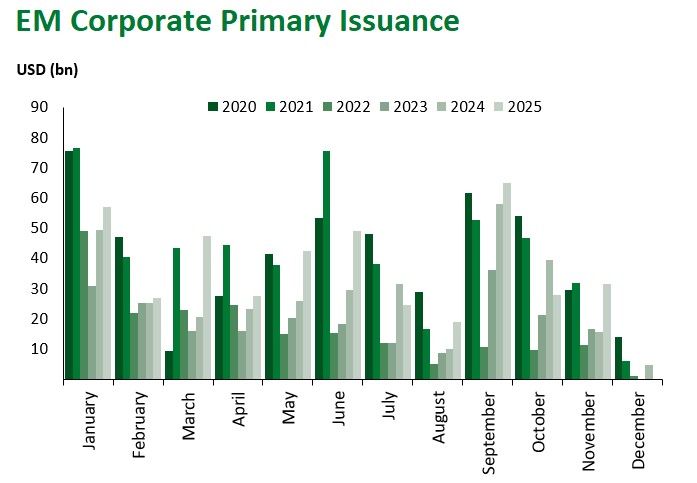
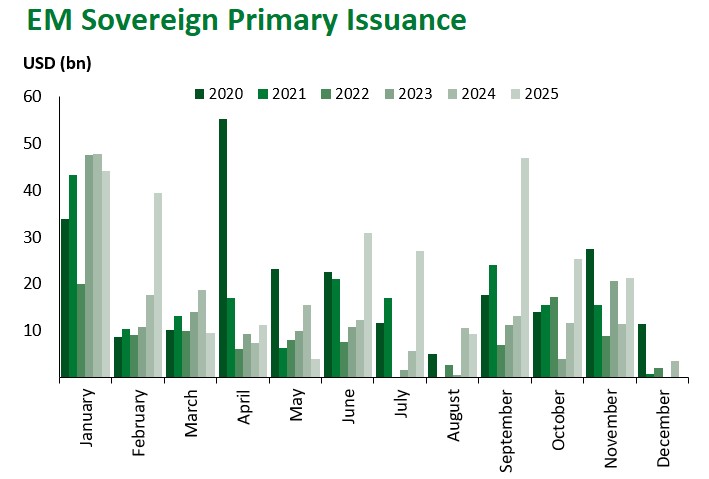
Primary issuance remained robust heading into the U.S. Thanksgiving holiday, with 21 new hard-currency deals that skewed towards investment grade (62%). Activity was evenly distributed across CEEMEA, Asia, and Latin America. Key sovereign and municipal data releases came from China, Indonesia, Colombia, and the city of Buenos Aires. Financials continued to represent a sizable share of supply, accounting for 38% this week.
The Week Ahead
It will be a short week in the U.S. due to the Thanksgiving holiday, marking the traditional start of the holiday shopping season. While the National Retail Federation expects holiday sales to surpass $1 trillion for the first time, year-over-year growth might slow.
Elsewhere, the UK’s autumn budget will be delivered by Chancellor Rachel Reeves, with higher levies on expensive homes to be among the tax increases being considered. The G20 meeting will be held in Africa for the first time, in Johannesburg; however, U.S. and Chinese leaders do not plan to attend. EU trade ministers will convene in Brussels to discuss EU-U.S. and EU-China trade relations, with U.S. Commerce Secretary Howard Lutnick scheduled to participate.
The Fed will release its Beige Book of regional economic assessments, while the ECB will publish the accounts of its Oct. 30th rate decision. In terms of notable macro data, markets will see retail sales, PPI, Conference Board consumer confidence, durable goods, and initial jobless claims in the U.S., as well as eurozone consumer confidence data. Final 3Q GDP numbers are set to be reported by Germany, France, Italy, India and Nigeria, and November CPI figures will be released in France, Germany, Italy, Poland and Sri Lanka. Central bank rate decisions are due in Israel, Nigeria and Sri Lanka.
Fixed Income
Equities
Commodities
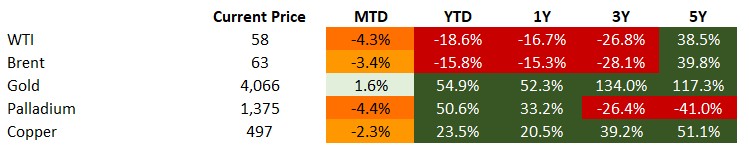
Source for data tables: Bloomberg, JPMorgan, Gramercy. EM Fixed Income is represented by the following JPMorgan Indicies: EMBI Global, GBI-EM Global Diversified, CEMBI Broad Diversified and CEMBI Broad High Yield. DM Fixed Income is represented by the JPMorgan JULI Total Return Index and Domestic High Yield Index. Fixed Income, Equity and Commodity data is as of Nov. 21, 2025 (mid-day).
Highlights
Ecuadorians Vote “No” on All Questions in National Referendum
Event: Contrary to what polls predicted, Ecuadorians did not support any of President Noboa’s questions that were put to voters in a national referendum on Sunday, including key ones on a new constitution and the re-opening of U.S. military bases in the country.
Gramercy Comment: The results came as a surprise given President Noboa’s high approval rating, and represent a meaningful political setback for the administration. Relative to Ecuador’s sovereign bonds’ outstanding performance in 2025, the main risks we will now be monitoring are a major erosion of President Noboa’s political capital and the fading of reform momentum under the country’s successful IMF program. Notably, the populist opposition that has been in political disarray since Mr. Noboa’s decisive victory in April 2025 may have now been awarded a window of opportunity to regroup, another near-term risk that we will watch closely.
However, with the results of the referendum, Ecuador has avoided a prolonged period of political uncertainty in 2026. That’s because another two plebiscites – one to elect a Constituent Assembly and another to ratify the new constitution – would have been necessary had the constitution question passed. Thus, from a market perspective, we see a silver lining in avoiding this uncertainty. In the coming weeks and months, we’ll be focused on assessing the extent of domestic political damage to the Noboa administration and if that damage could interfere with Ecuador’s otherwise constructive sovereign credit trajectory amid still attractive valuations.
Chile’s Election Marks Shift To the Right
Event: Conservative parties and candidates had a strong showing in Chile’s parliamentary and presidential elections on Sunday. Ms. Jara from Chile’s Communist Party came in first in the presidential vote with 27%. However, her result fell short of pre-election polling and was also below the 33% approval rating of current left-wing president Gabriel Boric. In the runoff on Dec. 14th, Ms. Jara will face right-wing candidate Mr. Kast, who performed strongly on Sunday with 24% of the vote, while other conservative candidates collectively secured around 70%. Conservative parties also did well in the legislative elections and will be the dominant force in the new Congress.
Gramercy Comment: The outcome of Chile’s elections is credit-positive as it points to a market-friendly shift in economic policy management. Most right-leaning voters are likely to back Mr. Kast in the upcoming December runoff, which reinforces his front runner status. In addition, a conservative-leaning Congress suggests that Mr. Kast would be able to build congressional support for legislative initiatives if he wins the presidency, which now appears the most likely scenario. This suggests a shift to more market-friendly economic policies, and an improvement of relations with the U.S. – although Chile’s links to China will be a constraint. Taken as a whole, we expect these developments to be supportive for Chilean assets across the board. On the sovereign side, we favor local debt and the Chilean peso, which we believe are well-positioned to outperform against an improving political and economic outlook.
Emerging Markets Technicals
Emerging Markets Flows
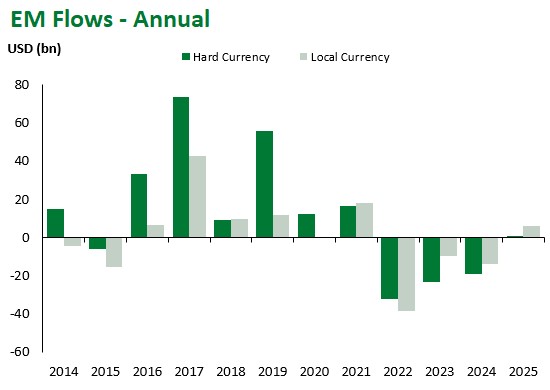
Source for graphs: Bloomberg, JPMorgan, Gramercy. As of Nov. 21, 2025.
For questions, please contact:
Kathryn Exum, CFA ESG, Director, Co-Head of Sovereign Research, [email protected]
Petar Atanasov, Director, Co-Head of Sovereign Research, [email protected]
This document is for informational purposes only. The information presented is not intended to be relied upon as a forecast, research or investment advice, and is not a recommendation, offer or solicitation to buy or sell any securities or to adopt any investment strategy. Gramercy may have current investment positions in the securities or sovereigns mentioned above. The information and opinions contained in this paper are as of the date of initial publication, derived from proprietary and nonproprietary sources deemed by Gramercy to be reliable, are not necessarily all-inclusive and are not guaranteed as to accuracy. This paper may contain “forward-looking” information that is not purely historical in nature. Such information may include, among other things, projections and forecasts. There is no guarantee that any forecasts made will come to pass. Reliance upon information in this paper is at the sole discretion of the reader. You should not rely on this presentation as the basis upon which to make an investment decision. Investment involves risk. There can be no assurance that investment objectives will be achieved. Investors must be prepared to bear the risk of a total loss of their investment. These risks are often heightened for investments in emerging/developing markets or smaller capital markets. International investing involves risks, including risks related to foreign currency, limited liquidity, less government regulation, and the possibility of substantial volatility due to adverse political, economic or other developments. References to any indices are for informational and general comparative purposes only. The performance data of various indices mentioned in this update are updated and released on a periodic basis before finalization. The performance data of various indices presented herein was current as of the date of the presentation. Please refer to data returns of the separate indices if you desire additional or updated information. Indices are unmanaged, and their performance results do not reflect the impact of fees, expenses, or taxes that may be incurred through an investment with Gramercy. Returns for indices assume dividend reinvestment. An investment cannot be made directly in an index. Accordingly, comparing results shown to those of such indices may be of limited use. The information provided herein is neither tax nor legal advice. Investors should speak to their tax professional for specific information regarding their tax situation.