


Contents
Market Overview
Macro Update – Published April 2
Markets continued to digest conflicting narratives of the Iran conflict, with the trajectory and endgame remaining highly uncertain. Kinetic activity persisted: Iran struck Kuwaiti and Qatari oil tankers, while U.S. and Israeli forces targeted a major pharmaceutical facility. Tehran reiterated its rejection of the U.S. 15-point proposal, even as an additional 3,500 U.S. marines and sailors deployed to the region. The conflict broadened with Houthi militants in Yemen launching missiles toward Israel and signaling a potential resumption of attacks on Red Sea shipping.
Midweek sentiment improved modestly after Iran’s president signaled a conditional willingness to de-escalate, contingent on security guarantees, and issued a conciliatory message to the American public. Meanwhile, Iran and Oman are reportedly drafting a protocol, including tolls, for Hormuz traffic. Despite this, the conflict likely remains on an escalatory trajectory. President Trump stated that the U.S. would continue “blasting Iran into oblivion” until the Strait is reopened and warned of a potential withdrawal of military aid to Ukraine should European allies fail to support U.S. efforts. His subsequent national address framed the rationale for continued military action. At this stage, a clear and credible path to de-escalation or resolution remains absent.
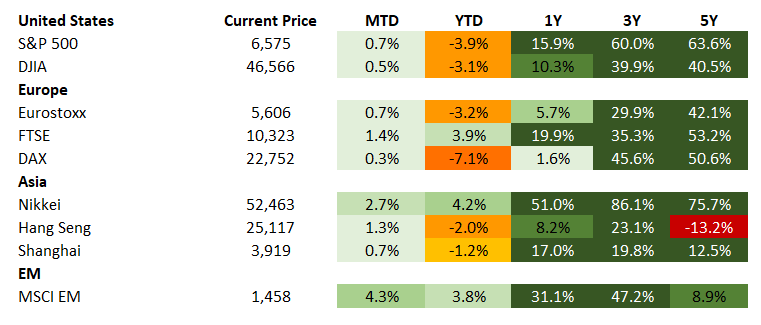
Oil prices traded in the $100- $110/bbl range with intra-week volatility and narrowing in the gap between WTI and Brent. The S&P 500 posted gains, while the U.S. 10-year yield declined to 4.3% mid-week from 4.4% the prior week. The U.S. Dollar Index continued to trade around 100, and gold recovered part of its recent losses.
Multilateral commentary continued to highlight the uneven global impact of the conflict. The IMF described the shock as “global, yet asymmetric,” underscoring the need for country-specific policy responses, while the Asia Global Institute emphasized differentiated exposure to the Strait of Hormuz by product and destination – reinforcing themes of dispersion and fragmentation.
U.S. data remained broadly resilient. March ISM, consumer confidence, and ADP employment exceeded expectations, though underlying components pointed to rising inflationary pressures. February retail sales were strong, but sustainability is uncertain as gasoline prices have risen roughly 40% to $4.06 since the onset of the conflict. Meanwhile, February JOLTS data signaled gradual cooling in the labor market with fewer vacancies and the lowest hiring since 2020, increasing focus on the March payrolls report to be released on April 3. Foreign holdings of U.S. Treasuries have fallen to their lowest level since 2012, reflecting reserve drawdowns and ongoing diversification trends, testing demand for upcoming UST auctions.
In the Eurozone, consumer confidence softened in March, while preliminary CPI rose to 2.5% despite easing in services inflation. In China, PMI data remained resilient but began to show conflict spillovers, with higher input costs, modest increases in output prices, and longer delivery times.
Elsewhere, Colombia’s central bank hiked its policy rate by 100bps to 11.25% as expected, helping anchor the Colombian peso. Venezuela Interim President Delcy Rodriguez was unsanctioned by the U.S., boosting the prospect for debt negotiations to commence.
EM Credit Update
Risk assets, including Emerging Markets (EM) fixed income, were whipsawed by a steady drumbeat of headlines this week, highlighting the fragility of conviction and a broader lack of directional clarity.
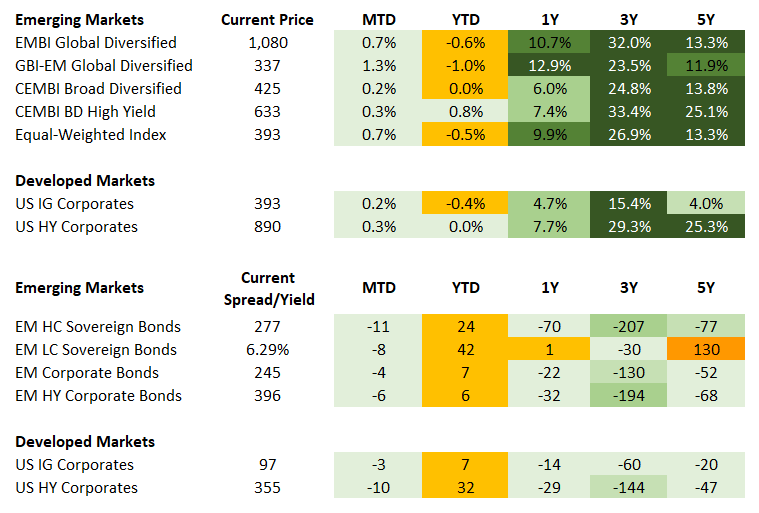
Through Wednesday, local currency sovereign debt was the standout performer, rising +1.26% as U.S. dollar strength eased and external conditions turned more supportive. At the country level, Hungary (+4.16%) and South Africa (+3.26%) outperformed. Hungary rallied on rising expectations of political change, with increasing signs that Viktor Orbán’s 16-year rule may be approaching an inflection point, while South Africa benefited from improving sentiment around a potential de-escalation in the Iran conflict – an outcome that would disproportionately ease pressures on its energy import-dependent economy. In contrast, Colombia (-0.70%) lagged as the Minister of Finance protested Banrep’s rate hike.
Hard currency sovereign bonds were up +0.95% at the index level through Wednesday, with gains broadly shared across investment grade (+0.92%) and high yield (+0.97%). This balance was also evident regionally, where higher beta Africa (+1.23%) and lower beta Asia (+1.12%) led performance, while the Middle East (+0.26%) lagged amid lingering uncertainty.
EM corporates also delivered positive, albeit more modest, returns, with the index up +0.43% through Wednesday. Performance across investment grade (+0.45%) and high yield (+0.40%) was broadly in line, mirroring the pattern in sovereigns. Regionally, Asia (+0.39%) outperformed as a more rate-sensitive segment of the market, while Africa (+0.16%) posted gains and other regions were largely flat. By rating, the AAA bucket outperformed (+0.46%), while the C-rated segment lagged (-0.51%) amid continued weakness in Ukrainian credits.
Primary market remains subdued with 11 issuers bringing $10 billion in hard currency supply, predominantly from investment grade borrowers. Select high yield issuers were also able to access the market, pointing to increasing differentiation at the issuer level, with those perceived as relative beneficiaries of the current backdrop still able to secure funding.
The Week Ahead
President Trump’s April 6 deadline for Iran to reopen the Strait of Hormuz could present a key inflection point, with markets bracing for either escalation or further delay. Attention will focus on signs of the next phase of the conflict and implications for energy flows and broader supply chains.
In the U.S., the spotlight will be on the release of the FOMC minutes, which should provide insight into the Federal Reserve’s initial response to rising energy prices and its tolerance for a potential inflation overshoot amid geopolitical shocks. Key data includes February core PCE, March CPI, the University of Michigan survey, and ISM services.
In the Eurozone, February retail sales and PPI will offer a snapshot of pre-conflict consumer demand and price dynamics.
In China, March CPI and PPI will be closely watched for early signs of conflict spillover.
Central banks in Peru, Poland, and Romania are scheduled to hold monetary policy meetings.
Djibouti, a key maritime gateway near the Bab-el-Mandeb Strait, will hold presidential elections on April 10, where the ruling party is expected to remain dominant.
Fixed Income
Equities
Commodities
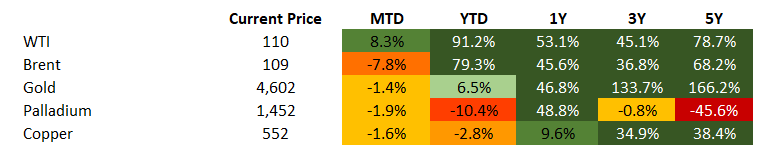
Source for data tables: Bloomberg, JPMorgan, Gramercy. EM Fixed Income is represented by the following JPMorgan Indicies: EMBI Global, GBI-EM Global Diversified, CEMBI Broad Diversified and CEMBI Broad High Yield. DM Fixed Income is represented by the JPMorgan JULI Total Return Index and Domestic High Yield Index. Fixed Income, Equity and Commodity data is as of Apr. 2, 2026 (mid-day).
Highlights
Pakistan and IMF reach staff level agreement on program reviews
Event: The government and IMF have reached a staff-level agreement on the latest reviews of Pakistan’s Extended Fund Facility and Resilience and Sustainability Facility. Subject to Board approval, this will unlock approximately $1.2 billion in disbursements.
The IMF noted that performance was broadly in line with program objectives prior to the conflict, with economic activity gaining momentum and both inflation and the current account deficit remaining contained.
Gramercy Comment: The multilateral backstop and the provision of timely fresh financing are clearly constructive. However, we remain cautious of the country’s outlook in the absence of greater clarity on the trajectory and duration of the regional conflict, particularly given the associated shocks to energy and fertilizer prices and supply. The authorities’ fuel-saving measures announced on March 9 could, if extended or broadened, weigh more materially on growth. At the same time, inflationary pressures are building with March CPI accelerating to 7.3%. The IMF has indicated that further rate hikes are likely should inflation pass-through intensify. Notably, the exchange rate has not functioned as a shock absorber – unlike Egypt. While this may help contain inflation pass-through in the near-term, it risks exacerbating external imbalances. Importantly, Pakistan entered this latest shock from a less strained financial position compared to previous episodes, which provides some buffer, but does not fully offset the evolving risks.
Emerging Markets Technicals
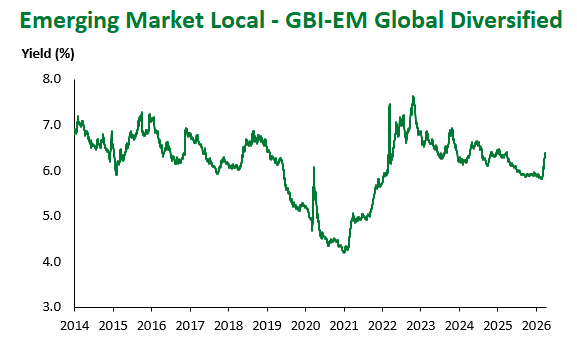
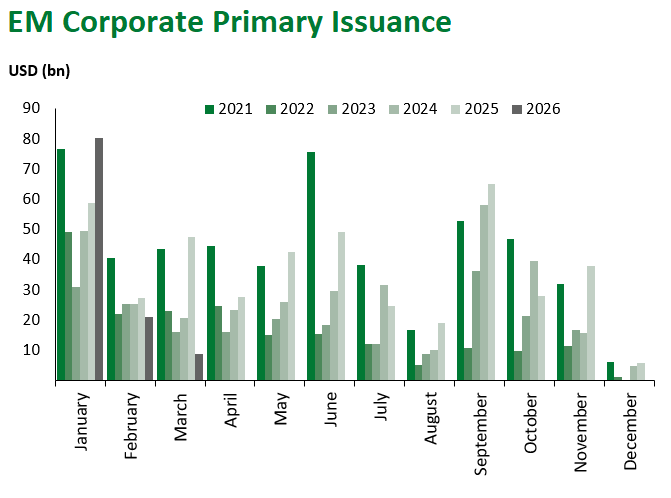
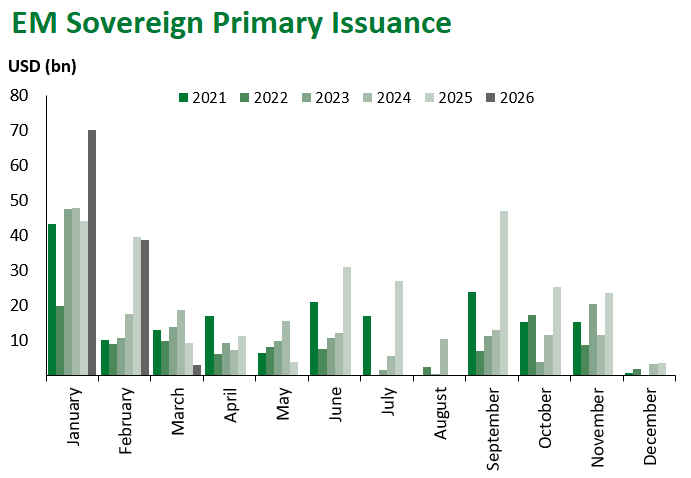
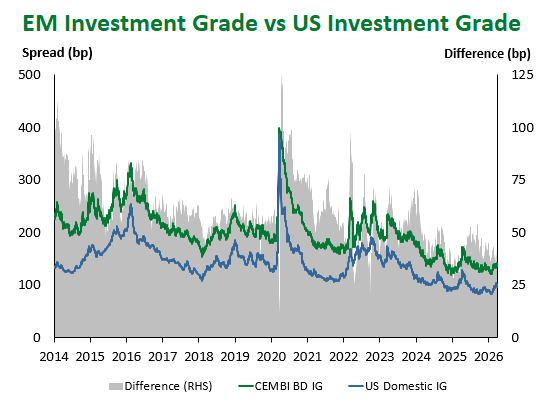
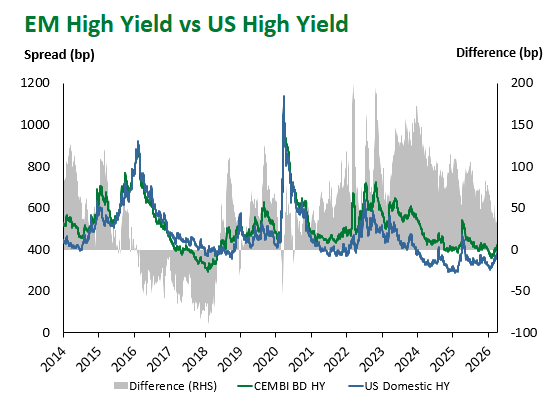
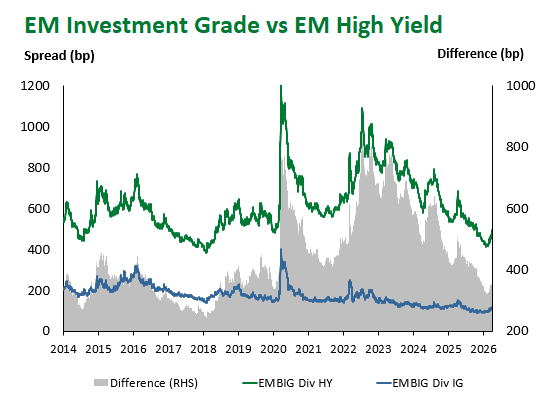
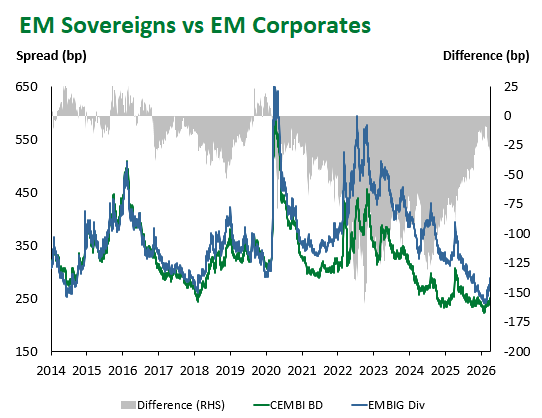
Emerging Markets Flows
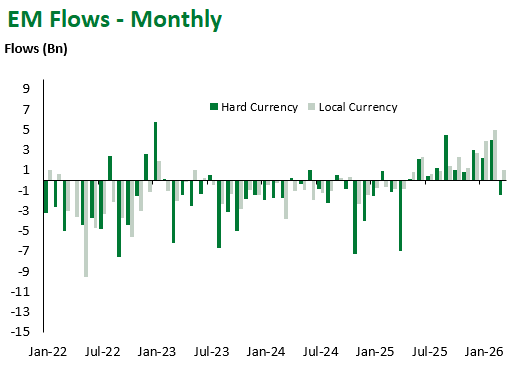
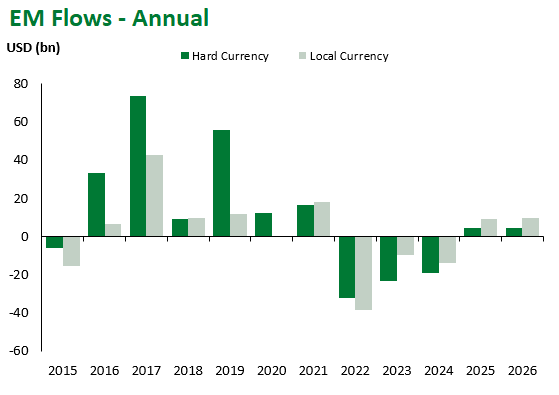
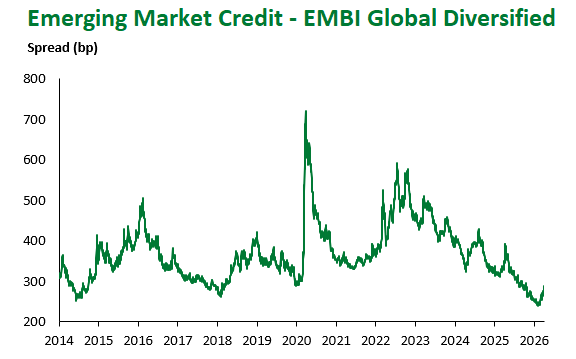
Source for graphs: Bloomberg, JPMorgan, Gramercy. As of Mar. 27, 2026.
For questions, please contact:
Kathryn Exum, CFA ESG, Director, Co-Head of Sovereign Research, [email protected]
Petar Atanasov, Director, Co-Head of Sovereign Research, [email protected]
This document is for informational purposes only. The information presented is not intended to be relied upon as a forecast, research or investment advice, and is not a recommendation, offer or solicitation to buy or sell any securities or to adopt any investment strategy. Gramercy may have current investment positions in the securities or sovereigns mentioned above. The information and opinions contained in this paper are as of the date of initial publication, derived from proprietary and nonproprietary sources deemed by Gramercy to be reliable, are not necessarily all-inclusive and are not guaranteed as to accuracy. This paper may contain “forward-looking” information that is not purely historical in nature. Such information may include, among other things, projections and forecasts. There is no guarantee that any forecasts made will come to pass. Reliance upon information in this paper is at the sole discretion of the reader. You should not rely on this presentation as the basis upon which to make an investment decision. Investment involves risk. There can be no assurance that investment objectives will be achieved. Investors must be prepared to bear the risk of a total loss of their investment. These risks are often heightened for investments in emerging/developing markets or smaller capital markets. International investing involves risks, including risks related to foreign currency, limited liquidity, less government regulation, and the possibility of substantial volatility due to adverse political, economic or other developments. References to any indices are for informational and general comparative purposes only. The performance data of various indices mentioned in this update are updated and released on a periodic basis before finalization. The performance data of various indices presented herein was current as of the date of the presentation. Please refer to data returns of the separate indices if you desire additional or updated information. Indices are unmanaged, and their performance results do not reflect the impact of fees, expenses, or taxes that may be incurred through an investment with Gramercy. Returns for indices assume dividend reinvestment. An investment cannot be made directly in an index. Accordingly, comparing results shown to those of such indices may be of limited use. The information provided herein is neither tax nor legal advice. Investors should speak to their tax professional for specific information regarding their tax situation.