


Contents
Market Overview
Macro Update
A tentative two-week ceasefire announced mid-week by President Trump and Iran, subject to the Islamic Republic agreeing to “immediate opening” of the Strait of Hormuz, drove a major relief rally across markets. Investors are betting that peak uncertainty and escalation risks might be behind us and that an even bigger energy price shock for the global economy might be avoided.
Vice President J.D. Vance will lead the U.S. delegation for negotiations with Iran, scheduled for this weekend in Pakistan. The truce is seen as fragile given the uncertainty about what was agreed to in preliminary discussions, including whether it applies to Israel’s campaign against Iran’s proxy militia, Hezbollah, in Lebanon. However, markets enter the weekend hopeful that the ceasefire will hold, boosting risk sentiment across the board, despite the Strait of Hormuz being effectively still shut and Israel and Hezbollah continuing to trade fire.
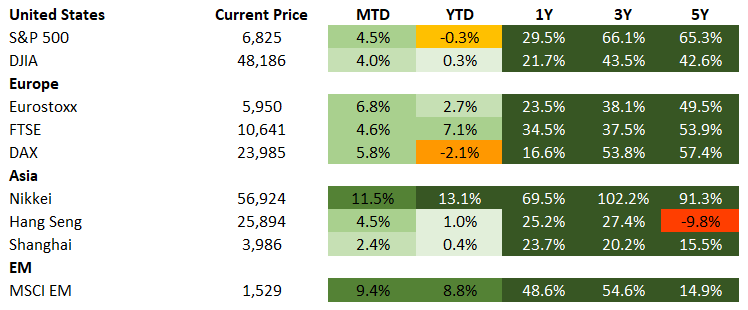
Brent crude, the global oil benchmark, settled around $96 per barrel, midway between its recent peak of around $120 and pre-escalation level of around $70. Global stock markets finished firmly in the green, with the S&P on pace for its best week since May 2025 on ceasefire optimism and tame core U.S. inflation. Recent U.S. dollar strength faded on de-escalation prospects and the DXY fell below 99 from above 100 a week ago.
The U.S. Treasuries curve bull-steepened, with the short-end and belly outperforming despite the relatively hawkish-sounding Fed minutes from the March meeting. The 2-Year yield was 6 bps lower to around 3.78%, the 10-Year 5 bps tighter to around 4.30%, while the 30-Year was almost unchanged at 4.90%. Gold and silver spot prices were also relatively stable, around $4800 and $75 per ounce, respectively.
In terms of major U.S. macro data, higher gasoline prices drove headline CPI for March to the highest monthly rate in four years (0.9% month-over-month), while core CPI remained muted and was softer than expected (0.2% month-over-month vs 0.3%) as services slowed and some heavily weighted items kept goods prices tame. The core PCE index, the Fed’s preferred measure of inflation, came in line with expectations (3.0% year-over-year and 0.4% month-over-month), but was largely overlooked as reflecting pre-war dynamics.
Meanwhile, the FOMC March minutes revealed “the vast majority” of Fed policymakers are saying that upside risks to inflation have increased, suggesting the committee would be inclined to keep rates on hold to evaluate how uncertainty from the Middle East war is affecting its dual mandate.
The preliminary April University of Michigan index indicated that U.S. consumer sentiment plummeted to a record low (47.6, well below the consensus forecast) due to increasing concerns about mounting inflation pressures caused by the Iran war. For comparison, the index was 52.2 last April when “Liberation Day” was announced. The “current conditions” component slipped to a record low of 50.1, while the “expectations” component fell to its lowest level since 1980.
In China, March PPI turned positive for the first time since 2022 on the higher energy and input price backdrop, though pass through to CPI remained limited (1.0% year-over-year from 1.3% in February and 1.1% consensus expectation).
EM Credit Update
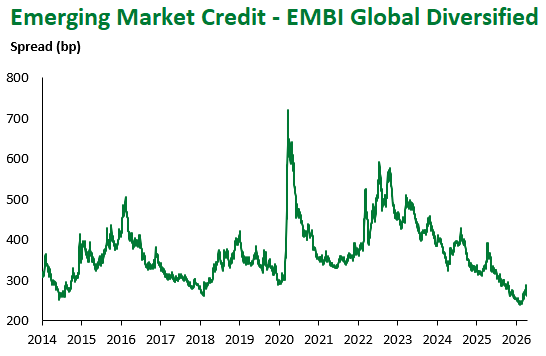
Risk assets, including Emerging Markets (EM) fixed income – are higher on the week, supported by cautious optimism that the fragile ceasefire could evolve into a more durable resolution. That said, trading conditions remained volatile, with sharp day-to-day swings underscoring the market’s continued sensitivity to headline risk.
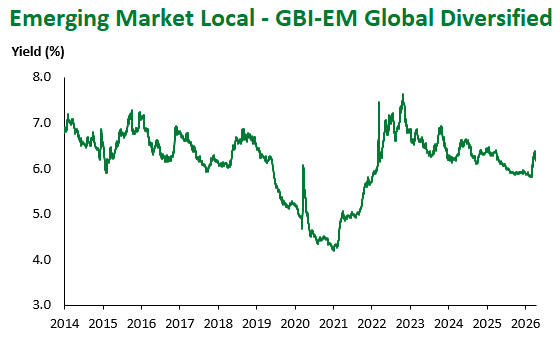
Local currency sovereign debt was the clear outperformer, advancing +2.21% as U.S. dollar strength moderated and the external backdrop turned more supportive. At the country level, South Africa (+5.67%), Egypt (+5.24%), and Hungary (+4.35%) led gains. Hungary continues to rally amid rising expectations of political change, with increasing signs that Viktor Orbán’s 16-year tenure may be approaching an inflection point. Meanwhile, South Africa and Egypt benefited from improving sentiment tied to a potential resolution of the Iran conflict. In contrast, Colombia (-1.28%) lagged following an S&P downgrade, reflecting limited fiscal flexibility, a high debt burden, and a weak external position.
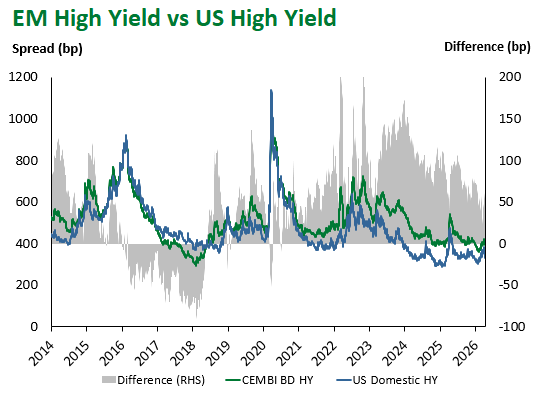
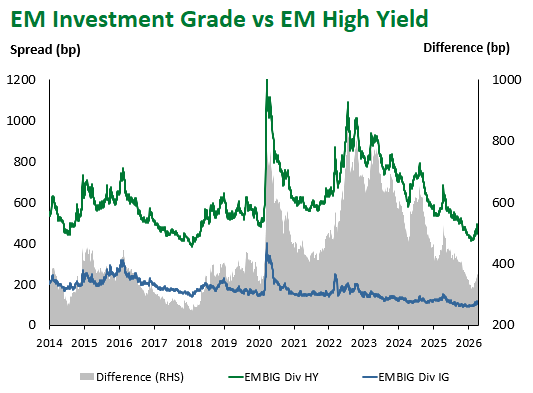
Hard currency sovereign bonds rose +1.48% at the index level, driven by a strong rally in high yield (+2.21%), while investment grade posted a more modest gain (+0.87%). Regionally, Africa (+1.81%) and Europe (+1.70%) outperformed, while Asia (+0.95%) lagged amid the net negative economic spillovers from the conflict.
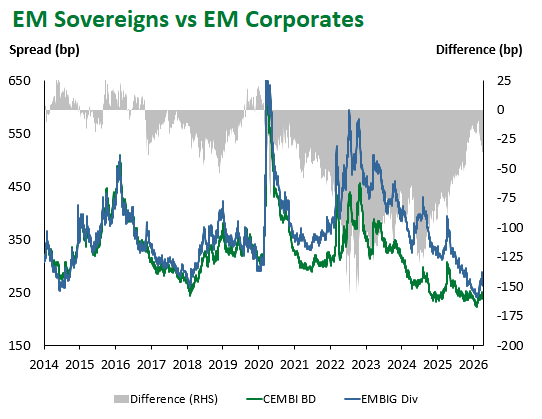
EM corporates also delivered positive, albeit more muted, returns, with the index up +0.63%. High yield (+0.88%) outperformed investment grade (+0.47%). Regionally, Africa (+0.73%) and Europe (+1.02%) led, while Asia (+0.39%) lagged – mirroring the pattern observed in sovereigns. By rating, the CCC segment outperformed (+1.34%), while AAA-rated bonds lagged (+0.23%).
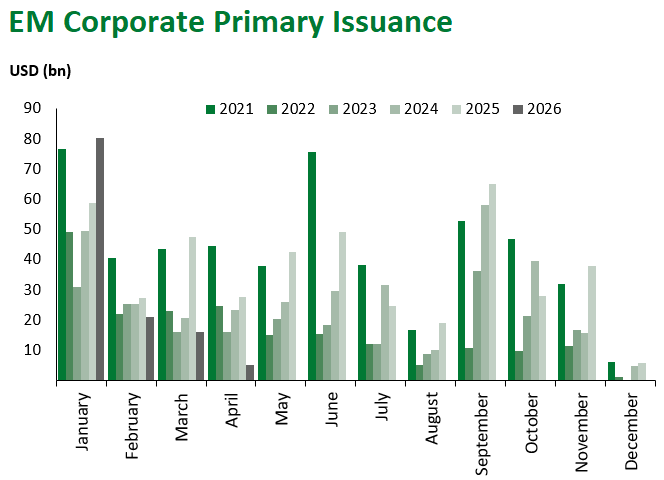
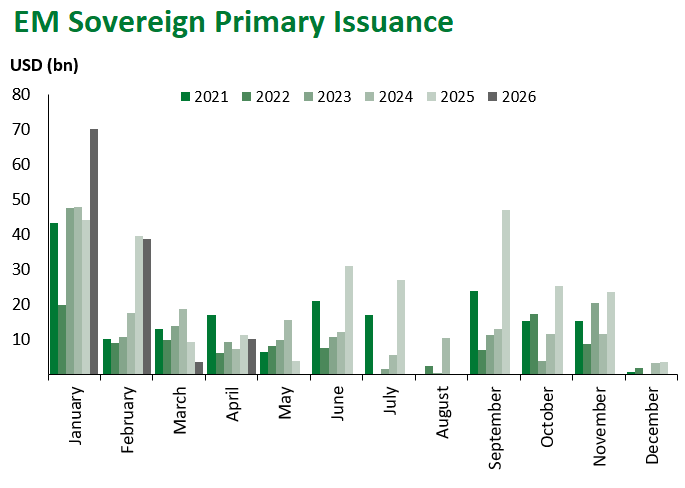
Primary market activity remained subdued, with seven issuers bringing approximately $10 billion in hard currency supply, predominantly from investment-grade borrowers. Notably, the Democratic Republic of Congo successfully raised $1.25 billion at yields between 8.75% and 9.50%, highlighting continued market access for select frontier issuers despite broader uncertainty.
The Week Ahead
All eyes will be on U.S.-Iran ceasefire negotiations expected to take place in Pakistan over the weekend, as well as on the IMF/WB spring meetings and various related events in Washington, DC, where global economic policymakers will participate and share views. Separately, the IMF will publish its flagship world economic outlook and global financial stability reports. On the domestic political front, Hungary holds a parliamentary election, with Prime Minister Viktor Orbán, the friendliest EU leader to Presidents Trump and Putin, facing the biggest challenge yet to his 16 years in power. Also on the agenda this weekend, the first round of Peru’s presidential and legislative election and Benin’s presidential election where incumbent Patrice Talon steps down after a decade. On Wall Street, Goldman Sachs kicks off the quarterly earnings rush, with trading revenue and credit conditions in focus amid geopolitical tensions, followed by JPMorgan, Bank of America, Citigroup, and Morgan Stanley, among others. In the world of major macro data, March CPI will be reported across EM and DM economies, including the Eurozone and its member-states, India, and Saudi Arabia, among others, with focus on spill-over effects from higher energy prices. Other highlights include March PPI, the Fed Beige Book release, and initial jobless claims in the U.S., 1Q26 GDP and retail sales in China, while the ECB publishes the account of its latest monetary policy meeting. Industrial production will be reported in the U.S., China, and the UK. Amid market focus on global oil prices, OPEC releases its monthly oil market report.
Fixed Income

Equities
Commodities

Source for data tables: Bloomberg, JPMorgan, Gramercy. EM Fixed Income is represented by the following JPMorgan Indicies: EMBI Global, GBI-EM Global Diversified, CEMBI Broad Diversified and CEMBI Broad High Yield. DM Fixed Income is represented by the JPMorgan JULI Total Return Index and Domestic High Yield Index. Fixed Income, Equity and Commodity data is as of Apr. 10, 2026 (mid-day).
Highlights
Hungary and Peru head to the polls
Event: Hungary and Peru will hold general elections on Sunday, April 12 with distinct but meaningful market implications. In Hungary, incumbent Prime Minister Viktor Orbán, in power for 16 years, faces his most significant challenge to date, as independent polls show the opposition Tisza party – led by former Fidesz member Péter Magyar – holding a clear lead.
In Peru, a record 35 candidates are competing to become the country’s tenth president in a decade, with more than a third of voters still undecided. Familiar right-leaning figures, including Keiko Fujimori, Lima Mayor Rafael López Aliaga, and comedian Carlos Álvarez, are polling in the 7-15% range. The legislature will also return to a bicameral structure for the first time in over three decades.
Gramercy Comment: In Hungary, despite the structural advantages for Fidesz and U.S. Vice President Vance’s last-minute visit to show support for Orbán, current signals point to a simple majority victory for Tisza. Markets are likely to view this outcome positively, albeit with some caution given the prospect of a protracted and contentious government formation process, including legal challenges and efforts to constrain Tisza’s ability to govern. Nonetheless, a transition of power remains the base case, alongside the expectation that Hungary could regain access to a portion of previously frozen EU budgetary funds later this year. A less likely supermajority outcome for Tisza would likely elicit a stronger market response, reflecting the potential for deeper structural and institutional reforms, including progress toward EMU accession. Conversely, a Fidesz victory would likely sustain downward rating pressures as analysts assess the credibility of near-term fiscal consolidation.
In Peru, the presidential election is widely expected to proceed to a second round on June 7, as no candidate is likely to reach the 50% threshold required for a first-round victory. Near-term uncertainty may keep volatility in Peruvian assets elevated, particularly as Julio Velarde concludes his two-decade tenure as central bank governor in July, coinciding with the inauguration of the new president. That said, Velarde has signaled a preference for technocratic internal successors, supporting expectations of policy continuity absent major political surprises. Local markets will also remain sensitive to the potential reversal of the prohibition on future pension withdrawals. In the event of a more market-friendly administration, private-sector partnerships and financing for PetroPeru may gain greater traction. Legislative elections are expected to yield another fragmented Congress, leaving the next president without a governing majority. However, the reintroduction of a bicameral legislature may gradually reshape party dynamics and influence over time.
S&P’s downgrade of Colombia’s sovereign credit rating carries limited market implications
Event: S&P lowered Colombia’s sovereign credit rating by one notch to BB- from BB and assigned a Stable outlook.
Gramercy Comment: This is the second downgrade of Colombia’s sovereign rating by S&P in less than a year following a one-notch downgrade in June 2025. The agency warned that further negative rating actions could take place if higher fiscal deficits lead to higher external debt, decreasing the sovereign’s ability to deal with external shocks. However, we note that such concerns are well known to markets and arguably largely priced in at levels where Colombia’s sovereign assets are trading currently relative to peers. In addition to S&P’s BB-/Stable rating, Colombia is rated BB/Stable by Fitch and Baa3/Stable by Moody’s, marking one of the very few cases of split HY/IG ratings in the global sovereign universe. Looking ahead, we believe that risk appetite on Colombian assets will be shaped predominantly by two key factors: global top-down macro developments and pre-election poll dynamics. Colombia faces the first round of presidential elections on May 31, with a likely second round run-off between the top two candidates on June 21. Senators Paloma Valencia (right-wing with centrist appeal) and Ivan Cepeda (left-wing, supported by popular incumbent President Petro) appear to be the two candidates best positioned to make it to the likely presidential runoff in June, signaling a binary market environment in the coming weeks prone to episodes of volatility.
Emerging Markets Technicals

Emerging Markets Flows
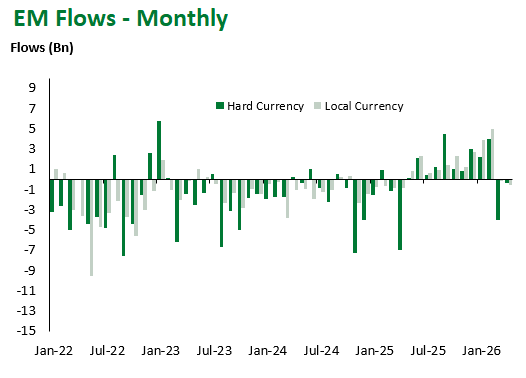
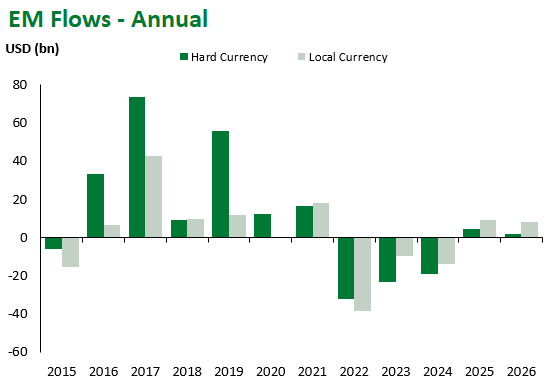
Source for graphs: Bloomberg, JPMorgan, Gramercy. As of Apr. 10, 2026.
For questions, please contact:
Kathryn Exum, CFA ESG, Director, Co-Head of Sovereign Research, [email protected]
Petar Atanasov, Director, Co-Head of Sovereign Research, [email protected]
This document is for informational purposes only. The information presented is not intended to be relied upon as a forecast, research or investment advice, and is not a recommendation, offer or solicitation to buy or sell any securities or to adopt any investment strategy. Gramercy may have current investment positions in the securities or sovereigns mentioned above. The information and opinions contained in this paper are as of the date of initial publication, derived from proprietary and nonproprietary sources deemed by Gramercy to be reliable, are not necessarily all-inclusive and are not guaranteed as to accuracy. This paper may contain “forward-looking” information that is not purely historical in nature. Such information may include, among other things, projections and forecasts. There is no guarantee that any forecasts made will come to pass. Reliance upon information in this paper is at the sole discretion of the reader. You should not rely on this presentation as the basis upon which to make an investment decision. Investment involves risk. There can be no assurance that investment objectives will be achieved. Investors must be prepared to bear the risk of a total loss of their investment. These risks are often heightened for investments in emerging/developing markets or smaller capital markets. International investing involves risks, including risks related to foreign currency, limited liquidity, less government regulation, and the possibility of substantial volatility due to adverse political, economic or other developments. References to any indices are for informational and general comparative purposes only. The performance data of various indices mentioned in this update are updated and released on a periodic basis before finalization. The performance data of various indices presented herein was current as of the date of the presentation. Please refer to data returns of the separate indices if you desire additional or updated information. Indices are unmanaged, and their performance results do not reflect the impact of fees, expenses, or taxes that may be incurred through an investment with Gramercy. Returns for indices assume dividend reinvestment. An investment cannot be made directly in an index. Accordingly, comparing results shown to those of such indices may be of limited use. The information provided herein is neither tax nor legal advice. Investors should speak to their tax professional for specific information regarding their tax situation.