


Contents
Market Overview
Middle East Conflict Updates
One week into the U.S./Israeli military attack against Iran, the duration and scope of the conflict remain shrouded in uncertainty. The focus of the U.S./Israeli air campaign appears to be on continuing to decapitate the political and military leadership of the Islamic Republic in order to disrupt the chain of command as well as to undermine Iran’s military capabilities, especially as it relates to its ability to fire at targets across the Middle East. For its part, Iran’s regime remains defiant, vowing to intensify its retaliation against U.S. military bases and civilian/energy infrastructure across the countries of the Gulf Cooperation Council (GCC). U.S./Israeli targeting of launch sites and Iran’s likely depletion of sophisticated ballistic missiles could ultimately limit the Islamic Republic’s ability to do so. However, cheaper and easier-to-manufacture military drones could continue to pose a significant threat to Iran’s Gulf Arab neighbors, who have also sounded the alarm about running into shortages of interceptors/air defenses against Iranian attacks. As such, one of the main factors that could drive a level of de-escalation might be the availability (or lack thereof) of munition on both sides, including for the U.S. and Israel.
Meanwhile, other countries in addition to those in the GCC, have claimed to be under attack by projectiles fired from Iran or Iranian proxy forces in the region, including Türkiye, Azerbaijan and even Cyprus, where a UK military base was targeted by a projectile allegedly fired by Hezbollah, the Iran-aligned Shia militia in Lebanon. Hezbollah has also broken its ceasefire with Israel by sending projectiles across Lebanon’s southern border in retaliation for Ayatollah Ali Khamenei’s killing, which prompted concerns that a renewed and potentially more significant Israeli ground offensive against Hezbollah and, by extension, Lebanon, might be forthcoming.
Another notable development is the Trump administration’s outreach to Tehran’s domestic opposition to foment an uprising against the regime, specifically to Kurdish community leaders in Iran and northern Iraq. With global markets still focused on two key questions/unknowns – i) the duration and severity of the conflict and ii) the ultimate end game of the Trump administration amid its reluctance to commit American “boots on the ground” – we believe the U.S. efforts to encourage internal rebellion in Iran could become the critical driver of market perception. In particular, this factor may shape market perceptions around both the likely trajectory of the conflict and whether it resolves quickly or becomes protracted. We know that Türkiye is extremely concerned about this, as any Kurdish military activity in the region is a red line from a Turkish perspective. As a precautionary measure, significant Turkish military forces are being amassed at the Turkey-Iran border. Another risk that concerns regional powers is that, if the Trump administration chooses to arm internal opponents in Tehran, Iran could descend into a Syria-like scenario.
Market Implications
As the situation remains extremely fluid, we continue to emphasize that the economic and market effects will ultimately depend on the duration, breadth and severity of the conflict and associated reaction in oil prices. For the time being, markets appear to be operating under the view that this represents a one-off short-term shock that should be manageable for global economic and credit fundamentals, provided it does not result in a sustained disruption to energy supply. That said, market sensitivity to escalation risk appears to have increased relative to earlier in the week given that the longer the conflict and related uncertainty continue, the higher the risk that some pre-existing “tipping points” in the global economy become more binding.
The most direct transmission mechanism from the conflict to the global economy and markets comes from higher oil prices with associated implications for inflation, GDP growth dynamics, external balances, and FX dynamics, to name just a few. Oil and gas flows through the strategic Strait of Hormuz (around 20% of global total under normal conditions) which remains blocked due to elevated risk perception and commercial insurance market closure. The U.S. military appears to be in a race against time to ensure the resumption of safe(r) passage of commercial oil tankers by escorting them through the strait.
A short disruption to Gulf oil/gas production and logistics (i.e. resolved within days) and moderately higher oil prices ($80/barrel reference level) relative to the pre-conflict environment should be manageable. However, a more prolonged conflict and disruption (several weeks to months) is likely to create significant production/supply issues, driving sustained higher oil prices ($100+/barrel reference level) with negative impact on growth and inflation, pointing to a renewed stagflationary impulse in the global economy. It will likely also complicate the path for central banks that may face a dramatically different balance of risks if the negative scenario materializes.
Against this week’s highly complex and constantly evolving backdrop, global markets traded with a risk-off tone but remained orderly. With geopolitical risks escalating, the beleaguered “Dollar Smile” made a partial comeback as investors sought refuge in traditional “safe haven” assets, propelling the DXY to a 99-handle, from as low as 96 in late January. However, somewhat counterintuitively, spot gold prices struggled, partially explained by technical reasons. Unlike the dollar, U.S. Treasuries came under pressure as concerns about the inflationary impact of higher oil and gas prices on the U.S. economy outweighed the UST’s safety appeal: the 10-year yield went back to trading at around 4.15%, some 20bps above the recent low of around 3.95% only a week ago. As the week ended, spot Brent touched $90 per barrel, with WTI in the mid-80s. Over the near-term, oil market experts believe that oil market faces an asymmetry in price outcomes: prices may decline by around $10 on reassuring headlines, while they could rise by as much as around $30 once Gulf production shut-ins begin to materialize and ripple through the market.
Portfolio Management
The most important shift over the past 24 hours is how investors are reassessing the potential economic transmission channels of the conflict. Markets initially focused on the direct price response in energy and other risk assets. Increasingly, however, attention is turning to the possibility that disruptions to regional logistics, infrastructure, and trade flows could prove more persistent than initially assumed. In the case of energy markets, this includes the risk that storage, export, and refining constraints could force production shut-ins if normal flows are not restored quickly.
From a portfolio perspective, this evolving assessment raises a broader question for markets: is this primarily a growth shock, an inflation shock, or a volatility shock? For now, the dominant manifestation appears to be volatility across commodities, rates, and currencies. However, if disruptions to energy flows and regional trade persist, the shock could increasingly take on stagflationary characteristics – simultaneously weighing on global growth while pushing inflation higher.
Periods like this tend to produce an initial phase of broad risk reduction followed by greater differentiation across countries and sectors. Our focus is therefore on identifying where the current environment creates fragility and where it creates opportunity. Fragility is most likely to emerge in energy-importing economies with weaker external buffers, while opportunities may arise in countries with stronger balance-of-payments dynamics or those benefiting from improved terms of trade. In that sense, the environment continues to reinforce the three themes we highlighted at the start of the year – volatility, dispersion, and fragmentation. These are conditions that typically expand the opportunity set for active portfolio management across emerging markets.
We remain confident that “A Better Approach to Emerging Markets®”, grounded in rigorous analysis, active selectivity, and disciplined risk management, positions us well to take advantage of these opportunities as they emerge.
EM Credit Update
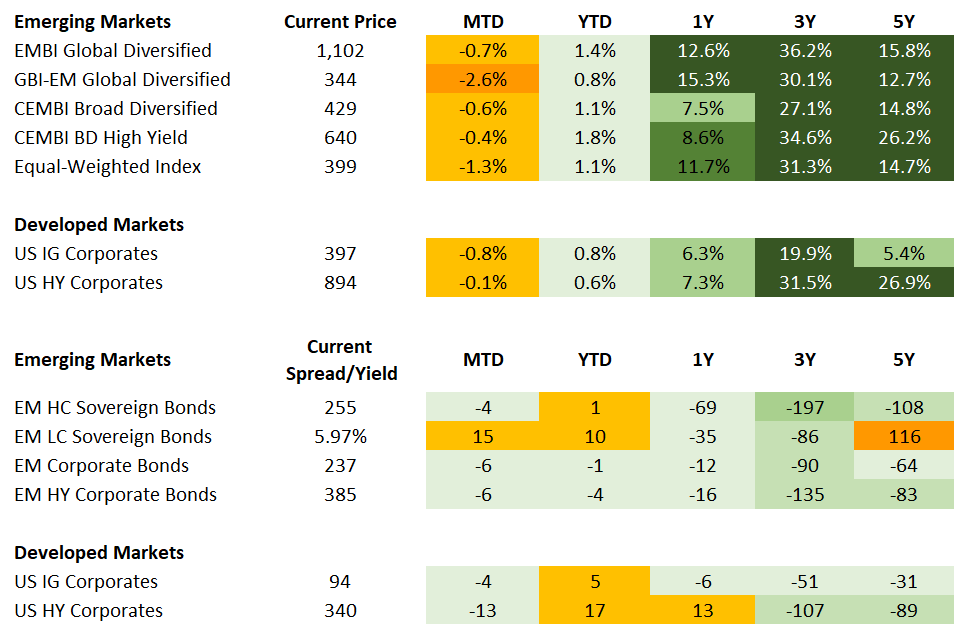
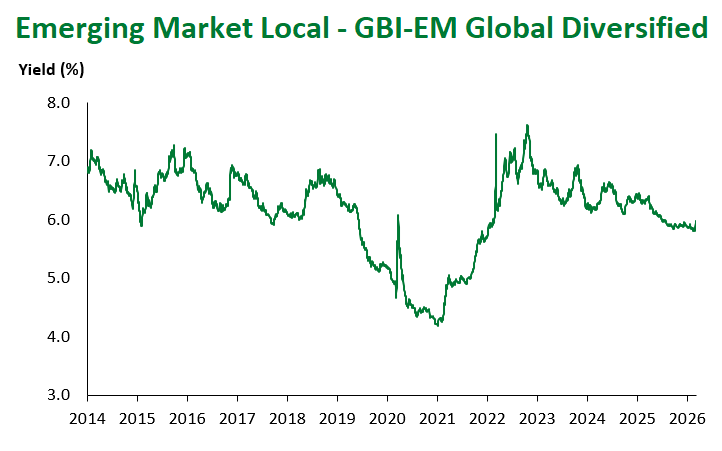
Emerging Markets (EM) fixed income was under pressure this week in sympathy with the geopolitically driven risk-off global backdrop. As investors sought refuge in the USD, local-currency debt, the best performer YTD, was the underperformer this week, returning -2.62% in USD terms at the index level. On the country level, retracement was broad-based, but Poland stood out (-4.39%) as the authorities contemplated plans to sell gold reserves to fund additional defense spending. Colombia was the main outperformer (+1.10%), recovering some lost ground from last week’s underperformance on election-related uncertainty.
In highly fluid market environment, hard-currency sovereigns (-0.72%) performed better than local-currency debt, with high yield (-0.47%) outperforming investment grade (-0.96%) as of Friday mid-morning. Regionally, Asia underperformed (-1.00%) on expected economic spillovers of higher oil prices on the region’s net oil importers; Latin America was the regional outperformer (-0.56%) on its relative remoteness from the conflict and potential gains from higher commodity prices. On the country level, Kenya (-2.11%) underperformed as a non-oil high yield African credit, while Lebanon continued to outperform (+3.77%) despite Israel’s increased military activity against the country’s territory as investors bet that a weaker Iran and Hezbollah post-conflict bodes well for Lebanon’s political and economic outlook and would ultimately support bond recovery values.
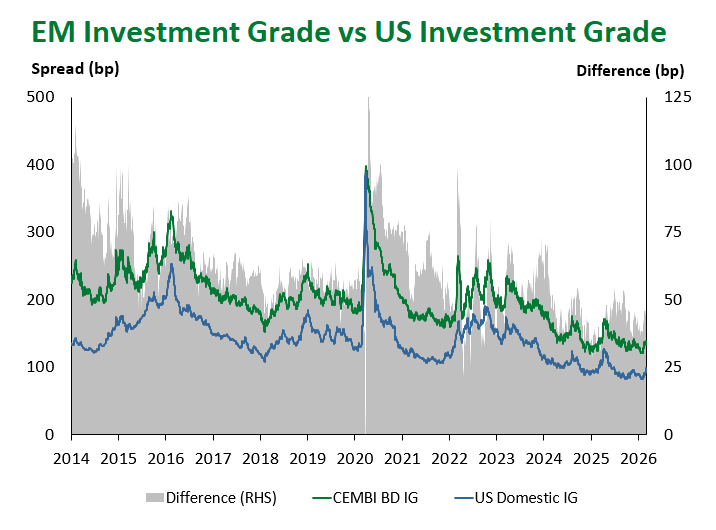
EM corporates delivered -0.56% at the index level, with high yield (-0.43%) also outperforming investment grade (-0.65%). Regionally, the Middle East (-0.83%) and CEEMEA (-0.65%) lagged, while Africa (-0.36%) and Latin America (-0.42%) outperformed. From a sectoral perspective, real estate (-1.40%) and transport (-1.10%) underperformed amid the unfolding situation in the Middle East. Across the curve, short-duration bonds outperformed as investors looked for safety, with the 1–3-year bucket delivering -0.27% vs. -0.98% for the 10+ space. By rating, sub-investment grade bonds performed relatively better, while the AA bucket was the main underperformer (-0.76%), underscoring the bottom-up dispersion theme.
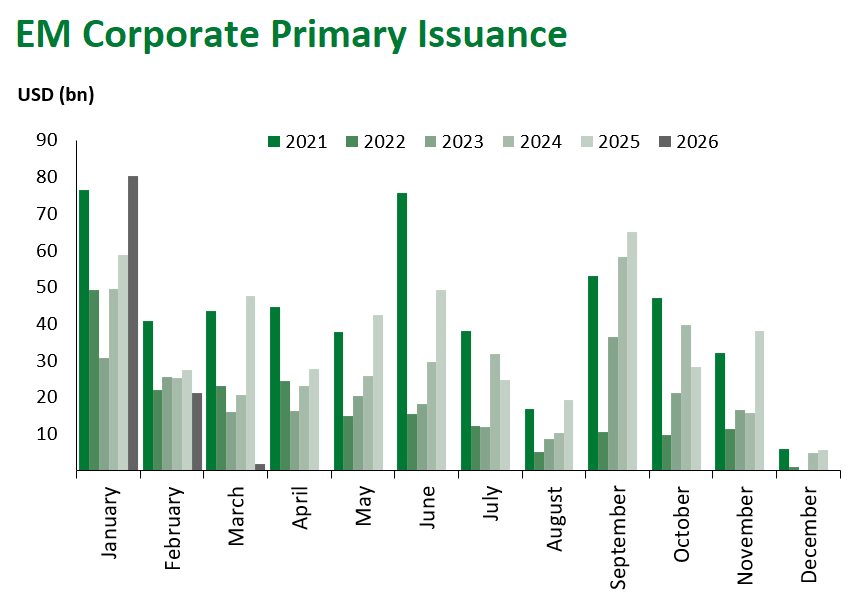
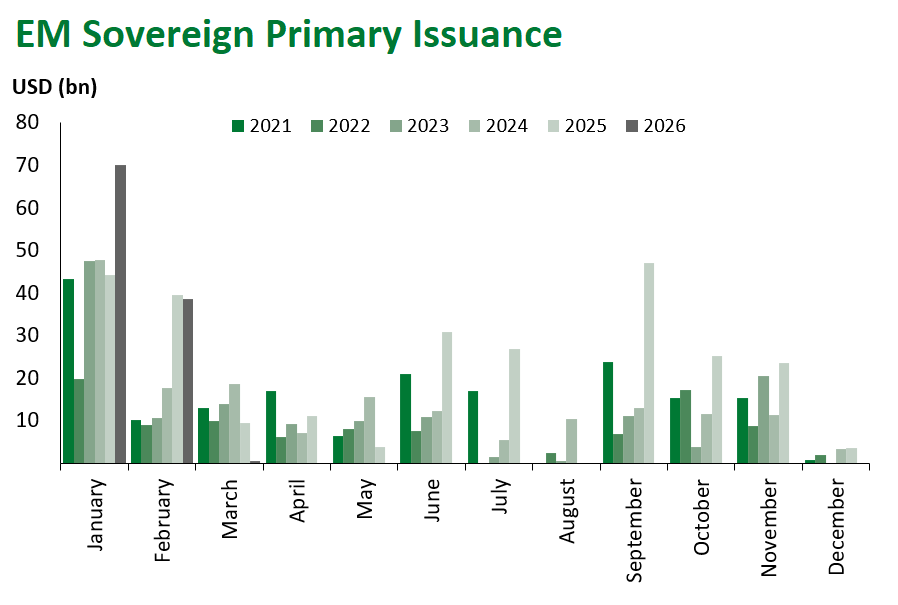
Amid the risk-off global environment, primary market activity came almost to a standstill, with only 10 issuers coming to market, mostly in Asia. Only one was sovereign, Mongolia, pricing a $500 million 2032 bond.
The Week Ahead
Looking beyond key developments in the Iran conflict – particularly the willingness and ability of shipping to resume transiting the Strait of Hormuz – the coming week will be data-heavy in the United States. Releases include January PCE inflation, the Federal Reserve’s preferred price gauge, February CPI, housing starts and existing home sales, small business optimism, the federal budget balance, GDP, consumer sentiment, and the February JOLTS report.
Over the weekend, President Trump will host Latin American leaders in Florida for the Shield of the Americas summit, aimed at advancing a regional security alliance.
In Asia, South Korea will publish fourth-quarter GDP, while China will continue its annual plenary session and release February CPI and PPI data. The central banks of Peru and Türkiye will hold policy meetings.
In Latin America, Colombia will hold parliamentary elections on Sunday, offering an early signal of political momentum ahead of the May presidential vote.
Fixed Income
Equities
Commodities
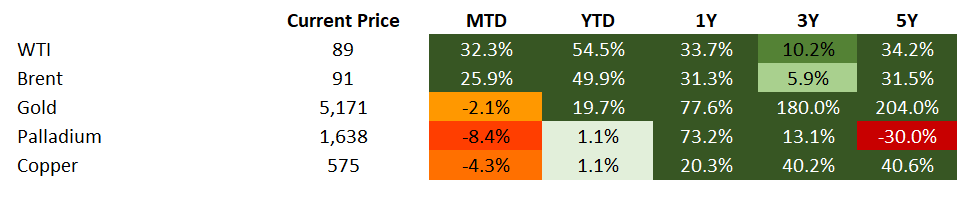
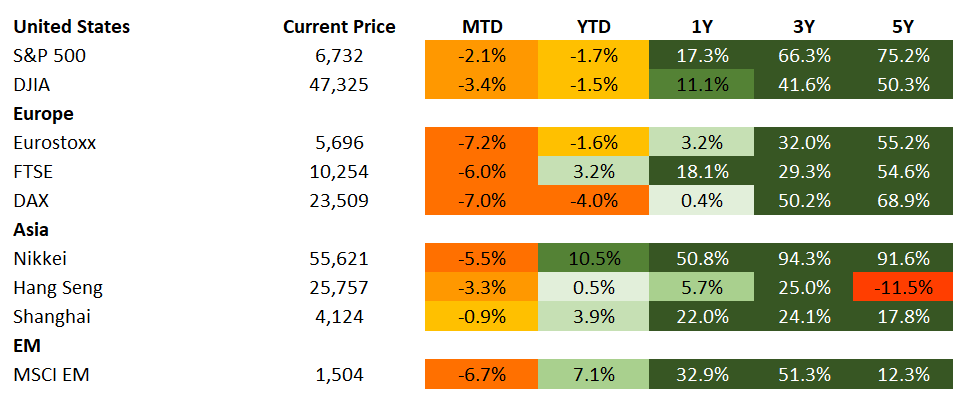
Source for data tables: Bloomberg, JPMorgan, Gramercy. EM Fixed Income is represented by the following JPMorgan Indicies: EMBI Global, GBI-EM Global Diversified, CEMBI Broad Diversified and CEMBI Broad High Yield. DM Fixed Income is represented by the JPMorgan JULI Total Return Index and Domestic High Yield Index. Fixed Income, Equity and Commodity data is as of Mar. 6, 2026 (mid-day).
Highlights
China Lowers 2026 Growth Target to 4.5-5.0%
Event: China’s annual plenary session commenced this week where authorities lowered the growth target for this year to 4.5-5.0% from around 5% in 2025. The fiscal outlook remained unchanged with a deficit of 4% of GDP and flat special government bond issuance. Policy priorities of consumption and technology alongside stabilization of the property sector largely align with what was presented at the Central Economic Work Conference at year-end, suggesting no changes from recent trade and geopolitical developments.
Gramercy Comment: The slowdown to the lowest growth target since 1991 reflects China’s structural constraints and lack of willingness to resort to large-scale stimulus measures. Still, we expect authorities to at least achieve the 4.5% floor, notwithstanding the possible need for additional measures as the year progresses. The private and more export-oriented PMI gauge for February exceeded expectations, reflecting limited near-term urgency for support although such strength is unlikely to be sustainable. The country’s strategic oil reserve covers an estimated 100 days of import cover, containing the immediate impact of the war in Iran, but an expanding scope or duration of the conflict would pose more material headwinds.
Emerging Markets Technicals
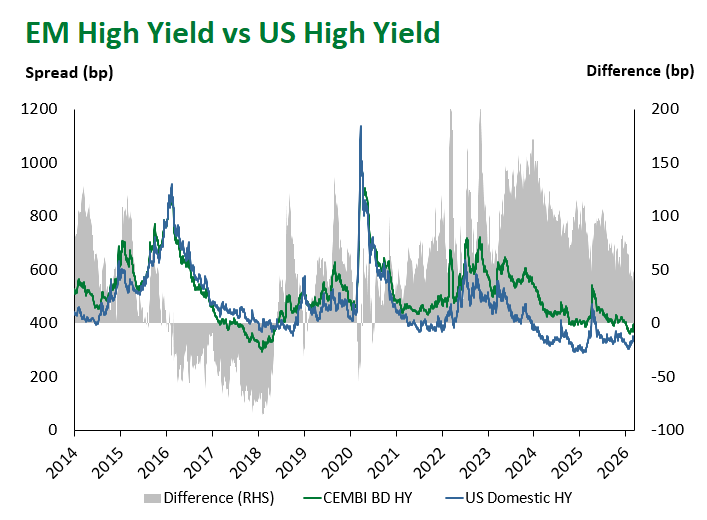
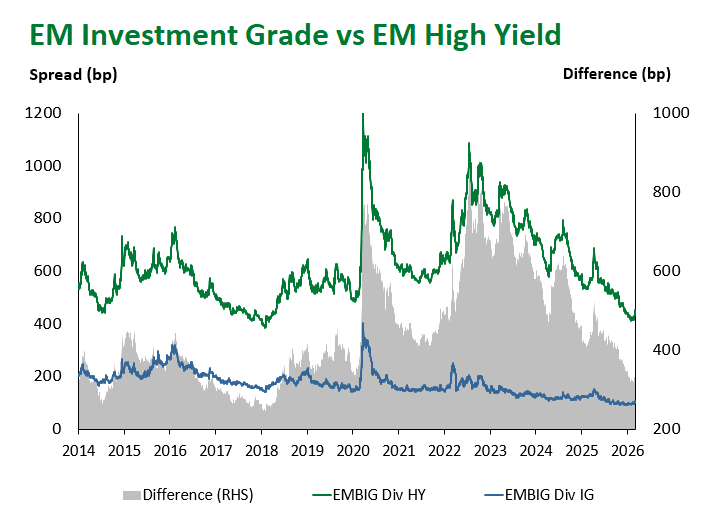
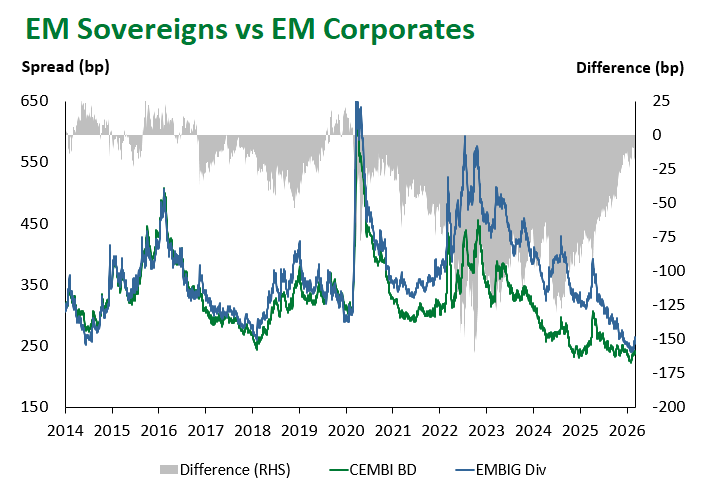
Emerging Markets Flows
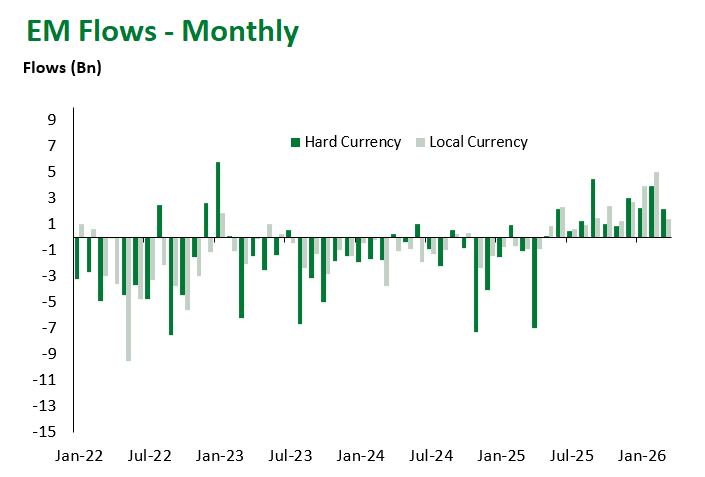
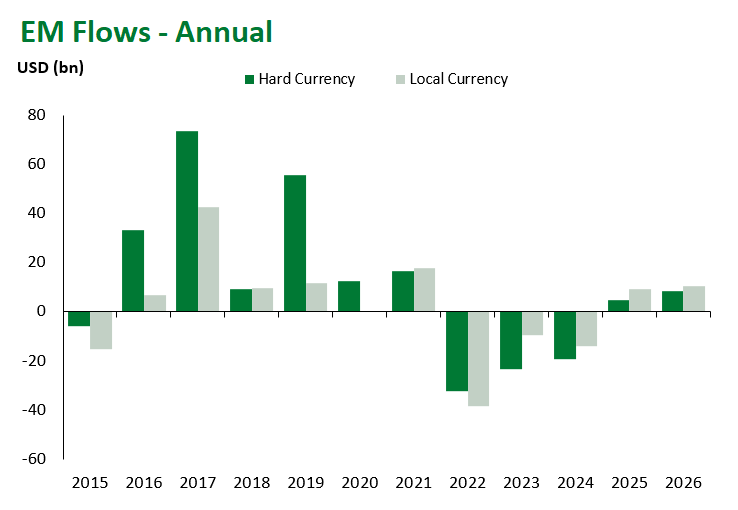
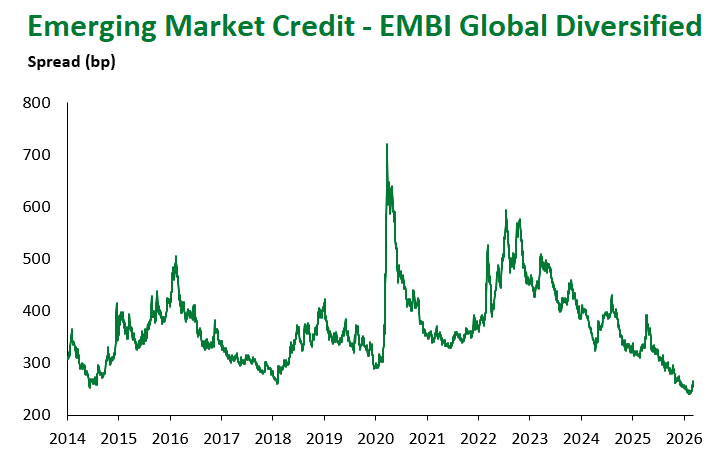
Source for graphs: Bloomberg, JPMorgan, Gramercy. As of Mar. 6, 2026.
For questions, please contact:
Kathryn Exum, CFA ESG, Director, Co-Head of Sovereign Research, [email protected]
Petar Atanasov, Director, Co-Head of Sovereign Research, [email protected]
This document is for informational purposes only. The information presented is not intended to be relied upon as a forecast, research or investment advice, and is not a recommendation, offer or solicitation to buy or sell any securities or to adopt any investment strategy. Gramercy may have current investment positions in the securities or sovereigns mentioned above. The information and opinions contained in this paper are as of the date of initial publication, derived from proprietary and nonproprietary sources deemed by Gramercy to be reliable, are not necessarily all-inclusive and are not guaranteed as to accuracy. This paper may contain “forward-looking” information that is not purely historical in nature. Such information may include, among other things, projections and forecasts. There is no guarantee that any forecasts made will come to pass. Reliance upon information in this paper is at the sole discretion of the reader. You should not rely on this presentation as the basis upon which to make an investment decision. Investment involves risk. There can be no assurance that investment objectives will be achieved. Investors must be prepared to bear the risk of a total loss of their investment. These risks are often heightened for investments in emerging/developing markets or smaller capital markets. International investing involves risks, including risks related to foreign currency, limited liquidity, less government regulation, and the possibility of substantial volatility due to adverse political, economic or other developments. References to any indices are for informational and general comparative purposes only. The performance data of various indices mentioned in this update are updated and released on a periodic basis before finalization. The performance data of various indices presented herein was current as of the date of the presentation. Please refer to data returns of the separate indices if you desire additional or updated information. Indices are unmanaged, and their performance results do not reflect the impact of fees, expenses, or taxes that may be incurred through an investment with Gramercy. Returns for indices assume dividend reinvestment. An investment cannot be made directly in an index. Accordingly, comparing results shown to those of such indices may be of limited use. The information provided herein is neither tax nor legal advice. Investors should speak to their tax professional for specific information regarding their tax situation.