


Contents
Market Overview
Macro Update
This week, week three of the war in the Middle East, the conflict escalated again as Israel struck Iran’s key gas installations, the South Pars field. Tehran retaliated by attacking energy infrastructure across the Gulf, including Ras Laffan, Qatar’s main energy hub, as well as facilities in Kuwait, Saudi Arabia, and the UAE, and continues to impede traffic through the Strait of Hormuz. President Trump rebuked both Iran and Israel, asking his Israeli allies to stop attacks against energy targets and warned of a “massive response” if Iran attacks Qatari LNG infrastructure again, which suffered significant damage (estimated close to 20% of gas capacity).
Amid increasing uncertainty and what appears to be a widening rift between the U.S. and Israel on their operational and strategic objectives in the war, global central banks braced for a changing macroeconomic outlook, increasingly characterized by lower growth and higher inflation prospects. The Federal Reserve left its benchmark target range unchanged at 3.50-3.75%, as expected, and the “dot plot” of rate projections indicated that the median policymaker still expects one 25bps cut in 2026. However, the Fed noted that developments in the Middle East increased uncertainty for the U.S. economy and oil shocks would boost short term inflation pressures.
The other three global systemic central banks, the European Central Bank (ECB), the Bank of Japan (BoJ), and the Bank of England (BoE), also left their respective policy rates unchanged this week amid upside risks to inflation, signaling that the likely next moves for global central banks, especially single-mandate (inflation only) ones, would be to start hiking rates. Policymakers at all three institutions indicated that they “stand ready to act” against a near-term surge in inflation triggered by the global energy shock, while medium-term implications will depend on the intensity and duration of the conflict.
Elsewhere, Australia’s central bank raised rates by 25bps, while Indonesia’s opted to hold. The central bank of Brazil (BCB) was the only central bank globally that could deliver an interest rate cut this week (25bps to 14.75%, in line with expectations), given its starting position from a very tight monetary policy stance; however, the BCB also signaled increasing caution and data-dependency, contingent on geopolitical developments.
Against the backdrop of shifting geopolitical and macroeconomic sands, markets began to price the risk of a protracted energy shock and significant upside pressures on global inflation. The Brent spot price, the global oil benchmark, jumped above $118 per barrel mid-week, its highest level since the start of the war, before retreating slightly to around $109. The U.S. dollar, supported in times of geopolitical stress by its historic “safe haven” status, fluctuated around the 100 level on the DXY, but failed to break sustainably above it.
In a major market perception shift, bond markets witnessed a reversal in expected monetary policy paths by DM central banks, now pricing rate hikes in 2026 by the Fed, ECB and BoE. The U.S. Treasury curve bear-flattened, as the short-end suffered investors shifting to pricing hikes as opposed to cuts by the Fed this year. Relative to last week, the 2-Year treasury yield moved sharply higher by almost 20bps to around 3.90%, the 10-Year sold off by 10bps to around 4.37%, while the 30-Year was around 4bps higher to 4.95%.
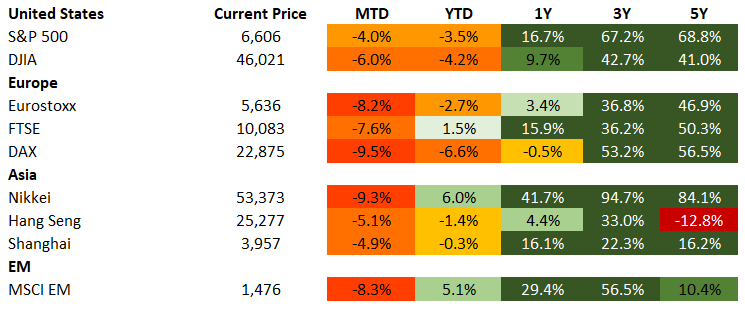
The major global stock indexes posted weekly losses for a third consecutive week, the longest such streak in a year, as concerns over the inflation impact of higher energy prices escalated and the global reset in interest-rate pricing began to settle in. Gold and silver spot prices came under significant pressure as well amid the market’s re-calibration of Fed expectations, dropping to levels comparable to where precious metals started the year, around $4500 and $70 per ounce, respectively.
EM Credit Update
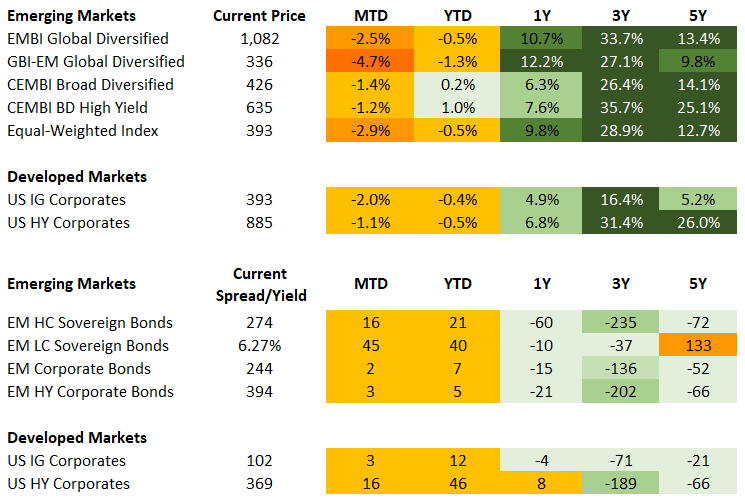
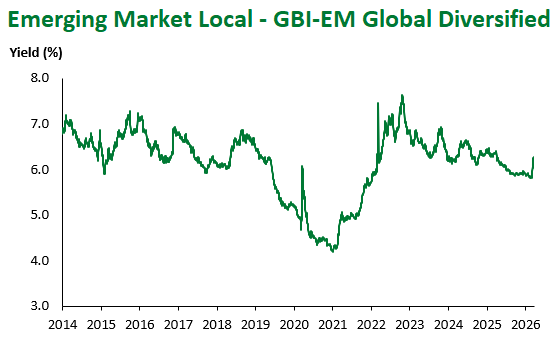
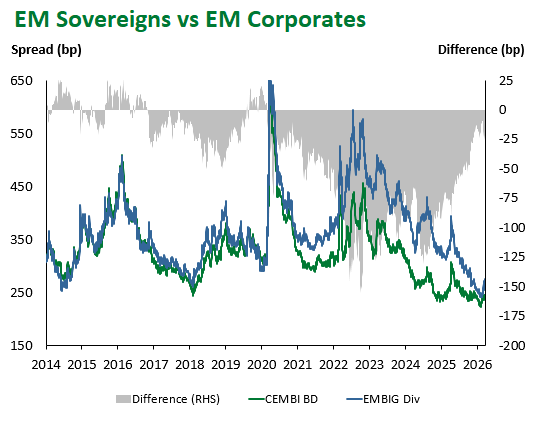
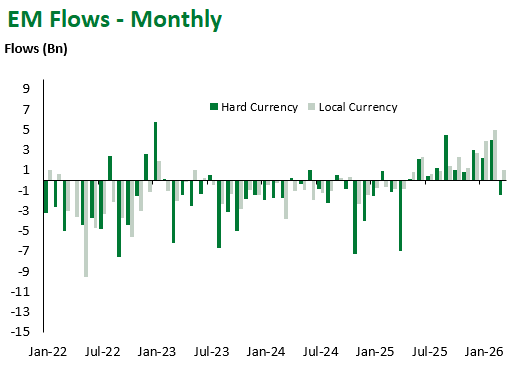
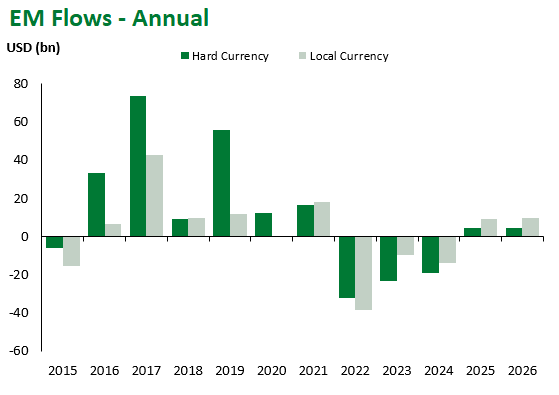
Emerging Markets (EM) fixed income remained under pressure this week amid escalating geopolitical tensions, with corporates outperforming and local sovereign debt bearing the brunt of the risk-off sentiment. Local currency debt was the main underperformer, declining -0.95% this week and pushing YTD performance down to -1.33%. At the country level, Brazil (+1.65%) and Colombia (+0.63%) remained in favor as Brazil’s central bank was the only one globally in a position to deliver a rate cut and Colombia’s pre-election political environment appeared to shift in a market-friendly direction. The main underperformers were Türkiye (-2.11%), Thailand (-1.93%), and Uruguay (-1.88%) as sharply higher global energy prices challenged investor sentiment on these net energy importing economies.
Hard currency sovereign bonds (-0.45%) continued to do better than local currency debt, but this week investment grade (-0.39%) outperformed high yield (-0.50%). Regionally, Europe (-0.84%) and the Middle East (-0.83%) underperformed, reflecting expected economic pressures on net oil/gas importers and sensitivity to rates, while Latin America (-0.13%) remained the main relative outperformer, benefiting from both distance from the conflict and potential gains from higher commodity prices. At the country level, Venezuela was the main beneficiary for a second week in a row (+5.17%), boosted by global energy developments and steps towards gradual political normalization, followed by other net oil exporters such as Angola (+ 1.14%) and Gabon (+0.63). On the other end of the spectrum, several economies remain vulnerable to higher energy prices and increased geopolitical uncertainty: Senegal (-4.49%), Ukraine (-4.21%), and Mozambique (-3.00%).
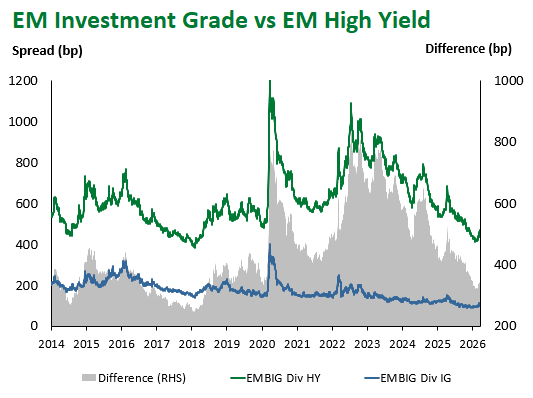
EM corporates remained the relative outperformer this week (-0.30% at the index level), with investment grade (-0.21%) outperforming high yield (-0.44%). Regionally, Asia (-0.12%) and Africa (-0.20%) outperformed, while the Middle East (-0.57%) and Europe (-0.53%) lagged. At the country level, gains were led by oil and gas companies in Ghana and Trinidad and Tobago.
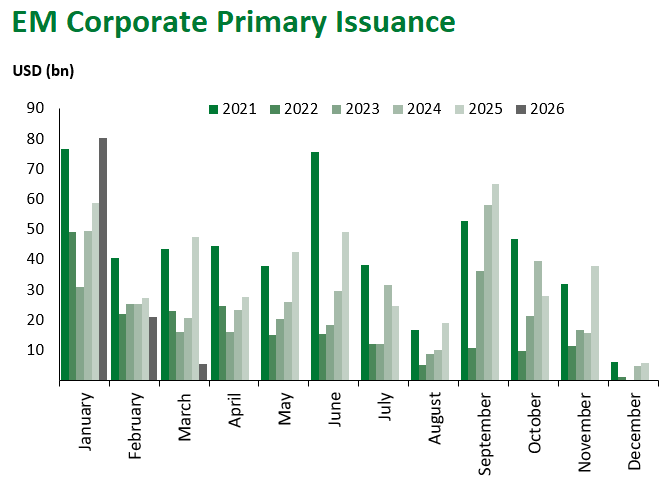
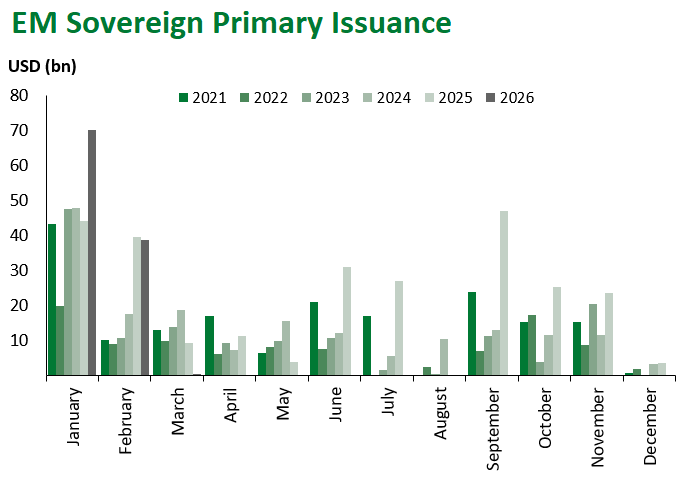
Primary market activity was almost non-existent, with only four Asian corporate issuers pricing small-size deals.
The Week Ahead
Next week, focus will remain on the Iran and Middle East tensions and their impact on global energy prices, supply chain disruptions, and inflation outlook. The G7 foreign ministers will be meeting in France to discuss these issues as well as the war in Ukraine. In the macro data universe, preliminary March PMI readings will be released in the Eurozone, U.S., UK, Japan, India, among others. Additionally, we’ll have February inflation in the UK, consumer confidence in the Eurozone, U.S. initial jobless claims and the University of Michigan consumer sentiment. Across emerging markets, there will be central bank rate decisions in Chile, Hungary, Sri Lanka, Mexico, and South Africa. The OECD will publish its interim economic outlook, with a focus on any adjustments due to the conflict in the Middle East. On the political front, Slovenian parliamentary elections are seen as a test of Europe’s populist momentum and Denmark’s snap general election will feature the future of Greenland as one of the main issues. A court hearing in New York is scheduled for Venezuelan President Nicolás Maduro, the first since his capture by U.S. forces in early January.
Fixed Income
Equities
Commodities

Source for data tables: Bloomberg, JPMorgan, Gramercy. EM Fixed Income is represented by the following JPMorgan Indicies: EMBI Global, GBI-EM Global Diversified, CEMBI Broad Diversified and CEMBI Broad High Yield. DM Fixed Income is represented by the JPMorgan JULI Total Return Index and Domestic High Yield Index. Fixed Income, Equity and Commodity data is as of Mar. 20, 2026 (mid-day).
Highlights
Brazil’s central bank launches a cautious rate cutting cycle amid global energy price shock
Event: The central bank of Brazil (BCB) lowered its benchmark SELIC rate by 25bps to 14.75%, marking the first easing of monetary policy since 2024.
Gramercy Comment: BCB’s monetary policy committee, the COPOM, cited elevated external uncertainty linked to the war in the Middle East as the main reason for the cautious start of its long-anticipated rate-cutting cycle. The policymakers removed forward guidance and signaled data-dependency amid fluid geopolitical developments. Nevertheless, it is notable that, having maintained the highest real interest rates across major economies for a prolonged period, BCB was in a strong enough position to deliver a modest rate cut, despite a universal shift by global central banks toward tighter financial conditions amid the ongoing energy price shock and associated inflation risks. From that perspective, Brazil remains a standout among emerging market local debt stories; however, in the current environment, investor sentiment on emerging market local debt is likely to be driven by global, rather than domestic, factors. Meanwhile, Finance Minister Fernando Haddad, one of President Lula’s closest allies, stepped down this week ahead of his expected bid for governor of Sao Paulo. Haddad, who often had to balance diverging market and political expectations during his tenure, favored efforts to stabilize Brazil’s fiscal health. Maintaining fiscal discipline will remain the market’s key focus area for the remainder of the Lula administration and into the new administration after the upcoming presidential elections in October.
Venezuela’s normalization process continues
Event: Venezuela’s Interim President Delcy Rodriguez replaced Defense Minister and hardliner Vladimir Padrino Lopez with former Interior Minister and Head of Intelligence, Gustavo Gonzalez Lopez. Additionally, OFAC issued another license allowing U.S. companies to conduct transactions with PdVSA and its majority-owned entities if contracts are governed by U.S. law and disputes are resolved in the U.S. The license does not allow dealings with sanctioned individuals or debt or bond transactions. Lastly, the IMF stated it is working toward taking technical-level interactions with the Venezuelan authorities.
Gramercy Comment: The removal of Padrino Lopez signals power consolidation under Rodriguez while removal of hardliners is a necessary precursor for the prospect of an eventual democratic transition. While Gonzalez Lopez has been sanctioned by the U.S. and is a regime loyalist, his close ties to the regime should help limit internal fractions. The next signpost on this front is the removal of Interior Minister Diosdado Cabello. On the economic side, additional U.S. licenses and gas agreements with Repsol and Eni coupled with progress toward IMF technical interaction and the broader geopolitical backdrop, bode well for the stabilization and recovery outlook.
Emerging Markets Technicals
Emerging Markets Flows
Source for graphs: Bloomberg, JPMorgan, Gramercy. As of Mar. 20, 2026.
For questions, please contact:
Kathryn Exum, CFA ESG, Director, Co-Head of Sovereign Research, [email protected]
Petar Atanasov, Director, Co-Head of Sovereign Research, [email protected]
This document is for informational purposes only. The information presented is not intended to be relied upon as a forecast, research or investment advice, and is not a recommendation, offer or solicitation to buy or sell any securities or to adopt any investment strategy. Gramercy may have current investment positions in the securities or sovereigns mentioned above. The information and opinions contained in this paper are as of the date of initial publication, derived from proprietary and nonproprietary sources deemed by Gramercy to be reliable, are not necessarily all-inclusive and are not guaranteed as to accuracy. This paper may contain “forward-looking” information that is not purely historical in nature. Such information may include, among other things, projections and forecasts. There is no guarantee that any forecasts made will come to pass. Reliance upon information in this paper is at the sole discretion of the reader. You should not rely on this presentation as the basis upon which to make an investment decision. Investment involves risk. There can be no assurance that investment objectives will be achieved. Investors must be prepared to bear the risk of a total loss of their investment. These risks are often heightened for investments in emerging/developing markets or smaller capital markets. International investing involves risks, including risks related to foreign currency, limited liquidity, less government regulation, and the possibility of substantial volatility due to adverse political, economic or other developments. References to any indices are for informational and general comparative purposes only. The performance data of various indices mentioned in this update are updated and released on a periodic basis before finalization. The performance data of various indices presented herein was current as of the date of the presentation. Please refer to data returns of the separate indices if you desire additional or updated information. Indices are unmanaged, and their performance results do not reflect the impact of fees, expenses, or taxes that may be incurred through an investment with Gramercy. Returns for indices assume dividend reinvestment. An investment cannot be made directly in an index. Accordingly, comparing results shown to those of such indices may be of limited use. The information provided herein is neither tax nor legal advice. Investors should speak to their tax professional for specific information regarding their tax situation.