


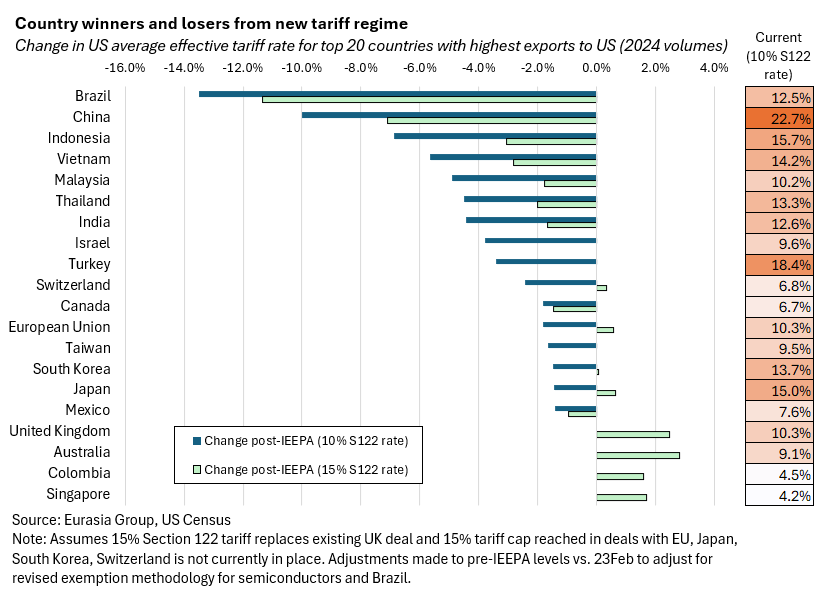
Following the decision by the Supreme Court of the United States to strike down tariffs imposed under the International Emergency Economic Powers Act (IEEPA), the U.S. administration has introduced a replacement global tariff of 10%, with the option to increase it to 15% for a 150-day period. This adjustment reduces the average effective tariff rate on imports to the U.S. by an estimated 1.5–3.5%. The administration has indicated its intention to pursue alternative legal mechanisms to extend tariff measures beyond this window; however, implementation is likely to be prolonged and targeted at specific sectors and products.
From a macro perspective, the shift is mildly constructive. The most punitive tariff measures appear to be forgone, and there is potential for further easing beyond the 150-day horizon, excluding select sectors and products. We continue to anticipate resilient emerging market (EM) growth, alongside a steeper U.S. Treasury curve and a weaker U.S. dollar. Lower tariff revenues and the prospect of eventual refunds are expected to weigh on U.S. fiscal receipts, keeping the budget deficit elevated.
Brazil and China stand to benefit the most, given their prior exposure to the highest IEEPA-related tariffs. Southeast Asian economies also benefit, as recently negotiated tariff frameworks were set at levels above the new global baseline. In Brazil, exports to the U.S. that were not part of the prior framework’s extensive exemptions (around 20% of Brazil’s total goods exports to the U.S.) will now face a much lower 15% levy compared to 50% previously. All else equal, this is naturally a positive development from Brazil’s perspective that reduces the erosion of relative competitiveness for a segment of its exports to the U.S. However, as we’ve argued previously, for Brazil’s large and domestically driven economy, the overall macro impact of trade relations with the U.S., either in a positive or negative direction, is likely to remain relatively muted. In China, recent developments are unlikely to alter President Donald Trump’s planned trip to Beijing from March 31–April 1 or Trump’s desired deliverables from the visit, including potential purchase agreements. Although China’s relative advantage may narrow if new sector- and product-specific tariffs are introduced, we do not expect Beijing to retaliate, as overall tariff levels are likely to remain below prior IEEPA thresholds.
Should the higher 15% global tariff be implemented across the board, relative underperformers within EM could include countries that previously faced lower 10% reciprocal tariffs, such as Colombia and Chile, for example. However, we note that the most likely scenario appears to be one in which existing and/or negotiated bi-lateral trade deals stay on track despite the latest tariff ruling. The impact on Mexico is expected to be moderate, as it already benefits from preferential access under the United States-Mexico-Canada Agreement (USMCA). The primary focus for Mexico will be the USMCA renewal negotiations in July. While headline volatility is possible, strong economic integration, President Claudia Sheinbaum’s pragmatic approach to geoeconomic engagement with the U.S. and sustained technical-level dialogue over the past year support the prospect of a constructive outcome.
Looking ahead, we expect trade negotiations and framework discussions to regain momentum as greater clarity emerges around the global tariff rate, exemptions, and the scope of sector- and product-level measures.
For questions, please contact:
Kathryn Exum, CFA ESG, Director, Co-Head of Sovereign Research, [email protected]
Petar Atanasov, Director, Co-Head of Sovereign Research, [email protected]
This document is for informational purposes only. The information presented is not intended to be relied upon as a forecast, research or investment advice, and is not a recommendation, offer or solicitation to buy or sell any securities or to adopt any investment strategy. Gramercy may have current investment positions in the securities or sovereigns mentioned above. The information and opinions contained in this paper are as of the date of initial publication, derived from proprietary and nonproprietary sources deemed by Gramercy to be reliable, are not necessarily all-inclusive and are not guaranteed as to accuracy. This paper may contain “forward-looking” information that is not purely historical in nature. Such information may include, among other things, projections and forecasts. There is no guarantee that any forecasts made will come to pass. Reliance upon information in this paper is at the sole discretion of the reader. You should not rely on this presentation as the basis upon which to make an investment decision. Investment involves risk. There can be no assurance that investment objectives will be achieved. Investors must be prepared to bear the risk of a total loss of their investment. These risks are often heightened for investments in emerging/developing markets or smaller capital markets. International investing involves risks, including risks related to foreign currency, limited liquidity, less government regulation, and the possibility of substantial volatility due to adverse political, economic or other developments. References to any indices are for informational and general comparative purposes only. The performance data of various indices mentioned in this update are updated and released on a periodic basis before finalization. The performance data of various indices presented herein was current as of the date of the presentation. Please refer to data returns of the separate indices if you desire additional or updated information. Indices are unmanaged, and their performance results do not reflect the impact of fees, expenses, or taxes that may be incurred through an investment with Gramercy. Returns for indices assume dividend reinvestment. An investment cannot be made directly in an index. Accordingly, comparing results shown to those of such indices may be of limited use. The information provided herein is neither tax nor legal advice. Investors should speak to their tax professional for specific information regarding their tax situation.