


Contents
Market Overview
Macro Update
Geoeconomics and volatility were key market themes this week. Amid heightened U.S. military pressure on Iran, the two sides engaged in indirect talks to reduce tensions, but concerns remained whether they could bridge major differences on expanding the negotiations beyond nuclear issues. President Trump announced his administration will lower tariffs on India to 18% from as high as 50% previously, in exchange for Prime Minister Modi’s commitment that India would stop purchasing Russian oil. These developments coincided with the resumption of trilateral talks between Russian, Ukrainian, and U.S. officials in the UAE aimed at finding common ground for ending the Russia-Ukraine conflict, but progress has been marginal.
A renewed wave of tech stock losses amid concerns about software firms’ vulnerability to AI and worries about chipmakers dominated markets, but eased at the end of the week as dip buyers appeared. Amid market scrutiny on big tech capex plans, Amazon forecast 2026 capital expenditure of about $200 billion, pushing collective guidance by tech firms to around $0.7 trillion this year and raising questions about how spending will be financed.
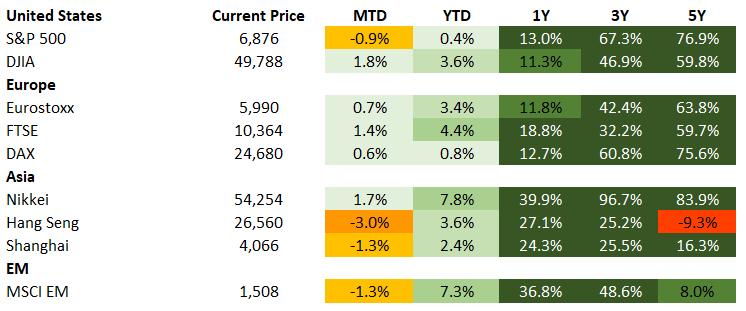
The tech-heavy NASDAQ index led the declines as global equity indexes closed the week mixed. Bonds climbed after a string of weak jobs data in the U.S. boosted Fed cuts expectations; the U.S. treasury curve bull-steepened marginally with the 10- and 30-year maturities yielding around 4.21% (-2bps) and 4.86% (-1bp), respectively.
Metals markets remained highly volatile: after last week’s 20% peak to bottom move, spot gold initially climbed back to above $5,000 per ounce but gave up some gains to finish the week just below the $5,000 mark. Spot silver’s volatility was even greater, closing in the mid-$70s per ounce, which is almost 40% lower from its peak reached last week. The dollar strengthened, recovering to the mid-97s on the DXY from its multi-month low of below 96 reached last week. Oil prices edged lower compared to last week to mid and low-60s for Brent and WTI, respectively as Iran and the U.S. appeared to look for a diplomatic solution to avoid a potential major military escalation in the Middle East. Crypto assets sold off sharply but also rebounded as Bitcoin closed around the high-60,000s, almost 50% below its October 2025 peak.
In the U.S. economy, signs of a cooling labor market abounded. Companies announced the largest number of job cuts for any January since the depths of the Great Recession in 2009, and U.S. jobless claims increased by more than forecast last week as the severe cold weather curtailed business activity. The December JOLTS job openings also came significantly below expectations. The January S&P Composite PMI and ISM Services printed slightly above expectations; however, the ISM employment sub-component was below market consensus. The February preliminary University of Michigan sentiment survey climbed to a 6-month high as consumers appeared to grow more optimistic about the short-term inflation outlook. The January jobs report was delayed to February 11 amid the partial U.S. federal government shutdown.
Meanwhile, President Trump signed a bill to end the shutdown, after it narrowly passed the House. The measure will fund several agencies until September and the Department of Homeland Security until February 13, allowing U.S. lawmakers to continue negotiating restrictions on immigration-enforcement agents. Following last week’s clarity on the new Fed chair, focus this week shifted to the transition process. Opposition Senators on the Senate Banking Committee as well Republican Thom Tillis demanded ongoing investigations into current Fed Chair Jerome Powell and Governor Lisa Cook be completed before advancing Warsh’s nomination.
In Europe, the European Central Bank kept interest rates unchanged (2.0%) as officials evaluate the impact of euro strength and trade unpredictability. The Bank of England also held at 3.75% but came within a vote of cutting interest rates and predicted that inflation is likely to fall below its target, which revived market hopes of a move next month.
Preliminary eurozone headline CPI eased in January to 1.7% year-over-year, down from 2.0% in December and below the ECB’s 2.0% target. Core CPI was softer than expected at 2.2 year-overoyear%, marking its lowest level in more than four years. Further declines, driven in part by a stronger euro, could open the door for additional rate cuts later this year. Meanwhile, other indicators softened at the margin with slight misses on January PMIs and December retail sales.
China’s PMI data was mixed with official composite PMI dipping into contractionary territory, underscoring weak domestic demand and uneven momentum. However, private sector PMIs continued to improve, remaining in expansionary territory. Price components increased on higher commodity prices.
President Trump and President Xi spoke for the first time since late November, discussing a broad range of topics in preparation for Trump’s visit to Beijing in April. Both sides provided constructive readouts while President Trump outlined expectations of Chinese purchase commitments from the upcoming visit.
Elsewhere, Laura Fernández, a 39-year-old right-wing populist, won Costa Rica’s presidential election in a landslide on a platform to crack down on drug-related crime amid rising gang violence in the tourism-dependent economy. Colombia’s President Gustavo Petro had a successful visit to the White House where he and President Trump downplayed previous mutual criticism and committed to cooperate in counternarcotics operations and ways to “reactivate Venezuela”, among other issues.
EM Credit Update
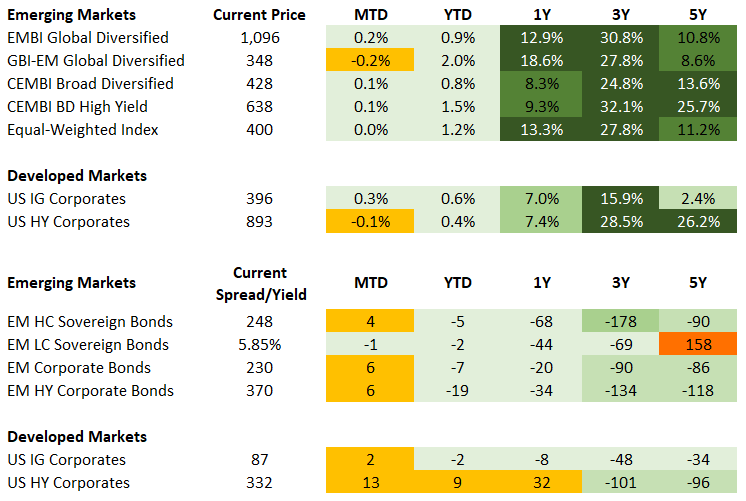
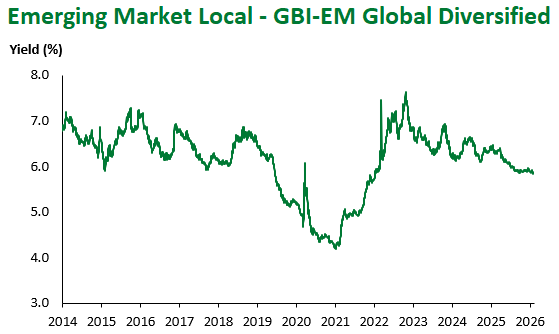
Emerging Markets (EM) fixed income delivered mixed results this week, with local-currency debt, the best performing sub-asset class YTD, underperforming this week amid slight USD recovery. Colombia (-1.93%) and Poland (-1.21%) were down as political risks combined with BanRep’s hawkish shift in Colombia, while the Polish central bank signaled it might soon resume rate cuts. The main outperformer this week was India (+2.12%) on constructive trade developments amid trade deals with the EU and the Trump administration.
Hard-currency sovereigns posted modest gains, returning +0.18%, driven by high yield (+0.24%), which outperformed investment grade (+0.12%). All EM regions delivered positive returns with the Middle East leading (+0.30%) and Asia lagging (+0.11%). At the country level, Senegal led gains (+5.26%) on speculation of positive news from the IMF’s recent visit, while the distressed stories in Venezuela (+2.26%) and Lebanon (+1.96%) outperformed as investors remain optimistic on recovery prospects. On the opposite end of the spectrum, El Salvador (-1.34%), Argentina (-0.76%) and Ukraine (-0.61%) underperformed. In El Salvador, frictions resurfaced between the authorities and IMF over the country’s Bitcoin purchases, Argentina gave back some of the gains from last week, and Ukraine saw limited progress in diplomatic efforts to end the war with Russia.
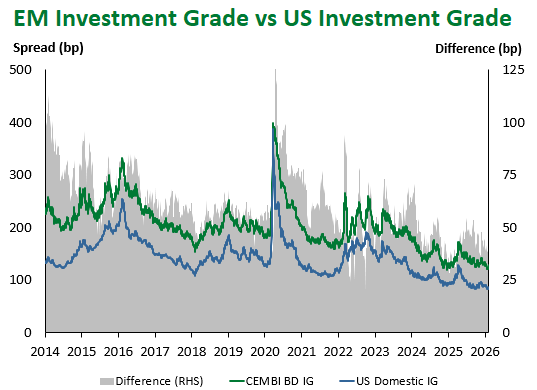
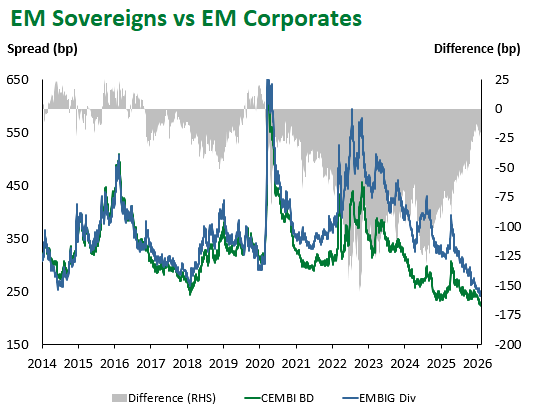
EM corporate bonds underperformed sovereigns this week, returning +0.09%, with high yield (+0.11%) again outperforming investment grade (+0.08%). Europe (+0.38%) led regional performance for a second week in a row, supported by continued strength in Ukrainian corporates (+3.75%). Latin America (-0.11%) lagged, pressured by idiosyncratic volatility in Brazil. Along the curve, the 3–5-year maturity bucket outperformed (+0.17%), while the 7-10-year segment lagged (+0.01%). By rating, the ‘C’ bucket led performance again (+1.40%), while BBBs (-0.01%) trailed. Corporate spreads widened by 5 bps at the index level.
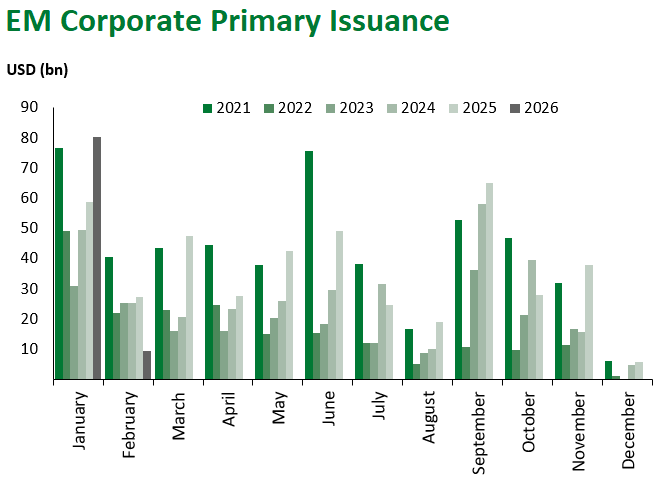
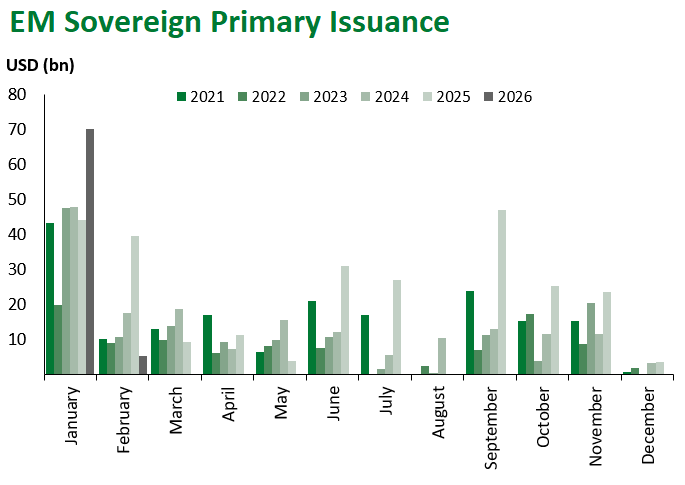
Primary market activity eased after the January deals deluge, with 24 hard-currency issuers coming to market this week. Only three sovereigns were among them: Türkiye with a EUR-denominated issuance, Korea with a USD-denominated, and Poland with a JPY-denominated one. Corporate issuance was balanced across regions and ratings.
The Week Ahead
As sports fans in the U.S. set their sight on Super Bowl LX and global audiences on the Milano-Cortina Winter Olympics, next week also offers market-relevant elections in the form of a snap lower-house election in Japan and a general vote in Thailand that can reshape the political balance in both countries. The January U.S. CPI report will be a key test of whether inflation is continuing to cool at a gradual pace. The January jobs report, delayed from February 6, is expected to show non-farm payrolls rising about 70,000 for the month against December’s 50,000 and the jobless rate to hold at 4.4%. Other notable U.S. macro data releases include retail sales, the federal budget balance and initial jobless claims. January PPI and CPI will be reported in China as well as home prices month-on-month changes. 4Q preliminary GDP readings are due in the Eurozone and UK. South African President Cyril Ramaphosa is scheduled to deliver his 2026 State of the Nation address in Cape Town. On the geopolitical stage, the Munich Security Conference is expected to focus on NATO’s future and the war in Ukraine.
Fixed Income
Equities
Commodities
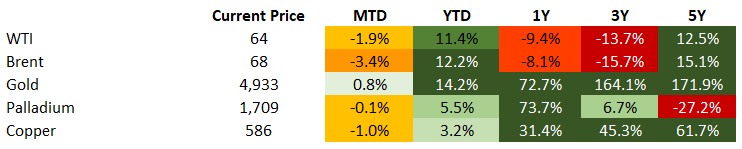
Source for data tables: Bloomberg, JPMorgan, Gramercy. EM Fixed Income is represented by the following JPMorgan Indicies: EMBI Global, GBI-EM Global Diversified, CEMBI Broad Diversified and CEMBI Broad High Yield. DM Fixed Income is represented by the JPMorgan JULI Total Return Index and Domestic High Yield Index. Fixed Income, Equity and Commodity data is as of Feb. 6, 2026 (mid-day).
Highlights
Progress on U.S.-Venezuela Normalization Continues
Event: U.S. envoy Laura Dogu met with interim President Delcy Rodriguez to begin the groundwork for a three-phase strategy, starting with security and stabilization, followed by economic recovery and finally transition to a “friendly, stable, and prosperous democratic Venezuela”. This came on the heels of Venezuela’s approval of a revised hydrocarbon law, which allows for greater private operational control, relative improvements to arbitration protections, and royalty caps as well as issuance of U.S. general licenses, which allow established U.S. entities to engage in transactions involving Venezuela oil—including lifting, exportation, transportation, storage, sale and refining as well as sale and export of diluents. President Rodriguez has announced intentions to submit an amnesty bill to the national assembly as well as reportedly detained key Maduro confidant and financier Alex Saab.
Gramercy Comment: We see recent developments as positive momentum towards normalization of U.S.-Venezuela relations. Oil sales have allowed for an initial $500 million available to the private sector through the U.S. managed account currently in Qatar, incrementally easing domestic dollar liquidity pressures. Higher oil revenue and investment should begin to boost economic output from its low base. At the same time, Secretary Rubio continues to signal a possible resolution to U.S. recognition of the 2015 national assembly which could open the door for a release of roughly $5 billion in IMF SDRs. The amnesty bill, if passed, would be a very constructive step towards eventual political transition and elections. On the economic front, markets will watch for domestic reaction and treatment to the reformed oil legislation, disbursement of future oil flows, and progress in oil production and exports. On the political side, continued cooperation between Rodriguez and the U.S., her domestic political capital, and further groundwork for a path towards elections will be key.
Cordial meeting between presidents Petro and Trump at the White House eases tensions
Event: President Trump and his Colombian counterpart Gustavo Petro had their first in-person meeting this week, which produced a dramatic reversal in the tense and noisy relationship during Mr. Trump’s first year in office. Both leaders tried to downplay previous mutual criticism and said that they discussed cooperation in counternarcotics operations and ways to reactivate Venezuela, including through energy projects, among other issues.
Gramercy Comment: Mr. Petro has been one of the most vocal critics of the Trump administration’s policies in the Western Hemisphere on the global stage and the two leaders have engaged in public disputes on social media. Historically, Colombia has been a staunch U.S. ally and was even designated as a major non-NATO ally before the relationship soured under Trump and Petro. In that context, this week’s in-person meeting was fraught with risks, reminiscent of the infamous Oval Office spat between Presidents Trump and Zelenskyy back in February 2025. However, the meeting appeared to produce a benign outcome: Trump called Petro a “terrific person” and suggested that the two administrations will be working closely “on many things”, including stemming the flow of illegal drugs. President Trump also signaled that sanctions placed on Petro and his family by the Trump administration will be removed. The two leaders also focused on regional issues of shared interest, such as ways to “reactivate Venezuela including through energy projects” and mediate an escalating trade war between Colombia and Ecuador. We note that markets are likely to feel reassured in the near-term by easing tensions between the Trump and Petro administrations. Beyond that, the medium-term credit outlook for Colombia hinges on the outcome of legislative and presidential elections in 1H 2026 that will determine Bogota’s economic and foreign policy direction once Mr. Petro leaves office in August.
Emerging Markets Technicals
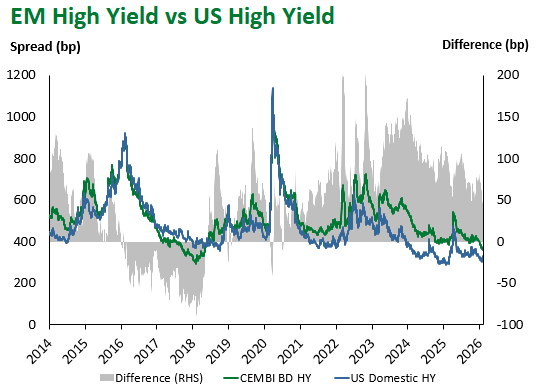
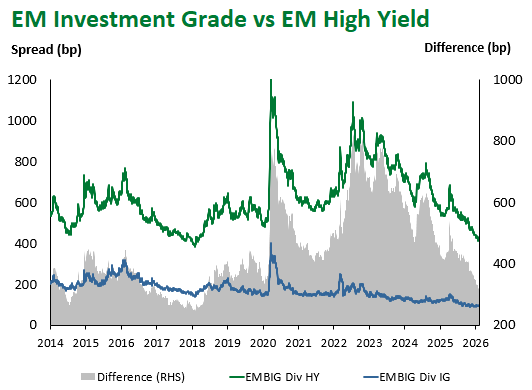
Emerging Markets Flows
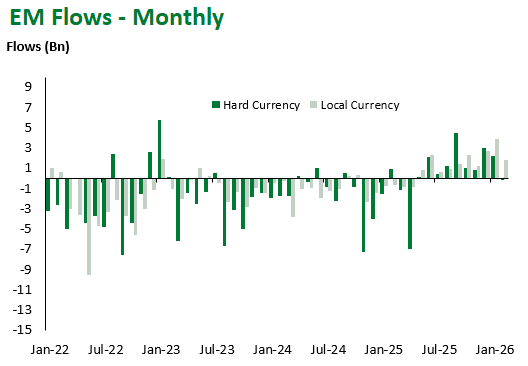
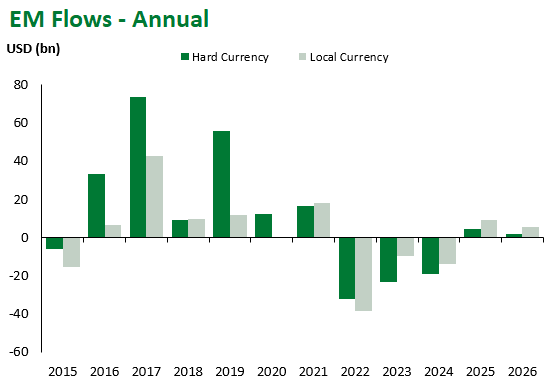
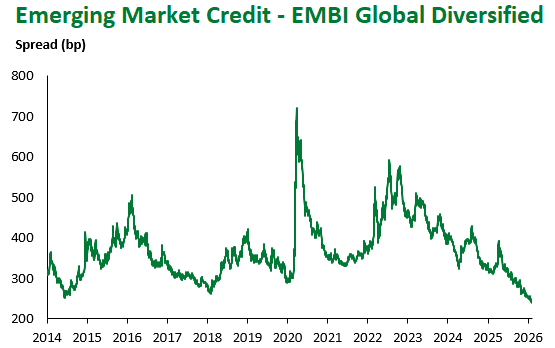
Source for graphs: Bloomberg, JPMorgan, Gramercy. As of Feb. 6, 2026.
For questions, please contact:
Kathryn Exum, CFA ESG, Director, Co-Head of Sovereign Research, [email protected]
Petar Atanasov, Director, Co-Head of Sovereign Research, [email protected]
This document is for informational purposes only. The information presented is not intended to be relied upon as a forecast, research or investment advice, and is not a recommendation, offer or solicitation to buy or sell any securities or to adopt any investment strategy. Gramercy may have current investment positions in the securities or sovereigns mentioned above. The information and opinions contained in this paper are as of the date of initial publication, derived from proprietary and nonproprietary sources deemed by Gramercy to be reliable, are not necessarily all-inclusive and are not guaranteed as to accuracy. This paper may contain “forward-looking” information that is not purely historical in nature. Such information may include, among other things, projections and forecasts. There is no guarantee that any forecasts made will come to pass. Reliance upon information in this paper is at the sole discretion of the reader. You should not rely on this presentation as the basis upon which to make an investment decision. Investment involves risk. There can be no assurance that investment objectives will be achieved. Investors must be prepared to bear the risk of a total loss of their investment. These risks are often heightened for investments in emerging/developing markets or smaller capital markets. International investing involves risks, including risks related to foreign currency, limited liquidity, less government regulation, and the possibility of substantial volatility due to adverse political, economic or other developments. References to any indices are for informational and general comparative purposes only. The performance data of various indices mentioned in this update are updated and released on a periodic basis before finalization. The performance data of various indices presented herein was current as of the date of the presentation. Please refer to data returns of the separate indices if you desire additional or updated information. Indices are unmanaged, and their performance results do not reflect the impact of fees, expenses, or taxes that may be incurred through an investment with Gramercy. Returns for indices assume dividend reinvestment. An investment cannot be made directly in an index. Accordingly, comparing results shown to those of such indices may be of limited use. The information provided herein is neither tax nor legal advice. Investors should speak to their tax professional for specific information regarding their tax situation.