


Contents
Market Overview
Macro Update
A relatively quiet week for markets ended with a big bang when the U.S. Supreme Court struck down President Donald Trump’s sweeping global tariffs in a 6-3 vote saying that Trump exceeded his authority by invoking a federal emergency powers law to impose his “reciprocal” tariffs. The justices left the issue of potential refunds to importers to a lower court to sort out, which looks set to be a highly complex process and refunds could total up to $170 billion from the U.S. treasury. The White House has said it has a “backup plan” and will quickly replace the levies using other legal tools, but the Trump administration could face limitations relative to the status quo.
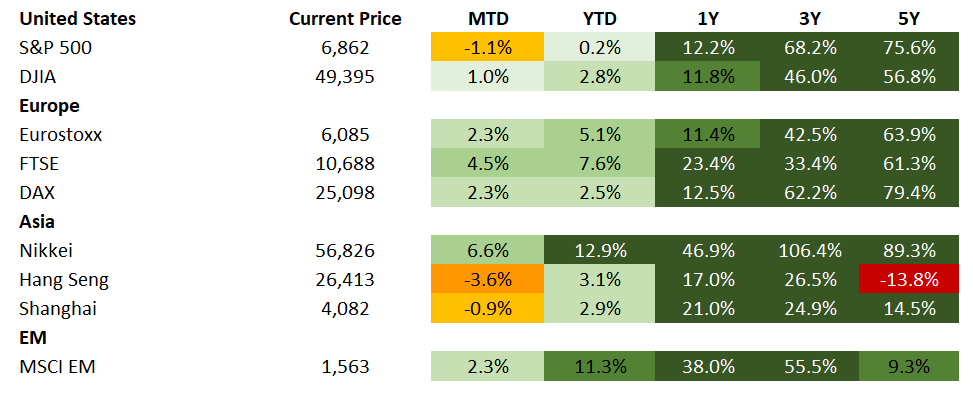
Against this backdrop, U.S. stocks edged higher, supported by tariff reversal hopes. The UST curve bear-steepened as markets priced in potential higher term premium in the long-end on fiscal concerns related to tariff refunds. The 10-year UST yield finished near the high around 4.10%, having rallied to 4.01% earlier in the week. The DXY drifted to its highest level in four weeks on some geopolitical risk-off demand during the week, but gave up some gains following the tariff news on Friday. Gold and silver spot prices edged higher as uncertainty increased but remain well off their recent peaks. Oil prices moved higher amid rising geopolitical tensions in the Middle East, with Brent and WTI closing the week in the low-70s and mid-60s per barrel, respectively. Bitcoin was range-bound in the mid-60,000s.
On the data front, U.S. GDP increased at an annualized 1.4% in 4Q, significantly below expectations and down from 4.4% in the prior period. It was dragged down by the record long federal government shutdown, consumer spending and trade. Despite the year-end slowdown, the U.S. economy is still expected to grow at around 2.5% year-over-year in 2026, supported by resilient consumer spending. Meanwhile, the core personal consumption expenditures price index, the Fed’s preferred inflation measure, rose 0.4% month-over-month and 3.0% year-over-year in December, which was higher than in the prior month and above expectations. The final February University of Michigan consumer sentiment index was revised lower from its preliminary reading of 57.3 but still edged up to 56.6 from 56.4 in January.
Earlier in the week, the latest FOMC minutes revealed a notable dispersion of views among policymakers, underscoring the complexity of the current economic landscape and “lame duck” status of the outgoing chair. Importantly, “several participants” expressed support for adopting a more explicitly two-sided characterization of the policy outlook -acknowledging that further upward adjustments to the federal funds rate could be warranted should inflation remain persistently above target.
Corporate developments added to a more cautious mood among investors. Walmart guided full-year earnings below expectations, citing uncertainty around trade dynamics and labor market conditions – an illustration of how macro crosscurrents are filtering into forward corporate guidance. Meanwhile, Blue Owl Capital, an alternative asset manager primarily focused on developed markets, announced restrictions on withdrawals from one of its retail-focused private credit funds, raising broader questions about liquidity mismatches in segments of private developed markets. While unlikely to become systemic, such developments warrant close monitoring given the growth of non-bank financial intermediation.
In geopolitics, little tangible progress emerged from U.S.-Iran talks, even as the U.S. continued to build its military presence in the region and President Trump suggested that he is considering a “limited military strike” on Iran. Similarly, Russia and Ukraine convened a third round of trilateral talks in Geneva, but negotiations showed limited headway on the core issues of comprehensive security guarantees and the status of occupied territories.
In Europe, reports surfaced that Christine Lagarde may step down from the helm of the European Central Bank before the end of her term in October 2027. Such a development – particularly ahead of the French presidential elections- would allow for current French President Macron alongside German chancellor Merz to shape her successor. Market speculation has centered on the Spanish and Dutch central bank governors as potential successors, both viewed as slightly more hawkish than Lagarde. Meanwhile, the preliminary February euro area PMIs improved across the board relative to January, outperforming market consensus expectations on the manufacturing and composite ones.
In the UK, higher than expected unemployment, slowing wage growth, and broad-based easing in inflation reinforced the likelihood that the Bank of England could resume rate cuts at its meeting next month. However, similar to the Euro zone, the flash February PMIs surprised to the upside and January retail sales were stronger-than-expected across the board.
In Japan, fourth-quarter GDP disappointed at 0.2% quarter-over-quarter versus expectations of 0.4% quarter-over-quarter. Yet, long-end JGB yields declined only modestly, reflecting a Bank of Japan that for now remains vigilant about upside inflation risks, particularly in the context of looser fiscal policy.
EM Credit Update
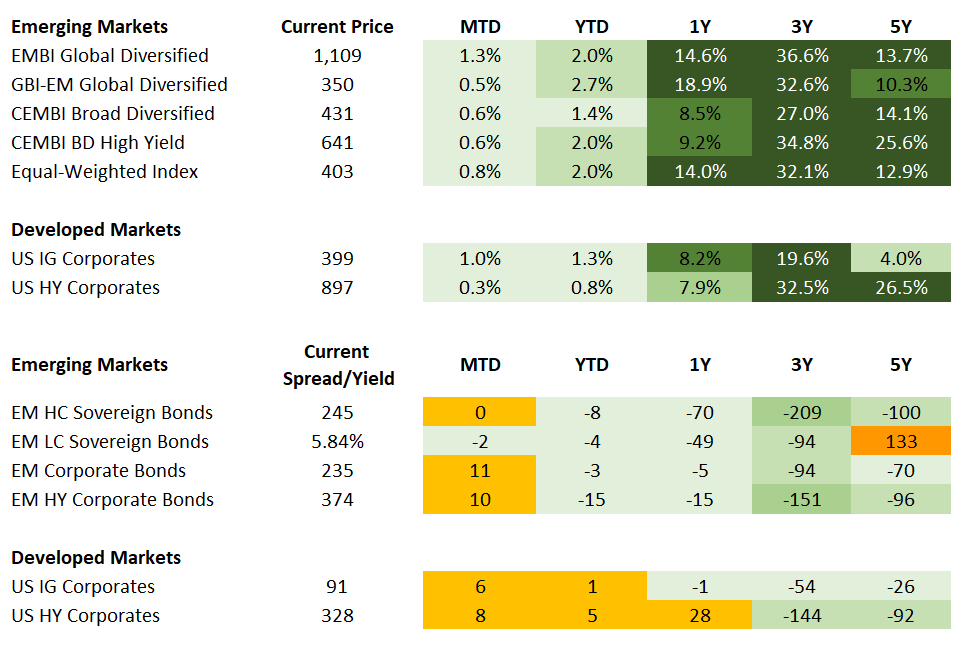
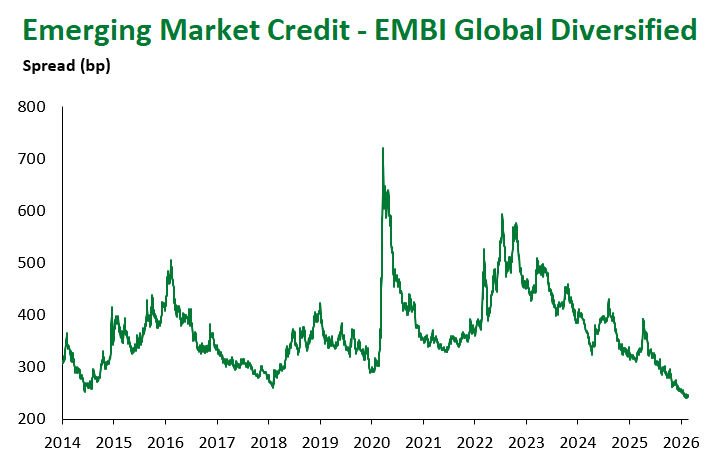
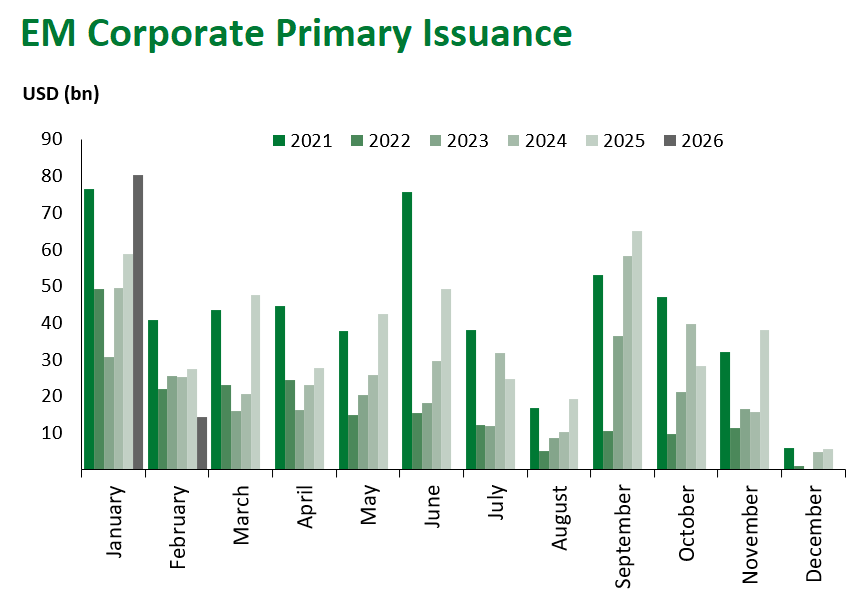
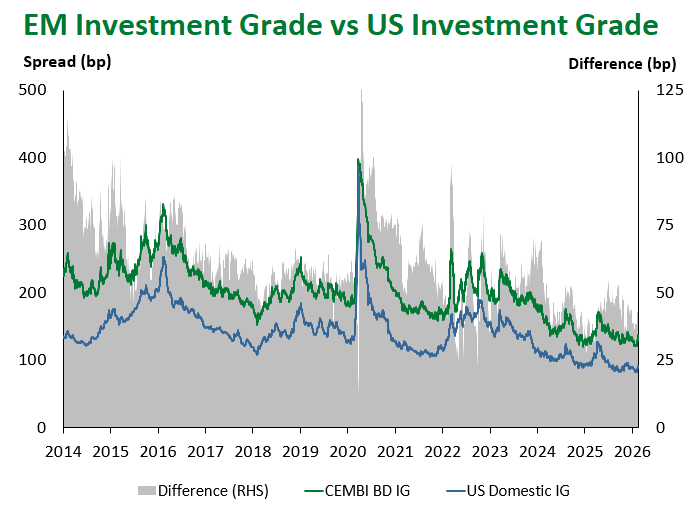
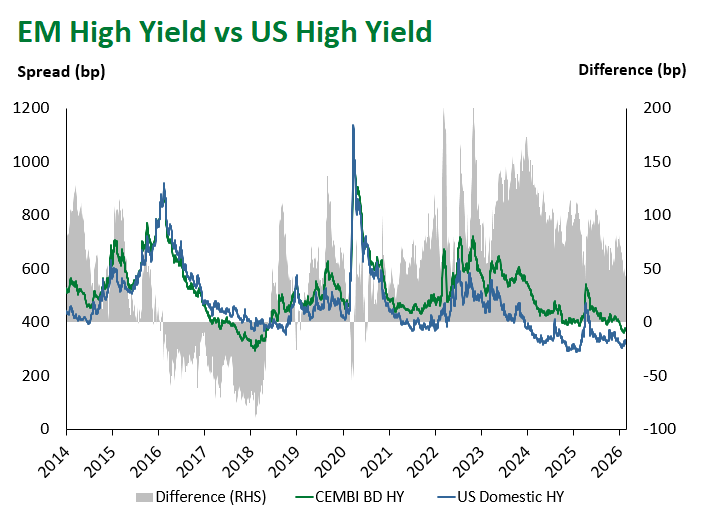
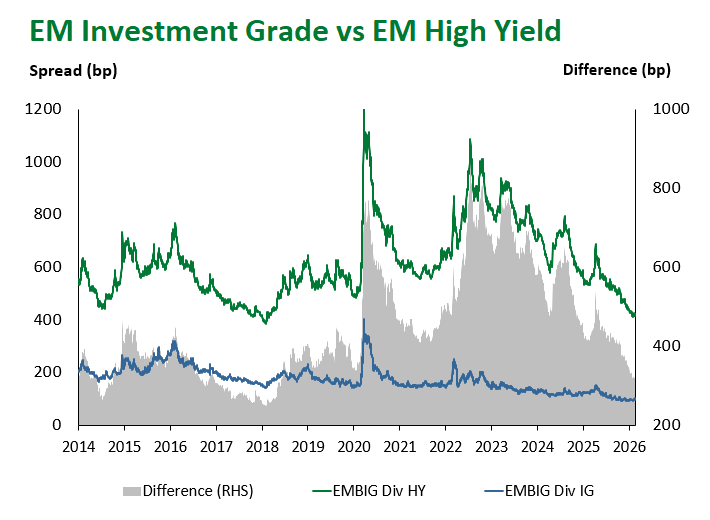
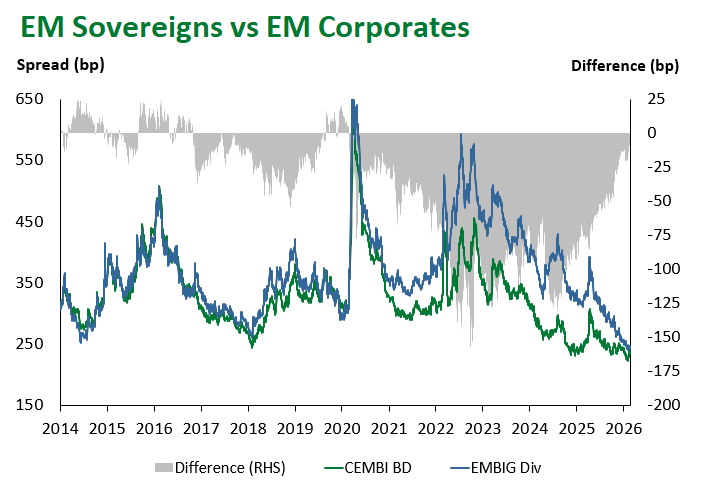
Emerging Markets (EM) fixed income delivered mixed performance this week, with EM corporates modestly outperforming at +0.13%. High yield continued to lead, returning +0.20%, compared to +0.09% for investment grade. Regionally, Latin America (+0.28%) topped performance, rebounding from recent weakness. Gains were driven by Jamaica (+0.64%), where hurricane-related concerns eased following resilient earnings, and Brazil (+0.51%), as positive developments in select idiosyncratic credits helped calm market anxiety. Asia (-0.01%) was the only region to post a marginal decline, with Taiwan (-0.14%) weighing on returns amid its exposure to the tech sector. Across the curve, longer-duration bonds outperformed, with the 10+ year segment gaining +0.23%, while the 1–3 year bucket lagged at +0.05%. By rating, BB and B credits (both +0.21%) led performance, while the C bucket retraced some recent gains (-0.07%). At the index level, corporate spreads tightened by 4bps, reflecting continued demand for carry despite a more cautious backdrop.
Hard-currency sovereigns were broadly flat (+0.01%). Solid investment grade performance (+0.16%) was offset by weakness in high yield (-0.15%), as investors trimmed liquid risk exposure amid rising Middle East tensions. Interestingly, the Middle East region outperformed (+0.36%), supported by a sharp rally in Lebanon (+3.79%) on optimism around potential regime change in Iran. Europe lagged (-0.18%) as hopes for a near-term resolution in Ukraine diminished.
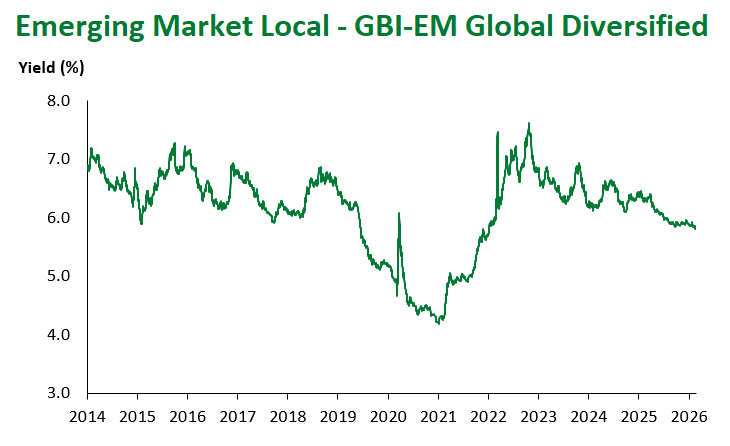
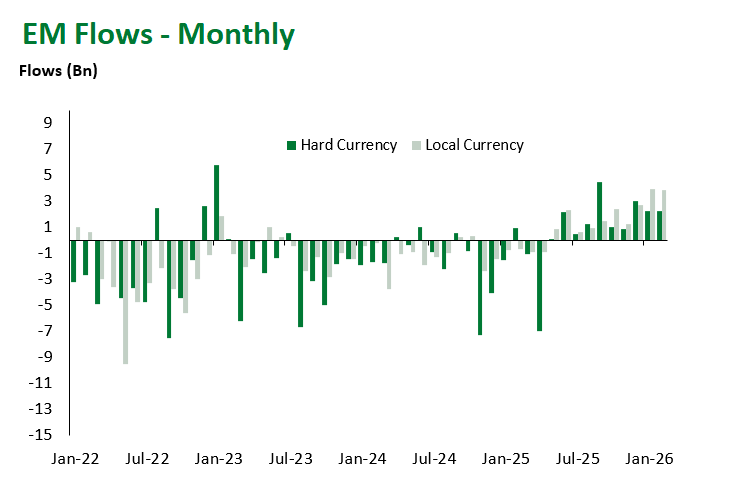
Local-currency debt — still the best-performing EM sub-asset class year-to-date — underperformed this week as the U.S. dollar regained part of its safe-haven appeal amid heightened geopolitical risk linked to Iran. Some of the move reversed on Friday as news that the Supreme Court struck down Trump’s tariffs broke. Egypt (-2.53%) and Colombia (-2.19%) were among the weakest performers. Egyptian assets faced spillover pressures from rising regional tensions, while Colombian bonds were weighed down by BanRep’s hawkish shift. In contrast, the Dominican Republic (+2.37%) and the Philippines (+0.20%) were the only local markets to post positive returns. In the Dominican Republic, bonds rallied as declining inflation and resilient growth reinforced expectations for future policy easing, compressing yields in a high-carry environment with stable FX. In the Philippines, softer growth and contained inflation led markets to price in earlier and deeper BSP rate cuts, driving a broad-based decline in yields.
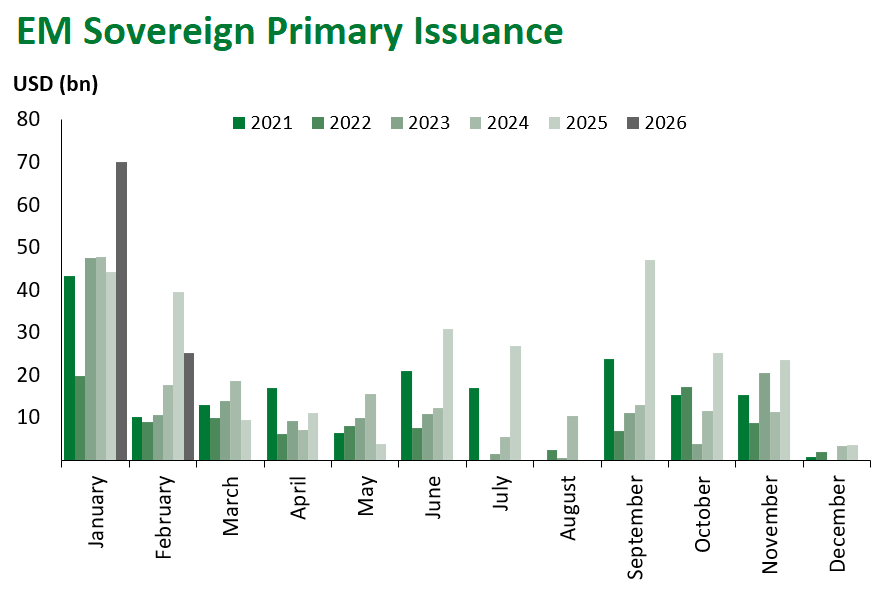
Amid a more fragile global risk environment, primary market activity slowed. Only six hard-currency sovereign deals priced during the week, totaling $11 billion, including issuance from Panama and Kenya.
The Week Ahead
Turning to next week, U.S. consumer confidence, jobless claims, and PPI will provide the latest gauge on sentiment, the durability of the labor market, and wholesale price pressures while Nvidia earnings will serve as a critical barometer for the tech sector.
In Europe, Eurozone CPI, inflation expectations, and consumer confidence indicators will be released. In Asia, Japan will publish CPI, industrial production, and retail sales while Prime Minister Takaichi may nominate candidates for the Bank of Japan’s board vacancies.
The PBoC is expected to keep rates on hold while Hungary’s central bank is expected to cut rates by 25bps. In South Africa, Finance Minister Enoch Godongwana’s presentation of the annual budget is the focal point with expectations for market positive revisions as well as guidance on a solidified fiscal anchor and credible path toward debt reduction.
Fixed Income
Equities
Commodities
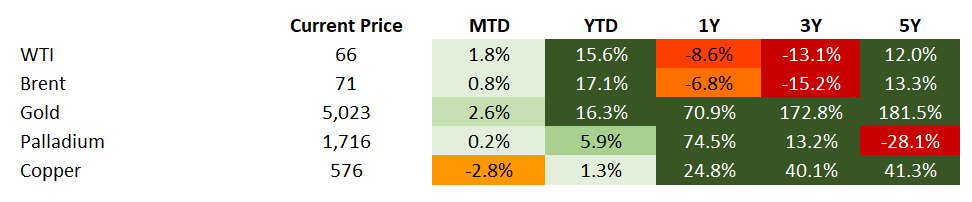
Source for data tables: Bloomberg, JPMorgan, Gramercy. EM Fixed Income is represented by the following JPMorgan Indicies: EMBI Global, GBI-EM Global Diversified, CEMBI Broad Diversified and CEMBI Broad High Yield. DM Fixed Income is represented by the JPMorgan JULI Total Return Index and Domestic High Yield Index. Fixed Income, Equity and Commodity data is as of Feb. 20, 2026 (mid-day).
Highlights
Peru’s New Interim Leftist President Unlikely to Impact Policy
Event: This week, Peru’s Congress voted to oust President Jose Jeri, who had taken the helm from Dina Boularte following her impeachment in October 2025. The decision followed a release of a video of a meeting between Jeri and a controversial Chinese businessman last month. A splintered Congress elected 83-year-old Jose Balcazar from the leftist Peru Libre party of the jailed former President Pedro Castillo. General elections are scheduled for April 12th, and President Balcazar is set to hold office until a new President is inaugurated on July 28th.
Gramercy Comment: Political instability and frequent presidential changes in Peru have become commonplace with Balcazar as the country’s 9th president to assume office in the past decade. While many speculated that Jeri’s replacement would be from a right-leaning party, a highly fractured congress and votes against ideological lines contributed to his victory. Balcazar’s tenure is short, and he has expressed intentions of macroeconomic and monetary policy continuity which have contained the market reaction and is in line with previous bouts of political volatility in Peru. Balcazar is also not free from controversy and could face premature removal. The general election remains the key event to follow with a highly populated and varied candidate pool and limited clarity from the polls at this juncture. Familiar names lead in the polls, with only moderate amounts of support led by right-wing Lima mayor Rafael Lopez Aliaga with 12%, followed by four-time presidential candidate Keiko Fujimori with 8%, and over 40% of voters still undecided or intending to cast blank ballots. Assets could come under pressure if an outsider that materially threatens policy continuity gains traction or uncertainty over central bank leadership emerges.
No progress on key issues in Ukraine-Russia Geneva talks
Event: Last week’s trilateral diplomatic talks in Geneva involving Ukraine and Russia’s negotiating teams as well as representatives from the Trump administration appeared to yield minimal progress on any of the main issues, including the most prominent one on potential ceding of Ukrainian territories not currently occupied by Russia.
Gramercy Comment: The second day of talks ended after less than two hours, signaling that the negotiating sides remain far apart on the key issues. On the thorniest one, i.e. Russia’s demand that Kyiv cedes territory in the Donbas region that the Ukrainian army has heavily fortified and successfully defended since 2014 (long before Russia’s full-scale invasion began in February 2022), President Zelenskyy said that the Kremlin appeared to remain unwilling to compromise and that the Ukrainian people would not support any unilateral ceding of sovereign Ukrainian territory. In this context, we remain skeptical that the two sides could bridge their differences in the foreseeable future. As such, as we’ve argued before, the prospect of a peace deal in Ukraine remains dim, unless a major structural change occurs in the form of Russia softening its maximalist demands that continue to be unacceptable in their current form to Ukraine and its European allies.
Emerging Markets Technicals
Emerging Markets Flows
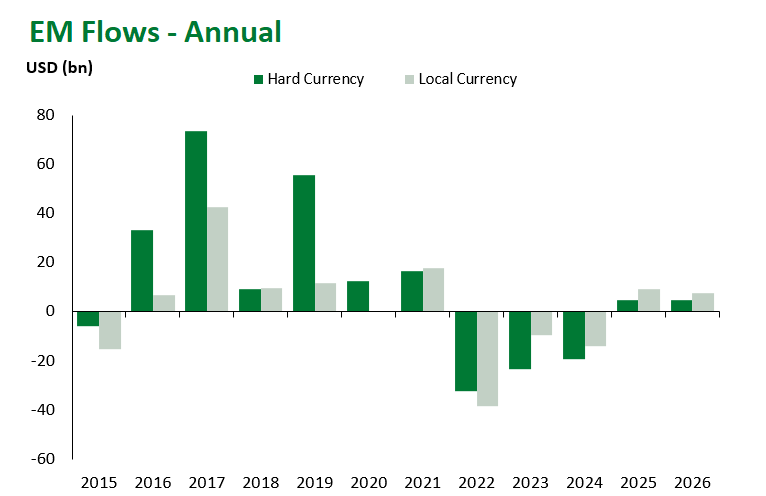
Source for graphs: Bloomberg, JPMorgan, Gramercy. As of Feb. 20, 2026.
For questions, please contact:
Kathryn Exum, CFA ESG, Director, Co-Head of Sovereign Research, [email protected]
Petar Atanasov, Director, Co-Head of Sovereign Research, [email protected]
This document is for informational purposes only. The information presented is not intended to be relied upon as a forecast, research or investment advice, and is not a recommendation, offer or solicitation to buy or sell any securities or to adopt any investment strategy. Gramercy may have current investment positions in the securities or sovereigns mentioned above. The information and opinions contained in this paper are as of the date of initial publication, derived from proprietary and nonproprietary sources deemed by Gramercy to be reliable, are not necessarily all-inclusive and are not guaranteed as to accuracy. This paper may contain “forward-looking” information that is not purely historical in nature. Such information may include, among other things, projections and forecasts. There is no guarantee that any forecasts made will come to pass. Reliance upon information in this paper is at the sole discretion of the reader. You should not rely on this presentation as the basis upon which to make an investment decision. Investment involves risk. There can be no assurance that investment objectives will be achieved. Investors must be prepared to bear the risk of a total loss of their investment. These risks are often heightened for investments in emerging/developing markets or smaller capital markets. International investing involves risks, including risks related to foreign currency, limited liquidity, less government regulation, and the possibility of substantial volatility due to adverse political, economic or other developments. References to any indices are for informational and general comparative purposes only. The performance data of various indices mentioned in this update are updated and released on a periodic basis before finalization. The performance data of various indices presented herein was current as of the date of the presentation. Please refer to data returns of the separate indices if you desire additional or updated information. Indices are unmanaged, and their performance results do not reflect the impact of fees, expenses, or taxes that may be incurred through an investment with Gramercy. Returns for indices assume dividend reinvestment. An investment cannot be made directly in an index. Accordingly, comparing results shown to those of such indices may be of limited use. The information provided herein is neither tax nor legal advice. Investors should speak to their tax professional for specific information regarding their tax situation.