


Contents
Market Overview
Macro Update
The week began with a sharp reminder of the fat tails embedded in this year’s investment scenario analysis, as geopolitics once again took center stage in shaping market dynamics. Markets opened decisively in risk-off mode, triggered first and foremost by escalating U.S. rhetoric around Greenland. This unsettled investors already sensitive to geopolitical brinkmanship, alliance risk, and policy unpredictability. Renewed concerns that the U.S. might resort to military or trade coercion against a NATO ally prompted a rapid reassessment of risk premia – particularly for U.S. assets. The reassessment resulted in a rare and uncomfortable configuration: A simultaneous sell-off in the dollar, equities, and bonds that briefly revived the long-dormant “sell the U.S.” trade.
The risk-off impulse was amplified by developments in Japan, which became a key transmission channel for global stress. Prime Minister Sanae Takaichi’s decision to call a snap Feb. 8 election in pursuit of stimulus, including food tax cuts, weighed on bonds as JGB yields surged 20 bps–25 bps, briefly in a disorderly move, triggering a broader developed market bond sell-off. Meanwhile, the Bank of Japan held its policy rate at 0.75% and raised the inflation outlook, with Governor Kazuo Ueda’s comments helping nudge the yen lower before it rebounded.
It was against this fragile backdrop that attention shifted to the World Economic Forum in Davos, where markets looked for signals of de-escalation and policy restraint.
Sentiment began to stabilize following remarks by President Donald Trump. By ruling out military action against NATO allies over Greenland and stepping back from related tariff threats, he eased fears of a renewed trans-Atlantic trade confrontation. This marked a clear inflection point in risk sentiment, offering markets a temporary reprieve from escalating anxieties.
Other geopolitical discussions, by contrast, had little immediate market impact. Ukrainian President Volodymyr Zelenskyy urged Europe to rebuild “real power,” while Mr. Trump’s envoys met with Russian President Vladimir Putin and proposed a U.S.-led “Board of Peace” for Gaza and potential broader crisis management. These initiatives drew attention, but major European powers remain absent, and Russia is still evaluating its stance – underscoring persistent uncertainties. Mr. Trump revived his threats to use military force against Iran and signaled the deployment of U.S. naval assets to the Middle East.
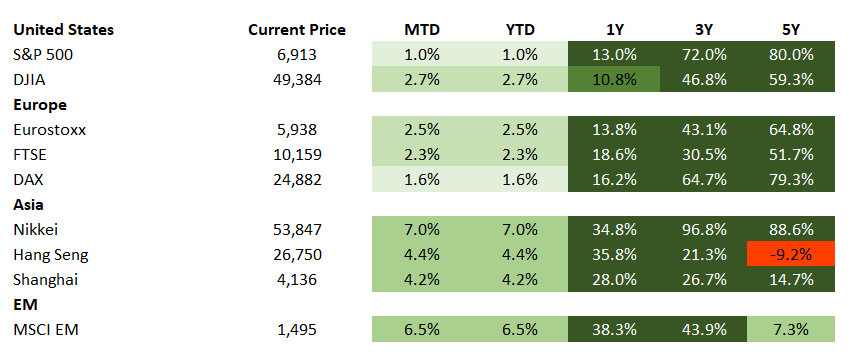
Markets responded asymmetrically as tensions around Greenland appeared to ease. Risk assets rebounded, led by a rally in large-cap technology stocks that helped global equities erase earlier weekly losses. Gold continued to outperform, extending its advance to fresh all-time highs as investors maintained demand for geopolitical hedges. On the other hand, U.S. Treasury yields closed the week broadly unchanged vs. last week and well off their mid-week highs, at around 4.24% on the 10-year and 4.84% on the 30-year. The dollar lost steam, with the DXY slipping back into a 98 handle, reflecting lingering concerns over the potential for international selling of U.S. assets. Bitcoin sold off, falling back below $90,000, while oil prices gained marginally on renewed U.S.-Iran tensions, with Brent in the mid-$60s and WTI in the low-$60s per barrel.
Beyond geopolitics this week, the U.S. Supreme Court heard oral arguments on President Trump’s emergency application to remove Fed Governor Lisa Cook. The broader legal question of presidential authority over Fed governors carries important implications for central bank independence, and a ruling in favor of Governor Cook could ultimately support market confidence.
Macro data were broadly steady. U.S. 3Q 2025 GDP growth was revised slightly higher to 4.4%, supported by stronger exports and consumer spending. Initial jobless claims remained anchored around 200,000. The November core PCE price index, the Fed’s preferred inflation measure, came in at 2.8% year-over-year, in line with expectations. The final January University of Michigan consumer sentiment index indicated that sentiment improved to a five-month high, as tariff-related concerns from 2025 continued to fade.
In Europe, Germany’s ZEW expectations index jumped to 59.6 in January, the highest level in four years, supported by optimism around the Merz government’s spending push. In the UK, headline inflation rose to 3.4% year-over-year in December, though the increase is unlikely to deter further Bank of England rate cuts.
In China, GDP growth was confirmed at 5.0% year-over-year in 2025, supported by a record trade surplus and meeting the official target. However, growth slowed to 4.5% in 4Q 2025, pointing to still-tepid underlying momentum. The 1-year and 5-year loan prime rates were left unchanged at 3.0% and 3.5%, respectively.
EM Credit Update
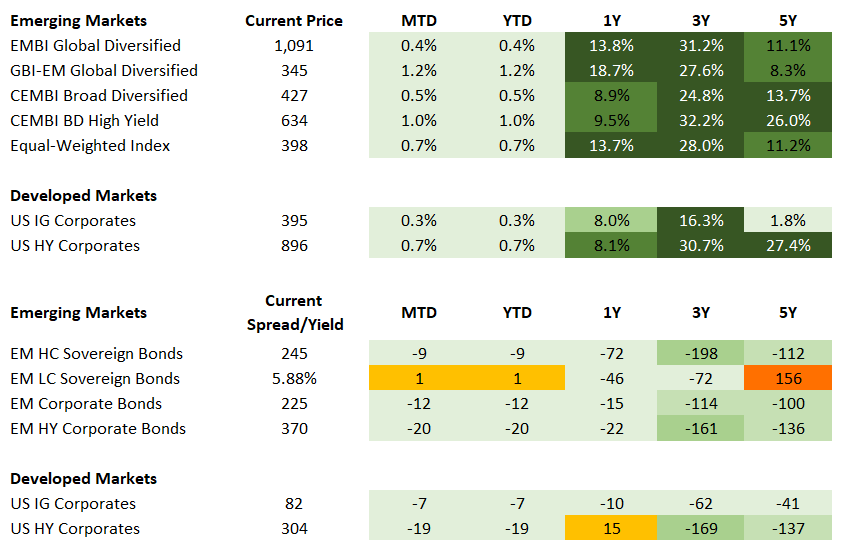
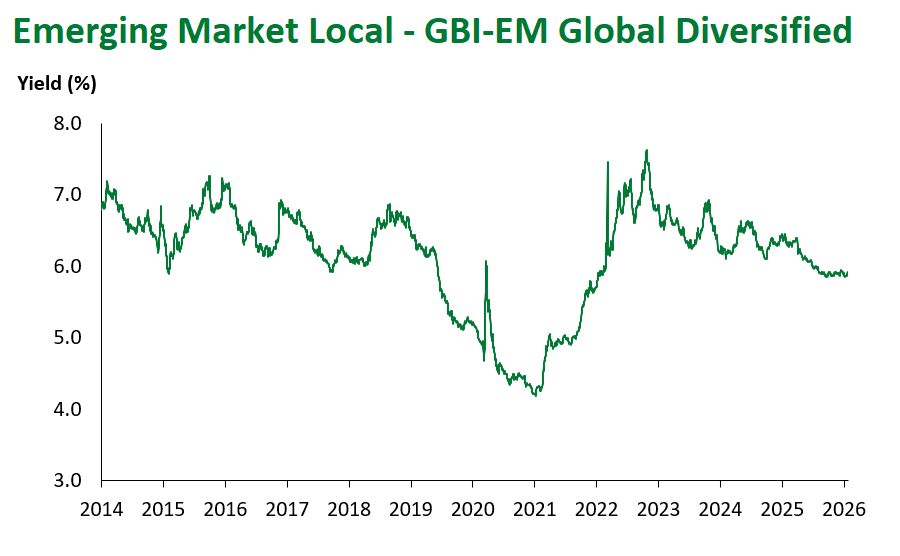
Emerging Markets (EM) fixed income posted mixed results this week, with performance diverging across sub-asset classes and quality segments. Local-currency debt led returns, gaining +0.97%, as the “sell U.S. assets” narrative resurfaced. Uruguay (+2.37%), Brazil (+2.19%), and Chile (+2.02%) outperformed, supported by currency strength and local rate dynamics, while India (-1.43%) and Indonesia (-0.24%) lagged.
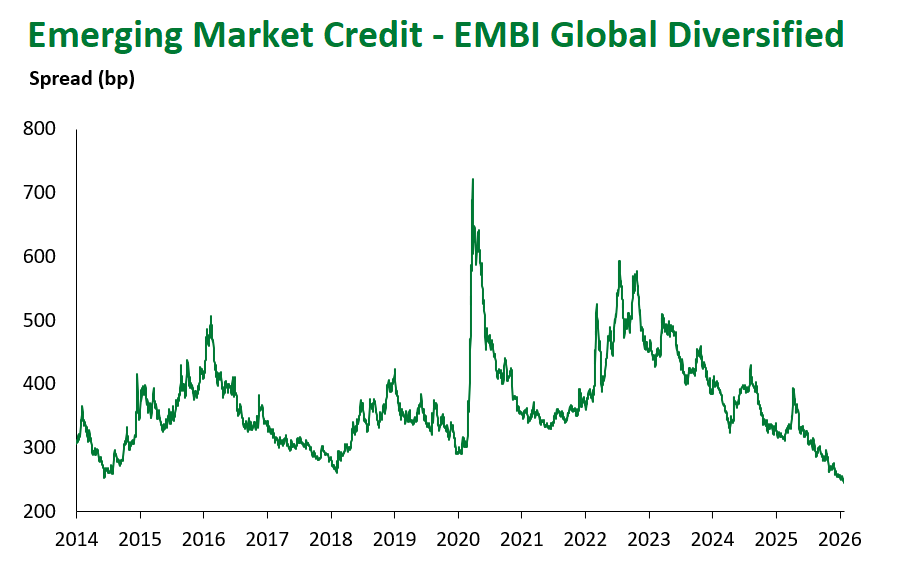
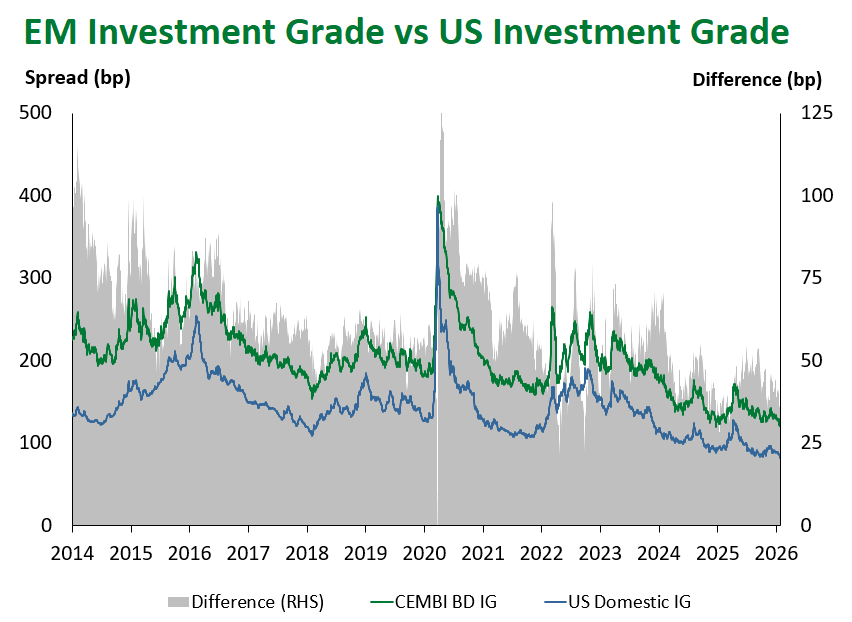
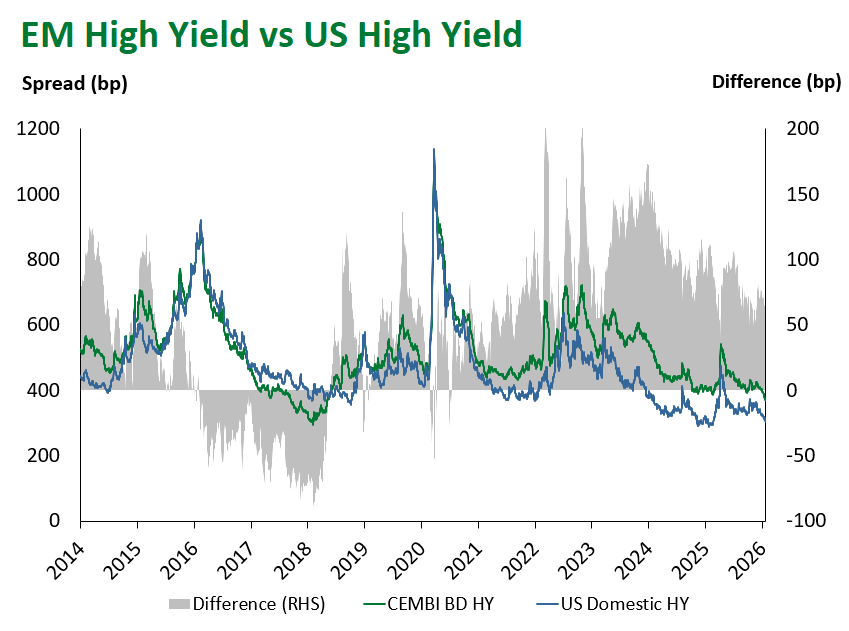
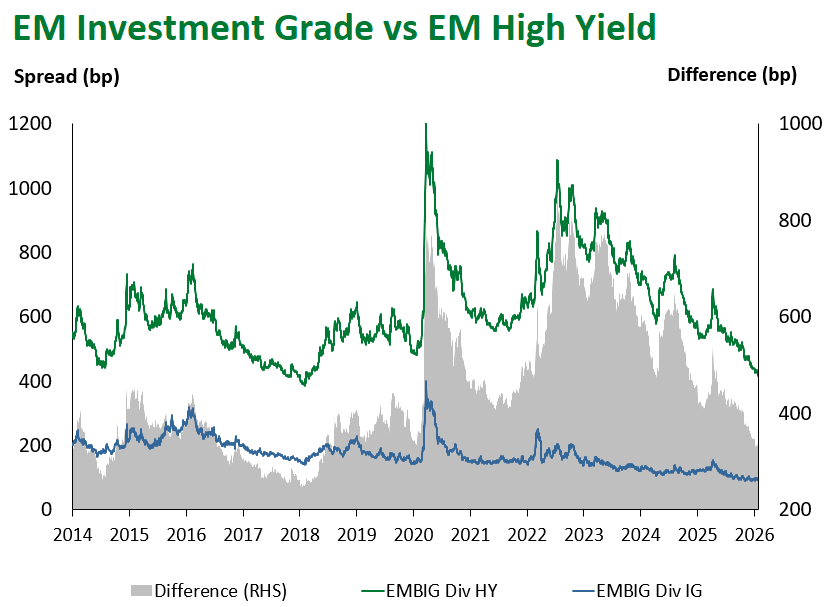
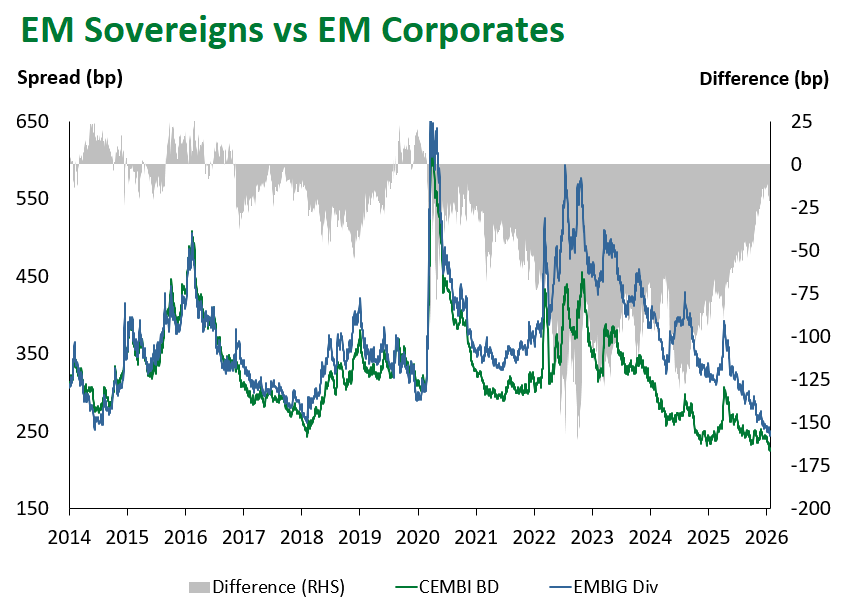
Hard-currency sovereigns also edged higher, returning +0.14%. Gains were driven by high yield (+0.38%), which more than offset weakness in investment grade (-0.12%). At the index level, spreads tightened modestly by 3 bps, led by compression in high yield (-8 bps), while investment grade spreads were broadly unchanged (+1 bp).
Regionally, Africa (+0.42%) and Latin America (+0.24%) led performance, while the Middle East (-0.18%) and Asia (+0.11%) lagged, with the Middle East posting negative returns. At the country level, Gabon (+4.20%) and Ukraine (+2.87%) outperformed. Gabon extended its recent rally as investors welcomed the government’s decision to proceed with an IMF-supported reform program. In Ukraine, renewed diplomatic momentum helped stabilize sentiment and supported prices. Lebanon (-0.62%) and Costa Rica (-0.45%) were the weakest performers. In Lebanon, the recent rally paused amid a lack of tangible progress from IMF discussions. In Costa Rica, delays in external bond authorization until after the 2026 elections weighed on sentiment despite otherwise solid fundamentals.
EM corporate bonds underperformed sovereigns this week, returning only +0.05%, with high yield (+0.15%) outperforming investment grade (-0.02%). Regionally, Europe (+0.23%) led, supported by strength in Ukrainian corporates (+1.66%) following the sovereign rally. The Middle East (-0.04%), Africa (+0.03%), and Asia (+0.03%) lagged. Along the curve, the 7-year to 10-year maturity bucket underperformed again (-0.08%), while the 5–year to 7-year bucket outperformed (+0.08%). By rating, the ‘C’ bucket led performance (+0.77%), while AAA (-0.03%) and A (-0.03%) lagged. Corporate spreads tightened modestly by 1 bp at the index level, with limited differentiation across quality segments.
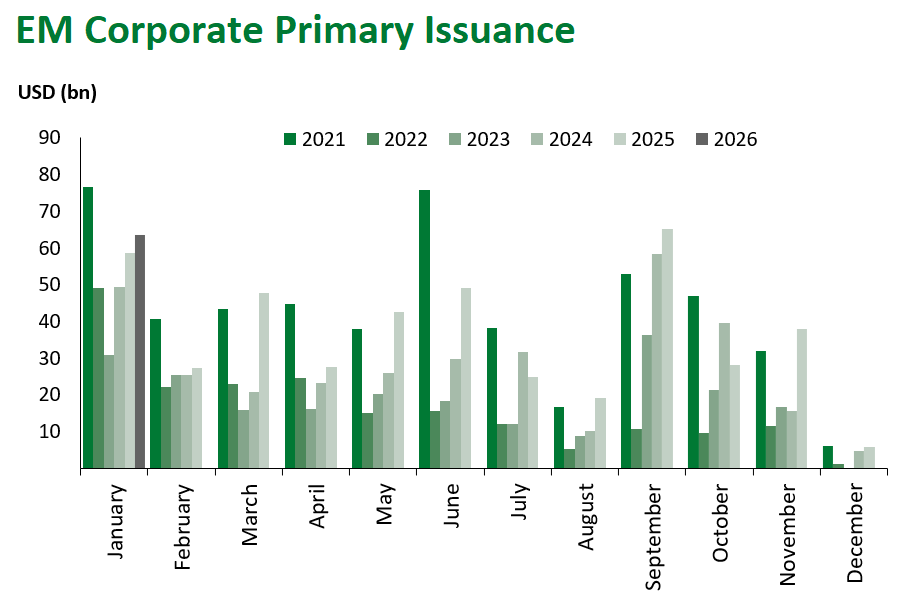
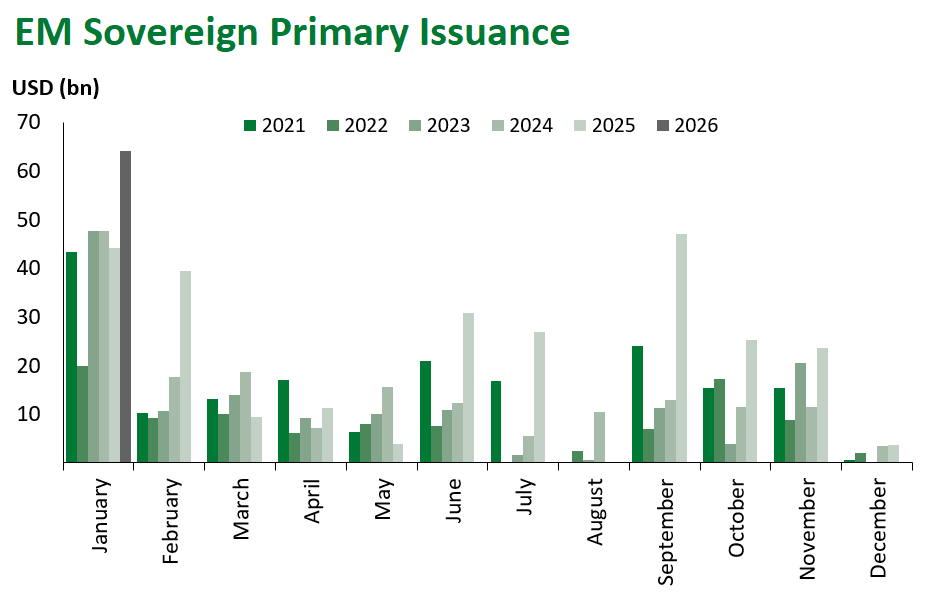
Primary market activity slowed amid heightened macro volatility, with approximately $18 billion in hard-currency issuance from 21 issuers across 28 tranches. Sovereigns accounted for 44% of total supply, led by issuance from the Philippines, Benin, Georgia, and Trinidad and Tobago. Issuance skewed more toward investment grade this week, which represented 71% of total volume.
The Week Ahead
Following three consecutive 25 bps interest rate cuts in 4Q 2025, the Fed is expected to hold the federal funds target rate at 3.75% this week, despite continuing pressure by President Trump for easier monetary policy. Notable macro data in the U.S. will include initial jobless claims, durable goods, factory orders, wholesale inventories, and PPI. Meanwhile, funding for parts of the U.S. federal government under the resolution that ended the last shutdown begins to expire. 4Q 2025 preliminary GDP will be published in the euro area, Germany, and France as well as euro area consumer confidence. An EU-India summit will take place in New Delhi, aimed at strengthening collaboration across key policy areas, and UK Prime Minister Keir Starmer is expected to visit China. In addition, markets will see a flood of corporate earnings from tech giants and oil majors such as Meta, Microsoft, Tesla, Apple, Exxon Mobil, and Chevron, among others.
Fixed Income
Equities
Commodities
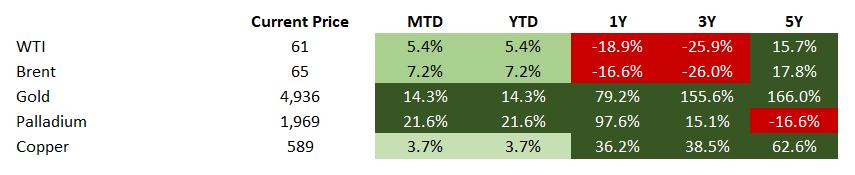
Source for data tables: Bloomberg, JPMorgan, Gramercy. EM Fixed Income is represented by the following JPMorgan Indicies: EMBI Global, GBI-EM Global Diversified, CEMBI Broad Diversified and CEMBI Broad High Yield. DM Fixed Income is represented by the JPMorgan JULI Total Return Index and Domestic High Yield Index. Fixed Income, Equity and Commodity data is as of Jan. 23, 2026 (mid-day).
Highlights
Diplomatic Push on Ukraine Intensifies at Davos; Key Obstacle Remains
Event: Efforts by global leaders to advance a workable peace plan for Ukraine intensified during the WEF in Davos. Presidents Trump and Zelenskyy met on the WEF sidelines, while Trump’s Special Envoy Steve Witkoff and son-in-law Jared Kushner headed to Moscow for meetings with President Putin. The Putin – Witkoff meeting confirms that the key impediment to peace in Ukraine – Russia’s territorial claims over the entire Donbas region – remains in place.
Gramercy Comment: Against the backdrop of world leaders gathering in Davos, diplomatic momentum on ending the war in Ukraine appears to have resurfaced, despite the sudden emergence of the thorny Greenland issue straining trans-Atlantic ties. In his fiery Davos speech, President Zelenskyy called on Europe to build “real global power” to confront the threats posed by Russia and the U.S.’s changing foreign policy priorities. The Ukrainian leader also signaled that a tri-lateral working group comprised of lower-level U.S., Russian, and Ukrainian officials is set to meet in the UAE as early as this weekend. If it materializes, this will mark progress.
However, the key obstacle to reaching a peace deal appears to remain in place: Russia’s demand to receive territories in the Donbas region that are currently under Ukrainian control. These have formed a natural topographical defense line that has been fortified by Ukraine’s army over the last four years of war. It would be extremely risky and politically dangerous for President Zelenskyy to agree to such a deal, unless Ukraine receives iron-clad security guarantees or President Putin is willing to compromise on his maximalist objectives, both of which seem unlikely.
Emerging Markets Technicals
Emerging Markets Flows
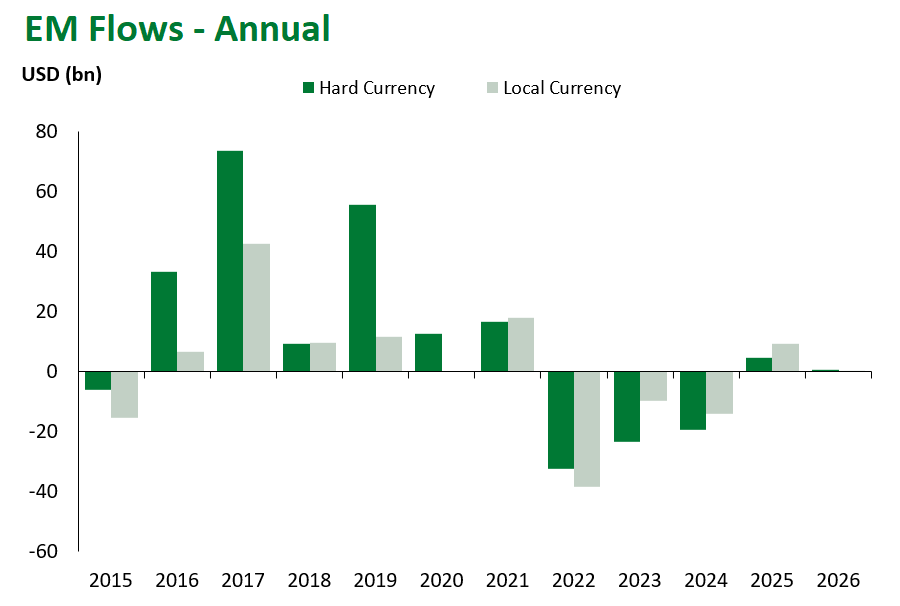
Source for graphs: Bloomberg, JPMorgan, Gramercy. As of Jan. 23, 2026.
For questions, please contact:
Kathryn Exum, CFA ESG, Director, Co-Head of Sovereign Research, [email protected]
Petar Atanasov, Director, Co-Head of Sovereign Research, [email protected]
This document is for informational purposes only. The information presented is not intended to be relied upon as a forecast, research or investment advice, and is not a recommendation, offer or solicitation to buy or sell any securities or to adopt any investment strategy. Gramercy may have current investment positions in the securities or sovereigns mentioned above. The information and opinions contained in this paper are as of the date of initial publication, derived from proprietary and nonproprietary sources deemed by Gramercy to be reliable, are not necessarily all-inclusive and are not guaranteed as to accuracy. This paper may contain “forward-looking” information that is not purely historical in nature. Such information may include, among other things, projections and forecasts. There is no guarantee that any forecasts made will come to pass. Reliance upon information in this paper is at the sole discretion of the reader. You should not rely on this presentation as the basis upon which to make an investment decision. Investment involves risk. There can be no assurance that investment objectives will be achieved. Investors must be prepared to bear the risk of a total loss of their investment. These risks are often heightened for investments in emerging/developing markets or smaller capital markets. International investing involves risks, including risks related to foreign currency, limited liquidity, less government regulation, and the possibility of substantial volatility due to adverse political, economic or other developments. References to any indices are for informational and general comparative purposes only. The performance data of various indices mentioned in this update are updated and released on a periodic basis before finalization. The performance data of various indices presented herein was current as of the date of the presentation. Please refer to data returns of the separate indices if you desire additional or updated information. Indices are unmanaged, and their performance results do not reflect the impact of fees, expenses, or taxes that may be incurred through an investment with Gramercy. Returns for indices assume dividend reinvestment. An investment cannot be made directly in an index. Accordingly, comparing results shown to those of such indices may be of limited use. The information provided herein is neither tax nor legal advice. Investors should speak to their tax professional for specific information regarding their tax situation.