


Contents
Market Overview
Macro Update
Welcome to 2026 and Venezuela week. The new year started with extraordinary events on Jan. 3rd, as a U.S. military operation extracted Venezuela’s leader, Nicolás Maduro, and his wife, Cilia Flores, from their fortified compound in Caracas. Shortly after the regime’s “decapitation,” Mr. Maduro was arraigned in a U.S. court on drug-trafficking charges, while his vice-president, Delcy Rodríguez, was sworn in as interim president.
President Donald Trump openly dismissed the possibility of Venezuelan opposition leader Maria Corina Machado, last year’s Nobel peace prize laureate and widely recognized winner (via surrogate candidate Edmundo Gonzalez) of the 2024 presidential elections, to participate in the initial post-Maduro governance of Venezuela. Instead, the White House has signaled its intention to use economic and military leverage to directly influence the policy decisions of Ms. Rodriguez’s interim government, and Mr. Trump said that “only time will tell how long the U.S. will be running Venezuela.”
Meanwhile, the president promised that U.S. companies will have “total access” to Venezuela’s oil industry and invest heavily to revive the ailing sector that sits on the world’s largest proven oil reserves. As an initial step, Venezuelan authorities agreed to export up to 50 million barrels of crude oil, worth around $3 billion, to the U.S., to be sold at market prices, and “to benefit the people of Venezuela and the United States.”
For more on Venezuela, see our in-depth analysis, below.
The intervention in Venezuela added further geopolitical significance to the situation around Greenland, given increasingly vocal plans by the Trump administration to take control over the autonomous territory from Denmark, a U.S. ally and NATO partner. Denmark’s prime minister urged Mr. Trump to “stop the threats” on annexing Greenland, and was promptly supported by European leaders, while the White House said it was considering “all options” to acquire the territory.
On the Ukraine war, Kyiv’s key European allies and a U.S. delegation met in Paris and agreed to provide security guarantees for the country in the case of a ceasefire with Russia. The UK, France, and other members of the so-called Coalition of the Willing committed to sending troops to Ukraine and establishing “military hubs” there. In line with Gramercy’s long-standing expectation, Russia firmly rejected any scenario involving the deployment of British or European soldiers as part of a peacekeeping force in Ukraine, labeling it a “direct threat” and likely derailing hopes for a ceasefire in the short term.
In Iran, demonstrations over deteriorating economic conditions appear to have intensified, prompting a harsh response by the authorities that have resorted to using deadly force.
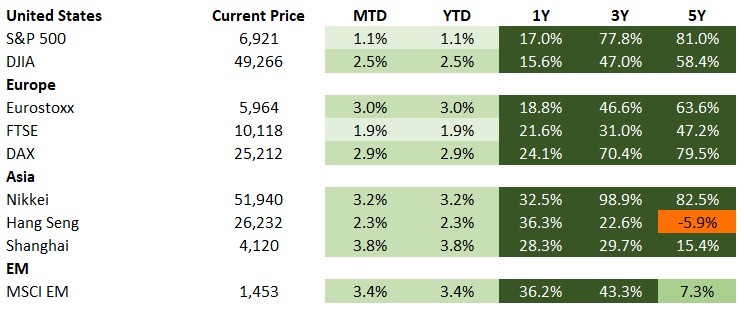
Amid a start to the year dominated by geopolitical events, U.S. equity indexes shrugged off some initial underperformance by big tech names to record yet another record close. Defense stocks around the world gained on President Trump’s goal to ramp up military spending to $1.5 trillion in 2027. The Treasury curve mildly flattened this week as the long end outperformed (down to around 4.82% on the 30-year Treasury), while the 10-year closed unchanged at around 4.17%, amid mixed signals on the U.S. economy that offered limited clarity on its health and the trajectory for further Fed cuts.
The dollar started the year on the strong side, closing above 99 on the DXY for the first time since early December; Bitcoin failed to sustain upside momentum and closed around $91,000. Oil prices were volatile as market participants sifted through the possible implications of the “Donroe Doctrine” for Venezuela’s oil sector but finished the week on stronger footing. They finished in the mid $60s and high 50s per barrel for Brent and WTI, respectively. Spot gold held near late-2025 record highs, closing around $4,500/oz, while spot silver took a breather, finishing the week around $80/oz.
In the world of U.S. macro data, services activity unexpectedly rose in December, by the most in a year, as new orders surged and employment gained for the first time since May. However, manufacturing activity disappointed. The November JOLTS report highlighted lingering downside risks for the labor market, but initial jobless claims for the week ending Jan. 3rd came in slightly below median expectations.
The December nonfarm payrolls report showed that U.S. employers added fewer jobs than expected in the last month of 2025. They added 50,000 vs. the 70,000 median expectation, and the November number was revised down, to 56,000, from the 64,000 figure that was initially reported. This suggests that the U.S. labor market remained soft at the end of last year. Most jobs were created in hospitality and health care, while headcounts in retail, construction, and manufacturing declined. However, the unemployment rate ticked down to 4.4% from 4.5% in the prior month, reflecting lower labor market participation in December. The preliminary January University of Michigan sentiment survey signaled that consumer sentiment has improved more than expected in recent weeks on more upbeat economic expectations and fading tariff concerns.
In China, December RatingDog’s composite and services PMIs were stable from the prior month, while December CPI/PPI came largely as expected (+0.8% and -1.9% year-over-year, respectively), with both measures edging higher relative to November. The eurozone’s final December services and composite PMIs were revised slightly lower from the preliminary reading, but remained in expansionary territory at 52.4 and 51.5, respectively. Preliminary December CPI was in line with expectations, declining to 2.0% year-over-year, from 2.1% previously. In the UK, the final December PMI readings were also revised lower, to 51.4, from 52.1.
EM Credit Update
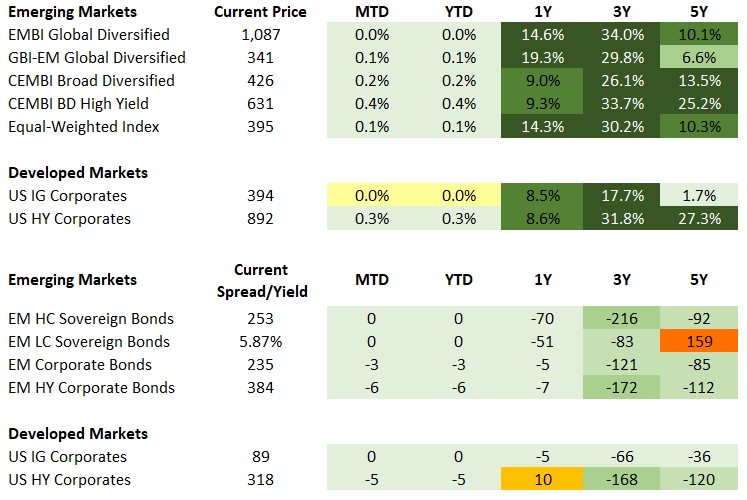
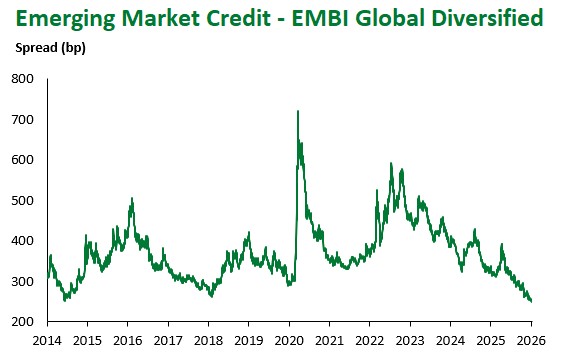
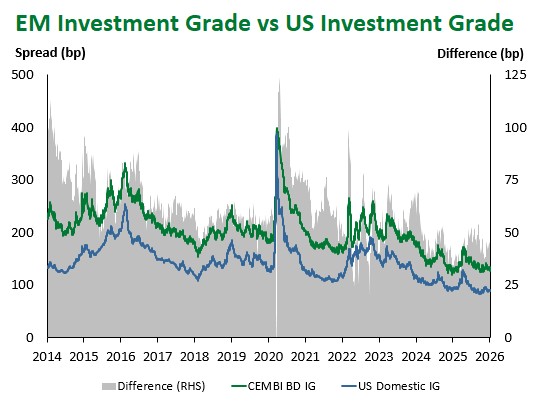
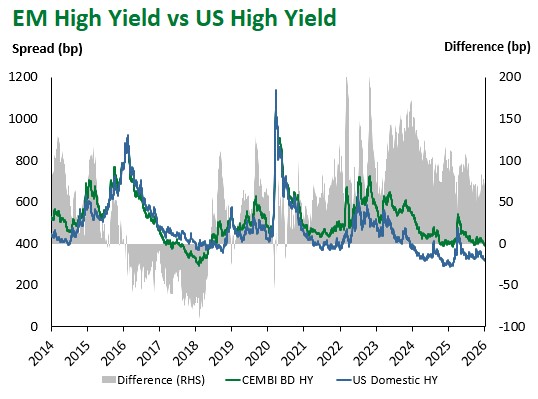
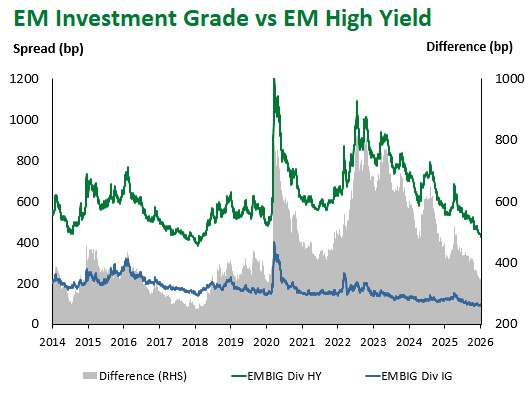
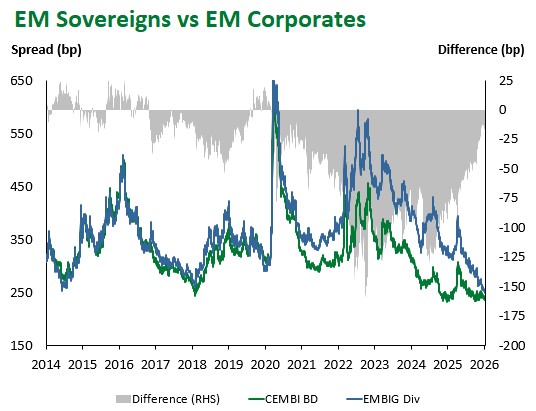
Emerging Markets (EM) fixed income delivered mixed performance this week. Hard-currency sovereigns edged modestly higher (+0.08%), supported by strength in high yield (+0.4%), which offset declines in investment grade (-0.24%). At the index level, spreads were broadly unchanged (+1 bp), masking a notable divergence across quality segments: Investment-grade spreads widened by 6 bps, while high-yield spreads tightened by 5 bps. This dispersion was largely technical in nature, as heavy primary issuance pressured investment-grade bonds, while high yield benefited from strong performance in select, idiosyncratic credits.
Regionally, Latin America (0.60%) and the Middle East (0.13%) led gains, while Africa (-0.97%) and Europe (-0.19%) lagged. Venezuela (+28.5%) and Lebanon (+13.5%) outperformed at the country level. In Venezuela, the ouster of Mr. Maduro and swearing in of Interim President Rodriguez drove a significant repricing in bonds on improved prospects for oil recovery and debt restructuring amid a shifting political backdrop. In Lebanon, progress on the disarmament of militant groups and regional developments drove prices higher. Ghana (-2.55%) and Nigeria (-1.66%) underperformed as oil prices moved lower on upside supply risks.
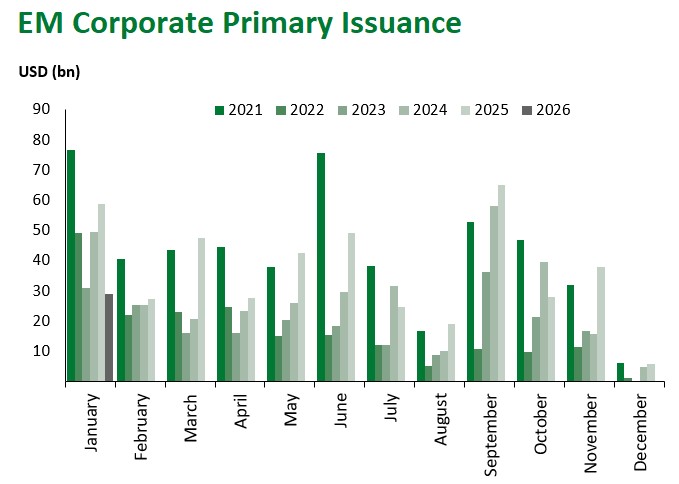
EM corporates gained 0.21% with high yield outperforming investment grade (+0.32% vs. +0.10%). Regionally, Middle East high yield (+0.40%) and Asia high-yield (+0.48%) led gains, while Middle East (-0.00%) and Africa (+0.5%) investment grade lagged. Returns in 5-year to 7-year maturities (+0.22%) slightly outperformed 7-year to 10-year maturities (+0.14%). By rating, the ‘C’ bucket led gains (+1.47%), whereas A (+0.03%) and AA (+0.08%) rating components lagged. Corporate spreads tightened modestly by 3 bps at the index level.
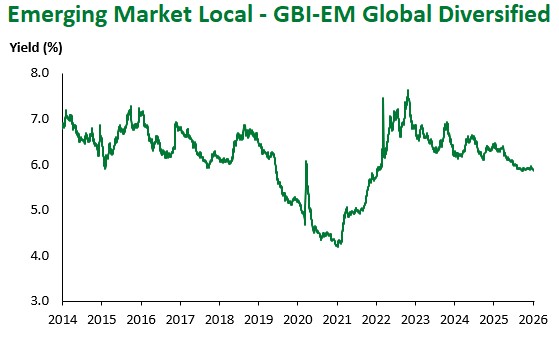
Local-currency debt returned -0.05% as the dollar rebounded. Colombia (+2.42%) and Chile (+1.40%) led gains. In Colombia, the peso retraced recent weakness on easing tensions between Presidents Gustavo Petro and Trump. In Chile, the peso was supported by elevated copper prices. Main underperformers were South Africa (-0.84%) led by a reversal in the rand after a strong rally into year-end, and Thailand (-0.83%) on possible curbs on speculative gold trading to manage appreciation pressure on the baht.
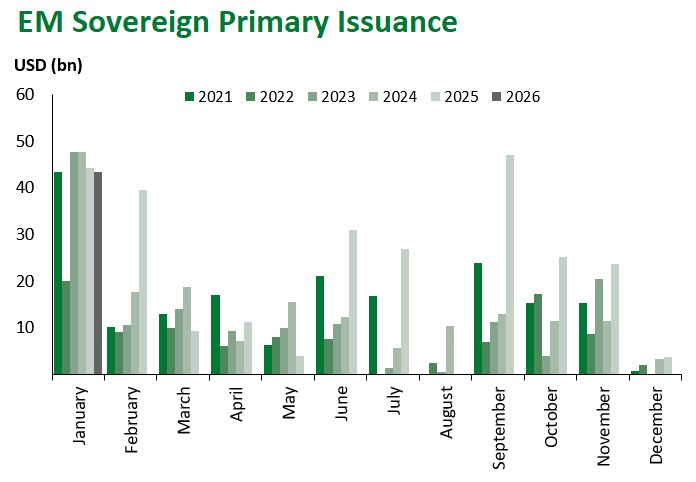
Primary markets were exceptionally active at the start of the year, with emerging market hard-currency issuance reaching approximately $72 billion across more than 50 tranches. Sovereign borrowers accounted for nearly 60% of total supply, led by sizeable multi-tranche deals from Saudi Arabia, Mexico, Israel, and Türkiye. The issuance skew was firmly investment grade, which represented roughly 90% of total volume.
The Week Ahead
The December U.S. CPI report is expected to show headline inflation remaining stable (2.7% year-over-year). Other notable U.S. macro data releases include PPI, retail sales, initial jobless claims, and industrial production, while the Fed will be releasing its Beige Book survey of regional economic conditions. Elsewhere, final December CPI will be reported by economies in the euro area, including Germany and France, as well as by India. In addition, the euro area and UK will release November industrial production.
Emerging market investors will see interest rate decisions by the central banks of Poland and Serbia, as well as Türkiye’s November current account balance. In the world of international relations, German Chancellor Friedrich Merz will visit India, where he is scheduled to meet with Prime Minister Narendra Modi and business leaders, while Canadian Prime Minister Mark Carney will make an official visit to China and is set to meet with President Xi Jinping to discuss trade, energy, and international security. Meanwhile, G7 finance ministers will meet in Washington with focus on rare earth minerals. JPMorgan will kick off quarterly U.S. big bank earnings, followed by Bank of America, Wells Fargo, Citigroup, Morgan Stanley, and Goldman Sachs, among others.
Fixed Income
Equities
Commodities
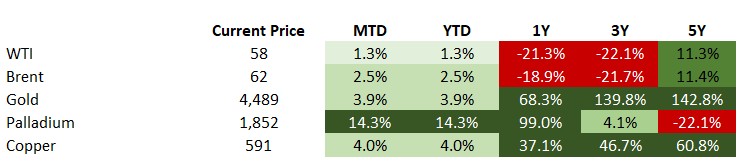
Source for data tables: Bloomberg, JPMorgan, Gramercy. EM Fixed Income is represented by the following JPMorgan Indicies: EMBI Global, GBI-EM Global Diversified, CEMBI Broad Diversified and CEMBI Broad High Yield. DM Fixed Income is represented by the JPMorgan JULI Total Return Index and Domestic High Yield Index. Fixed Income, Equity and Commodity data is as of Jan. 9, 2026 (mid-day).
Highlights
Gramercy on Venezuela – Analysis
Maduro Ousted
This week saw Washington’s pressure campaign against Venezuela culminate in the surgical removal of Nicolás Maduro on Jan. 3, with Vice President Delcy Rodríguez promptly sworn in as interim president. The manner of Mr. Maduro’s exit strongly suggests pre-arranged negotiations and fractures within the military establishment.
At this stage, Venezuela appears to be undergoing a “small r” regime change. The power structure of the controlling socialist party, the PSUV, remains intact under Ms. Rodríguez’s leadership, even as President Donald Trump has signaled U.S. intent to exert decisive economic and military leverage. He has stopped short, however, of a large-scale ground presence. With the armed forces still aligned with the PSUV, and opposition leader María Corina Machado remaining abroad, an immediate handover to the opposition was always improbable. The key uncertainty is whether this equilibrium lasts or gradually transitions into a “big-R” regime change via competitive elections. While Ms. Rodríguez’s initial rhetoric was openly defiant toward Washington, subsequent statements hinted at a more pragmatic approach to dialogue. Investors will closely monitor influential hardliners, especially Interior Minister Diosdado Cabello and Defense Minister Vladimir Padrino López, for signals of consolidation, accommodation, or resistance within the ruling coalition. Reports mid-week suggested that the U.S. warned Mr. Cabello he could be the next target if he is not cooperative in keeping order and supporting Interim President Rodriguez.
U.S. Secretary of State Marco Rubio presented a three-phase plan to Congress for stabilization, rebuilding, and transition in Venezuela. While full details remain classified, this reportedly encompasses a tightened blockade on Venezuela oil in the near-term, including 30 mbpd to 50 mbpd of Venezuelan oil to date that the US plans to sell at market rates, with proceeds managed by the U.S. and “disbursed in a way that benefits the Venezuelan people.” The economic recovery plan needs to include fair access for American, western, and other companies to the Venezuelan market, according to Secretary Rubio, and needs to establish a transition towards a more representative government.
From a market perspective, the outlook for Venezuelan bonds has improved. Rising expectations for oil sector recovery and an eventual restructuring support higher oil revenue and nominal GDP assumptions. However, the restructuring process itself will take time to execute and probably will not occur under a caretaker or transition government. Rather, to complete a restructuring, one typically needs to see a permanent government in place, one that seeks normalization of relations generally, and with bondholders specifically. Should political developments raise the probability of an electoral transition, or should oil output recover more rapidly under Ms. Rodríguez, bond prices would likely re-rate higher. More broadly, compressed sovereign spreads and a constructive global risk environment should sustain investor engagement with Venezuela, despite persistent political and execution risks.
Broader Implications
Beyond Venezuela’s political and economic outlook, last weekend’s developments have regional and global implications. Venezuela has the largest proven oil reserves in the world, and there are questions around what a recovery in the country’s embattled oil sector could mean for global oil production and prices. The logical expectation is that increased production puts further downside pressure on the oil futures curve, all else being equal. However, ramping up Venezuelan oil production would require significant time and investment. Most experts are estimating up to $100 billion in needed investments over the medium term. Provided that FDI inflows into the oil sector start to materialize, experts estimate that production could double (from close to 1 million barrels per day now to around 2 million barrels per day) over a 2-year to 3-year period. Production could potentially return to its historic peak of around 3.5 million barrels per day within a decade.
This means the impact on global oil markets is likely to be muted initially, but the prospect of potential additional supply should keep a lid on any near-term price appreciation. In turn, this could counter or ease inflationary pressures worldwide this year, including in the U.S. economy, supporting potential further easing of monetary policy by the Fed and other central banks.
From a regional perspective, the weekend events in Caracas were a manifestation of the so-called “Donroe doctrine,” which calls for aggressive re-assertion of U.S. political and economic influence over the Western Hemisphere and protection from “meddling” by other powers. We expect this policy bias by the Trump administration to continue to have material implications for Latin American and Caribbean sovereigns in 2026. This means strong support for those countries whose leaders and policies are aligned with the Oval Office’s interests, and pressure on those that are opposed or are seen as threats to U.S. national security. Also, governments in the Western Hemisphere should be prepared to face stronger pressure by the Trump administration to “pick sides,” especially when it comes to China’s economic interests in the region, creating an increasingly challenging balancing act for a number of them.
Beyond Latin America and the Caribbean, one potential “second derivative” geopolitical scenario includes more flexibility for the Trump administration and Israel to re-escalate pressure on Iran’s regime, in an effort to spark its internal collapse. Such a scenario would be facilitated by increased Venezuelan oil output under U.S. sponsorship or control, which could offset any decline from material disruption in the Middle East. Similar logic could apply in the case of Russia. If current efforts to broker a mutually acceptable ceasefire between Moscow and Kyiv fail, then the Trump administration could have greater flexibility to “get tougher” on the Russian sanctions front.
Emerging Markets Technicals
Emerging Markets Flows
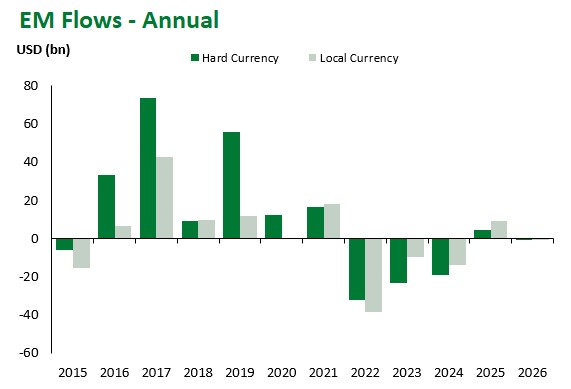
Source for graphs: Bloomberg, JPMorgan, Gramercy. As of Jan. 9, 2026.
For questions, please contact:
Kathryn Exum, CFA ESG, Director, Co-Head of Sovereign Research, [email protected]
Petar Atanasov, Director, Co-Head of Sovereign Research, [email protected]
This document is for informational purposes only. The information presented is not intended to be relied upon as a forecast, research or investment advice, and is not a recommendation, offer or solicitation to buy or sell any securities or to adopt any investment strategy. Gramercy may have current investment positions in the securities or sovereigns mentioned above. The information and opinions contained in this paper are as of the date of initial publication, derived from proprietary and nonproprietary sources deemed by Gramercy to be reliable, are not necessarily all-inclusive and are not guaranteed as to accuracy. This paper may contain “forward-looking” information that is not purely historical in nature. Such information may include, among other things, projections and forecasts. There is no guarantee that any forecasts made will come to pass. Reliance upon information in this paper is at the sole discretion of the reader. You should not rely on this presentation as the basis upon which to make an investment decision. Investment involves risk. There can be no assurance that investment objectives will be achieved. Investors must be prepared to bear the risk of a total loss of their investment. These risks are often heightened for investments in emerging/developing markets or smaller capital markets. International investing involves risks, including risks related to foreign currency, limited liquidity, less government regulation, and the possibility of substantial volatility due to adverse political, economic or other developments. References to any indices are for informational and general comparative purposes only. The performance data of various indices mentioned in this update are updated and released on a periodic basis before finalization. The performance data of various indices presented herein was current as of the date of the presentation. Please refer to data returns of the separate indices if you desire additional or updated information. Indices are unmanaged, and their performance results do not reflect the impact of fees, expenses, or taxes that may be incurred through an investment with Gramercy. Returns for indices assume dividend reinvestment. An investment cannot be made directly in an index. Accordingly, comparing results shown to those of such indices may be of limited use. The information provided herein is neither tax nor legal advice. Investors should speak to their tax professional for specific information regarding their tax situation.