


Contents
Market Overview
Macro Update
Markets this week anticipated a nearly 100% probability of a 25 bps rate cut at next week’s Fed meeting. The expectation emerged despite a slide in reported jobless claims, with both initial and continuing jobless claims for the week ending Nov. 29th coming in below consensus expectations and declining from the prior week. The rate cut optimism also came despite FOMC officials’ ongoing division over the best rate path.
A dated reading, from September, of the Fed’s preferred inflation gauge, the core Personal Consumption Expenditures (PCE) price Index, suggested sticky, but stable, inflationary pressures. The data came in at 0.2% month-over-month and 2.8% year-over-year, in line with median market expectations.
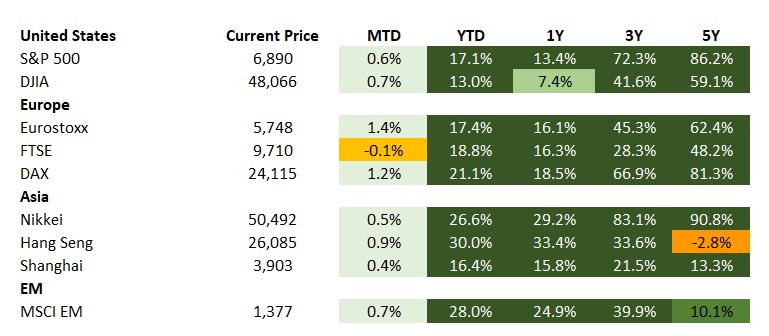
With the market viewing a Fed rate cut next week as a near certainty, global equity indexes ended the week higher across the board, with U.S. stocks touching all-time highs as last month’s concerns about stretched AI-related valuations fizzled out. Bonds came under pressure, however, with the yield on 10-year and 30-year U.S. Treasuries rising to around 4.13% and 4.4%, respectively, 10 bps to 15 bps higher than last week. The dollar continued to slide this week. The DXY revisited 98, after briefly touching 100 in late November, amid the dovish Fed narrative.
Bitcoin rebounded somewhat, but ended the week around $90,000, well below the all-time high of roughly $126,000 in October. Oil prices edged higher, in the mid- to low-$60s for Brent and WTI, respectively. Gold was relatively stable at around $4,200 per ounce, not far from its all-time high in October. The price of copper reached a record high near $11,500 per ton on the London market, driven by a combination of strong demand ahead of expected U.S. tariffs, supply concerns amid disruptions at mines in Indonesia, Chile and Congo, and AI development.
In other U.S. macro data, services activity expanded at a slightly faster pace in November relative to the prior month, with the ISM index edging up to a nine-month high of 52.6, outpacing median expectations of 52.0. The preliminary December University of Michigan sentiment survey indicated U.S. consumer sentiment improved for the first time in five months, supported by a more optimistic outlook on inflation by U.S. consumers and the end of the longest-ever federal government shutdown in mid-November.
Meanwhile, U.S. President Donald Trump said he plans to nominate a new Fed chair “early next year,” with Kevin Hassett, a close economic adviser to the president who openly favors low interest rates, widely considered to be the frontrunner.
Elsewhere, the Bank of Japan (BoJ) suggested that it might raise interest rates this month in response to above-target inflation, which drove yields on the 2-year government bonds above 1.0% for the first time in 17 years. The preliminary November CPI in the euro area rose to 2.2%, from 2.1% the prior month, while core inflation remained stable at 2.4%, supporting the ECB argument for a pause to the rate-cutting cycle at the current level of 2.0%. China’s RatingDog manufacturing PMI came in weaker-than-expected for November, marginally in contraction territory at 49.9 vs. median expectations of 50.5, and 50.6 in October. This signaled additional softness in Chinese exports.
On the geopolitical front, market focus remained on the Trump administration’s continuing “shuttle diplomacy” efforts to facilitate an end to the Russia-Ukraine war. However, we believe prospects for near-term conflict resolution remain dim. Discussions continue, but the path to peace in Ukraine remains unclear, as admitted by President Trump after this week’s meetings. Meanwhile, Russia claimed to have fully captured the town of Pokrovsk, a strategically important Ukrainian stronghold in the Donetsk region, and has continued attacks against Ukraine’s energy infrastructure. Against this backdrop, the EU agreed this week to ban imports of Russian gas by late 2027.
On Venezuela, President Trump confirmed he had spoken by phone with President Nicolás Maduro in November, hinting at potential military escalation if Mr. Maduro refuses to leave office voluntarily. For his part, Mr. Maduro described the conversation as “respectful and cordial” and reiterated calls for diplomacy. Meanwhile, it was revealed this week that following the phone call between the two leaders, Joesley Batista, a Brazilian billionaire, traveled to Caracas to meet with Mr. Maduro in a bid to persuade him to step down and allow for a peaceful transition.
In Honduras, presidential elections were yet to be finalized, but indicated a shift to the right, similar to the recent elections in Chile. This bodes well for Honduran relations with the IMF and the U.S., particularly in the event of a victory by conservative candidate Nasry “Tito” Asfura. Investors welcomed the prospects for market-friendly policies, propelling Honduran eurobond spreads to near 10-year lows.
EM Credit Update
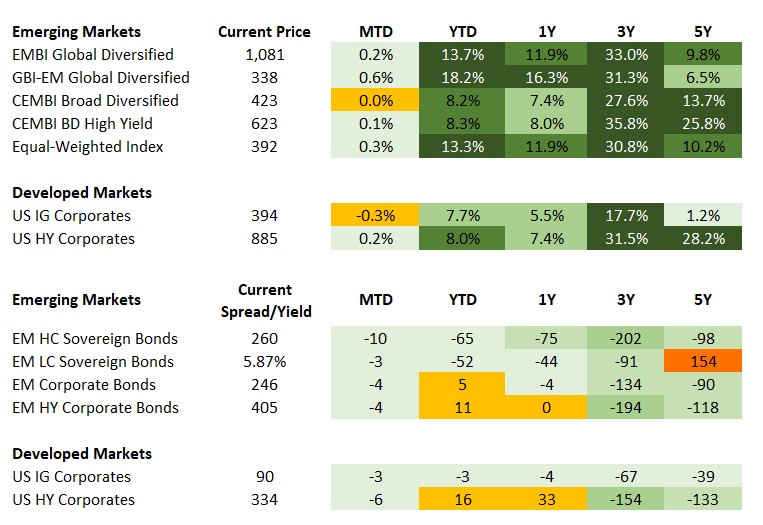
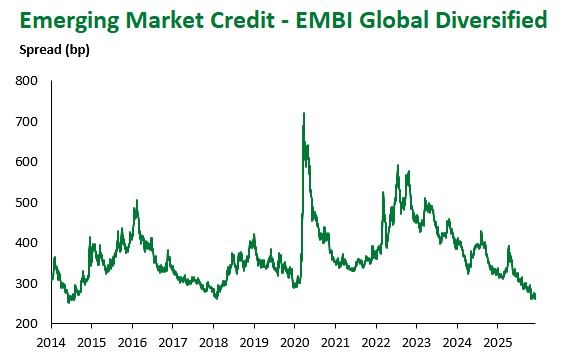
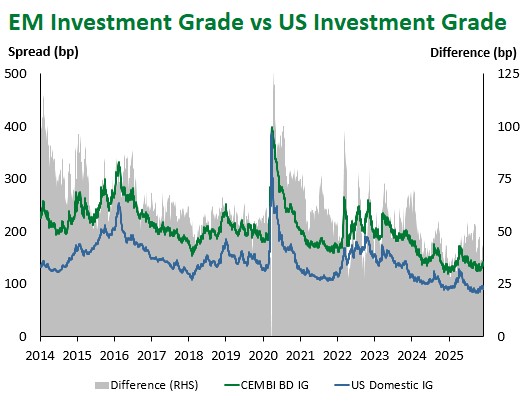
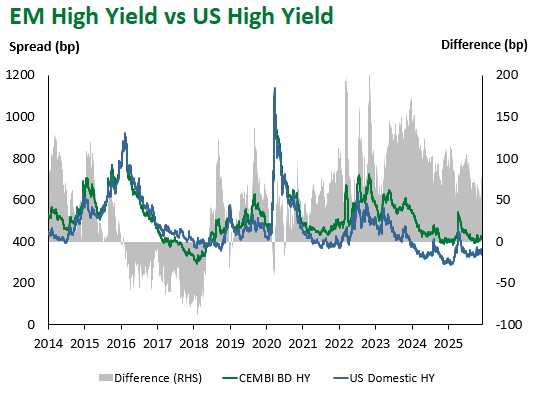
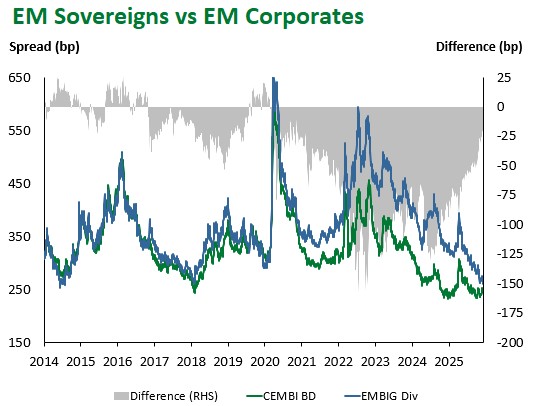
Emerging Markets (EM) fixed income continued to show resiliency this week, despite pressure from Developed Market (DM) rates, with EM hard-currency sovereign bonds gaining 0.16%, led by strong high-yield performance (+0.41%), which offset a slight decline in investment grade (-0.09%). At the index level, spreads tightened by 10 bps, with the high-yield component delivering 13 bps of tightening. Investment grade tightened by 7 bps.
Regionally, Africa was the strong outperformer, while more rate-sensitive areas such as Europe and Asia delivered slightly negative returns. Venezuela continued to deliver outperformance, as optimism continued around potential regime change and eventual debt restructuring. Honduras was another Latin American outperformer as presidential election results signaled a likely political shift to the right and therefore improved relations with the IMF and the Trump administration. In Africa, high-yield sovereign credits performed strongly across the board amid a constructive EM outlook for 2026, led by credits such as Zambia and Gabon that had previously lagged peers. Fading market hopes for a possible path toward ending the Russia-Ukraine war dragged Ukraine’s sovereign bond complex lower.
EM corporates had a marginally negative return (-0.03%), with high yield (+0.07%) outperforming investment grade (-0.1%). From a regional perspective, Europe (+0.19%) and Latin America (+0.13%) outperformed, while the Middle East lagged (-0.25%). Amid the sell-off in DM rates, duration was under pressure, with the 5-year to 7-year segment performing the best, while the 10+ segment struggled. Index-level spreads tightened 6 bps, with investment grade and high yield 7 bps and 9 bps tighter, respectively.
Local-currency debt was the EM outperformer again, returning +0.72% in USD terms this week. Colombia (+1.9%) and Turkey (+1.4%) were the main outperformers, supported by sizable real rates buffers, despite inflation gradually moving toward target levels. The Dominican Republic underperformed (-0.8%), partially giving back some of its recent gains.
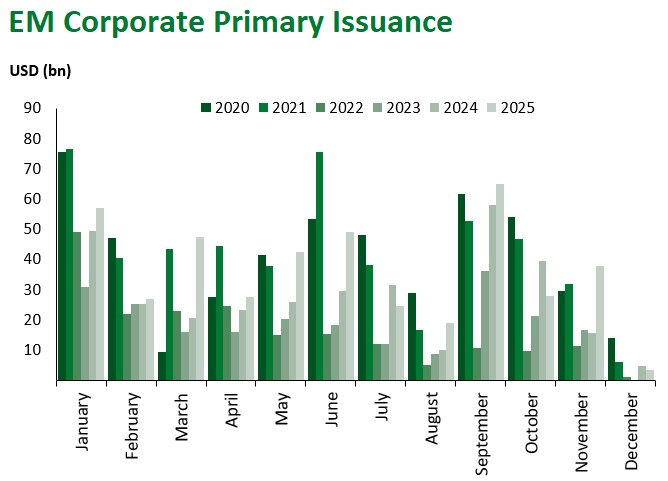
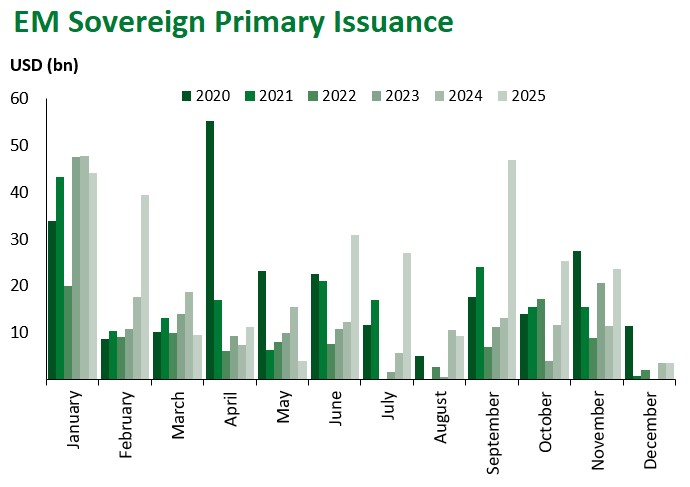
Primary issuance started to slow down as markets entered the end of the year, with 11 new hard-currency deals pricing this week, only one of which was sovereign (South Africa). Activity was concentrated in CEEMEA and Asia, and financials continued to represent a sizable share of supply, accounting for two-thirds of the total.
The Week Ahead
Next week is set to be dominated by the Fed’s rate decision. Despite some missing key data due to the government shutdown, and even though FOMC officials remain divided on the appropriate rates path, markets are convinced there will be a third consecutive 25 bps cut.
Besides the Fed, central banks in Switzerland, Canada, Australia, Brazil, Peru, the Philippines, Serbia, Türkiye, and Ukraine will also deliver rate decisions. Other notable global macro data releases will include 3Q GDP in Japan, Saudi Arabia, and Ukraine, as well as November CPI in Mexico, Argentina, Ukraine, Brazil, India, France, and Germany, among others. Germany will report industrial production, as will the UK; Türkiye reports its October current account balance, always closely watched in relation to foreign-exchange flows and the lira. In the U.S., data will include the JOLTS job openings report, which comes the day before the FOMC rate decision, as well as the initial jobless claims report, which comes the day after. In China, trade, PPI, and CPI data for November will be published, with a median expectation for a sizable pickup in monthly inflation.
In other developments, UK Chancellor Rachel Reeves will appear before the Treasury Select Committee to defend a budget marked by £26 billion in tax increases, while the Doha Forum assembles global leaders to discuss geopolitical challenges. Hong Kong will hold legislative elections, while mayoral elections in Bucharest will be an important test for Romania’s ruling coalition. The WSJ CEO Council Summit will be held in Washington, with participants to include Mr. Hassett, who is director of the White House National Economic Council and the presumed frontrunner for Fed chair.
In addition, OPEC and the IEA will release their oil market reports and projections, and the 2025 Nobel Prize awards ceremony will be held in Oslo. It isn’t clear if winner and Venezuelan opposition leader Maria Corina Machado, who is in hiding, will attend in person.
Fixed Income
Equities
Commodities
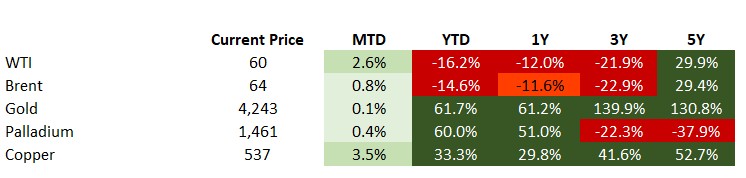
Source for data tables: Bloomberg, JPMorgan, Gramercy. EM Fixed Income is represented by the following JPMorgan Indicies: EMBI Global, GBI-EM Global Diversified, CEMBI Broad Diversified and CEMBI Broad High Yield. DM Fixed Income is represented by the JPMorgan JULI Total Return Index and Domestic High Yield Index. Fixed Income, Equity and Commodity data is as of Dec. 5, 2025 (mid-day).
Highlights
Honduras Election Results Indicate a Rightward Shift
Event: Honduras held its presidential election last weekend where conservative candidate Nasry “Tito” Asfura, and center-right candidate Salvador Nasralla, appear to have obtained roughly 40% of the votes, with over 85% of the votes counted. The two parties together should have a qualified majority in Congress. Results must be finalized by Dec. 30th ahead of the presidential transition on Jan. 27th. The ruling leftist Libre party has not yet challenged the validity of the results but has accused the U.S. of electoral influence after President Trump pardoned former conservative Honduran President Juan Orlando Hernandez. Hernandez had been extradited to the U.S. to serve 45 years in prison on drug trafficking and weapons charges. Honduras’ eurobonds rallied in the aftermath on the prospect of market-friendly policies.
Gramercy Comment: The political shift to the right should bode well for relations with the IMF and the U.S., particularly in the event of an Asfura victory. However, a smooth transition is not yet a foregone conclusion. At a minimum, we expect the ruling party to seek legal guarantees before it leaves office, potentially impeding and delaying the transition. There is also the prospect of a recount given the close results between Messrs. Asfura and Nasralla, leaving room for near-term market volatility with Honduras EMBIG spreads near 10-year lows.
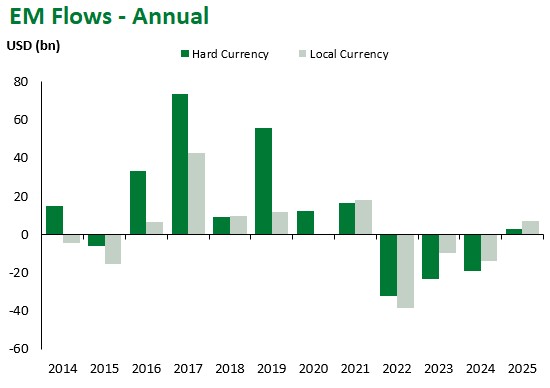
Emerging Markets Technicals


Emerging Markets Flows

Source for graphs: Bloomberg, JPMorgan, Gramercy. As of Dec. 5, 2025.
For questions, please contact:
Kathryn Exum, CFA ESG, Director, Co-Head of Sovereign Research, [email protected]
Petar Atanasov, Director, Co-Head of Sovereign Research, [email protected]
This document is for informational purposes only. The information presented is not intended to be relied upon as a forecast, research or investment advice, and is not a recommendation, offer or solicitation to buy or sell any securities or to adopt any investment strategy. Gramercy may have current investment positions in the securities or sovereigns mentioned above. The information and opinions contained in this paper are as of the date of initial publication, derived from proprietary and nonproprietary sources deemed by Gramercy to be reliable, are not necessarily all-inclusive and are not guaranteed as to accuracy. This paper may contain “forward-looking” information that is not purely historical in nature. Such information may include, among other things, projections and forecasts. There is no guarantee that any forecasts made will come to pass. Reliance upon information in this paper is at the sole discretion of the reader. You should not rely on this presentation as the basis upon which to make an investment decision. Investment involves risk. There can be no assurance that investment objectives will be achieved. Investors must be prepared to bear the risk of a total loss of their investment. These risks are often heightened for investments in emerging/developing markets or smaller capital markets. International investing involves risks, including risks related to foreign currency, limited liquidity, less government regulation, and the possibility of substantial volatility due to adverse political, economic or other developments. References to any indices are for informational and general comparative purposes only. The performance data of various indices mentioned in this update are updated and released on a periodic basis before finalization. The performance data of various indices presented herein was current as of the date of the presentation. Please refer to data returns of the separate indices if you desire additional or updated information. Indices are unmanaged, and their performance results do not reflect the impact of fees, expenses, or taxes that may be incurred through an investment with Gramercy. Returns for indices assume dividend reinvestment. An investment cannot be made directly in an index. Accordingly, comparing results shown to those of such indices may be of limited use. The information provided herein is neither tax nor legal advice. Investors should speak to their tax professional for specific information regarding their tax situation.