


Contents
Market Overview
Macro Update
Data released this week showed U.S. inflation for November cooled significantly more than expected, driving a moderate relief rally in equities. Investors boosted bets on a dovish Fed policy path in 2026, pricing in between two and three 25 bps cuts next year. However, U.S. treasuries had a muted reaction, initially rallying, but subsequently giving up gains as questions about the accuracy of the November data surfaced due to still incomplete data for October and a number of imputed, rather than observed, data points in the report.
The inflation figures showed the core consumer price index increasing 2.6% year-over-year in November, compared to 3.0% in September (with October data not yet available), with expectations at 3.0%. Headline CPI was 2.7% year-over-year in November vs. 3.1% consensus expectation, marking the slowest pace since early 2021.
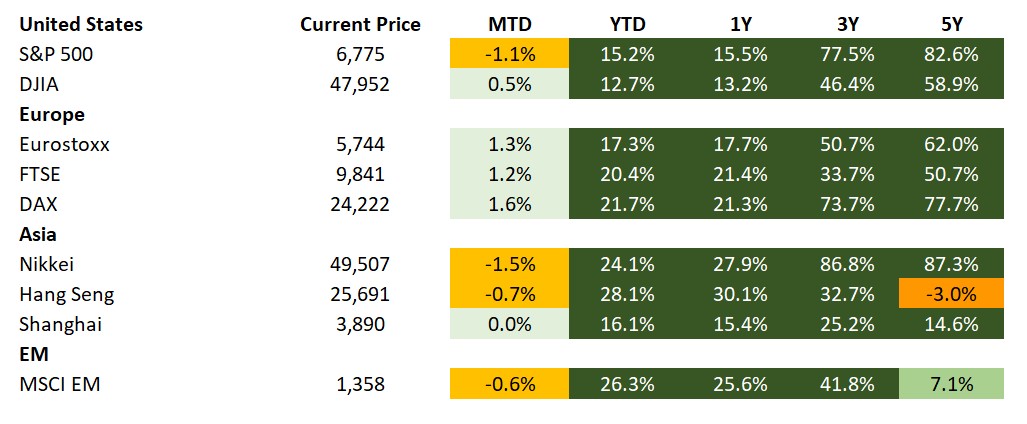
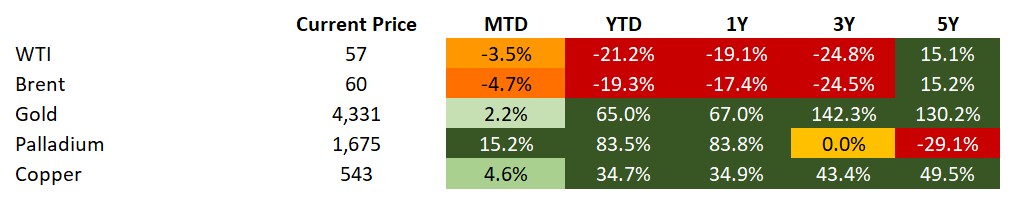
Against this backdrop, earlier declines in stock markets on concerns over AI data center spending reversed. The S&P 500 halted a four-day slide and the tech-heavy Nasdaq was further supported by an upbeat outlook from Micron Technology Inc. Nevertheless, U.S. equity markets still closed lower on the week. Treasury yields finished around levels where they started: 4.15% and 4.82% for the 10-year and 30-year, respectively. The dollar was little changed, closing the week marginally stronger, slightly above 98.5, on the DXY; Bitcoin experienced similar dynamics, remaining below $90,000, around $40,000 off its peak. Oil prices continued to slide, with Brent struggling to hold $60 per barrel and WTI dropping to the mid-$50s. Despite softer-than-expected November U.S. inflation data, gold held firm around $4,300/oz and silver rallied further.
It was a busy week for global monetary policy. The euro consolidated its recent gains against the dollar as the European Central Bank (ECB) left its main policy rate unchanged at 2.0% for a fourth consecutive meeting. Updated ECB projections point to firmer growth and inflation returning to target by 2028, but ECB President Christine Lagarde sought to protect maximum policy flexibility depending on incoming data. Meanwhile, the Bank of England (BoE) cut rates to 3.75% in line with expectations, the lowest level in almost three years, but its guidance was perceived as hawkish amid diverging views on the committee – illustrated by the 5-4 split vote. The Bank of Japan (BoJ) went in the opposite direction, hiking its main rate 0.75% from 0.50%, the highest level in 30 years, but BoJ messaging was interpreted as less hawkish than expected, so the yen weakened.
In the U.S., President Donald Trump attempted to reassure voters concerned about the rising cost of living during a prime-time televised address from the White House and added that he will “soon announce the next chairman of the Federal Reserve, someone who believes in lower interest rates, by a lot, and mortgage payments will be coming down even further.” Also, November non-farm payrolls report pointed to a continued cooling in the labor market; the unemployment rate ticked up to 4.6%, reflecting a higher participation rate. Preliminary PMIs for December came in short of consensus across the board but remain in expansionary territory (>50). Meanwhile, the final University of Michigan consumer sentiment survey for December rose by less than expected (52.9 vs. 53.5) and remains at depressed levels amid increasing affordability concerns.
Elsewhere, the UK’s annual inflation rate dropped to 3.2% in November from 3.6% in the prior month, mainly due to lower food prices, which was likely the key factor that tilted the BoE balance in favor of a rate cut; unemployment rose to 5.1%, the highest since January 2021. Euro area data were mixed: Preliminary December PMIs underperformed expectations, like those in the U.S., but also remained expansionary on the composite level. The euro area’s October industrial production marginally outperformed, while the preliminary consumer confidence index for December came in below expectations at -14.6 (vs. -14.0), declining from -14.2 in November. German ZEW survey expectations index for December rose to 45.8, from 38.5 previously. In China, November retail sales and industrial production disappointed, signaling lingering economic activity weakness and potential forthcoming further economic stimulus.
In geopolitics, focus remained on the diplomatic back and forth around the war in Ukraine. The EU reached an agreement to freeze €210 billion ($246 billion) in Russian assets until the war ends and Russia contributes to Ukraine’s reconstruction, but a proposal to leverage the frozen assets to finance Ukraine for the next two years collapsed. Instead, EU leaders reached a deal to lend €90 billion to Kyiv through joint market debt backed by the EU budget.
Meanwhile, the U.S. and Europe appeared to agree in principle to provide Ukraine with “NATO-like” security guarantees; while the proposal is seen as a significant step forward, it remains unlikely that it would be acceptable to Russia. President Vladimir Putin has not signaled any willingness to deviate from his maximalist objectives in Ukraine, although he continues to express willingness for talks with President Trump and continues to criticize European leaders.
On Venezuela, Mr. Trump ordered a blockade of sanctioned oil tankers entering or leaving the country’s territorial waters, turning up pressure on the Maduro regime. The Trump administration appears to be betting that tightening the U.S. grip around Venezuela will erode financial inflows for the regime and its ability to maintain a loyal security apparatus.
EM Credit Update
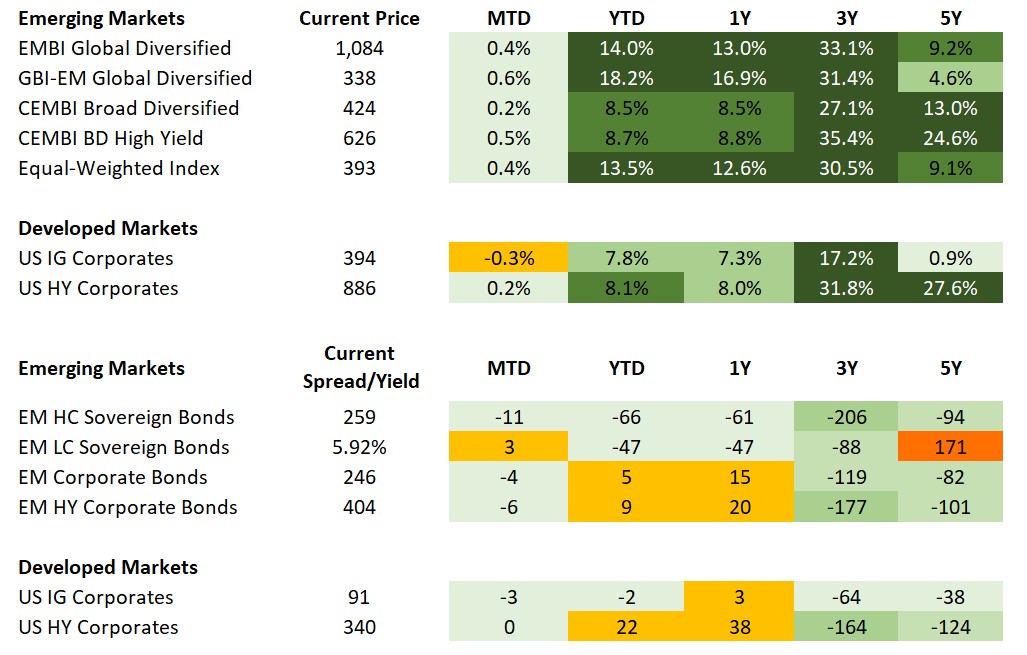
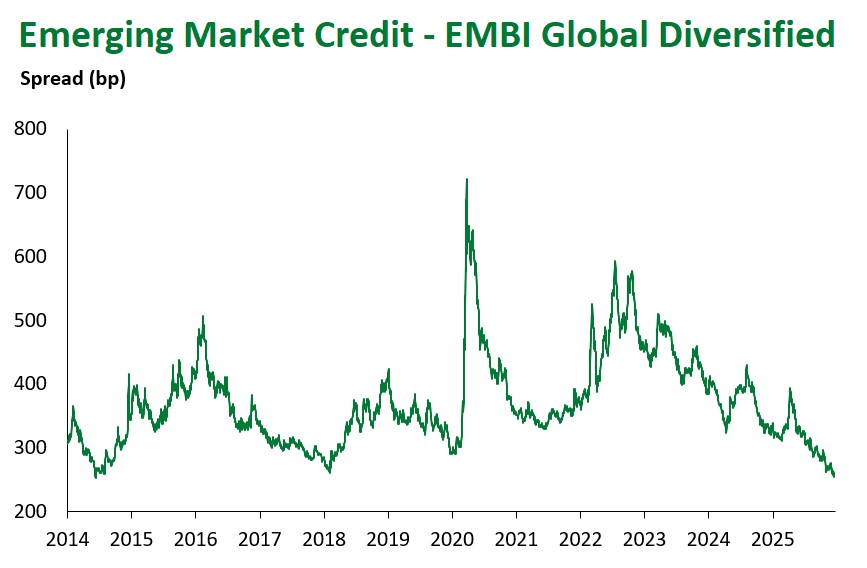
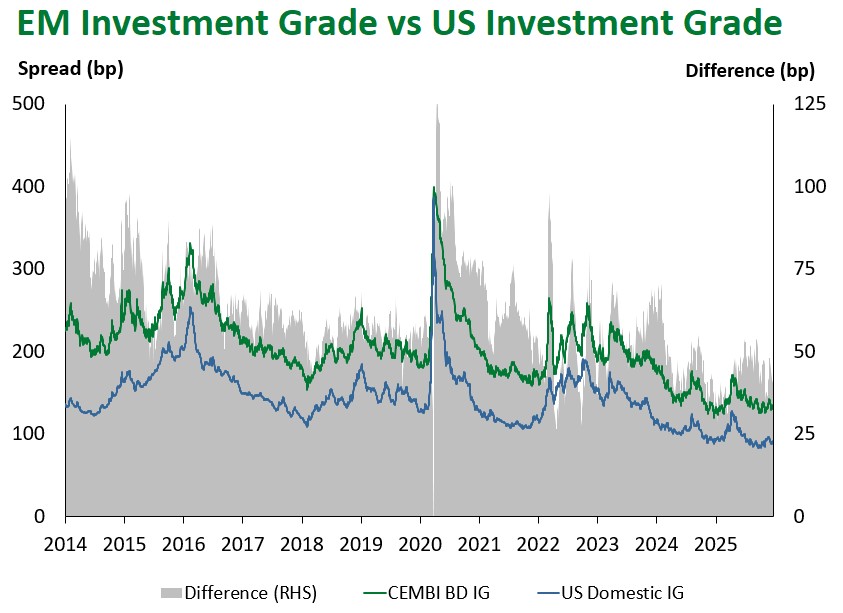
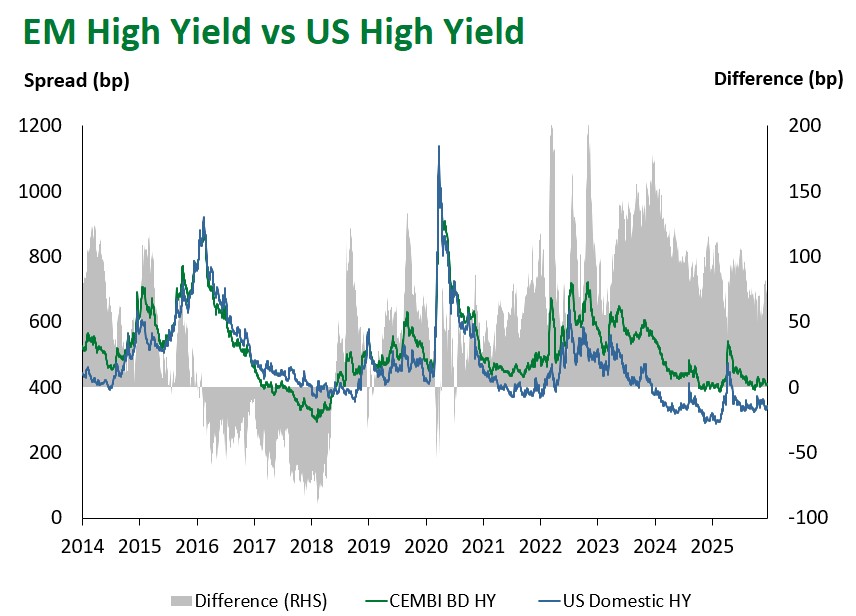
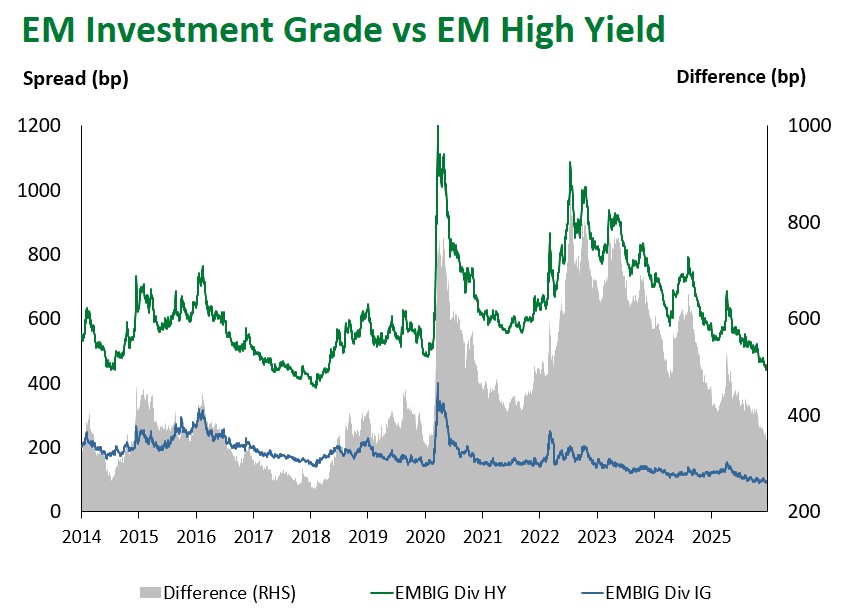
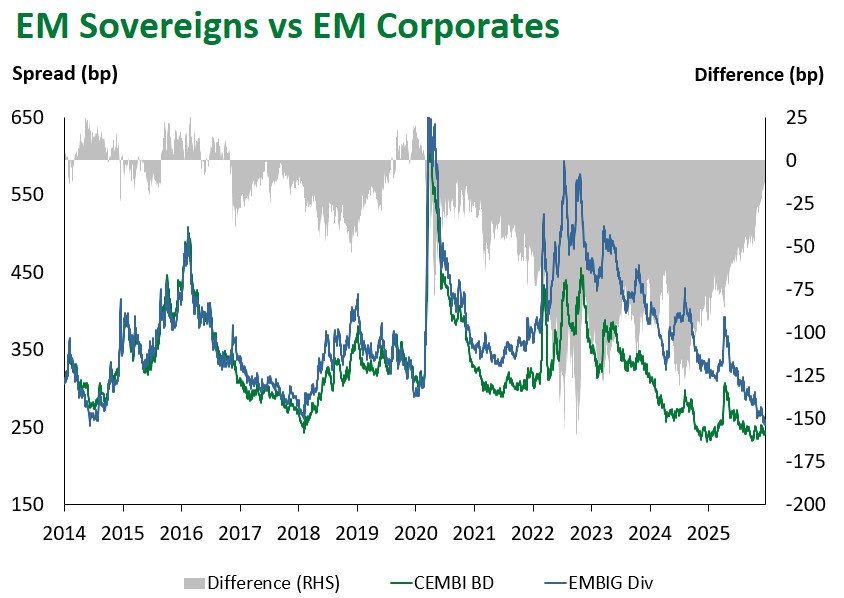
Emerging Markets (EM) fixed income delivered solid results this week. EM hard-currency sovereigns posted moderate gains, returning 0.30%, bringing year-to-date performance to 13.97%. High-yield bonds (0.37%) outpaced investment grade returns (0.23%). Spreads widened 4 bps at the index level, with investment grade and high-yield sub-components 5 bps and 3 bps wider, respectively.
Regionally, Africa (0.41%), Latin America (0.4%), and Europe led gains, while the Middle East (-0.03%) and Asia (+0.19%) lagged. Argentina (+3.0%) and Cote d’Ivoire (+1.7%) outperformed at the country level. In Argentina, the central bank announced it would widen the currency band and aim to accumulate foreign-exchange reserves in January. In Cote d’Ivoire, Fitch upgraded the country’s ratings to BB on reduced political uncertainty and improved macro stability amid a declining debt burden and narrowing current account deficit. Venezuela underperformed (-4.66%) as investors reduced risk on latest oil blockade headlines and year-to-date returns of 97.6%.
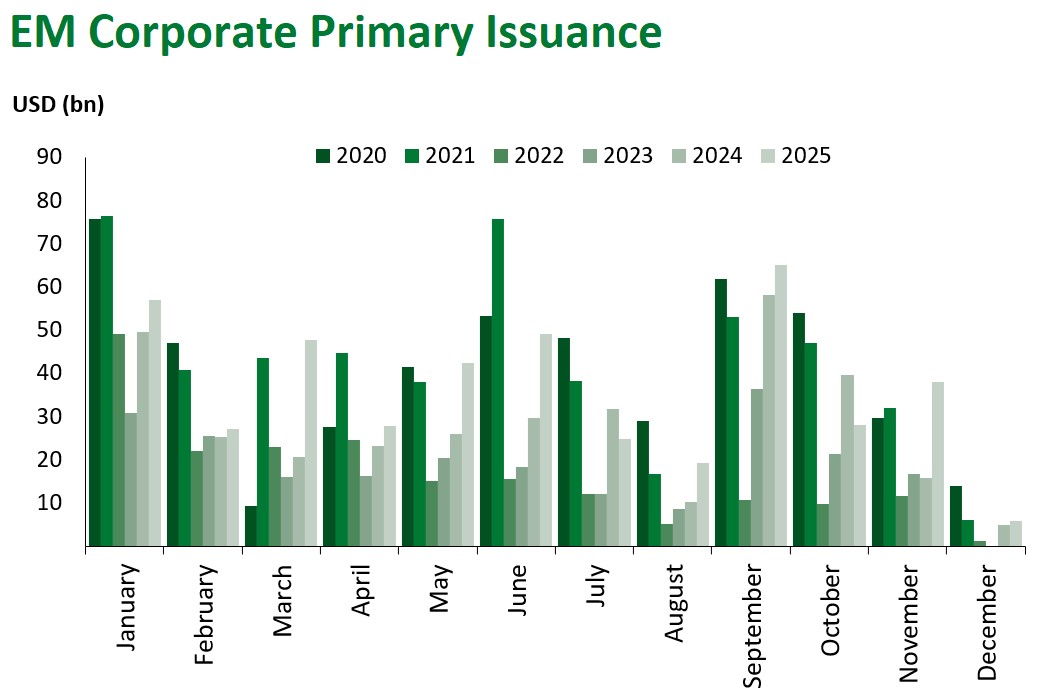
EM corporates gained 0.22%, with high yield slightly outperforming investment grade (+0.24% vs. +0.2%), bringing year-to-date performance to +9.48%. Regionally, Asia (+0.28%) and Europe (+0.24%) outperformed, while Latin America lagged (+0.17%). Returns were broad based across maturities. By rating, the ‘C’ bucket led (+1.04%) gains, whereas BB and A (+0.18%) components lagged. Corporate spreads widened modestly by 5 bps at the index level.
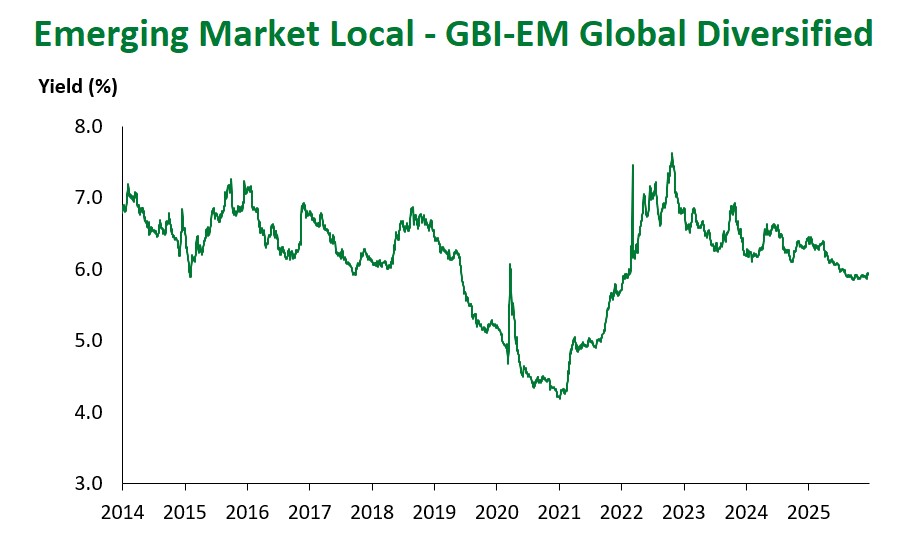
Local-currency debt returned +0.16%, bringing year-to-date performance to +18.19%. Dominican Republic (+2.2%) and South Africa (+1.25%) led gains. In the Dominican Republic, the peso continued its recent reversal and rates moved lower. In South Africa, the rand continued to rally on positive terms of trade dynamics. Colombia lagged (-2.93%) on a weaker peso on the back of lower oil prices and a ratings downgrade to BB by Fitch.
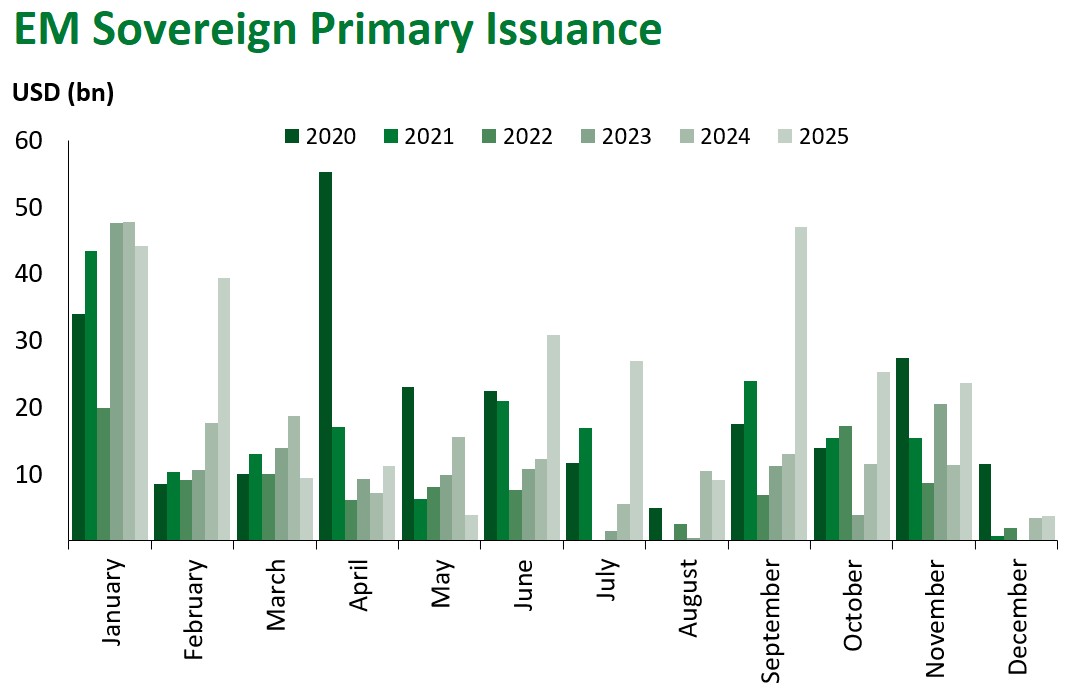
Primary issuance remained slow this week, with only two hard-currency deals: one African sovereign tap and an Asian corporate.
The Week Ahead
Most markets will close mid-week for the holidays. The Mercosur summit will take place in Brazil during the weekend, where South American leaders aim to finalize a free-trade agreement with the EU. Russian President Putin is scheduled to host his annual informal summit of the Commonwealth of Independent States (CIS) and a meeting of the Supreme Eurasian Economic Council. China’s loan prime rates are expected to remain unchanged at 3.0% and 3.5% for 1-years and 5-years, respectively. The shutdown-delayed 3Q U.S. GDP report will be released, as will data on industrial production, consumer confidence, and initial jobless claims. Final 3Q GDP will be reported in the UK and November CPI will be reported in Malaysia.
Fixed Income
Equities
Commodities
Source for data tables: Bloomberg, JPMorgan, Gramercy. EM Fixed Income is represented by the following JPMorgan Indicies: EMBI Global, GBI-EM Global Diversified, CEMBI Broad Diversified and CEMBI Broad High Yield. DM Fixed Income is represented by the JPMorgan JULI Total Return Index and Domestic High Yield Index. Fixed Income, Equity and Commodity data is as of Dec. 19, 2025 (mid-day).
Highlights
Conservative Jose Antonio Kast Wins Chile’s Presidency in Landslide
Event: Right-wing candidate Jose Antonio Kast won the Chilean presidential runoff against leftist Jeannete Jara with a large margin, 58% to 42%, the worst result for Chile’s left in an election runoff since Chile’s return to democracy in 1990.
Gramercy Comment: Mr. Kast’s victory comes amid widespread disappointment with the outgoing left-wing Boric administration and voter concerns over crime, immigration, and the economy. We expect the new Kast administration to enjoy an initial period of relatively strong governability when it assumes office in March, especially given the composition of Congress, which leans to the center and center-right. Market attention in the coming weeks will focus on the key cabinet appointments, which we anticipate will include some right-wing Kast loyalists, but also a significant number of moderate figures from Chile’s mainstream right-of-centre political parties. We expect the appointment of a credible cabinet and economic team to corroborate market perception of a market-friendly shift in economic policy management compared to the Boric administration, which should be supportive to Chilean assets at the start of the new year.
An expected improvement in the relationship with the Trump administration, as well as with President Javier Milei in neighbouring Argentina – who is an ideological ally of Mr. Kast – will also be seen as credit-positive. Near-term challenges include a potentially complex geopolitical balancing game between Washington and Beijing, given Chile’s significant economic linkages with China and the risk of street protests against public spending cuts advocated by Mr. Kast. However, we note that Chile’s starting fiscal position is much stronger than that of Argentina when President Milei was elected in 2023 and does not require anything akin to Argentina’s economic “shock therapy”.
Argentina Tweaks its Foreign-Exchange Framework and Reserve Plans
Event: The Central Bank of Argentina (BCRA) announced a new phase of its monetary program, with the aim of achieving “the convergence of domestic inflation to the level of international inflation.” As of Jan. 1st, 2026, the upper and lower bounds of the floating exchange rate band will widen at the rate of the latest monthly inflation data. At the same time, BCRA will initiate a program to accumulate foreign-exchange reserves with a target of $10 billion, subject to the supply of balance-of-payment flows. As a result, S&P upgraded Argentina’s ratings to CCC+ and eurobonds rallied moderately.
Gramercy Comment: Limiting the real appreciation of the peso going forward, combined with the intent to build foreign-exchange reserves, are both credit positive developments. However, execution and broader balance of payments dynamics will be key. The authorities’ revised intentions and framework should allow for relatively smoother discussions with the IMF ahead of the next program review in late January, particularly in the context of reserve targets that have unsurprisingly not been met. Further currency flexibility and loosening of capital controls beyond the latest adjustment, alongside progress on structural reforms, would better and more durably enhance the country’s ability to build foreign exchange reserves and drive spread compression.
Emerging Markets Technicals
Emerging Markets Flows
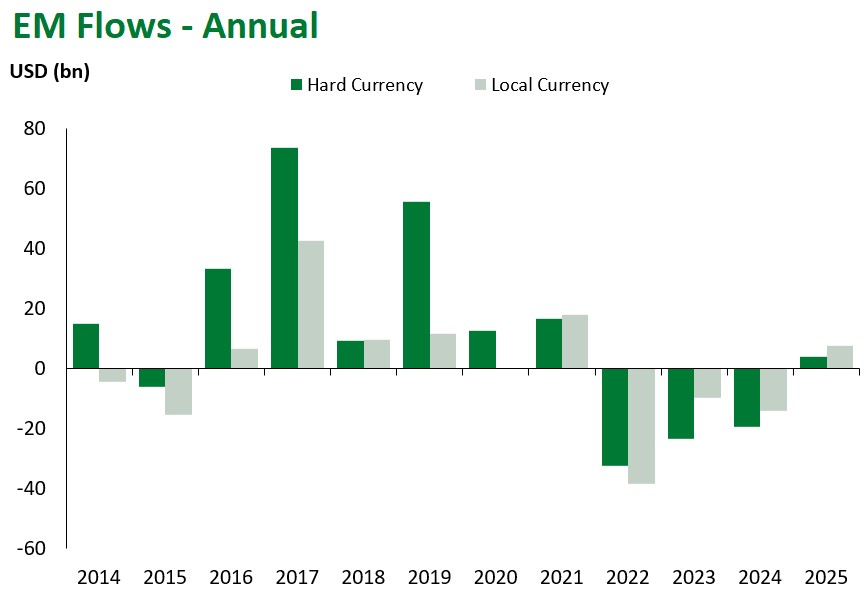
Source for graphs: Bloomberg, JPMorgan, Gramercy. As of Dec. 19, 2025.
For questions, please contact:
Kathryn Exum, CFA ESG, Director, Co-Head of Sovereign Research, [email protected]
Petar Atanasov, Director, Co-Head of Sovereign Research, [email protected]
This document is for informational purposes only. The information presented is not intended to be relied upon as a forecast, research or investment advice, and is not a recommendation, offer or solicitation to buy or sell any securities or to adopt any investment strategy. Gramercy may have current investment positions in the securities or sovereigns mentioned above. The information and opinions contained in this paper are as of the date of initial publication, derived from proprietary and nonproprietary sources deemed by Gramercy to be reliable, are not necessarily all-inclusive and are not guaranteed as to accuracy. This paper may contain “forward-looking” information that is not purely historical in nature. Such information may include, among other things, projections and forecasts. There is no guarantee that any forecasts made will come to pass. Reliance upon information in this paper is at the sole discretion of the reader. You should not rely on this presentation as the basis upon which to make an investment decision. Investment involves risk. There can be no assurance that investment objectives will be achieved. Investors must be prepared to bear the risk of a total loss of their investment. These risks are often heightened for investments in emerging/developing markets or smaller capital markets. International investing involves risks, including risks related to foreign currency, limited liquidity, less government regulation, and the possibility of substantial volatility due to adverse political, economic or other developments. References to any indices are for informational and general comparative purposes only. The performance data of various indices mentioned in this update are updated and released on a periodic basis before finalization. The performance data of various indices presented herein was current as of the date of the presentation. Please refer to data returns of the separate indices if you desire additional or updated information. Indices are unmanaged, and their performance results do not reflect the impact of fees, expenses, or taxes that may be incurred through an investment with Gramercy. Returns for indices assume dividend reinvestment. An investment cannot be made directly in an index. Accordingly, comparing results shown to those of such indices may be of limited use. The information provided herein is neither tax nor legal advice. Investors should speak to their tax professional for specific information regarding their tax situation.